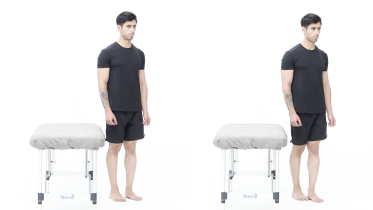
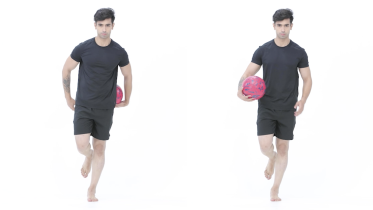
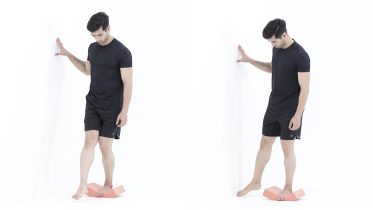
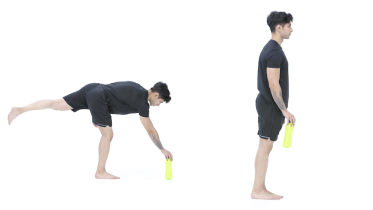
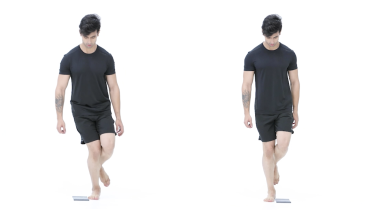
Single leg balance with eyes closed
This is standing on one leg next to a chair, finding your balance with your eyes open, and then closing your eyes and holding. Without your eyes to help, your feet, ankles and hips have to feel and correct every small sway on their own. It is a harder step than balancing with your eyes open, so most programs add it once standing on one leg feels steady.
How to do the single leg balance with eyes closed
- Stand side on to a sturdy chair or a kitchen counter and rest the nearest hand on it. Stand on a firm, non-slip floor. Wear flat shoes that fit well and grip the floor, not socks, tights or bare feet.
- Shift your weight onto the leg your program is working on and lift the other foot off the floor by bending that knee, as in the video. Keep the lifted leg free, not resting against the standing leg.
- Find your balance with your eyes open first. Stand tall with your head up and your standing knee straight but not locked.
- Once you feel steady, close your eyes. Keep your head up and pay attention to the pressure under the sole of your foot as it shifts between your heel, your toes and the edges.
- Hold for the time your program sets, then open your eyes and lower the foot. Keep your hand on the chair, or hovering just above it, the whole time.
What you should feel
Lots of small, quick corrections in your ankle and foot, and effort at the side of the standing hip. The wobble is much bigger with your eyes closed than with them open, and that is expected.
Common mistakes
- Closing your eyes before you are steady with them open.
- Resting the lifted foot or knee against the standing leg.
- Dropping your head to look down.
- Moving your hand away from the chair, so you cannot grab it quickly.
How often
Many programs start with short holds of 5 to 10 seconds, building toward 30 seconds, 3 to 5 times on each leg, once a day. Your physio will adjust this and tell you when to hold on less.
Stop and check with your physio if
- You feel dizzy, lightheaded, faint or sick, or the room seems to spin. Hold your support, sit down and get medical advice the same day before you practice again. If you faint, it does not settle within a few minutes of sitting still, your vision suddenly blurs or goes double, or you cannot stand or walk steadily, call emergency services.
- You lose your balance and have to grab the chair hard to stay up.
- New pain in the ankle, knee or hip of the standing leg.
- Your feet feel newly numb or tingly, or your balance has been slipping over recent weeks. Get medical advice within a few days, and leave out eyes-closed work until you have been checked. If the numbness or tingling spreads quickly up your legs or into your hands, get medical advice the same day. If your legs also feel stiff, heavy or weak, walking suddenly becomes hard, you have trouble breathing or swallowing, or you have trouble controlling your bladder or bowels, call emergency services.
From the clinic
Closing your eyes takes away one of the main ways your body keeps its balance. That is why this usually comes after you can hold single leg stance steadily with your eyes open. If one leg with eyes closed is too much for now, tandem stance with your eyes open is an easier place to build from.
Falls are the real risk here. Have the chair or counter right beside you every time, clear away rugs and clutter, and open your eyes the moment you start to tip. Standing in the corner of a room, with the chair in front of you, gives you walls on two sides to catch yourself. If you have fallen in the past year, feel unsteady, have dizziness or an inner ear problem, or take medicines that make you drowsy, check with your physio or doctor before you try the eyes closed version, and only practice when someone else is at home. After a hip or knee replacement, standing on the operated leg alone comes at a set stage of rehab, so wait until your surgical team or physio says it is time.
A sudden loss of balance is different. Call emergency services straight away for any sign of a stroke, even if it goes away: sudden dizziness with unsteadiness or falling over, a face that droops on one side, an arm you cannot lift or keep up, slurred or muddled speech, weakness or numbness on one side of your body or face, sudden blurred vision, double vision or loss of sight, or a sudden severe headache.
Written and checked by the PocketPhysio editorial team. Last updated 2026-09-28.
This page is general education, not a diagnosis or a personal treatment plan. If you have pain, an injury or a health condition, see a physiotherapist or doctor before starting new exercises.