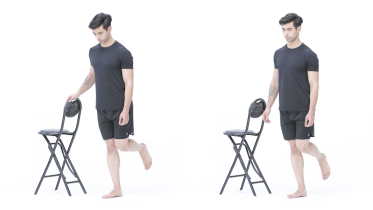
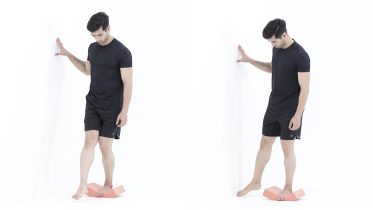
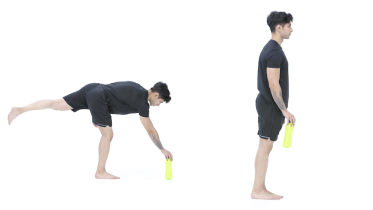
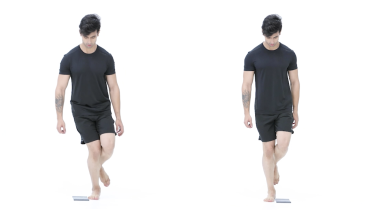
Single leg balance with ball kicks
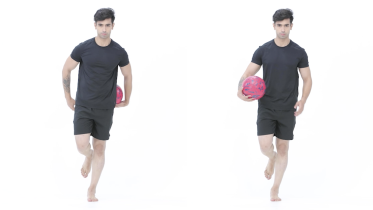
Single leg balance with ball kicks is a moving balance exercise. You kick a ball at a wall in front of you, then stop it with your foot as it rolls back. Every kick and every trap leaves you on one leg for a moment, and the standing leg has to react to a moving ball. It usually shows up late in ankle and knee rehab, or in return to sport work, once still balance on one leg is easy.
How to do the single leg balance with ball kicks
- Stand facing a wall, a few steps away from it, with a light ball on the floor just in front of you. The distance gives the ball time to roll back to you. Clear the floor around you.
- Stand tall, shift your weight onto the standing leg and keep a slight bend in that knee.
- Kick the ball toward the wall with the other foot using a short, controlled swing. It only needs enough pace to bounce off the wall and roll back.
- As the ball rolls back, trap it with the same foot that kicked: rest the sole lightly on top of the ball, as in the video, while you balance on the standing leg. Get it still before the next kick. Put the kicking foot down between kicks whenever you need to.
- Carry on for the set, then change legs so the other foot does the kicking.
What you should feel
Most of the work is in the standing leg: quick adjustments at the ankle and effort at the side of the hip and front of the thigh. The kicking leg works less than you might expect.
Common mistakes
- Kicking so hard that the ball comes back fast and you have to lunge for it.
- Letting the standing knee cave inward as you swing the other leg.
- Leaning far back to make the kick.
- Rushing the next kick before the ball is under control.
How often
Many programs use 1 to 3 sets of 10 to 15 kicks with each leg, once a day. Your physio will adjust this.
Stop and check with your physio if
- Your ankle or knee gives way, or you get sharp pain in the standing leg.
- Pain in the knee or ankle keeps building from one kick to the next.
- You feel dizzy, or you nearly fall while trapping the ball. If you faint while exercising, call emergency services, even if you feel fine again quickly.
From the clinic
The wall is out of shot in the video and there is nothing beside him, but at home have a chair back or counter within arm's reach at your side, and work on a flat floor that is not slippery. A soft, light ball is easier to control than a hard one and will not rebound too fast. If you have fallen in the past 12 months, get dizzy easily, or feel unsteady walking, stay with a still balance exercise such as single leg stance and ask your physio before adding a ball. Barefoot or flat, well-fitting shoes both work.
Treat the kick as a gentle pass. What trains your balance is the moment on one leg while the ball moves, so a hard strike adds nothing. If you find yourself hopping or grabbing for support to trap the ball, stand closer to the wall and slow the kicks down.
Written and checked by the PocketPhysio editorial team. Last updated 2026-09-26.
This page is general education, not a diagnosis or a personal treatment plan. If you have pain, an injury or a health condition, see a physiotherapist or doctor before starting new exercises.