
Terminal knee extension with band
Terminal knee extension is the last part of straightening the knee, done here in standing against a band that pulls the knee forward. It is often used in knee rehab to work the muscles at the front of the thigh (quadriceps) in the fully straight position you stand and walk on.
How to do the terminal knee extension with band
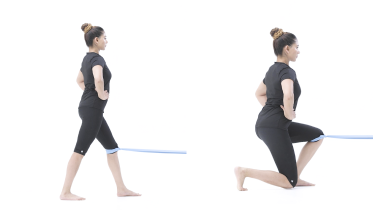
- Tie a resistance band into a loop around something sturdy at knee height, and stand facing it.
- Put your affected leg into the loop so the band sits behind that knee. The other leg stays free. Step back until the band has some tension, with your feet flat and about hip width apart.
- Put your hands on your hips and keep your body upright. Bend both knees a little, a small dip rather than a squat, and let the band draw the banded knee forward.
- Straighten back up, pushing the banded knee back against the band until the leg is fully straight. Tighten the front of the thigh as you go.
- Hold the straight position for 1 to 2 seconds, relax, then bend again slowly and with control.
What you should feel
Work in the front of the thigh, strongest in the last part as the knee straightens. You may feel your buttocks working too.
Common mistakes
- Snapping the knee back hard into a locked position. Straighten firmly, but under control.
- Letting the knee drift inward as you bend.
- Bending too deep. A small bend is enough, because the work is in the last part of straightening.
- Using a band so strong that you cannot reach fully straight.
- Leaning the upper body forward instead of straightening the knee.
How often
Many programs use 2 to 3 sets of 10 to 15, with a short hold when the knee is straight, once a day. Your physio will adjust this and the band strength for you.
Stop and check with your physio if
- Pain at the front of the knee or behind the kneecap that builds during the set.
- The knee gives way, locks or catches.
- The knee is more swollen after the session than before it.
From the clinic
Physios often reach for this one when a knee bends well but struggles to lock out straight once you put weight through it. It is commonly part of programs after knee surgery and for pain around the kneecap.
If the band keeps sliding down, place it just above the crease at the back of the knee rather than on the calf. A lighter band that lets you reach fully straight is better than a heavy one that stops you short.
Reviewed by the PocketPhysio by VirtueLife expert physiotherapy team. Last reviewed 2026-09-25.
This page is general education, not a diagnosis or a personal treatment plan. If you have pain, an injury or a health condition, see a physiotherapist or doctor before starting new exercises.
.png)