
Pain behind the knee: causes, exercises and when to get help
What causes pain behind the knee?
The list of possible causes is long. One review of posterior knee pain works through the tendons and muscles, the ligaments, the meniscus, the bone, fluid-filled cysts and sacs (bursae), and the nerves and blood vessels (English and Perret, 2010). Its authors treat the exact spot that hurts as one of the most useful clues. How the pain started, and what sets it off, fill in the rest. Below is what tends to point to each cause: use it as a guide, not a diagnosis.
A Baker's cyst
A Baker's cyst is a pocket of fluid that bulges out at the back of the knee. The NHS describes a soft lump there, sometimes with knee or leg pain, a tight or stiff feeling, trouble bending the knee and clicking, and symptoms that may be worse after walking. Adults seldom get one without another problem inside the knee feeding it, usually osteoarthritis, a meniscus tear or rheumatoid arthritis (Herman and Marzo, 2014). The Baker's cyst program covers it in detail.
The hamstring tendons or muscle
Your hamstring tendons pass the back of the knee on the inner and outer sides on their way to the shin. An ache at the inner back of the knee, tender to press just below the joint, fits a sore semimembranosus tendon, one of the inner hamstrings (English and Perret, 2010). Pain here that has built up over weeks or months can also suggest hamstring tendon trouble (Bunt and colleagues, 2018). A hamstring strain feels different: the NHS describes a sharp pain in the back of the leg, sometimes with a pop, and a thigh that turns tender and swollen, with bruising, over a few hours. See the hamstring strain program for that injury.
The calf muscle
The large calf muscle (gastrocnemius) starts just above the knee and crosses the back of it, so it works at both the knee and the ankle. Pain that comes on when you bend the knee against resistance or rise onto your toes fits a problem in this muscle (English and Perret, 2010). A calf strain usually starts with a sudden tearing or stabbing pain at the back of the lower leg. Swelling and bruising may then spread down toward the ankle (University Hospitals Plymouth NHS Trust).
Because a torn calf muscle and a blood clot can look alike, new calf swelling always needs checking. A sudden pop or snap lower down, at the back of the ankle or heel, is a different matter, and so is a feeling of being kicked in the back of the leg. Either can be a torn Achilles tendon (Cambridge University Hospitals). Get it checked the same day at an urgent care center or emergency department, even if you can still walk.
Knee osteoarthritis
Osteoarthritis becomes more common as you get older and often affects both knees. The NHS lists pain and stiffness, sometimes with mild swelling. OrthoInfo adds that the knee can be hard to bend and straighten, with pain and swelling that may be worse in the morning or after sitting. It is also one of the problems that most often lies behind a Baker's cyst (Herman and Marzo, 2014). The knee osteoarthritis program begins with easy exercises and adds load step by step.
A meniscus tear
The menisci are two C-shaped pads of cartilage inside the knee. A tear often follows a twist in sport, but in an older knee an awkward twist while getting up from a chair can be enough (OrthoInfo). The knee usually hurts and becomes stiff and swollen over hours to days, and it may catch, lock or give way (NHS; OrthoInfo). Pain at the back of the knee alone is a rare way for a meniscus tear to show itself (English and Perret, 2010). Pain there straight after an injury is another matter: it raises the question of damage to the back part of the meniscus or to the ligament at the back of the knee (posterior cruciate ligament), so get it checked the same day (Bunt and colleagues, 2018).
A nerve from your lower back
The lower back can refer pain to the back of the knee (English and Perret, 2010). Sciatica usually affects the bottom and the back of one leg, often down into the foot. The pain can be sharp or burning, and there may be pins and needles, numbness or weakness (NHS). Back pain at the same time, or tingling below the knee, points this way. If that sounds like you, see the sciatica program.
Could pain behind the knee be a blood clot?
It can be, and it is the one cause you should never try to sort out yourself. A clot in a deep leg vein (deep vein thrombosis, or DVT) typically causes throbbing pain in one leg, usually in the calf or thigh, with swelling, red, blue or darker skin, or swollen veins (NHS). The NHS lists things that make a clot more likely: being over 60, a clot in the past, smoking, being overweight, taking HRT or the combined contraceptive pill, cancer or heart failure, pregnancy or a baby in the last 6 weeks, surgery or a recent hospital stay, 3 or more days in bed, and a trip of more than 4 hours.
Other causes can also pass for a clot. When a Baker's cyst bursts, fluid leaks into the calf and can look just like one (Herman and Marzo, 2014). The NHS lists leg pain or swelling that suddenly gets worse, or swelling with bruising and warm skin, as reasons to be seen urgently, because either a burst cyst or a clot could be behind them. A torn calf muscle can fool people too: in an ultrasound study of 141 people referred with a suspected calf muscle tear, 14 had a clot and no tear at all (Delgado and colleagues, 2002). A doctor may need a scan to tell these apart.
The sign to act on: a calf or thigh that is newly swollen, warm, tender, red or darker than usual, has swollen veins that are sore to touch, or has a throbbing or cramping pain that does not fit your injury or condition, or that feels different from normal muscle soreness after exercise. This can be a sign of a blood clot (deep vein thrombosis), especially after surgery, an injury, time in a cast or boot, a long trip or a spell of being much less mobile than usual. Get medical advice the same day. If you are also short of breath or have chest pain, call emergency services.
What helps at home
If you have none of the warning signs further down, start simply. The NHS suggests an ice pack wrapped in a towel, held on the knee for up to 20 minutes and repeated every 2 to 3 hours. Paracetamol (acetaminophen) or ibuprofen, as tablets or a gel, can also ease the pain (NHS). After a fresh hamstring strain, the NHS advises protecting and resting the leg for the first 2 to 3 days, with a snug bandage and the leg raised on a pillow.
Cut back on whatever clearly flares the pain, such as long walks, deep squats or kneeling, but do not stop moving altogether. After the first few days, keep the knee moving: bend and straighten it gently within a comfortable range a few times a day, so it does not stiffen while it settles. The NHS gives this advice for hamstring injuries and for meniscus tears. Do not massage or roll a calf that is newly swollen, warm or painful until a doctor has checked it. This advice is written for adults: a child with a lump or pain behind the knee should see a doctor first.
Exercise and back of knee pain
Exercise is part of the treatment for most of the causes above. For knee osteoarthritis, a Cochrane review found that exercise probably eases pain and helps everyday function in the short term, but the average gain was small and it is not clear how much it matters (Lawford and colleagues, 2024). For the other causes, the linked programs set out what is known.
The exercises below are gentle starting points. They keep the knee moving and get the muscles at the front and back of the thigh working, along with the calf, without much load. If your calf is newly swollen, warm, red or throbbing, leave all of them until you have been checked. After a fresh hamstring or calf strain, begin with the quad sets and heel slides, and keep them pain free. The seated knee extension, the hamstring curl and the calf raises wait until you can walk normally without pain, which is the point where the hamstring strain program starts to load the muscle harder or at a longer length.
Exercises that can help
Quad sets (10 holds of 5 to 10 seconds) are done several times a day, and heel slides (10 to 15 slow repetitions) 2 or 3 times a day. Knee extensions and calf raises often start at 2 to 3 sets of 10 to 15, and hamstring curls at 2 to 3 sets of 10 on each leg. Your physio will adjust this. Any exercise that brings on sharp pain behind the knee can wait.
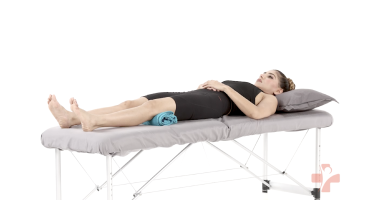 Quad sets (towel under knee)
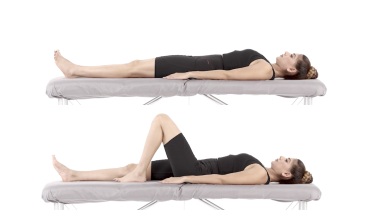 Heel slides
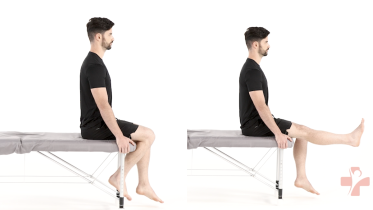 Seated knee extension
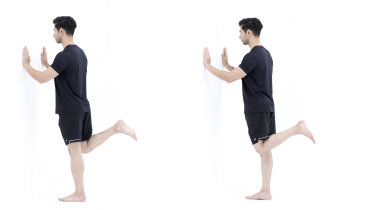 Standing hamstring curl
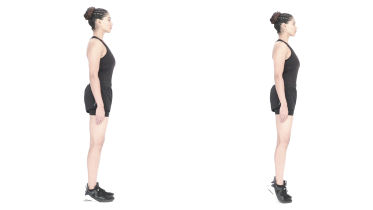 Calf raises
If the pain comes mainly as you bend, the page on knee pain when bending looks at that in more detail.
When to see a physio (physical therapist)
Get the knee checked by a physio or doctor if a few weeks pass without the pain improving (NHS), keeps coming back, or gets in the way of walking, sleeping or work. Show your doctor any lump behind the knee that nobody has checked, as the NHS advises for a lump you cannot explain. A physio will feel the tendons, test the joint and meniscus, and check whether your back is involved. Then they can set a program for the cause they find. If you have had knee surgery, follow the plan from your surgeon and physio instead of this page.
Related exercise programs
See a doctor promptly if
- Emergency: pain, tingling, numbness or weakness in both legs, numbness or altered feeling around your genitals or bottom, or new trouble peeing or controlling your bladder or bowels. The same applies if you lose feeling in one leg. Call emergency services or go to an emergency department straight away. These can be signs of pressure on the nerves at the base of the spine (cauda equina syndrome).
- Emergency: sudden, severe pain in your calf that is much worse than you would expect or keeps getting worse, especially if you take medicine to thin your blood. It may come with a tight, swollen calf, pain that gets worse when the muscle is stretched, numbness, pins and needles or weakness. Call emergency services or go to an emergency department straight away, and do not drive yourself. Rarely, bleeding from a burst cyst builds up pressure inside the calf (compartment syndrome), which needs urgent surgery.
- Emergency: your foot or leg suddenly turns cold, pale or blue, or suddenly becomes very painful, numb or weak, even while you are resting. Call emergency services or go to an emergency department straight away. This can be a sign that the blood supply to the leg is blocked, which needs treatment at once.
- Same day: a calf or thigh that is newly swollen, warm, tender, red or darker than usual, has swollen veins that are sore to touch, or has a throbbing or cramping pain that does not fit your injury or condition, or that feels different from normal muscle soreness after exercise. This can be a sign of a blood clot (deep vein thrombosis), especially after surgery, an injury, time in a cast or boot, a long trip or a spell of being much less mobile than usual. Get medical advice the same day. If you are also short of breath or have chest pain, call emergency services.
- Same day: pain or swelling in your calf or leg that suddenly gets worse, or new bruising on your leg, even if you know you have a Baker's cyst. Get medical advice the same day. A burst cyst and a blood clot can look exactly the same, and a doctor may need a scan to tell them apart. Do not assume it is the cyst.
- Same day: new numbness, pins and needles or weakness in your calf or foot. Get medical advice the same day, as a large cyst can rarely press on a nerve. If your foot turns cold, pale or blue compared with the other side, go to an emergency department straight away, and do not drive yourself.
- Same day: a leg or foot that is getting weaker, for example your foot drags, catches on the ground or slaps down when you walk (foot drop). Get medical advice the same day. If the weakness is getting worse by the hour, go to an emergency department.
- Same day: the knee is hot, red and swollen, or you have knee pain with a high temperature or feel hot, cold or shivery. Get medical advice the same day, and go to an emergency department if you feel very unwell. This can be a sign of infection in the joint, which needs treatment quickly.
- Same day: the pain started with a fall, a twist or a blow to the knee, or you cannot put weight on the leg. Get medical advice the same day. If the knee has changed shape, swelled up very quickly or you felt a pop or snap, or your foot turns cold, pale or blue or you have tingling or no feeling in the leg or foot, go to an emergency department straight away, and do not drive yourself.
- Same day: you felt or heard a pop or snap high at the back of your thigh, near the buttock or the bone you sit on, and now have large bruising spreading down the back of the thigh, a gap or dip you can feel, a stiff-legged walk, or clear weakness when you bend the knee. Get assessed the same day at urgent care or an emergency department, and ask whether you need a scan and a surgeon's opinion. The tendon may have pulled away from the bone (proximal hamstring avulsion). When surgery is needed, repair within the first 4 weeks is favored over later repair, so do not wait to see if it settles. This page does not cover this injury.
- Same day: the knee is locked, which means it is stuck bent and you cannot fully straighten it, even after gently trying to move it, or you cannot bend or straighten the leg at all. Get assessed the same day by a doctor, at urgent care or at an emergency department. A torn piece of meniscus can get caught in the joint and block it, and when a tear like this can be repaired, it should be done as early as possible. A knee that catches for a moment and then frees itself can happen with a meniscus tear. That is not the same as a locked knee, but tell your physio or doctor about it.
- Same day: the knee keeps giving way under you, or it gave way after a recent injury, or it gives way and is also very painful or swollen. Get medical advice the same day. If it only happens now and then, with no recent injury and no swelling, it is not an emergency, but book an assessment with a physio or doctor in the next few days.
- Same day: the knee clicks painfully when you bend or straighten it. Get medical advice the same day. Painless clicking on its own is common.
- Same day: the knee swells up with no clear reason, especially if you take medicine to thin your blood. Get medical advice the same day.
- Same day: you are a teenager who is still growing and you have a limp, or pain in the hip, groin or thigh as well as the knee. Get an urgent appointment with a doctor the same day, and stay off sport and these exercises until you have been checked. If you cannot put weight on the leg, have a high temperature or feel very unwell, go to an emergency department. Some hip problems in growing teenagers, such as a slipped growth plate at the top of the thigh bone (slipped capital femoral epiphysis), are felt in the knee and need checking quickly.
- Within a day or two: you are still growing and have pain that wakes you at night, pain at rest that keeps getting worse, or a lump or swelling around the knee or thigh that keeps growing. See a doctor within a day or two. Do the same if the pain comes with looking pale, unusual tiredness, fevers with no clear cause, bruising or bleeding easily, or weight loss. If you also have a rash that does not fade when you press it, call emergency services or go to an emergency department. Bone pain that is worse at night, or a new lump, needs checking to rule out rarer causes such as a bone tumor or a blood cancer (leukemia).
- Within a few days: a lump behind your knee that no doctor has checked, or a lump that is getting bigger or feels hard. See your doctor within a few days. Most lumps here are Baker's cysts, but other problems can look similar, so it is worth confirming what it is.
- Within a few days: pain at night or at rest that keeps getting worse. See your doctor within a few days. If you have had cancer, now or in the past, see your doctor sooner, within a day or two, and mention it, even if the pain is not getting worse. Do the same if you have knee pain and are losing weight without trying, even if it does not hurt at night. If you are being treated for cancer now, contact your cancer team the same day.
Common questions
Is pain behind the knee a blood clot?
It can be, but a clot is one of several causes, and most of the others are problems in the joint, a tendon or a muscle. The signs that point to a clot: a calf or thigh that is newly swollen, warm, red or darker than usual, or a throbbing or cramping pain. Clots are more likely after surgery, a long trip or a spell of being much less mobile (NHS). A burst Baker's cyst or a torn calf muscle can look the same, so this is not something to sort out at home. If any of those signs are there, get medical advice the same day, and call emergency services if you are also short of breath or have chest pain.
When should I worry about pain behind my knee?
Get medical advice the same day if your calf or thigh swells, feels warm, changes color or throbs. The same goes for a knee that is swollen, hot to the touch and red, knee pain with a fever, pain that started with a fall, a twist or a blow to the knee, and a knee that locks, will not straighten or keeps giving way. Call emergency services if you are short of breath or have chest pain, if the calf pain is sudden and severe, if your foot or leg suddenly turns cold, pale or blue, or if you have numbness around your genitals or bottom, new bladder or bowel trouble, or symptoms in both legs. If none of these apply, see a physio or doctor when the pain has not eased within a few weeks.
Why does the back of my knee hurt when I bend or straighten it?
A Baker's cyst often makes the back of the knee feel tight and harder to bend (NHS). If it hurts when you bend the knee against resistance, as in a hamstring curl, or when you go up onto your toes, a sore calf muscle near the knee fits (English and Perret, 2010). The hamstrings bend the knee as well, so a sore hamstring can hurt with the same movement. Osteoarthritis can leave the knee stiff to bend and straighten, especially after rest (OrthoInfo). A knee that suddenly will not straighten at all, particularly after a twist, may be locked by a torn piece of meniscus and needs checking the same day.
Why does the back of my knee hurt when I walk?
Walking can make several of these causes worse: the NHS notes that Baker's cyst symptoms may be worse after walking, and OrthoInfo says vigorous activity can make knee arthritis flare. A different pattern is an ache in the leg that comes on every time you walk a certain distance and goes away after a few minutes' rest. That can be narrowed arteries in the legs (peripheral arterial disease), especially if you smoke or have diabetes, and the NHS advises seeing a GP about leg pain like this. See your doctor within a few days if the distance you can walk before it starts has become much shorter over a few weeks, and the same day for burning pain in the feet at rest, sores that do not heal, or toes that turn cold and numb and then red or black. If your foot or leg suddenly turns cold, pale or blue, or suddenly becomes very painful, numb or weak, call emergency services.
Can sciatica cause pain behind the knee?
Yes. A problem in the lower back can send pain to the back of the knee (English and Perret, 2010). The NHS describes sciatica as pain from the bottom down the back of one leg, often reaching the foot. It may burn, the leg may tingle or go numb, and moving, coughing or sneezing can make it worse. Back pain alongside the knee pain, or tingling below the knee, makes a nerve more likely than a knee problem. A leg or foot that is getting weaker needs medical advice the same day.
References
- English S, Perret D. Posterior knee pain. Current Reviews in Musculoskeletal Medicine. 2010;3(1-4):3-10. https://doi.org/10.1007/s12178-010-9057-4
- Bunt CW, Jonas CE, Chang JG. Knee Pain in Adults and Adolescents: The Initial Evaluation. American Family Physician. 2018;98(9):576-585. https://www.aafp.org/pubs/afp/issues/2018/1101/p576.html
- NHS. Baker's cyst. Page last reviewed 26 June 2025. https://www.nhs.uk/conditions/bakers-cyst/
- Herman AM, Marzo JM. Popliteal cysts: a current review. Orthopedics. 2014;37(8):e678-e684. https://doi.org/10.3928/01477447-20140728-52
- NHS. Deep vein thrombosis (DVT). Page last reviewed 30 April 2026. https://www.nhs.uk/conditions/deep-vein-thrombosis-dvt/
- Delgado GJ, Chung CB, Lektrakul N, Azocar P, Botte MJ, Coria D, Bosch E, Resnick D. Tennis leg: clinical US study of 141 patients and anatomic investigation of four cadavers with MR imaging and US. Radiology. 2002;224(1):112-119. https://doi.org/10.1148/radiol.2241011067
- University Hospitals Plymouth NHS Trust. Calf muscle tears and strains (patient information, A-538 v2). February 2025. https://www.plymouthhospitals.nhs.uk/display-pil/pil-calf-muscle-tears-and-strains-6064/
- NHS. Hamstring injury. Page last reviewed 28 July 2025. https://www.nhs.uk/conditions/hamstring-injury/
- Degen RM. Proximal hamstring injuries: management of tendinopathy and avulsion injuries. Current Reviews in Musculoskeletal Medicine. 2019;12(2):138-146. https://doi.org/10.1007/s12178-019-09541-x
- Cambridge University Hospitals NHS Foundation Trust. Achilles tendon rupture. Patient information. Approved 14 January 2025. https://www.cuh.nhs.uk/patient-information/achilles-tendon-rupture/
- NHS. Meniscus tear (knee cartilage damage). Page last reviewed 2 September 2026. https://www.nhs.uk/conditions/meniscus-tear/
- American Academy of Orthopaedic Surgeons. Meniscus Tears. OrthoInfo. https://www.orthoinfo.org/en/diseases--conditions/meniscus-tears/
- American Academy of Orthopaedic Surgeons. Arthritis of the Knee. OrthoInfo. https://www.orthoinfo.org/en/diseases--conditions/arthritis-of-the-knee/
- NHS. Knee pain. Page last reviewed 21 December 2023. https://www.nhs.uk/symptoms/knee-pain/
- Lawford BJ, Hall M, Hinman RS, et al. Exercise for osteoarthritis of the knee. Cochrane Database of Systematic Reviews. 2024;12(12):CD004376. https://doi.org/10.1002/14651858.CD004376.pub4
- NHS. Sciatica. Page last reviewed 3 December 2024. https://www.nhs.uk/conditions/sciatica/
- NHS. Peripheral arterial disease (PAD). Page last reviewed 10 April 2026. https://www.nhs.uk/conditions/peripheral-arterial-disease-pad/
Written and checked by the PocketPhysio editorial team. Last updated 2026-09-29.
This page is general education, not a diagnosis or a personal treatment plan. See a physiotherapist or doctor for advice about your own situation.