
Outer knee pain: what it could be, what helps and when to worry
What sits on the outside of the knee
Run a finger down the outer side of your knee and you cross several structures in a few centimeters. There is a bony bump at the end of the thigh bone, with the iliotibial band passing over it. Below that comes the joint line, with the lateral meniscus inside. Then the ligament on the outer side, running to the top of the calf bone (the fibula), where one of the hamstring tendons also attaches and where the nerve that lifts your foot wraps around the bone. A family medicine review lists meniscal tears, collateral ligament sprains and iliotibial band syndrome as the usual reasons this side of the knee hurts (Bunt and colleagues, 2018).
The useful questions are the same as anywhere else in the knee. Where exactly is the sore point, how did it start, and what brings it on? None of what follows is a diagnosis. Read it as a way to describe the problem, not to name it.
What causes outer knee pain?
A sharp point above the joint that builds during running or riding
This is the classic picture of IT band syndrome, which in runners is the most common injury found on that side of the joint (van der Worp and colleagues, 2012). The pain is sharp and concentrated at one spot, and it usually appears after a stretch of running rather than at the start (Geisler, 2021). Most people can name something that changed just before: more miles, more hills, or a road that slopes to one side. The older explanation, a tight band rubbing back and forth over the bump, has not held up. Dissection and MRI work showed the band is tethered to the bone and instead compresses a nerve-rich fat layer underneath it at about 30 degrees of knee bend (Fairclough and colleagues, 2006).
Pain on the joint line, with catching, swelling or a knee that gives way
The lateral meniscus is the cushion in the outer half of the joint. A tear in it hurts lower down than IT band pain, right where the two bones meet. The NHS lists knee pain or tenderness, stiffness or swelling, difficulty moving the knee, a knee that gives way when you try to stand, and a crunching or clicking feeling, adding that the swelling may not start for a few hours or days. A twist in sport is the usual trigger, and OrthoInfo adds that the knee may catch or lock and may not move through its whole range. If your outer knee pain began in a single moment rather than creeping up, a meniscus tear belongs on the list.
Pain after a force from the inside: an LCL sprain
The lateral collateral ligament runs from the thigh bone to the fibula and resists the knee being pushed outward. OrthoInfo describes these injuries as far less common than sprains of the ligament on the inner side, making up under 2 percent of knee injuries, and as usually caused by trauma to the inside of the knee that forces the knee outward. The symptoms it lists are pain on the outer knee with swelling, tenderness, stiffness and a sense of instability, sometimes with a pop.
Grade 1 and grade 2 tears that leave the knee stable are generally treated without surgery, with a hinged brace and physical therapy. Surgery becomes a question when the ligament has pulled off the bone or other structures are damaged too. There is no separate LCL program on this site yet, so an outer knee that was forced outward and now feels loose needs an assessment rather than a list of exercises.
A stiff, gritty outer half of the joint
Osteoarthritis can settle in the outer half of the knee, though it does so less often than in the inner half. Among 5,202 knees x-rayed in the Multicenter Osteoarthritis Study, whose participants were aged 50 to 79 and either had knee osteoarthritis or were at high risk of it, the outer half was narrowed in 8.2 percent, about a quarter as often as the inner side (Wise and colleagues, 2012). The pattern is a knee that aches and stiffens through its whole range rather than biting at one point, worse after resting and worse again after a heavy day. NICE NG226 lets a clinician diagnose it from 45 onward without imaging, using pain that activity brings on plus morning stiffness that clears inside half an hour. The knee osteoarthritis program can be started at whatever level the knee is at.
The hamstring tendon on the bony bump at the side
One of the hamstrings, the biceps femoris, ends in a tendon that attaches to the top of the fibula, the small bone you can feel at the side just below the joint. Overuse in that tendon causes pain at the back-outer corner of the knee, but it is genuinely uncommon. A 2025 review of distal hamstring problems counted only 12 cases of biceps femoris tendinopathy in the literature, all in young athletes, and suggested the tendon may be overlooked and the pain blamed on something else (Koolmees and colleagues, 2025). First-line treatment in that review is rest, anti-inflammatory medicine and physical therapy. Raise it with a physio if your sore point is on that bump rather than above the joint, especially if bending the knee against resistance reproduces it.
A sudden tear of this tendon is a different matter. The same review notes that it usually happens in high-energy trauma along with damage to the corner of the knee, so a pop at the outside of the knee after a heavy blow or twist needs assessing rather than exercises.
Pain coming down from your lower back
Not all outer knee pain starts at the knee. On the NHS description, sciatica is felt in the bottom and along one leg as a sharp, burning pain, often reaching the foot and toes, and it brings pins and needles, numbness or weakness with it. Moving, sneezing or coughing can make it worse.
The back of the leg is not the only route. Which nerve root is irritated decides where the symptoms travel, and they can run down the outside of the calf and into the top of the foot instead of down the back. That is why this one gets mistaken for a knee problem. Back pain alongside the knee pain, or pins and needles below the knee, makes it more likely than anything in the joint. The sciatica program covers what to do about it.
When outer knee pain spreads down the leg
There is a second nerve story, and this one belongs to the knee itself. The nerve that lifts your foot passes around the outside of the fibula just below the joint, close to the surface and easy to squeeze. Pressure there causes weakness lifting the foot and turning it outward, along with loss of feeling over the outer shin and the top of the foot (Fortier and colleagues, 2021). The same review lists habitual leg crossing and repeated squatting among the everyday causes, alongside injuries such as fractures of the fibula.
The sign that matters is weakness rather than pain. The NHS describes foot drop as difficulty lifting the front of the foot and toes, usually in one foot, and lists nerve injury, a slipped disc, crossing the legs or kneeling for long periods, diabetes and hip or knee replacement surgery among the causes. A foot that drags, catches on the ground or slaps down when you walk needs medical advice the same day. Uncross your legs if you sit that way for hours, and mention any numbness on the top of the foot when you are examined.
Outer knee pain when kneeling or sitting cross legged
Both positions ask two things of the outer knee at once: a deep bend, and pressure or twist on the structures at the side. Most of the causes above dislike that, so pain in these positions on its own does not narrow much down. The nerve is the one specific point worth knowing. Sitting with the legs crossed for long spells presses on it where it wraps around the bone, and that is one of the recognized everyday causes of a temporary foot drop (Fortier and colleagues, 2021; NHS). If a position leaves your foot feeling numb or heavy, change it and do not keep testing it.
What helps at home
Do less of what clearly brings the pain on, and keep doing the rest. For runners with a band problem, a 2021 clinical review describes a calming period first, with reduced load and other exercise to hold your fitness, and it suggests swimming or flat walking with shorter strides while staying off the exercise bike, stair machine and rowing machine (Geisler, 2021). That comes from clinical experience rather than trials, but it is a reasonable default while the outer knee is sore. Cyclists usually do better with shorter, easier rides than with a full stop, and it is worth having someone experienced check your bike setup.
For day to day soreness, the NHS suggests an ice pack inside a towel held against the sore point, for up to 20 minutes at a time and no more often than every 2 to 3 hours, along with paracetamol (acetaminophen) or ibuprofen if those suit you. A pharmacist can tell you whether they fit with your other medicines. Stick to flat routes for now. Long downhill stretches and cambered roads come back last of all.
Exercise for outer knee pain
Strengthening the hip and the leg is the most widely recommended approach for the band problem. The evidence points the same way but is thin. A 2024 systematic review gathered 13 studies and 201 runners and could not combine them, because they were too unalike; what it could report is that pain and function improved across 2 to 8 weeks, and that hip work appeared in more programs than any other ingredient (Sanchez-Alvarado and colleagues, 2024). An earlier study measured weakness in the muscles at the side of the hip on the painful side of 24 distance runners, and 22 of them were running pain free after 6 weeks of rehab, although there was no comparison group (Fredericson and colleagues, 2000). If your outer knee pain turns out to be arthritis or a torn meniscus instead, the linked programs are the better fit.
The list below starts with the muscles at the side and back of the hip worked while you lie down, so the knee takes no load at all. It then asks the leg to control your body weight, which is where running and riding actually load it. The early exercises should not provoke the sore spot at the side of the knee at all, though a tired, working ache in the buttock is expected.
Keep a hand on a counter or a door frame for the single leg work until you are steady on that leg. Some discomfort in the standing exercises is acceptable if it settles within the hour and the knee feels the same as usual next morning. For the reasoning behind that rule, read the guide to the pain monitoring model.
Exercises that can help
The first three are done lying down and are the usual place to start. The last three ask the leg to hold you up, which is closer to what running and riding demand. Clamshells and side lying hip abduction often start at 2 to 3 sets of 10 to 15 on each side once a day, and glute bridges at 2 to 3 sets of 10 to 12. Banded side steps usually begin with a light band and 2 to 3 sets of 10 to 15 steps each way, step ups at 2 to 3 sets of 8 to 12 on each leg, and single leg stance at 5 to 10 lifts per leg held for a few seconds. Your physio will adjust this.
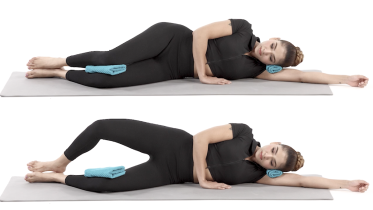 Clamshell
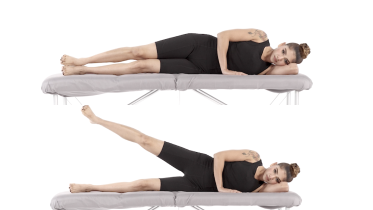 Side lying hip abduction
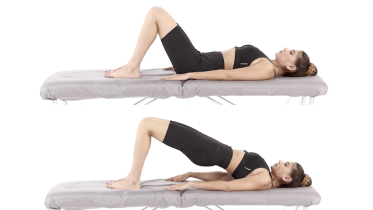 Glute bridge
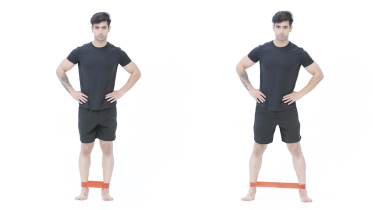 Lateral band walk
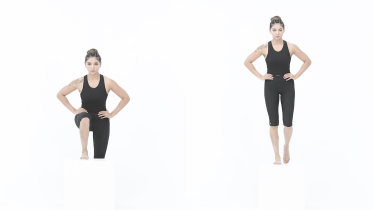 Step up
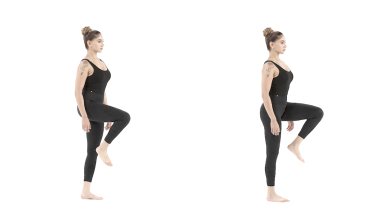 Single leg stance
If running is what sets it off, the page on knee pain after running covers training load and the way back. If squats are the problem, see knee pain when squatting.
When to see a physio (physical therapist)
Ask a physio or doctor to look at the knee if it has not improved within a few weeks (NHS), if it is stopping you running, riding, working or sleeping, or if you cannot tell where the pain is coming from. The structures on this side of the knee sit within a couple of centimeters of each other, so pressing the right spots is a large part of the examination. A physio will also test the ligament, check the joint line, look at your back if the pain travels, and watch the knee while you stand on one leg.
Go sooner if the pain began with a knock or a twist, if the knee feels loose, or if there is any numbness or weakness in the leg or foot. Anyone still growing, and any child, needs the knee looked at before starting these exercises. After knee surgery, your surgeon's and physio's plan comes first. Every warning sign below carries its own timing, from a trip to the emergency department to an appointment inside 2 weeks.
Related exercise programs
See a doctor promptly if
- Emergency: pain, tingling, numbness or weakness in both legs, numbness or altered feeling around your genitals or bottom, or new trouble peeing or controlling your bladder or bowels. The same applies if you lose feeling in one leg. Call emergency services or go to an emergency department straight away. These can be signs of pressure on the nerves at the base of the spine (cauda equina syndrome).
- Emergency: you felt a sudden pop or tearing feeling just above or below your kneecap, you can see or feel a dip there, the kneecap seems to have moved up toward the thigh or to sag lower than usual, or you suddenly cannot straighten your knee or lift your leg out straight. Stop exercising and go to an emergency department straight away, even if you can still walk, as this can be a torn tendon at the front of the knee, either below the kneecap (patellar tendon) or above it (quadriceps tendon). Do not drive yourself. A repair usually does better if it is done soon after the injury.
- Same day: the pain started with a fall, a twist or a blow to the knee, or you cannot put weight on the leg. Get medical advice the same day. If the knee has changed shape, swelled up very quickly or you felt a pop or snap, or your foot turns cold, pale or blue or you have tingling or no feeling in the leg or foot, go to an emergency department straight away, and do not drive yourself.
- Same day: the kneecap has slipped out of place, even if it went back by itself. If it is still out of place, go to an emergency department straight away, and do not drive yourself. If it went back by itself, get medical advice the same day.
- Same day: the knee is locked, which means it is stuck bent and you cannot fully straighten it, even after gently trying to move it, or you cannot bend or straighten the leg at all. Get assessed the same day by a doctor, at urgent care or at an emergency department. A torn piece of meniscus can get caught in the joint and block it, and when a tear like this can be repaired, it should be done as early as possible. A knee that catches for a moment and then frees itself can happen with a meniscus tear. That is not the same as a locked knee, but tell your physio or doctor about it.
- Same day: the knee keeps giving way under you, or it gave way after a recent injury, or it gives way and is also very painful or swollen. Get medical advice the same day. If it only happens now and then, with no recent injury and no swelling, it is not an emergency, but book an assessment with a physio or doctor in the next few days.
- Same day: the knee clicks painfully when you bend or straighten it. Get medical advice the same day. Painless clicking on its own is common.
- Same day: the knee swells up with no clear reason, especially if you take medicine to thin your blood. Get medical advice the same day.
- Same day: new numbness, pins and needles or weakness in the outer shin, the top of the foot or the toes. Get medical advice the same day. The nerve that lifts the foot passes close to the bone on the outside of the knee, so numbness or weakness there needs checking.
- Same day: a leg or foot that is getting weaker, for example your foot drags, catches on the ground or slaps down when you walk (foot drop). Get medical advice the same day. If the weakness is getting worse by the hour, go to an emergency department.
- Same day: the knee is hot, red and swollen, or you have knee pain with a high temperature or feel hot, cold or shivery. Get medical advice the same day, and go to an emergency department if you feel very unwell. This can be a sign of infection in the joint, which needs treatment quickly.
- Same day: a calf or thigh that is newly swollen, warm, tender, red or darker than usual, has swollen veins that are sore to touch, or has a throbbing or cramping pain that does not fit your injury or condition, or that feels different from normal muscle soreness after exercise. This can be a sign of a blood clot (deep vein thrombosis), especially after surgery, an injury, time in a cast or boot, a long trip or a spell of being much less mobile than usual. Get medical advice the same day. If you are also short of breath or have chest pain, call emergency services.
- Same day: you are a teenager who is still growing and you have a limp, or pain in the hip, groin or thigh as well as the knee. Get an urgent appointment with a doctor the same day, and stay off sport and these exercises until you have been checked. If you cannot put weight on the leg, have a high temperature or feel very unwell, go to an emergency department. Some hip problems in growing teenagers, such as a slipped growth plate at the top of the thigh bone (slipped capital femoral epiphysis), are felt in the knee and need checking quickly.
- Within a day or two: you are still growing and have pain that wakes you at night, pain at rest that keeps getting worse, or a lump or swelling around the knee or thigh that keeps growing. See a doctor within a day or two. Do the same if the pain comes with looking pale, unusual tiredness, fevers with no clear cause, bruising or bleeding easily, or weight loss. If you also have a rash that does not fade when you press it, call emergency services or go to an emergency department. Bone pain that is worse at night, or a new lump, needs checking to rule out rarer causes such as a bone tumor or a blood cancer (leukemia).
- Within a few days: pain at night or at rest that keeps getting worse. See your doctor within a few days. If you have had cancer, now or in the past, see your doctor sooner, within a day or two, and mention it, even if the pain is not getting worse. Do the same if you have knee pain and are losing weight without trying, even if it does not hurt at night. If you are being treated for cancer now, contact your cancer team the same day.
- Within 2 weeks: pain that spreads from your lower back or buttock down the outside of the thigh or below the knee, especially with numbness, tingling or pins and needles in the leg or foot. The pain may be coming from your back rather than the knee. Book an appointment with a doctor or physio. If your leg or foot is getting weaker, for example your foot drags, catches on the ground or slaps down when you walk (foot drop), get medical advice the same day, and if the weakness is getting worse by the hour, go to an emergency department.
Common questions
Is outer knee pain IT band syndrome?
Often, but not always. Among runners it heads the list of problems on that side of the joint (van der Worp and colleagues, 2012), so it is a sensible first thought if you run or ride. What fits the pattern: a sharp pain at one point just above the joint, on the bony bump at the end of the thigh bone, arriving after some minutes of activity rather than at the first stride. It fits less well if the pain arrived in one moment with a twist or a knock, if the knee swells, catches or gives way, or if the sore point is below the joint on the bone at the side of the shin. A physio can press on the bump with the knee slightly bent and see whether that reproduces your familiar pain.
Why does the outside of my knee hurt when I bend or straighten it?
For IT band syndrome there is a mechanical reason. The band is anchored to the end of the thigh bone rather than gliding over it, and at roughly 30 degrees of knee bend it squashes sensitive tissue sitting underneath (Fairclough and colleagues, 2006). That is why the pain often turns up at one particular part of the stride or the pedal stroke. A torn lateral meniscus behaves differently: the NHS puts a crunching or clicking feeling and trouble moving the knee on its symptom list, and the sore point sits lower, on the joint line itself. A knee that will not straighten at all needs assessing the same day.
Why does the outside of my knee hurt when running?
Every stride takes the knee through the angle that squeezes the sore tissue, and a run is thousands of strides. A 2021 clinical review describes the pain as sharp, at one spot, and typically arriving after a period of running, and it lists the usual background as a sudden jump in distance, more hill work, especially downhill, or running on a cambered road (Geisler, 2021). Look back at what changed in the 2 or 3 weeks before the pain started, because that is usually where the answer sits. Cutting distance, sticking to flat routes and strengthening the hip is the standard plan, and the review suggests returning with a walk and run program on flat ground, adding hills last.
Why does the outside of my knee hurt when walking or squatting?
Both take the knee through the angle where the band presses, and squatting piles body weight on top of it. A 2021 clinical review notes that squatting and going down stairs can hurt with this problem as well as running (Geisler, 2021). If squatting is the worst thing you do and the pain sits deep on the joint line with catching, a lateral meniscus tear moves up the list instead. Wear in the outer half of the joint also dislikes getting low and staying there. Walk on flat ground in amounts that do not bring the pain on, and pick a squat depth and a rep count that leave the knee no worse the next morning.
Why does pain on the outside of my knee spread down my leg?
Two very different things can do this. One is your lower back, where an irritated nerve sends pain along the outside of the thigh and calf, and the NHS notes that tingling, numbness or weakness may come with it and that coughing or sneezing often makes it worse. Back pain at the same time, or pins and needles below the knee, points that way, and this site has a separate program for sciatica. The other cause is local: the nerve that lifts your foot runs around the bone at the outside of the knee, and pressure on it there, from long spells with the legs crossed for example, produces numbness on the outer shin and the top of the foot (Fortier and colleagues, 2021). Whichever it is, a foot that drags, catches or slaps down when you walk needs medical advice the same day, and an emergency department if the weakness is worsening by the hour.
What exercises help outer knee pain?
It depends which structure is sore, but for the band problem the answer is hip and leg strengthening, alongside a temporary cut in whatever provokes it. The research points that way but is thin: a 2024 review covering 201 runners saw pain and function improve within 2 to 8 weeks, with hip work in most of the programs, though its authors could not combine the studies (Sanchez-Alvarado and colleagues, 2024). Stretching and foam rolling the band do not lengthen it, so treat them as optional extras rather than the treatment. Clamshells, side lying hip abduction and glute bridges are typical starting points, with banded side steps, step ups and single leg balance added once the knee tolerates standing work. If arthritis or a meniscus tear turns out to be the cause, a different program suits you better.
References
- Bunt CW, Jonas CE, Chang JG. Knee Pain in Adults and Adolescents: The Initial Evaluation. American Family Physician. 2018;98(9):576-585. https://www.aafp.org/pubs/afp/issues/2018/1101/p576.html
- Fairclough J, Hayashi K, Toumi H, Lyons K, Bydder G, Phillips N, Best TM, Benjamin M. The functional anatomy of the iliotibial band during flexion and extension of the knee: implications for understanding iliotibial band syndrome. Journal of Anatomy. 2006;208(3):309-316. https://doi.org/10.1111/j.1469-7580.2006.00531.x
- Geisler PR. Current Clinical Concepts: Synthesizing the Available Evidence for Improved Clinical Outcomes in Iliotibial Band Impingement Syndrome. Journal of Athletic Training. 2021;56(8):805-815. https://doi.org/10.4085/1062-6050-548-19
- van der Worp MP, van der Horst N, de Wijer A, Backx FJ, Nijhuis-van der Sanden MW. Iliotibial band syndrome in runners: a systematic review. Sports Medicine. 2012;42(11):969-992. https://doi.org/10.2165/11635400-000000000-00000
- Fredericson M, Cookingham CL, Chaudhari AM, Dowdell BC, Oestreicher N, Sahrmann SA. Hip abductor weakness in distance runners with iliotibial band syndrome. Clinical Journal of Sport Medicine. 2000;10(3):169-175. https://doi.org/10.1097/00042752-200007000-00004
- Sanchez-Alvarado A, Bokil C, Cassel M, Engel T. Effects of conservative treatment strategies for iliotibial band syndrome on pain and function in runners: a systematic review. Frontiers in Sports and Active Living. 2024;6:1386456. https://doi.org/10.3389/fspor.2024.1386456
- Koolmees DS, Klott JD, Poppe TR, Bernholt DL. Distal Hamstring Injuries and Disorders. Journal of the American Academy of Orthopaedic Surgeons Global Research and Reviews. 2025;9(9):e25.00248. https://doi.org/10.5435/JAAOSGlobal-D-25-00248
- Fortier LM, Markel M, Thomas BG, Sherman WF, Thomas BH, Kaye AD. An Update on Peroneal Nerve Entrapment and Neuropathy. Orthopedic Reviews. 2021;13(2):24937. https://doi.org/10.52965/001c.24937
- Wise BL, Niu J, Yang M, Lane NE, Harvey W, Felson DT, Hietpas J, Nevitt M, Sharma L, Torner J, Lewis CE, Zhang Y. Patterns of compartment involvement in tibiofemoral osteoarthritis in men and women and in whites and African Americans: the Multicenter Osteoarthritis Study. Arthritis Care and Research. 2012;64(6):847-852. https://doi.org/10.1002/acr.21606
- National Institute for Health and Care Excellence. Osteoarthritis in over 16s: diagnosis and management (NG226). 2022. https://www.nice.org.uk/guidance/ng226
- American Academy of Orthopaedic Surgeons. Collateral Ligament Injuries. OrthoInfo. https://www.orthoinfo.org/en/diseases--conditions/collateral-ligament-injuries/
- American Academy of Orthopaedic Surgeons. Meniscus Tears. OrthoInfo. https://www.orthoinfo.org/en/diseases--conditions/meniscus-tears/
- American Academy of Orthopaedic Surgeons. Slipped Capital Femoral Epiphysis (SCFE). OrthoInfo. https://www.orthoinfo.org/en/diseases--conditions/slipped-capital-femoral-epiphysis-scfe
- NHS. Knee pain. Page last reviewed 21 December 2023. https://www.nhs.uk/symptoms/knee-pain/
- NHS. Meniscus tear (knee cartilage damage). Page last reviewed 2 September 2026. https://www.nhs.uk/conditions/meniscus-tear/
- NHS. Sciatica. Page last reviewed 3 December 2024. https://www.nhs.uk/conditions/sciatica/
- NHS. Foot drop. Page last reviewed 30 June 2025. https://www.nhs.uk/conditions/foot-drop/
- NHS. Deep vein thrombosis (DVT). Page last reviewed 30 April 2026. https://www.nhs.uk/conditions/deep-vein-thrombosis-dvt/
Written and checked by the PocketPhysio editorial team. Last updated 2026-09-30.
This page is general education, not a diagnosis or a personal treatment plan. See a physiotherapist or doctor for advice about your own situation.