
IT band syndrome exercises and physiotherapy
What is IT band syndrome?
The iliotibial band (IT band) is a thick strip of connective tissue (fascia) that runs down the outside of your thigh, from the hip to just below the knee. It is part of the sheet of fascia that wraps around the thigh (fascia lata). IT band syndrome is pain where the band crosses the bony bump on the outside of the thighbone, just above the knee joint (the lateral femoral epicondyle). It is a common overuse problem in runners and cyclists (Fairclough and colleagues, 2006), and a systematic review describes it as the most common injury on the outside of the knee in runners (van der Worp and colleagues, 2012).
The pain is usually sharp and in one spot on the outside of the knee, and it tends to come on after a period of running (Geisler 2021). Squatting and going down stairs can hurt too. Many people can point to a change in training beforehand, most often a sudden jump in distance, more hill running (especially downhill) or running on roads or tracks that slope to one side. A physio or doctor usually diagnoses it from your story and by pressing over the bony bump with the knee slightly bent, which brings on the familiar pain.
This page is for adults and for teenagers aged 16 and over. Younger children with knee pain should be assessed by a physio or doctor before starting any program. If you have had surgery on your knee or IT band, follow your surgeon's program instead of this one. If you are pregnant, check with your midwife, doctor or physio before starting new exercises.
Is IT band syndrome caused by a tight IT band?
Probably not in the way it used to be explained. The old view was that a tight band rubbed back and forth over the bony bump each time the knee bent and straightened, which is why it was called a friction syndrome. A 2006 study that combined dissections with MRI scans found that the band is firmly anchored to the thighbone by fibrous strands, so it cannot roll over the bump (Fairclough and colleagues, 2006). Instead, when the knee is bent to about 30 degrees, the band presses on a layer of fat underneath it that is rich in nerves and blood vessels.
The authors concluded that the pain is more likely to come from this compression than from friction. They also found no fluid-filled sac (bursa) under the band in any of the people they examined. Later reviews have taken up this compression, or impingement, explanation (Geisler 2021).
This matters for treatment. If the problem is sensitive tissue being squeezed under a band that barely stretches, trying to lengthen the band makes little sense. The focus moves to calming the sore area by changing the load for a while, and to how the hip and knee control the leg each time you land on it.
Why hip and leg strength helps IT band syndrome
The idea is that better control at the hip reduces how far the thigh drops inward and turns in as you land, which may lessen the squeeze at the outside of the knee. A review of 13 studies included one that followed runners over time: female runners who went on to develop IT band syndrome had more of this inward movement at the hip and more inward turning at the knee while the foot was on the ground (Aderem and Louw, 2015). The studies were few and had methodological weaknesses, and the differences were small, so this is a lead rather than proof.
In a 2000 study, 24 distance runners with IT band syndrome had weaker hip abductors (the muscles that move the leg out to the side) on the sore side than on their other side, and than healthy runners (Fredericson and colleagues, 2000). After 6 weeks of rehab that focused on the muscle at the side of the hip (gluteus medius), their hip strength went up and 22 of the 24 were back running without pain. There was no comparison group, so it cannot show how much the exercises themselves helped. A 2012 systematic review found the research on causes limited and conflicting, and said it is not clear whether hip weakness plays a major part (van der Worp and colleagues, 2012).
A 2024 systematic review of 13 studies with 201 runners found that pain and function improved over 2 to 8 weeks with several approaches, and that hip strengthening was the most used, usually combined with other treatments (Sanchez-Alvarado and colleagues, 2024). The studies were too different to pool, and 6 of them were case reports or case series. So hip and leg strengthening is the most widely recommended approach and seems to help, but the evidence behind it is thin. Baker and Fredericson (2016) suggest that how well the muscles are coordinated while you run may matter as much as raw strength, which is one reason the later stages add single leg control and running drills.
Running and cycling: what to change while it settles
You may not need to stop everything. A 2021 clinical review describes a calming period first: do less of the activity that hurts, change the load, and use other exercise to keep your fitness (Geisler 2021). Physios often take that to mean running or riding only as far as you can without bringing the pain on, or stopping for a while if it comes on early. For runners, the same review suggests swimming and walking on flat ground with shorter strides, and staying off the exercise bike, stair machine and rowing machine for now so the sore area is not squeezed further. That is expert advice, not something tested in trials, but it is a sensible default while the knee is sore.
Running distance
A sudden jump in training is a common story before IT band syndrome starts (Geisler 2021). When you build back up, add distance in small steps and let the knee guide you. A knee that is no worse the next morning is a good sign that the step was the right size. This is common practice, not a tested rule.
Downhill and sloping ground
Keep to flat routes for now, and avoid long downhill stretches and roads that slope to the side. Running downhill means the knee is straighter when your foot lands, and one early study proposed that this puts the knee right in the range where the band presses as your weight comes onto it (Orchard and colleagues, 1996). Hills and uneven ground come back last, once longer flat runs are comfortable.
Running cadence
Taking slightly shorter, quicker steps is something some physios try. In healthy runners, raising the step rate by 10% reduced how far the thigh moved inward at the hip (Heiderscheit and colleagues, 2011), which is the same movement linked to IT band syndrome. This has not been tested in trials of people with IT band syndrome, and the 2024 review found only case reports on changing running style (Sanchez-Alvarado and colleagues, 2024). Treat it as something to discuss with a physio who can watch you run.
Cycling and bike fit
For cyclists, an early paper on IT band syndrome in riders lists bike adjustments and training changes as part of treatment (Holmes and colleagues, 1993). A later review suggests watching whether the knee drifts in toward the top tube of the bike as you push down on the pedal (Geisler 2021). A bike fit usually looks at things such as saddle height and cleat position, but there are no good trials showing which changes help. Get your setup checked by someone experienced instead of making big changes yourself, and cut back long rides and hard efforts for a while, the same way a runner cuts back distance.
Easing the pain day to day
The NHS knee pain page suggests an ice pack wrapped in a towel for up to 20 minutes every 2 to 3 hours, and paracetamol or ibuprofen. Ask a pharmacist if you are not sure a medicine is safe for you.
How to use this program
Pick the stage that matches your knee today. If you are not sure, start at stage 1, and move up when the current stage feels easy and your knee is no worse the next morning. The signs for moving on are adapted from the levels in one clinical review (Geisler 2021) and from common practice. They are a rough guide, not fixed rules.
In stage 1, keep the exercises pain free at the outside of the knee. A tired ache in the hip and buttock muscles is normal. In stage 2, mild discomfort at the outside of the knee, up to about 3 out of 10, is acceptable if it settles soon after and is no worse the next morning. From stage 3 on, aim to be pain free at the outside of the knee during and after each session. Sharp pain, pain that builds with each repetition, or a knee that is sorer the next day means the load was too much, so drop back a step rather than stopping altogether.
Each exercise page gives a typical starting dose. As a rough guide, many programs use 2 to 3 sets of 6 to 15 repetitions for the strength exercises, depending on the exercise, a few days a week or daily for the lighter ones. Side plank holds often start at 10 to 30 seconds, and the harder star side plank at 5 to 15 seconds. Foam rolling is done in slow passes for 30 to 60 seconds on each leg. Your physio will adjust the exercises and the numbers to suit your knee and what you want to get back to.
Breathe normally through each hold and repetition rather than holding your breath, especially if you have high blood pressure. Check with your doctor before you start if you have a heart or lung condition.
The exercise program
Stage 1: Settle the knee and start the hip work
For the first weeks, while running or riding brings on pain at the outside of the knee and you are cutting back as described above. These exercises work the muscles at the side and back of your hip (gluteus medius and gluteus maximus) while you lie down, so the knee hardly bends under load. Keep them pain free at the outside of the knee; a tired ache in the hip and buttock is normal. In the side lying exercises, keep your top hip stacked over the bottom one and the top leg in line with your body, and in the kneeling side plank keep your elbow under your shoulder and your hips lifted in a line. Move on when these feel easy and everyday walking and stairs bring on no more than mild knee pain, about 3 out of 10 or less.
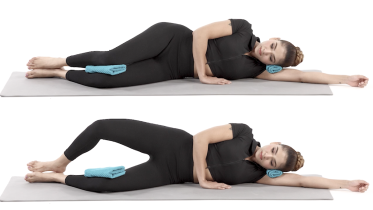 Clamshell
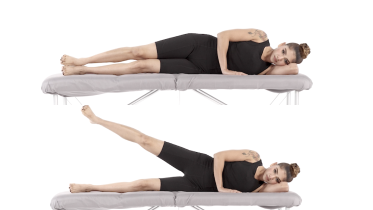 Side lying hip abduction
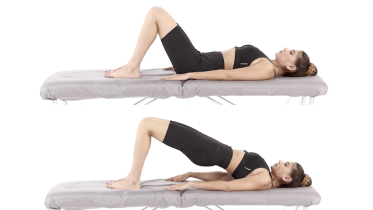 Glute bridge
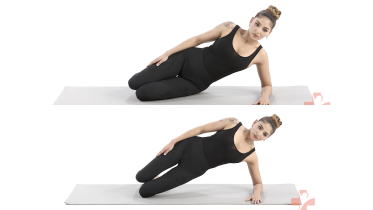 Kneeling side plank
Stage 2: Standing strength and knee control
When stage 1 feels easy, the outside of your knee is no worse the next morning, and any knee pain in daily life is mild, about 3 out of 10 or less. These work the side of the hip while you stand on the leg, which is what running and riding ask of it. In the band exercises, the step up and the single leg stance, keep your pelvis level and your knee pointing over your second toe instead of drifting inward. Start with a light band and a low step, and hold a counter if your balance is not steady. Mild discomfort at the outside of the knee, up to about 3 out of 10, is acceptable in this stage if it settles soon after and is no worse the next morning.
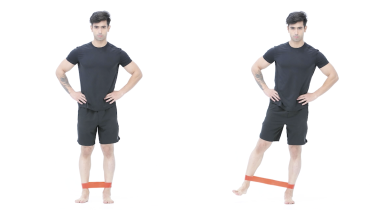 Standing hip abduction with band
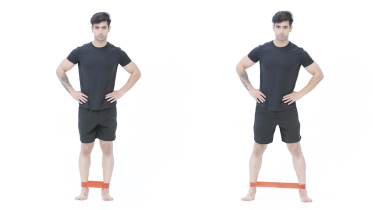 Lateral band walk
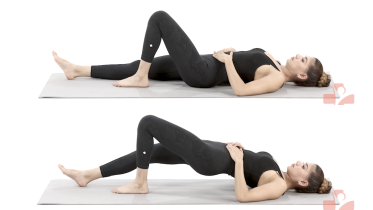 Single leg bridge
.png) Side plank
Side plank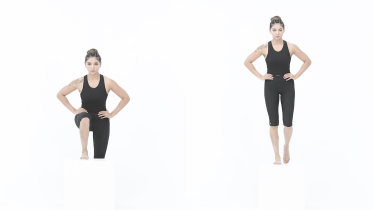 Step up
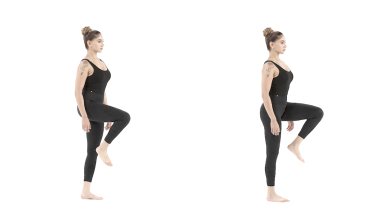 Single leg stance
Stage 3: Single leg strength and control
When the stage 2 exercises are pain free at the outside of the knee during and after each session, your knee stays in line over your second toe, and you can walk for about 30 minutes without pain at the outside of the knee. These load one leg at a time through deeper knee bends, closer to what running and hard riding ask. Aim to keep them pain free at the outside of the knee, and if it is sorer the next day, go back to the stage 2 work for a few sessions. Build a steady side plank before trying the star side plank, and hold a counter for the single leg deadlift and the lunges until you feel steady. Keep the working knee in line with your second toe throughout.
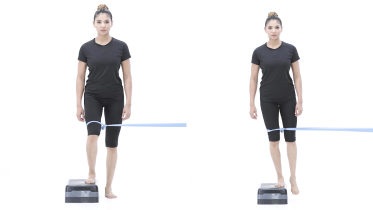 Lateral step-down with band
.png) Single leg deadlift
Single leg deadlift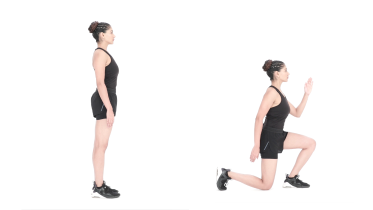 Reverse lunge
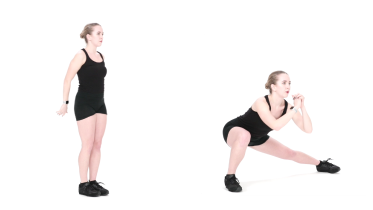 Lateral lunge
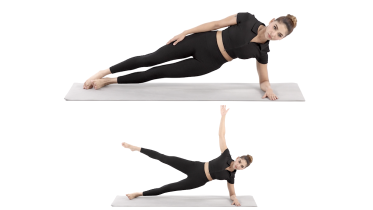 Star side plank
Stage 4: Back to running
For runners, when stage 3 feels strong and is pain free during and after each session, and you can walk for 30 minutes and jog gently on the spot for about 1 minute without pain at the outside of the knee. The arm swing drill and jogging on the spot bring back running rhythm before you cover any ground. After that, one clinical review suggests a walk and run program on flat ground, for example 1 minute of running and 1 minute of walking for up to 30 minutes, with hills and uneven ground added only once longer flat runs are comfortable (Geisler 2021). Keep the stage 3 strength work going 2 to 3 times a week. Cyclists can skip these drills and follow the cycling advice above instead.
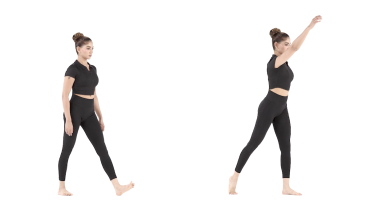 Running arm swing drill
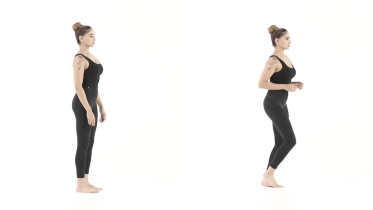 Jogging on the spot
Optional: foam rolling for comfort
Foam rolling does not lengthen or release the IT band, and you do not need it to recover. Some people find it eases the tight feeling along the outer thigh, so use it only if it helps, alongside the strength work and never instead of it. Keep the pressure moderate, roll the outer thigh only and stop above the knee. Do not press on the sore spot. Stop rolling if the knee or hip is sorer that evening or the next morning.
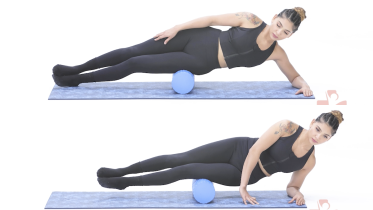 IT band foam rolling
Do foam rolling and stretching help IT band syndrome?
They may help how the leg feels, but they do not change the band. In a study on donated bodies, common IT band stretches lengthened the band by less than 0.5% (Falvey and colleagues, 2010). A mathematical model found that very large forces, well outside the normal range the body meets, would be needed to change the shape of the thigh fascia by even 1% (Chaudhry and colleagues, 2008). In a small trial in 30 healthy adults who did not have IT band syndrome, one session of foam rolling or stretching did not change the stiffness of the band (Pepper and colleagues, 2021).
So why do some people feel easier after rolling or stretching? The effect is more likely on the muscles and on how sensitive the area feels than on the band itself. A review of foam rolling in general found small benefits, including a modest drop in muscle soreness when people rolled after exercise, but those studies were not in people with IT band syndrome (Wiewelhove and colleagues, 2019). Falvey and colleagues concluded that research should focus on the muscle at the top of the band rather than the band itself.
Some experts go further. The 2021 clinical review advises leaving IT band stretching and deep friction massage out of treatment altogether (Geisler 2021). The evidence behind that advice is limited, but so is the evidence for stretching.
Crossing the leg behind you, as the standing IT band stretch does, pulls the thigh inward, and in the Pepper trial that position made the band stiffer near the knee. So this program leaves the stretch out. Foam rolling of the outer thigh sits in an optional section: if you like it and the knee is no worse afterward, it is fine to keep as an extra, but it does not replace the strength work.
If you roll, keep to the outer thigh and stop above the knee. Do not grind on the sore spot, because that is the area already being squeezed. Keep off the bony point at the side of the hip too. If that point is sore, see the page on greater trochanteric pain.
When to see a physio or doctor
See a physio or doctor if your knee pain does not improve within a few weeks (NHS), or sooner if it is stopping you running, riding, working or sleeping. It is worth an assessment at the start if you are not sure the pain is IT band syndrome. Pain on the outside of the knee can also come from a torn cartilage (meniscus), a sprained ligament on the outer side, wear in the outer part of the joint or a kneecap problem, and these are managed differently (Geisler 2021). If you have done the program regularly for 6 to 8 weeks and nothing has changed, a physio can check the diagnosis and adjust the plan.
Most cases settle without surgery, and surgery is kept for pain that does not settle with other treatment (Beals and Flanigan, 2013). The warning signs below need prompt medical attention.
For physiotherapists
This page gives patients a starting framework built on the compression model. Fairclough and colleagues (2006) found the ITB anchored to the distal femur by fibrous strands, with a richly innervated and vascular fat layer deep to it, no bursa in any cadaver, volunteer or patient, and MRI evidence that the ITB is compressed against the lateral femoral epicondyle at about 30 degrees of knee flexion as the tibia rotates internally. Geisler (2021) frames the condition as ITB impingement syndrome, describes increased pain on compression over the epicondyle at 30 degrees of flexion (the Noble test) as diagnostic, and advises that the Ober test should not be factored into the diagnosis.
The stages loosely follow the three levels in Geisler (2021). Level I is low load, open chain hip work (side-lying short arc abduction, clamshells, quadruped hip extension, single leg bridges and hip external rotation). Level II is closed chain loading (hip hikes, mini squats progressing to single leg, step-ups and step-downs, banded side stepping), with pain kept at or below 3 out of 10. Level III requires pain-free sessions and either 30 minutes of walking or 1 minute of jogging without lateral knee pain, then adds hopping and landing work and a 1:1 run-walk program on flat ground for 30 minutes, with hills and uneven ground introduced gradually.
This page uses the 3 out of 10 ceiling for stage 2, the pain-free and 30 minute walk gate for stage 3 (which already holds deeper single leg loading, as in level III), and asks for both the walk and 1 minute of gentle jogging on the spot before stage 4, which is stricter than Geisler's either-or gate and a lower-load test than overground jogging. Crossover step-ups and curtsy lunges were left out because they load the hip in adduction, the movement linked to ITBS; the lateral lunge follows Geisler's side lunging. The library has no hop or landing progressions for this page, so plyometric work and the running progression are left to the treating physio.
The evidence for hip-focused rehab is weak but consistent in direction. Aderem and Louw (2015) included 13 studies (1 prospective, 12 cross-sectional); the increased peak hip adduction and knee internal rotation during stance in female runners who went on to develop ITBS comes from the single prospective study, and effect sizes were small. Fredericson and colleagues (2000) is an uncontrolled case series of 24 runners, and van der Worp and colleagues (2012) rated the treatment literature as poor quality and highly conflicting. Sanchez-Alvarado and colleagues (2024) included 5 RCTs among 13 studies and could not meta-analyze because of heterogeneity.
On gait, Heiderscheit and colleagues (2011) found that a 10% increase in step rate reduced peak hip adduction angle and peak hip adduction and internal rotation moments in 45 healthy runners; it has not been tested as an ITBS treatment. Orchard and colleagues (1996) proposed that downhill running aggravates the condition by reducing knee flexion at footstrike, and that faster running on level ground is less provocative because the knee passes beyond the impingement range at footstrike. Geisler (2021) cautions running-based patients against stationary cycling, stair climbers and rowing ergometers during the calming period.
Foam rolling of the lateral thigh is included as an optional comfort measure, clearly labeled, because patients ask about it; it stops above the knee, so it is not deep friction over the distal ITB. The standing ITB stretch is left out: Falvey and colleagues (2010) measured less than 0.5% ITB lengthening during common stretches in cadavers, Geisler (2021) recommends against ITB stretching and deep friction massage (SORT B), and Pepper and colleagues (2021) found higher distal ITB stiffness in 10 degrees of hip adduction. Drop rolling for any patient who flares or who relies on it in place of loading. Screen for lateral meniscal injury, lateral collateral ligament sprain, lateral compartment osteoarthritis and patellofemoral pain (Geisler 2021), and for lumbar referral when pain spreads from the back with neurological symptoms.
See a doctor promptly if
- Emergency: pain, tingling, numbness or weakness in both legs, numbness or altered feeling around your genitals or bottom, or new trouble peeing or controlling your bladder or bowels. The same applies if you lose feeling in one leg. Call emergency services or go to an emergency department straight away. These can be signs of pressure on the nerves at the base of the spine (cauda equina syndrome).
- Emergency: after a fall, a twist or a blow, the knee looks out of place or misshapen, or you have tingling or no feeling in the knee, leg or toes, or your foot turns cold, pale or blue. Go to an emergency department straight away. Do not drive yourself: ask someone to drive you or call an ambulance.
- Same day: the pain started with a fall, a twist or a blow to the knee, and now the knee is very painful or swollen, or you cannot put weight on the leg or move the knee. Get medical advice the same day, and go to an emergency department if the pain is severe. This points to an injury, not IT band syndrome.
- Same day: the knee swells up, locks so you cannot straighten it, gives way under you, or clicks painfully. These can be signs of a problem inside the joint, such as a torn meniscus (the cartilage cushion in the knee) or a ligament injury. Get medical advice the same day and stop running and riding until it has been checked.
- Same day: the knee is hot, red and swollen, or you have knee pain with a high temperature or feel hot, cold or shivery. Get medical advice the same day, and go to an emergency department if you feel very unwell. This can be a sign of infection in the joint, which needs treatment quickly.
- Same day: a calf or thigh that is newly swollen, warm, tender, red or darker than usual, has swollen veins that are sore to touch, or has a throbbing or cramping pain that does not fit your injury or condition, or that feels different from normal muscle soreness after exercise. This can be a sign of a blood clot (deep vein thrombosis), especially after surgery, an injury, time in a cast or boot, a long trip or a spell of being much less mobile than usual. Get medical advice the same day. If you are also short of breath or have chest pain, call emergency services.
- Within a few days: pain at night or at rest that keeps getting worse. See your doctor within a few days. If you have had cancer, now or in the past, or are losing weight without trying, see your doctor sooner, within a day or two, and mention it. This applies even if the pain is not getting worse. If you are being treated for cancer now, contact your cancer team the same day.
- Within 2 weeks: pain that spreads from your lower back or buttock down the outside of the thigh or below the knee, especially with numbness, tingling or pins and needles in the leg or foot. The pain may be coming from your back rather than the knee. Book an appointment with a doctor or physio. If your leg or foot is getting weaker, for example your foot drags, catches on the ground or slaps down when you walk (foot drop), get medical advice the same day, and if the weakness is getting worse by the hour, go to an emergency department.
Common questions
Can I keep running with IT band syndrome?
Often yes, at a lower amount and on flat ground. A common approach in practice is to run only as far as you can without the outside of the knee starting to hurt, and to stop that run if it does. If the pain comes on within the first few minutes, or makes you limp, stop running for now, keep your fitness with swimming or walking on the flat, and get advice from a physio. When you go back, a walk and run program on flat ground is a common way to rebuild, with hills added last (Geisler 2021).
Should I foam roll my IT band?
You can if it feels good, but it will not loosen or lengthen the band. By one mathematical model, changing the shape of the thigh fascia by even 1% would take forces far beyond anything the body normally meets (Chaudhry and colleagues, 2008). And in a small trial in 30 healthy adults without IT band syndrome, a single rolling session left the band's stiffness unchanged (Pepper and colleagues, 2021). If you roll, keep it gentle, stay on the outer thigh, stop above the knee and keep off the sore spot. It is an extra alongside the strength work, not the treatment.
Does stretching the IT band help?
Not in the way it is often described. Measured in donated bodies, the usual IT band stretches lengthened the band by less than 0.5% (Falvey and colleagues, 2010), and a 2021 clinical review advises leaving IT band stretching out of treatment (Geisler 2021). Crossing the leg behind you also pulls the thigh inward, and in a small trial in healthy adults that position made the band stiffer near the knee (Pepper and colleagues, 2021), so this program leaves the stretch out. If you already stretch the outer hip and it feels good, with the knee no worse afterward, you can keep it as an extra, but stop if the knee or hip is sorer later that day or the next morning. That last point comes from practice, not from trials.
Is IT band syndrome the same as runner's knee?
Not quite. Runner's knee is a loose name used for more than one problem, most often pain around or behind the kneecap, which is called patellofemoral pain. IT band syndrome hurts on the outside of the knee, over the bony bump just above the joint. A physio can tell the two apart and adjust the program if you have signs of both.
How long does IT band syndrome take to get better?
Often several weeks, but there is no reliable timetable. In the studies in a 2024 review, pain and function improved over 2 to 8 weeks (Sanchez-Alvarado and colleagues, 2024), and in one study 22 of 24 runners were back running without pain after a 6 week rehab program, although that study had no comparison group (Fredericson and colleagues, 2000). Most cases settle without surgery (Beals and Flanigan, 2013).
Can I cycle with IT band syndrome?
If cycling is your sport, you may not need to stop completely. A 2021 clinical review describes cutting back and changing the load while the knee settles (Geisler 2021). For riders that usually means shorter, easier rides that do not bring on the pain at the outside of the knee, or a break if even short rides hurt. Have your bike setup checked by someone experienced, since bike adjustments are part of treatment for riders (Holmes and colleagues, 1993). If you are a runner looking for other exercise while the knee settles, the same review suggests swimming or flat walking instead of the exercise bike, though that is expert advice and has not been tested in trials (Geisler 2021).
References
- Fairclough J, Hayashi K, Toumi H, Lyons K, Bydder G, Phillips N, Best TM, Benjamin M. The functional anatomy of the iliotibial band during flexion and extension of the knee: implications for understanding iliotibial band syndrome. Journal of Anatomy. 2006;208(3):309-316. https://doi.org/10.1111/j.1469-7580.2006.00531.x
- Geisler PR. Current Clinical Concepts: Synthesizing the Available Evidence for Improved Clinical Outcomes in Iliotibial Band Impingement Syndrome. Journal of Athletic Training. 2021;56(8):805-815. https://doi.org/10.4085/1062-6050-548-19
- Baker RL, Fredericson M. Iliotibial Band Syndrome in Runners: Biomechanical Implications and Exercise Interventions. Physical Medicine and Rehabilitation Clinics of North America. 2016;27(1):53-77. https://doi.org/10.1016/j.pmr.2015.08.001
- Fredericson M, Cookingham CL, Chaudhari AM, Dowdell BC, Oestreicher N, Sahrmann SA. Hip abductor weakness in distance runners with iliotibial band syndrome. Clinical Journal of Sport Medicine. 2000;10(3):169-175. https://doi.org/10.1097/00042752-200007000-00004
- Aderem J, Louw QA. Biomechanical risk factors associated with iliotibial band syndrome in runners: a systematic review. BMC Musculoskeletal Disorders. 2015;16:356. https://doi.org/10.1186/s12891-015-0808-7
- van der Worp MP, van der Horst N, de Wijer A, Backx FJ, Nijhuis-van der Sanden MW. Iliotibial band syndrome in runners: a systematic review. Sports Medicine. 2012;42(11):969-992. https://doi.org/10.2165/11635400-000000000-00000
- Sanchez-Alvarado A, Bokil C, Cassel M, Engel T. Effects of conservative treatment strategies for iliotibial band syndrome on pain and function in runners: a systematic review. Frontiers in Sports and Active Living. 2024;6:1386456. https://doi.org/10.3389/fspor.2024.1386456
- Falvey EC, Clark RA, Franklyn-Miller A, Bryant AL, Briggs C, McCrory PR. Iliotibial band syndrome: an examination of the evidence behind a number of treatment options. Scandinavian Journal of Medicine and Science in Sports. 2010;20(4):580-587. https://doi.org/10.1111/j.1600-0838.2009.00968.x
- Chaudhry H, Schleip R, Ji Z, Bukiet B, Maney M, Findley T. Three-dimensional mathematical model for deformation of human fasciae in manual therapy. Journal of the American Osteopathic Association. 2008;108(8):379-390. https://doi.org/10.7556/jaoa.2008.108.8.379
- Pepper TM, Brismée JM, Sizer PS Jr, Kapila J, Seeber GH, Huggins CA, Hooper TL. The Immediate Effects of Foam Rolling and Stretching on Iliotibial Band Stiffness: A Randomized Controlled Trial. International Journal of Sports Physical Therapy. 2021;16(3):651-661. https://doi.org/10.26603/001c.23606
- Wiewelhove T, Döweling A, Schneider C, Hottenrott L, Meyer T, Kellmann M, Pfeiffer M, Ferrauti A. A Meta-Analysis of the Effects of Foam Rolling on Performance and Recovery. Frontiers in Physiology. 2019;10:376. https://doi.org/10.3389/fphys.2019.00376
- Orchard JW, Fricker PA, Abud AT, Mason BR. Biomechanics of iliotibial band friction syndrome in runners. American Journal of Sports Medicine. 1996;24(3):375-379. https://doi.org/10.1177/036354659602400321
- Heiderscheit BC, Chumanov ES, Michalski MP, Wille CM, Ryan MB. Effects of step rate manipulation on joint mechanics during running. Medicine and Science in Sports and Exercise. 2011;43(2):296-302. https://doi.org/10.1249/MSS.0b013e3181ebedf4
- Holmes JC, Pruitt AL, Whalen NJ. Iliotibial band syndrome in cyclists. American Journal of Sports Medicine. 1993;21(3):419-424. https://doi.org/10.1177/036354659302100316
- Beals C, Flanigan D. A Review of Treatments for Iliotibial Band Syndrome in the Athletic Population. Journal of Sports Medicine. 2013;2013:367169. https://doi.org/10.1155/2013/367169
- NHS. Knee pain. Page last reviewed 21 December 2023. https://www.nhs.uk/symptoms/knee-pain/
- NHS. Sciatica. Page last reviewed 3 December 2024. https://www.nhs.uk/conditions/sciatica/
Written and checked by the PocketPhysio editorial team. Last updated 2026-09-28.
This page is general education, not a diagnosis or a personal treatment plan. See a physiotherapist or doctor for advice about your own situation.