Side plank
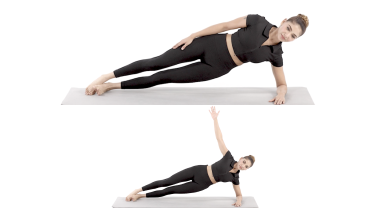
A side plank is a hold on your side with your legs straight and your hips lifted off the mat. In the video it is done on a straight arm, with the hand flat under the shoulder and the top hand resting on the hip. The side of your trunk and hip hold you up, and the supporting shoulder works hard too. It is a step up from the kneeling side plank.
How to do the side plank
- Lie on your side on a mat with your legs straight. Stack your feet, or put the top foot just in front of the bottom one for a wider base.
- Place your bottom hand flat on the mat directly under your shoulder and push up until the elbow is straight. Rest your top hand on your hip.
- Tighten your stomach and lift your hips until your body makes a straight line from your ankles to your head.
- Push the floor away through your hand so the shoulder does not sink toward your ear. Keep your head in line with your spine.
- Hold and keep breathing, then lower your hips to the mat with control. Change sides and repeat.
What you should feel
Effort along the side of your waist and hip nearest the mat, and in the shoulder and arm you are leaning on.
Common mistakes
- Letting the hips sag toward the mat, or pushing them back so you bend at the waist.
- Placing the hand ahead of or too far out from the shoulder.
- Rolling the chest toward the floor instead of staying stacked on your side.
- Holding your breath.
How often
A common starting point is a hold of 10 to 30 seconds, 2 to 5 times on each side, a few days a week. The voice guide works toward 30 seconds. Your physio will set the hold time and repeats for you.
Stop and check with your physio if
- Pain in the wrist, elbow or shoulder you are leaning on.
- Sharp pain in the lower back or the side of the hip.
- Pain or tingling spreads down the arm.
- Pins and needles in your arm or hand that do not go away after you stop, or part of your arm or hand goes numb. Get medical advice the same day. If one side of your face or body suddenly goes numb or weak, or your speech becomes slurred or muddled, call emergency services, even if it goes away.
From the clinic
The voice guide describes the forearm version, propped on your elbow and forearm with the elbow right under your shoulder. The video shows the straight-arm version. Both are common. The forearm version is usually easier on the wrist and gives you a more stable base, so start there if your wrist or hand complains, and ask your physio which one suits you.
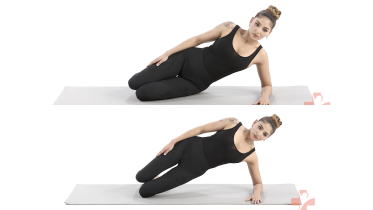
If you cannot hold a straight line for about 10 seconds without your hips sagging, the kneeling side plank is a good place to build up first. The forearm plank trains the front of the trunk in a similar way. With a painful shoulder, or after shoulder surgery or a dislocation, check with your physio before putting your full weight through one arm. If you have high blood pressure, keep the holds short and breathe steadily the whole time.
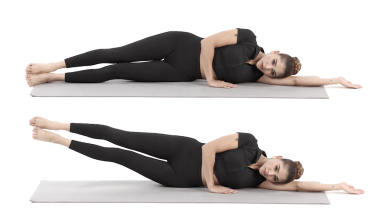
Holding your hips up also works the muscles at the side of the bottom hip, much like a side leg lift. If you have had a hip replacement or other hip surgery, get the go-ahead from your surgeon or physio before you try the side plank. Some operations limit this kind of work for the first months, so the timing depends on your surgery.
Written and checked by the PocketPhysio editorial team. Last updated 2026-09-28.
This page is general education, not a diagnosis or a personal treatment plan. If you have pain, an injury or a health condition, see a physiotherapist or doctor before starting new exercises.