Alternating superman
The alternating superman strengthens the muscles along your back and buttocks. Lying face down with your arms stretched out overhead, you lift one arm and the opposite leg a little way off the mat, hold, lower, then switch sides. It is an easier step toward the full superman, where both arms and both legs lift at once.
How to do the alternating superman
- Lie face down on a mat with your legs straight and your arms stretched out on the mat past your head. Rest your forehead on the mat or on a folded towel.
- Gently draw in your lower stomach and lightly lift your pelvic floor, the muscles you would use to hold in wind. Keep breathing.
- Keeping that gentle tension, lift one arm and the opposite leg off the mat, for example your right arm and left leg. Go only as high as you can while both hip bones stay on the mat. The leg in the video lifts well clear of the mat, but a smaller lift is fine. Keep the elbow and knee straight but not locked.
- Hold for a few seconds and keep breathing. Your eyes stay on the mat so the back of your neck stays long.
- Lower slowly, then lift the other arm and leg. Keep swapping sides.
What you should feel
Work along your back and in the buttock of the lifted leg, with some effort at the back of the lifted shoulder. It should feel like muscles working, not a pinch in your lower back.
Common mistakes
- Lifting the leg as high as it will go. The extra height comes from arching your lower back.
- Rolling onto one hip as the leg lifts. Both hip bones stay resting on the mat.
- Raising your head to look forward, which strains the neck.
- Holding your breath while the arm and leg are up.
How often
A common start is 1 to 3 sets of 6 to 10 lifts on each side, holding each lift for 3 to 5 seconds. Your physio will adjust this.
Stop and check with your physio if
- Pain travels down your leg, or you get numbness or tingling.
- Your back pain builds during the set, or is worse afterward and does not settle.
- Your shoulder or neck hurts when you lift your arm.
From the clinic
If the full superman, with both arms and both legs up together, is too much for now, this version is the usual stepping stone. Still too hard? Lift a leg only, or an arm only, and add the opposite limb once that feels steady. Height matters less than control. A lift of a few inches with your hips flat on the mat is plenty.
Lifting the leg puts a small arch into your back. If you have narrowing of the spinal canal (spinal stenosis) or a slipped vertebra (spondylolisthesis), ask your physio before you start. If you have had a fracture in your spine, check with your physio before you begin. If you have had a hip replacement, get the go-ahead from your surgeon or physio before you try this exercise. Lifting the leg takes the hip back behind the line of your body, and many surgeons ask you to avoid that for the first months after some operations, especially when the hip was replaced from the front.
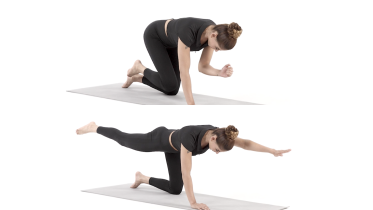
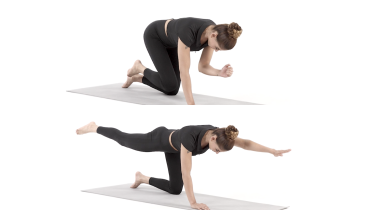
Lying face down presses on your stomach. If you are pregnant, have recently given birth, have had abdominal surgery or have a hernia, ask your physio or doctor before you start. The bird dog trains the same opposite arm and leg pattern from your hands and knees, with nothing pressing on your stomach. With high blood pressure, breathe steadily all the way through each hold and never hold your breath. If it is not well controlled, get your doctor's go-ahead before you start.
Written and checked by the PocketPhysio editorial team. Last updated 2026-09-26.
This page is general education, not a diagnosis or a personal treatment plan. If you have pain, an injury or a health condition, see a physiotherapist or doctor before starting new exercises.