Bicycle crunches
A bicycle crunch is a crunch with a twist added. You lie on your back with your shoulder blades lifted and bring one elbow toward the opposite knee as the other leg straightens, then swap sides in a slow pedaling rhythm. Much of the turning comes from the muscles down the sides of your waist (obliques). The front stomach muscles hold the curl.
How to do the bicycle crunches
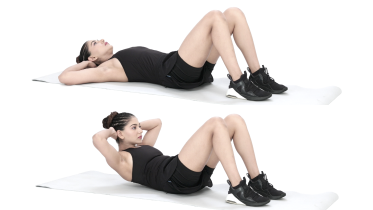
- Lie on your back with your lower back pressed gently into the floor. Put your hands lightly behind your head.
- Bring your knees in toward your chest and lift your head and shoulder blades off the floor. Your hands support your head but do not pull on it.
- Straighten your right leg out and hold it off the floor while you turn your upper body to the left, bringing your right elbow toward your left knee. Start with the straight leg at about 45 degrees. The video shows it lower, which is harder on your back.
- Turn from your rib cage. If only your elbow moves across, the twist is not really happening.
- Switch sides: bend the right knee back in, straighten the left leg and turn your left elbow toward your right knee. Keep alternating at a slow, steady pace.
What you should feel
Work in your stomach, especially along the sides of your waist as you turn. Your lower back should stay quiet. If it starts to arch or ache, keep the straight leg higher or bend your knees more.
Common mistakes
- Pulling your head forward with your hands.
- Flapping the elbows across instead of turning the ribs.
- Letting the lower back arch off the floor as the leg straightens. Keep the straight leg higher until you can control it.
- Racing through the reps. Fast and loose feels easier, and it does less for you.
How often
Programs often begin with 2 to 3 sets of 10 to 20 slow repetitions (each side counts as one), a few days a week. Your physio may change the numbers, or hold this one back until simpler core exercises feel easy.
Stop and check with your physio if
- Back pain that sharpens during the set or spreads down a leg.
- Neck pain that builds, or tingling in your arms.
- Pins and needles in your arm or hand that do not go away after you stop, or part of your arm or hand goes numb. Get medical advice the same day. If one side of your face or body suddenly goes numb or weak, or your speech becomes slurred or muddled, call emergency services, even if it goes away.
- A bulge or a feeling of pressure in your stomach wall. Let your physio know.
From the clinic
Speed is the usual problem with bicycle crunches. Done fast, the legs swing and the body rocks, and momentum does the work. Take about two seconds into each twist.
Still too hard? Keep your feet closer to you, or leave your head on the floor and do only the leg movement until your back stays steady. The dead bug trains the same back control with less load, and plain abdominal crunches let you learn the curl before adding the twist.
Talk to your physio first if you have a hernia, a gap in the stomach muscles after pregnancy (diastasis recti), or you have had stomach or back surgery. Past the first trimester of pregnancy, ask before doing exercises flat on your back.
If you have osteoporosis, this one is usually skipped. It bends you forward and twists you at the same time, which is the movement people with fragile bones are most often told to avoid. Your physio can suggest a safer core exercise.
Written and checked by the PocketPhysio editorial team. Last updated 2026-09-28.
This page is general education, not a diagnosis or a personal treatment plan. If you have pain, an injury or a health condition, see a physiotherapist or doctor before starting new exercises.