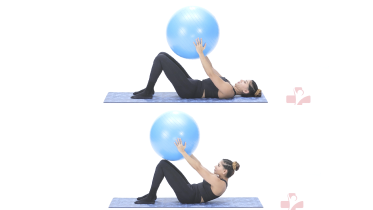
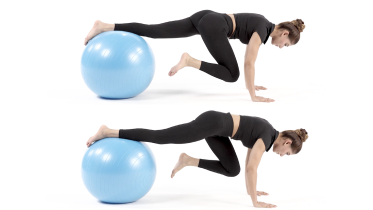
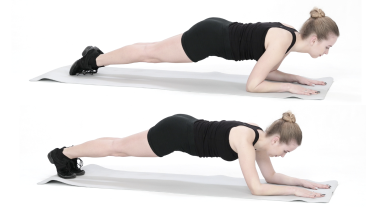
Abdominal crunches
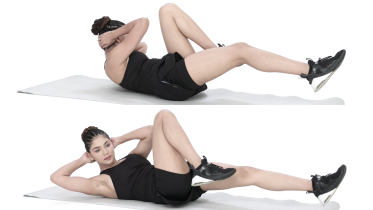
A crunch is a small curl up from lying on your back. Your stomach muscles curl your upper body up until your shoulder blades leave the floor, then you lower slowly. Unlike a full sit-up, your lower back stays down the whole time. Most of the effort comes from the long muscle down the front of your stomach (rectus abdominis).
How to do the abdominal crunches
- Lie on your back with your knees bent and your feet flat on the floor, about hip width apart.
- Rest your hands lightly behind your head with your elbows out to the sides. Do not lock your fingers together, because that makes it easy to pull on your neck.
- Gently draw your stomach in. Then breathe out as you curl your head, neck and shoulder blades up and forward off the floor.
- Keep your lower back on the floor and look up toward your knees, leaving some space between your chin and your chest.
- Hold for a moment at the top, then lower yourself slowly back down.
What you should feel
Your stomach muscles working, mostly at the front. Your neck should not be doing the work. If it aches, rest your head between repetitions and check that your hands are not pulling.
Common mistakes
- Pulling your head forward with your hands, so the neck bends instead of the chest lifting.
- Curling up so far that it turns into a sit-up and your lower back leaves the floor.
- Dropping back down fast instead of lowering with control.
- Holding your breath. Breathe out on the way up.
How often
A common plan is 2 to 3 sets of 10 to 15 slow crunches, a few days a week. Your physio will adjust the numbers, and may start you on an easier core exercise first.
Stop and check with your physio if
- Neck pain that builds, or pain or tingling spreading into your arms.
- Pins and needles in your arm or hand that do not go away after you stop, or part of your arm or hand goes numb. Get medical advice the same day. If one side of your face or body suddenly goes numb or weak, or your speech becomes slurred or muddled, call emergency services, even if it goes away.
- Back pain that spreads down a leg, or numbness or tingling in the leg.
- A bulge or pressure in your stomach wall, or pain around a surgical scar. Stop and tell your physio.
From the clinic
If your neck tires before your stomach does, cup the back of your head in both hands so they take its weight, and keep your elbows wide and still. Your hands hold the head. They never pull it.
You only need to curl up until your shoulder blades clear the floor. There is no prize for going higher. If crunches are too much for now, the pelvic tilt and the dead bug train stomach control with less strain on the neck.
Ask your physio or doctor before you start if you have had stomach or back surgery, have a hernia, or have a gap in the stomach muscles after pregnancy (diastasis recti). If you are past the first trimester of pregnancy, check with your physio before exercising flat on your back.
Crunches and sit-ups are usually left out for people with osteoporosis. Repeated forward bending of the spine raises the risk of a spine fracture, so ask your physio for a core exercise that keeps your back straighter.
Written and checked by the PocketPhysio editorial team. Last updated 2026-09-28.
This page is general education, not a diagnosis or a personal treatment plan. If you have pain, an injury or a health condition, see a physiotherapist or doctor before starting new exercises.