Rolling side plank
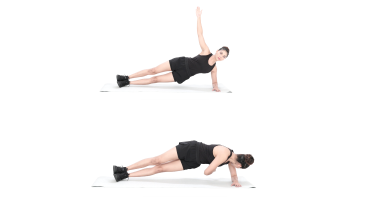
The rolling side plank links three planks together. You hold a side plank on one forearm with your top arm reaching to the ceiling, bring that arm down into a front plank on both forearms, then turn the other way into a side plank on the other forearm. It works the muscles around your trunk and both shoulders, and trains you to keep your body in one line while it turns. It is a harder exercise, best added once a steady side plank feels comfortable on each side.
How to do the rolling side plank
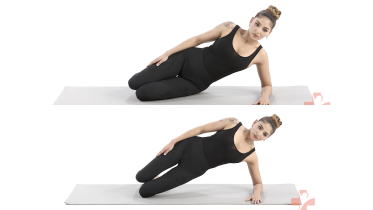
- Lie on one side on a mat with both legs straight. Prop yourself up on your bottom forearm, with the elbow directly under your shoulder.
- Lift your hips until your body forms a straight line from head to feet, then reach your top arm straight up to the ceiling.
- Bring the top arm down and rest that forearm on the mat as your chest turns to face the floor. You are now in a front plank on both forearms, elbows under your shoulders. Pivot on your feet as you turn.
- Lift the other forearm, turn your chest the other way and reach that arm up to the ceiling, so you are in a side plank on the opposite forearm.
- Pause there, then roll back through the front plank to the first side. Your hips stay lifted and your body stays in one line through every turn.
- Lower your hips to the mat to rest as soon as your form starts to slip.
What you should feel
Work along the side of your waist on the supporting side and across your stomach, with both shoulders and arms working as your weight passes from one arm to the other.
Common mistakes
- Letting the hips sag or pike up while you pass through the front plank.
- Turning the shoulders first and the hips later, so the body twists instead of rolling as one piece.
- Putting the supporting elbow out in front of the shoulder instead of under it.
- Rushing the turns. Each position should feel steady before you move on.
How often
Many programs start with 2 or 3 sets of 4 to 6 rolls to each side, pausing for a breath or two in each side plank, a few days a week. Your physio will adjust this.
Stop and check with your physio if
- Chest pain or pressure, dizziness or feeling faint, a racing or irregular heartbeat, or being far more out of breath than the effort should cause.
- Pain in a shoulder, elbow or wrist, or a feeling that a shoulder could slip out.
- Lower back pain that is sharp or grows with each roll.
- The shoulder feels as if it has slipped out of place, looks a different shape or suddenly locks so you cannot move the arm, or your hand turns cold, pale or blue. Go to an emergency department straight away, without driving yourself, and do not try to put the shoulder back in yourself.
From the clinic
The voice guide describes the forearm version. The video uses the forearms for the front plank and for the side plank facing away, but shows the first side plank on a straight arm with the hand under the shoulder. The steps here keep both sides on the forearms, which is steadier and kinder to the wrists. Rolling on straight arms is a harder step your physio may add later.
Before adding the rolls, you should be able to hold a steady side plank on each side and a forearm plank. Staggering your feet, top foot in front, gives you a wider base in each side plank.
Each roll shifts much of your weight onto one arm, so the shoulders work hard. A folded towel under your elbows helps if they feel sore on the mat. After shoulder or wrist surgery, a shoulder dislocation or a broken arm, or with ongoing shoulder or wrist pain, get your physio's go-ahead before you load one arm like this.
Each side plank also works the muscles at the side of the bottom hip hard, much like a side leg lift. If you have had a hip replacement or other hip surgery, get the go-ahead from your surgeon or physio before you try the rolling side plank. Some operations limit this kind of work for the first months, so the timing depends on your surgery.
Like every plank, this one asks a lot of your stomach wall. If you are pregnant, have recently given birth, have had abdominal surgery or have a hernia, ask your physio or doctor before you plank. If you have high blood pressure, breathe steadily through every hold and never hold your breath. With a heart condition or high blood pressure, check with your doctor before you start.
If chest pain, pressure or tightness does not ease quickly when you rest, spreads to your arm, neck, jaw, stomach or back, or comes with sweating, feeling sick, feeling light-headed or being short of breath, call emergency services straight away, as this can be a heart attack. If it eases quickly and none of these happen, get medical advice the same day, and do not exercise again until you have been checked. If you faint while exercising, call emergency services, even if you feel fine again quickly.
Written and checked by the PocketPhysio editorial team. Last updated 2026-09-28.
This page is general education, not a diagnosis or a personal treatment plan. If you have pain, an injury or a health condition, see a physiotherapist or doctor before starting new exercises.
.png)