
Hip impingement (FAI) exercises and physiotherapy
What is hip impingement?
The hip is a ball and socket joint. In hip impingement, the shape of the ball, the socket or both means they meet earlier than they should when the hip bends and turns. A bump on the edge of the ball is called cam morphology, and a socket rim that covers too much of the ball is called pincer morphology. OrthoInfo explains that these shapes form while the bones are still growing. A cam bump is more common in young people who played a lot of high-impact sport such as soccer at that age (Agricola and colleagues, 2012), but exercise as an adult does not create the bone shape.
The international Warwick Agreement of 2016 introduced the name femoroacetabular impingement syndrome (FAI syndrome) to put the person's symptoms at the center (Griffin and colleagues, 2016). It describes a hip problem linked to movement, and the diagnosis needs three things together: typical symptoms, positive findings when a clinician examines the hip, and imaging that shows the bone shape. A scan showing the shape on its own is not enough. The main symptom is pain in the hip or groin that comes with certain movements or positions, and people may also describe clicking, catching, locking, stiffness or the hip giving way.
The pain is usually in the groin, sometimes toward the outside of the hip, and turning, twisting or squatting can bring on a sharp, stabbing pain (OrthoInfo). Most people in the trials on this page were young to middle-aged, active adults.
This page is for adults with hip impingement that is being managed without surgery, or while they decide about surgery. A child or teenager with hip, thigh or knee pain or a limp needs to see a doctor first, as the warning signs below explain. After hip surgery, follow the rehab program from your surgeon and physio instead.
Hip impingement, hip osteoarthritis or outer hip pain?
These three overlap, and a physio or doctor can help sort out which one fits you. Hip impingement usually affects younger adults who are active, and the groin pain comes on with deep bending and twisting. Hip osteoarthritis is wear of the joint cartilage, is more common from middle age on, and brings stiffness that is often worse in the morning; if you have been told you have it, that program is the one to follow. Pain on the outside of the hip that is sore to lie on is more often greater trochanteric pain syndrome, which has its own program and positions to avoid.
Labral tears
The labrum is a rim of cartilage around the edge of the socket. OrthoInfo explains that the rubbing in hip impingement can tear the labrum and, over time, wear the joint cartilage, which is osteoarthritis. A labral tear can cause the catching and clicking described above. This page touches on labral tears only where they overlap with impingement, and the exercise approach here is the one used in the impingement trials.
Physio-led care or surgery for hip impingement?
The Warwick Agreement accepts conservative care and rehab as suitable treatments, and surgery too, whether keyhole (arthroscopic) or open. The Zurich 2018 consensus from the International Hip-related Pain Research Network recommends exercise-based treatment for hip-related pain, for at least 3 months, alongside physical activity and education, with decisions made together (Kemp and colleagues, 2020). Several trials have compared keyhole surgery, which reshapes the bone and treats the labrum, with a structured physio program.
The largest is UK FASHIoN, with 348 people from 23 UK hospitals (Griffin and colleagues, 2018). The physio group had 6 to 10 sessions over 12 to 24 weeks. These covered education and pain relief, plus an exercise program tailored to each person and progressed over time. Both groups improved. At 12 months, the surgery group scored 6.8 points higher on a 100-point hip quality of life scale, just above the 6.1 points the authors set as the smallest change that matters, and there were 6 serious adverse events in the surgery group, 5 of them linked to the treatment, against 1 in the physio group that was not linked to the treatment.
In the UK FAIT trial of 222 people aged 18 to 60, hip function in daily activities was 10 points higher with surgery than with physio and activity changes at 8 months (Palmer and colleagues, 2019). At about 3 years the surgery group still scored higher on function, and the joint space on X-ray did not differ between groups (Palmer and colleagues, 2025). A US military trial of 80 people found that both groups improved, with no significant difference at 2 years, although many people in the physio group went on to have surgery (Mansell and colleagues, 2018). In the Australian FASHIoN trial of 99 people, cartilage health on MRI did not differ at 12 months, though the surgery group reported more improvement in symptoms (Hunter and colleagues, 2021).
A 2025 review pooled 6 randomized trials that compared keyhole surgery with physio or with washing out the joint (Lamo-Espinosa and colleagues, 2025). It found no difference between surgery and non-surgical care at 6 months, and a statistical advantage for surgery at 12 months that the authors did not judge to be a clear clinical advantage. Put simply, surgery gives a modestly better average result in some trials, physio-led care helps many people, and the choice is a personal one to make with your surgeon. The evidence beyond a few years is still thin.
Positions to ease off for now
Impingement pain tends to come from the hip bending deeply, the knee moving across the body and the thigh turning inward, especially together. The physio program in UK FASHIoN included advice on cutting down on these positions in daily life (Wall and colleagues, 2016).
- Sitting: choose a higher, firm chair so your hips are level with or a little above your knees, and avoid low, soft sofas. Get up and move every so often on long drives or at a desk.
- Getting out of a car: swing both legs out together rather than twisting on the sore hip.
- Picking things up: rather than squatting or folding deeply at the hips, go down on one knee with the sore side's knee on the floor, or use a long-handled grabber.
- Crossing your legs: try not to cross one knee over the other for now.
- Sport and the gym: cut back on deep squats, sprints, kicking or sharp cutting turns while the hip settles, and keep the rest of your training going.
These tips come from common practice rather than from trials. They are for now, not forever. As the hip settles and gets stronger, many people can go back to more of their usual range and activity, guided by how the hip feels the next day.
How to use this program
Start with the stage that fits how your hip is now. Unsure? Begin at stage 1. Move on once the current stage feels easy and the hip is no worse the next morning, a rough rule from common practice rather than a fixed one.
You will find a typical starting dose on each exercise page. As a rough guide, most use 1 to 3 sets of 5 to 15 repetitions, holds of 5 to 10 seconds for the gentle muscle holds, and plank holds of 10 to 30 seconds. In PhysioFIRST, people exercised about 3 times a week for 6 months, with one of those sessions supervised each week for the first 3 months (Kemp and colleagues, 2026). Your physio will adjust this, including how far into the range you go.
A tired ache in the muscles of the hip and buttock while you exercise is normal. A sharp pinch at the front of the hip or in the groin usually means you have gone into the impingement position, so make the movement smaller rather than pushing through it. Mild discomfort is fine if it settles soon after and your hip is no worse the next morning. If the groin is clearly sorer the next day, drop back a step rather than stopping altogether.
Keep breathing through every hold and repetition, and do not hold your breath, especially if you have high blood pressure. Walking, cycling with the seat set high enough that your hip does not bend deeply, and swimming are useful for general fitness alongside the program.
The exercise program
Stage 1: Settle the hip and start the muscles working
For a sore hip or a flare, when sitting, bending or twisting brings on groin pain. These are done lying down with the hip bent no further than a right angle, so it stays out of the deep bend that pinches. In the bridge and the clamshell, move only as far as you can without a pinch at the front of the hip. The deep tummy hold teaches you to brace your trunk gently before you add load. Keep walking at a pace and distance that does not build the pain.
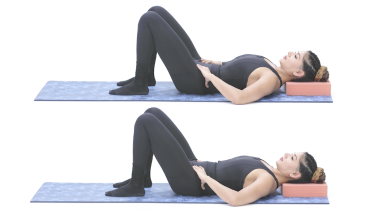 Transverse abdominis activation
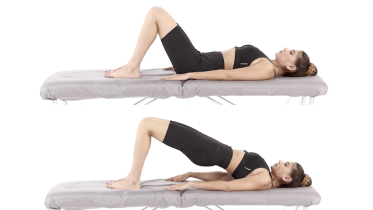 Glute bridge
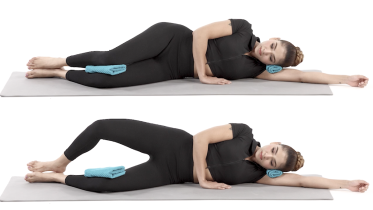 Clamshell
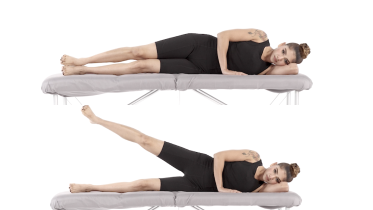 Side lying hip abduction
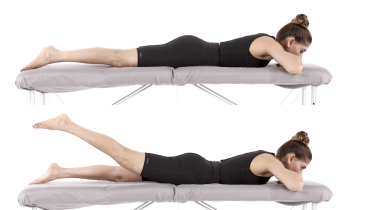 Prone hip extension
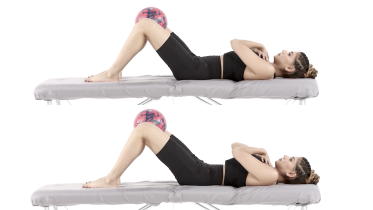 Adductor ball squeeze
Stage 2: Trunk control and standing strength
When stage 1 feels easy and your hip is no worse the next morning, which for many people takes a few weeks. The dead bug and bird dog bring the hips to about a right angle, so keep the movement small if the front of the hip pinches, and in the bird dog do not sit back toward your heels. For sit to stand, use a higher chair so you do not start from a deep bend, and in the mini squat stay in the range that is free of the pinch. The kneeling side plank and the band work build the muscles at the side of the hip and trunk; hold a counter for the standing ones if your balance is not steady.
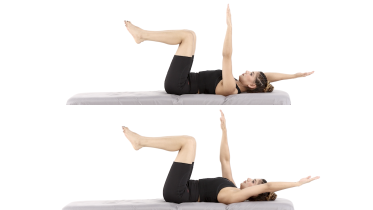 Dead bug
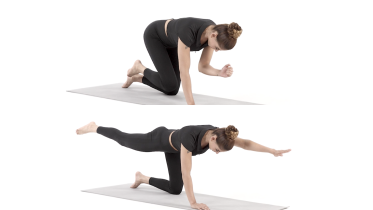 Bird dog
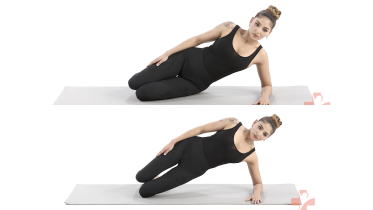 Kneeling side plank
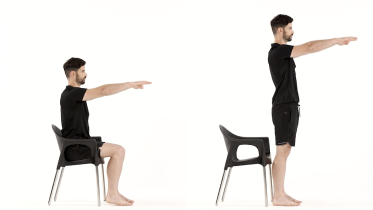 Sit to stand
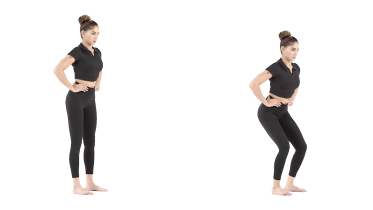 Mini squat
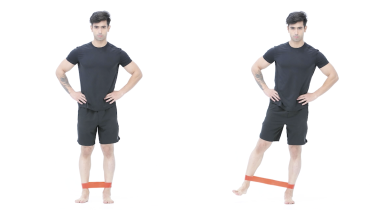 Standing hip abduction with band
Stage 3: One leg at a time and back to sport
When stage 2 is comfortable and the hip settles well after each session. These load one leg at a time and build the strength that stairs, running and sport need. Squat only to a depth that stays free of the groin pinch, and let it get deeper over weeks as your hip allows. The single leg deadlift bends the hip as you tip forward, so start with a small tip and keep a hand on a counter. Running, twisting and jumping sports usually come back gradually after this stage, with a plan from your physio.
.png) Side plank
Side plank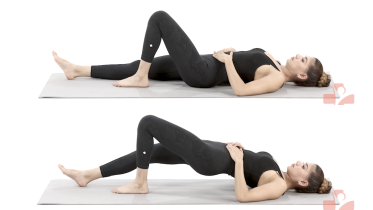 Single leg bridge
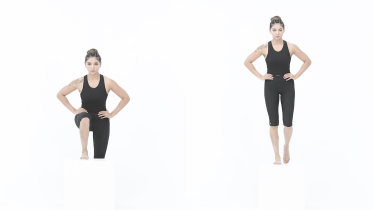 Step up
.png) Single leg deadlift
Single leg deadlift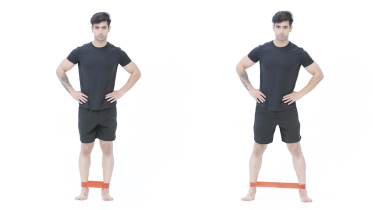 Lateral band walk
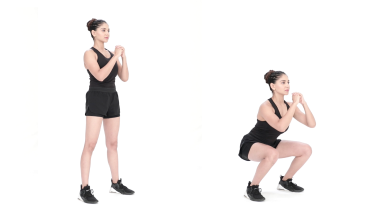 Squat
SquatAfter hip arthroscopy
If you have had keyhole surgery on your hip, follow your surgeon's program. The Zurich consensus recommends physio-led rehab after hip surgery (Kemp and colleagues, 2020). In the small Australian FAIR trial of 30 people, those who had a physio program after surgery improved more by 14 weeks than those who did their own rehab without formal physio, but the difference had gone by 24 weeks (Bennell and colleagues, 2017). The exercises on this page may become part of your rehab later, once your surgical team says so.
When to see a physio or doctor
Book a routine appointment with a GP or physio if hip pain is stopping you sleeping or doing normal activities, if it is getting worse or keeps coming back, or if it has not improved after 2 weeks of looking after it at home (NHS). Groin pain in a young, active adult has several possible causes, and an assessment helps confirm whether it is impingement. If you have done a program like this regularly for 3 months and are not improving enough, ask about the next options, which can include a referral to a hip specialist.
Certain symptoms need quicker help. The warning signs further down say how soon, from an emergency visit to an appointment within 2 weeks.
For physiotherapists
This page gives patients a starting framework for FAI syndrome as defined by the Warwick Agreement (Griffin and colleagues, 2016). The staging follows Personalised Hip Therapy from UK FASHIoN (Wall and colleagues, 2016): it starts with assessment and education, including advice on reducing deep flexion, adduction and internal rotation. Pain relief sits alongside that. The exercise program is individualized, supervised and progressed over time, aimed at pelvic and hip control and at strength in gluteus maximus, gluteus medius, the short external rotators and the abdominals. Stretching in that protocol targeted external rotation and abduction, with no vigorous, painful end-range stretching.
PhysioFIRST (Kemp and colleagues, 2026) compared targeted strengthening against a standardized stretching program with the same contact time. The strengthening arm combined hip and trunk exercise with functional and plyometric work and a return to activity plan. Education and manual therapy were part of it too. There was no between-group difference in iHOT-33 at 6 months, but more of the strengthening group rated their pain as improved and hip strength gained more. Both groups improved by clinically meaningful amounts, which is worth sharing with patients weighing surgery.
The Zurich 2018 recommendations (Kemp and colleagues, 2020) call for at least 3 months of exercise-based treatment, monitoring with patient-reported outcomes and physical measures, and shared decision making. Screen for femoral neck stress fracture in runners and military recruits with exertional groin pain, pain at the extremes of hip movement and a limp (Clough, 2002), for lumbar referral when pain spreads below the knee, and for osteonecrosis in patients on long-term corticosteroids or with heavy alcohol intake (AAOS).
See a doctor promptly if
- Emergency: you have had a fall or an injury and now have severe hip pain, or you cannot walk or put weight on the leg. Call emergency services or go to an emergency department. This can be a sign of a broken hip (hip fracture).
- Emergency: tingling or loss of feeling in the hip or leg after a fall or injury. Call emergency services or go to an emergency department.
- Emergency: pain, tingling, numbness or weakness in both legs, numbness or altered feeling around your genitals or bottom, or new trouble peeing or controlling your bladder or bowels. The same applies if you lose feeling in one leg. Call emergency services or go to an emergency department straight away. These can be signs of pressure on the nerves at the base of the spine (cauda equina syndrome).
- Same day: the hip is hot and swollen, the skin around it has changed color, or you have hip pain with a high temperature or feel hot, cold or shivery. Get medical help the same day, and go to an emergency department if you feel very unwell. A joint infection needs treatment quickly.
- Same day: severe hip pain that came on suddenly without a fall, or pain that is getting worse quickly over a few days. Get medical advice the same day.
- Same day: groin pain that built up with running, marching or jumping, often after you increased your training, and now hurts when you walk, makes you limp, or aches at rest or at night. Stop running and jumping and keep walking to a minimum until it has been checked. Get medical advice the same day and mention your training. If you cannot put weight on the leg, go to an emergency department. This can be a stress fracture in the neck of the thighbone (femoral neck stress fracture), which is easy to miss at first and can become a full break if you keep loading it.
- Same day: new hip or groin pain after a fall, even a small one, if you are older, have low bone density (osteoporosis) or have taken steroid tablets for a long time, even if you can still walk. Get medical advice the same day. A broken hip is not always obvious at first.
- Same day: a child or teenager has sudden pain in the hip, thigh or knee, is limping, or cannot put weight on one leg. Get an urgent appointment with a doctor the same day. If they have a high temperature or seem very unwell, go to an emergency department. This page is for adults, and hip pain in children has different causes.
- Same day: a leg or foot that is getting weaker, for example your foot drags, catches on the ground or slaps down when you walk (foot drop). Get medical advice the same day. If the weakness is getting worse by the hour, go to an emergency department.
- Within a few days: hip or groin pain that is worse at night or does not ease with rest, and keeps getting worse. See your doctor within a few days. If you have had cancer, now or in the past, or are losing weight without trying, see your doctor sooner, within a day or two, and mention it. This applies even if the pain is not getting worse. If you are being treated for cancer now, contact your cancer team the same day.
- Within a few days: new groin or hip pain and you take steroid tablets long term, or have in the past, or you regularly drink a lot of alcohol. This can be a sign of a problem with the blood supply to the top of the thighbone (avascular necrosis). Book an appointment with your doctor within a few days and mention the steroids or alcohol.
- Within 2 weeks: pain that spreads down the leg below the knee, especially with numbness or tingling in the leg or foot. The pain may be coming from your lower back rather than the hip. Book an appointment with a doctor or physio.
Common questions
Can hip impingement get better without surgery?
Often, yes. In the PhysioFIRST trial of 154 adults aged 18 to 50 with FAI syndrome, hip-related quality of life improved by a clinically meaningful amount over 6 months with physio-led treatment, whether people did a strengthening or a stretching program (Kemp and colleagues, 2026). Exercise does not change the shape of the bone; only surgery does that. The aim is less pain and a hip that copes better with what you want to do. If a well-run program of at least 3 months has not helped enough, talk the options through with a doctor or surgeon.
What movements should I avoid with hip impingement?
The positions that tend to pinch are deep hip bending, the knee pulled across the body and the thigh turned inward, especially all three together. The physio program in the UK FASHIoN trial included advice on cutting down on these in daily life (Wall and colleagues, 2016). In practice that often means avoiding low soft chairs, deep squats, pulling a knee hard to your chest and crossing one knee over the other for now. You do not have to avoid them forever. Many people build back into more range as the hip settles.
Is stretching good for hip impingement?
Gentle stretching can be part of it, but strengthening seems to do more for pain. In PhysioFIRST, a stretching program and a strengthening program improved hip-related quality of life by similar amounts, while more people in the strengthening group felt their pain had improved, and their hip strength went up more (Kemp and colleagues, 2026). The FASHIoN physio program used stretches for turning the hip out and moving the leg out to the side, and it ruled out vigorous stretches that push hard into pain (Wall and colleagues, 2016). Do not force a stretch into the groin pinch.
Can I keep running or playing sport with hip impingement?
Usually, with some changes. The Zurich consensus on hip-related pain recommends physical activity, which may include sport, alongside exercise-based treatment (Kemp and colleagues, 2020). Cut back on whatever brings on the pinch, such as deep squatting, sprinting, kicking or sharp turns, and keep the rest going. Build it back up in steps as the stage 3 exercises get easier. Your physio will help you plan the return.
Does hip impingement lead to arthritis?
It can. OrthoInfo explains that the rubbing can damage the joint, leading to tears of the rim of cartilage around the socket (the labrum) and to wear of the joint cartilage (osteoarthritis). Whether surgery lowers that risk is not yet known. In the FAIT trial, after about 3 years the joint space on X-ray was similar with surgery and with physio, although MRI cartilage scores were better in the surgery group (Palmer and colleagues, 2025). If you already have hip osteoarthritis, the hip osteoarthritis program is the better fit.
References
- Griffin DR, Dickenson EJ, O'Donnell J, et al. The Warwick Agreement on femoroacetabular impingement syndrome (FAI syndrome): an international consensus statement. British Journal of Sports Medicine. 2016;50(19):1169-1176. doi:10.1136/bjsports-2016-096743
- Kemp JL, Risberg MA, Mosler A, et al. Physiotherapist-led treatment for young to middle-aged active adults with hip-related pain: consensus recommendations from the International Hip-related Pain Research Network, Zurich 2018. British Journal of Sports Medicine. 2020;54:504-511. doi:10.1136/bjsports-2019-101458
- Griffin DR, Dickenson EJ, Wall PDH, et al. Hip arthroscopy versus best conservative care for the treatment of femoroacetabular impingement syndrome (UK FASHIoN): a multicentre randomised controlled trial. The Lancet. 2018;391(10136):2225-2235. doi:10.1016/S0140-6736(18)31202-9
- Wall PD, Dickenson EJ, Robinson D, et al. Personalised Hip Therapy: development of a non-operative protocol to treat femoroacetabular impingement syndrome in the FASHIoN randomised controlled trial. British Journal of Sports Medicine. 2016;50(19):1217-1223. doi:10.1136/bjsports-2016-096368
- Palmer AJR, Ayyar Gupta V, Fernquest S, et al. Arthroscopic hip surgery compared with physiotherapy and activity modification for the treatment of symptomatic femoroacetabular impingement: multicentre randomised controlled trial. BMJ. 2019;364:l185. doi:10.1136/bmj.l185
- Palmer A, Fernquest S, Rombach I, et al. Medium-term results of arthroscopic hip surgery compared with physiotherapy and activity modification for the treatment of femoroacetabular impingement syndrome: a multi-centre randomised controlled trial. British Journal of Sports Medicine. 2025;59(2):109-117. doi:10.1136/bjsports-2023-107712
- Mansell NS, Rhon DI, Meyer J, Slevin JM, Marchant BG. Arthroscopic surgery or physical therapy for patients with femoroacetabular impingement syndrome: a randomized controlled trial with 2-year follow-up. American Journal of Sports Medicine. 2018;46(6):1306-1314. doi:10.1177/0363546517751912
- Hunter DJ, Eyles J, Murphy NJ, et al. Multi-centre randomised controlled trial comparing arthroscopic hip surgery to physiotherapist-led care for femoroacetabular impingement (FAI) syndrome on hip cartilage metabolism: the Australian FASHIoN trial. BMC Musculoskeletal Disorders. 2021;22(1):697. doi:10.1186/s12891-021-04576-z
- Lamo-Espinosa JM, Mariscal G, Gómez-Álvarez J, San-Julián M. Efficacy and safety of arthroscopy in femoroacetabular impingement syndrome: a systematic review and meta-analysis of randomized clinical trials. Scientific Reports. 2025;15(1):7775. doi:10.1038/s41598-025-91788-1
- Kemp JL, Scholes MJ, Smith AJ, et al. Physiotherapist-led treatment for femoroacetabular impingement syndrome (the PhysioFIRST study): an assessor-blinded, limited disclosure randomised controlled trial. British Journal of Sports Medicine. 2026;60(13):951-961. doi:10.1136/bjsports-2025-110986
- Bennell KL, Spiers L, Takla A, et al. Efficacy of adding a physiotherapy rehabilitation programme to arthroscopic management of femoroacetabular impingement syndrome: a randomised controlled trial (FAIR). BMJ Open. 2017;7(6):e014658. doi:10.1136/bmjopen-2016-014658
- Agricola R, Bessems JH, Ginai AZ, et al. The development of Cam-type deformity in adolescent and young male soccer players. American Journal of Sports Medicine. 2012;40(5):1099-1106. doi:10.1177/0363546512438381
- Clough TM. Femoral neck stress fracture: the importance of clinical suspicion and early review. British Journal of Sports Medicine. 2002;36(4):308-309. doi:10.1136/bjsm.36.4.308
- American Academy of Orthopaedic Surgeons. Femoroacetabular impingement. OrthoInfo. https://www.orthoinfo.org/en/diseases--conditions/femoroacetabular-impingement/
- American Academy of Orthopaedic Surgeons. Osteonecrosis of the hip. OrthoInfo. https://www.orthoinfo.org/en/diseases--conditions/osteonecrosis-of-the-hip/
- NHS. Hip pain in adults. Page last reviewed 20 November 2025. https://www.nhs.uk/symptoms/hip-pain/
- NHS. Hip pain in children (irritable hip). Page last reviewed 3 April 2024. https://www.nhs.uk/symptoms/hip-pain-children-irritable-hip/
Written and checked by the PocketPhysio editorial team. Last updated 2026-09-28.
This page is general education, not a diagnosis or a personal treatment plan. See a physiotherapist or doctor for advice about your own situation.