
Inner knee pain: likely causes, exercises and warning signs
What sits on the inside of the knee
A lot is packed into a small area. The joint line runs across the inner side, with a C-shaped pad of cartilage (the medial meniscus) tucked between the thigh bone and the shin bone. A strong band, the medial collateral ligament, crosses that line and stops the knee buckling inward. Lower down, on the top of the shin, three thigh tendons join and attach together over a small fluid-filled sac. A family medicine review of knee pain lists meniscal tears, collateral ligament sprains, medial plica syndrome, pes anserine bursitis and osteoarthritis as the usual reasons this part of the knee hurts (Bunt and colleagues, 2018).
Two questions sort most of it out. How high is the sore spot, and did the pain arrive in one moment or build over weeks? Nothing below is a diagnosis. It is here so you can describe your knee more precisely to whoever examines it.
What causes inner knee pain?
A tender patch a few centimeters below the joint
Press along the inner side of your knee and then keep going down onto the shin. If the worst point is on the shin, about 5 cm (2 inches) below where the bones meet, that is where the three tendons attach and where pes anserine bursitis is felt (Helfenstein and Kuromoto, 2010). Stairs and rising out of a chair are the classic complaints, and some people ache at night. Women get it more often than men, diabetes raises the risk, and carrying extra weight or having an arthritic knee may do the same. The same review admits that scans have not settled whether the pain comes from the sac, the tendons or both.
Pain on the joint line itself, with catching or a slow swelling
Pain right on the line where the two bones meet points inside the joint. A torn medial meniscus is one of the ways that happens, and the NHS symptom list runs to tenderness, stiffness, swelling, trouble moving the knee and a crunching or clicking feeling. A twist during sport is the usual story, though the NHS notes that twisting while standing up can be enough. Tears in middle age are more often the result of gradual wear, and in a trial of 140 such patients the group given supervised exercise ended up with knee function no different from the group sent for keyhole surgery (Kise and colleagues, 2016). The meniscus tear program covers who should be assessed early instead.
Pain that arrived with a blow or a sideways force
A force from the outside that pushes the knee inward sprains the ligament on the inner side. OrthoInfo describes pain over the inner knee, swelling over the injured spot, tenderness and a knee that can feel stiff or unstable, sometimes with a pop at the moment of injury. Most of these heal without an operation, including many complete tears when nothing else is torn (Encinas-Ullán and Rodríguez-Merchán, 2018). A hinged brace and a staged return are the usual plan, so follow the MCL sprain program rather than the general list on this page.
If the whole knee swelled up within a few hours of the injury, or you felt a pop or snap, go to an emergency department straight away, and do not drive yourself. Fast swelling suggests bleeding inside the joint, which can come from a torn ACL.
A stiff, gritty knee from the mid-forties on
Wear tends to land on the inner half of the knee rather than the outer half. A US study x-rayed 5,202 knees in people aged 50 to 79 with knee osteoarthritis or a high risk of it, and found narrowing in the inner half of 29.5 percent of them against 8.2 percent in the outer half (Wise and colleagues, 2012). OrthoInfo describes pain that usually builds gradually, a joint that becomes stiff and swollen, symptoms at their worst first thing or after you have been sitting, and flares after heavy activity. From 45 up, NICE NG226 accepts the diagnosis on the story alone, so a scan is often unnecessary. The knee osteoarthritis program starts gently and adds load in stages.
Clicking and catching with no swelling
Folds of joint lining, called plicae, are left over from the way the knee forms before birth. Most people have at least one and never know it. Now and then the fold on the inner side becomes irritated and starts to snap over the end of the thigh bone. The review of anterior knee pain describes pain at the plica itself with snapping, clicking, catching or popping as the knee bends and straightens, brought on by repeated bending or by holding the knee bent for a long time (Kuwabara and Fredericson, 2021). Its authors suggest conservative treatment, including physical therapy, for at least three months before considering anything else.
This one is easy to over-diagnose, since plicae are so common and usually silent, so treat it as a possibility to raise rather than a conclusion. Scans can show a plica but do not reliably show whether it is the source of the pain, so the call is made on examination (Kuwabara and Fredericson, 2021).
Pain that is really coming from the hip or the back
The hip is the classic imposter. OrthoInfo puts the groin first as the place a worn hip is felt, then adds that the pain spreads to the thigh, the buttock or the knee. When 60 people waiting for a hip replacement marked their pain on body maps, 47 percent of them had pain below the knee, running along the saphenous nerve, which travels down the inner side of the leg (Khan and colleagues, 2004). Groin or buttock pain, a stiff hip, or trouble reaching your foot to put a sock on all make this worth raising. The hip osteoarthritis program is the one to use if the hip turns out to be the source.
The lower back is the other candidate. Where the pain lands depends on which nerve in the back is irritated, so it does not always follow the familiar route down the back of the calf. Sciatica is the common version, and the NHS adds pins and needles, numbness or weakness, often worse when you move, sneeze or cough. Back pain that started around the same time, or tingling anywhere below the knee, moves this up the list, and the sciatica program sets out the treatment. An image of the knee will not settle either of these, which is one more reason the examination counts for more than the scan.
Does it matter that there is no swelling?
Less than people expect. A knee can be genuinely sore on the inside and look no different from the other one. Two of the causes above, the tender patch on the shin and the irritated fold of lining, sit outside the joint, so there is nothing for the joint to swell about. Even a torn meniscus may show no more than a little stiffness in the first days.
What swelling does tell you is when to stop guessing. A knee that fills up within a few hours of an injury needs an emergency department straight away. A knee that puffs up for no reason, or one that turns hot and red, needs medical advice the same day, whichever side of the knee hurts.
What helps at home
For the first days, the NHS advice for knee pain is an ice pack wrapped in a towel on the sore area for up to 20 minutes, repeated every 2 to 3 hours, with paracetamol (acetaminophen) or ibuprofen as tablets or a gel if they suit you. Ask a pharmacist if you are unsure, particularly if you have stomach, kidney or heart problems or take other medicines. For a sore bursa, the NHS also suggests keeping pressure off the area while it settles.
Change the things that clearly flare it, without shutting the knee down. A higher seat takes some of the bend out of standing up. On stairs, one step at a time with a hand on the rail is easier on the inner knee than the usual rhythm. For night pain, the review of pes anserine pain suggests a pillow between the legs so the knees are not resting against each other (Helfenstein and Kuromoto, 2010). Keep walking, but on shorter and flatter routes for a few weeks.
Body weight is worth a mention if arthritis is part of the picture. OrthoInfo describes losing weight as a way to reduce the stress going through the knee joint, with less pain and better function as the result. For people with osteoarthritis who are living with overweight or obesity, NICE says any amount of weight loss is likely to help, and that losing 10 percent of body weight is likely to beat losing 5 percent. Neither replaces the exercises.
Exercise for inner knee pain
Exercise is the first treatment for most of what is on this list, although the evidence is stronger for some causes than others. For knee osteoarthritis, a Cochrane review judged that exercise probably reduces pain and improves function in the short term, with small average benefits whose importance is unclear (Lawford and colleagues, 2024). For pes anserine pain, the review recommends strengthening the inner thigh and the front of the thigh, with the front of the thigh worked especially through the final part of straightening the knee, but exercise programs for that problem on its own have not been properly tested (Helfenstein and Kuromoto, 2010).
The list below follows that outline. It opens with the front of the thigh working while the knee barely moves. Body weight comes later, and the hip work at the end helps keep the knee tracking in line as you walk and climb.
A bit of discomfort during a session is usually fine as long as it dies down afterward. A knee that is sorer, stiffer or puffier the next morning had more than it could take, so drop back a step rather than stopping altogether. That judgment has a name, the pain monitoring model, and the guide walks through it.
Exercises that can help
Work down the list as the knee allows. Start with whichever one you can do without the inner knee complaining. Quad sets are often 10 holds of 5 to 10 seconds several times a day, short arc quads 2 to 3 sets of 10 to 15 with a 3 to 5 second hold, and straight leg raises 2 to 3 sets of 10 on each leg. Glute bridges usually begin at 2 to 3 sets of 10 to 12, sit to stand at 2 to 3 sets of 5 to 10, and standing hip abduction at 2 to 3 sets of 10 to 15 on each leg. Your physio will adjust this.
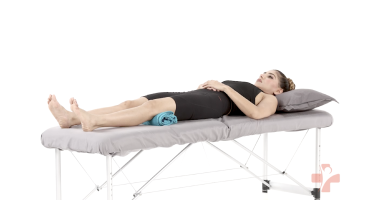 Quad sets (towel under knee)
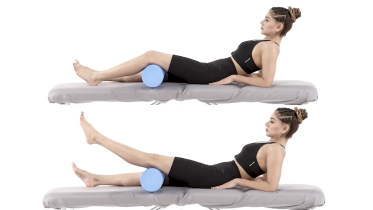 Short arc quads
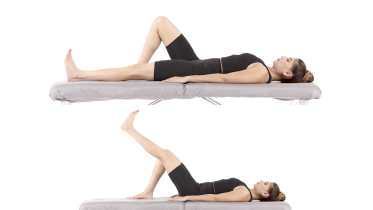 Straight leg raise
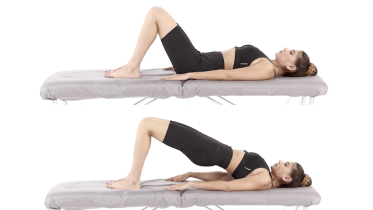 Glute bridge
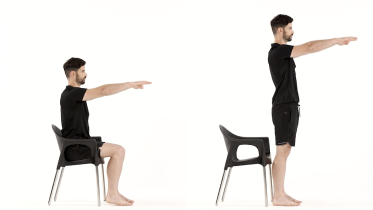 Sit to stand
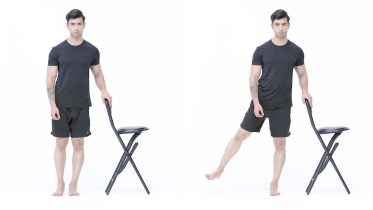 Standing hip abduction
If your pain started or worsens with running, the page on knee pain after running sets out how to manage training while the knee settles. If the pain is mostly about a movement rather than a spot, see knee pain when bending or knee pain on stairs.
When to see a physio (physical therapist)
Make an appointment if the inner knee has not improved after a few weeks (NHS), if it is breaking your sleep, or if it has changed the way you walk. Say so as well if morning stiffness lasts well beyond half an hour, because that sits outside the osteoarthritis pattern NICE describes and is worth a doctor looking at. A physio will press along the joint line and down onto the shin, test the ligament, ask how it began and watch you stand up and climb a step. Expect your hip to be moved and your back checked too, since both can send pain to this part of the knee. That examination usually names the pattern, and treatment can start without waiting for a scan.
Get seen sooner if the pain began with an injury, since the ligament and the meniscus are both managed differently from an overuse problem. If you are still growing, get the knee examined before you start any program. After knee surgery, the plan from your surgeon and physio comes before anything here. Each warning sign below tells you how quickly to act.
Related exercise programs
See a doctor promptly if
- Emergency: you felt a sudden pop or tearing feeling just above or below your kneecap, you can see or feel a dip there, the kneecap seems to have moved up toward the thigh or to sag lower than usual, or you suddenly cannot straighten your knee or lift your leg out straight. Stop exercising and go to an emergency department straight away, even if you can still walk, as this can be a torn tendon at the front of the knee, either below the kneecap (patellar tendon) or above it (quadriceps tendon). Do not drive yourself. A repair usually does better if it is done soon after the injury.
- Same day: the pain started with a fall, a twist or a blow to the knee, or you cannot put weight on the leg. Get medical advice the same day. If the knee has changed shape, swelled up very quickly or you felt a pop or snap, or your foot turns cold, pale or blue or you have tingling or no feeling in the leg or foot, go to an emergency department straight away, and do not drive yourself.
- Same day: the kneecap has slipped out of place, even if it went back by itself. If it is still out of place, go to an emergency department straight away, and do not drive yourself. If it went back by itself, get medical advice the same day.
- Same day: the knee is locked, which means it is stuck bent and you cannot fully straighten it, even after gently trying to move it, or you cannot bend or straighten the leg at all. Get assessed the same day by a doctor, at urgent care or at an emergency department. A torn piece of meniscus can get caught in the joint and block it, and when a tear like this can be repaired, it should be done as early as possible. A knee that catches for a moment and then frees itself can happen with a meniscus tear. That is not the same as a locked knee, but tell your physio or doctor about it.
- Same day: the knee keeps giving way under you, or it gave way after a recent injury, or it gives way and is also very painful or swollen. Get medical advice the same day. If it only happens now and then, with no recent injury and no swelling, it is not an emergency, but book an assessment with a physio or doctor in the next few days.
- Same day: the knee clicks painfully when you bend or straighten it. Get medical advice the same day. Painless clicking on its own is common.
- Same day: the knee swells up with no clear reason, especially if you take medicine to thin your blood. Get medical advice the same day.
- Same day: the knee is hot, red and swollen, or you have knee pain with a high temperature or feel hot, cold or shivery. Get medical advice the same day, and go to an emergency department if you feel very unwell. This can be a sign of infection in the joint, which needs treatment quickly.
- Same day: the tender spot below the inner side of your knee becomes hot, red and swollen, especially if the skin over it was recently cut or grazed, or you have diabetes. Get medical advice the same day, and go to an emergency department if you feel very unwell. A bursa can become infected, and then it needs antibiotics.
- Same day: a calf or thigh that is newly swollen, warm, tender, red or darker than usual, has swollen veins that are sore to touch, or has a throbbing or cramping pain that does not fit your injury or condition, or that feels different from normal muscle soreness after exercise. This can be a sign of a blood clot (deep vein thrombosis), especially after surgery, an injury, time in a cast or boot, a long trip or a spell of being much less mobile than usual. Get medical advice the same day. If you are also short of breath or have chest pain, call emergency services.
- Same day: you are a teenager who is still growing and you have a limp, or pain in the hip, groin or thigh as well as the knee. Get an urgent appointment with a doctor the same day, and stay off sport and these exercises until you have been checked. If you cannot put weight on the leg, have a high temperature or feel very unwell, go to an emergency department. Some hip problems in growing teenagers, such as a slipped growth plate at the top of the thigh bone (slipped capital femoral epiphysis), are felt in the knee and need checking quickly.
- Within a day or two: you are still growing and have pain that wakes you at night, pain at rest that keeps getting worse, or a lump or swelling around the knee or thigh that keeps growing. See a doctor within a day or two. Do the same if the pain comes with looking pale, unusual tiredness, fevers with no clear cause, bruising or bleeding easily, or weight loss. If you also have a rash that does not fade when you press it, call emergency services or go to an emergency department. Bone pain that is worse at night, or a new lump, needs checking to rule out rarer causes such as a bone tumor or a blood cancer (leukemia).
- Within a few days: a lump on the inner side of the knee or the top of the shin that no doctor has checked, or a lump that is getting bigger or feels hard. See your doctor within a few days. A swollen bursa can cause a soft lump here, but other problems, such as a fluid cyst or a growth on the bone, can sit in the same spot, so it is worth confirming what it is.
- Within a few days: pain at night or at rest that keeps getting worse. See your doctor within a few days. If you have had cancer, now or in the past, see your doctor sooner, within a day or two, and mention it, even if the pain is not getting worse. Do the same if you have knee pain and are losing weight without trying, even if it does not hurt at night. If you are being treated for cancer now, contact your cancer team the same day.
- Within 2 weeks: pain that spreads from your lower back, buttock or hip into the thigh or the knee, especially with numbness, tingling or pins and needles in the leg or foot. The pain may be coming from your back or your hip rather than the knee. Book an appointment with a doctor or physio. If your leg or foot is getting weaker, for example your foot drags, catches on the ground or slaps down when you walk (foot drop), get medical advice the same day, and if the weakness is getting worse by the hour, go to an emergency department.
Common questions
Why does the inside of my knee hurt when I bend or straighten it?
Most causes of inner knee pain dislike that movement, each for its own reason. With a torn meniscus the NHS lists difficulty moving the knee and a crunching or clicking feeling, because a damaged pad of cartilage sits between two surfaces that have to glide. An irritated fold of joint lining is described as painful with repeated bending and straightening, or after a long spell with the knee bent, and it often snaps or clicks as it goes (Kuwabara and Fredericson, 2021). An arthritic knee tends to feel gritty and stiff rather than sharp, and the stiffness is worst after sitting still (OrthoInfo). A knee that gets stuck and refuses to straighten at all is a locked knee, and that needs seeing the same day.
Why does the inside of my knee hurt when walking?
Walking loads the inner half of the joint more than the outer half, so a problem in that half tends to show up there first. Osteoarthritis is the common one, and OrthoInfo notes that pain and swelling may be worse in the morning or after sitting or resting. In clinic most people say it eases a little once they get going. Pes anserine pain behaves differently: the review of this problem singles out stairs and getting up out of a chair rather than flat walking, so if your worst moments are those two, the sore spot is likely on the shin rather than in the joint (Helfenstein and Kuromoto, 2010). Long or hilly walks will flare most of these causes, so shorten the route for a few weeks instead of giving walking up.
Why does the inside of my knee hurt at night or when sleeping?
Two patterns are worth telling apart. The common one is a sore inner knee that only bothers you in certain positions, usually when you lie on your side and the knees press together. A pillow between the thighs or knees is the standard suggestion for that, and it comes from the review of pes anserine pain (Helfenstein and Kuromoto, 2010). The pattern to act on is pain at night or at rest that keeps getting worse whatever you do with your legs. See your doctor about that within a few days, and sooner if you have had cancer or are losing weight without trying.
Is inner knee pain arthritis?
It can be, and the odds rise with age, but plenty of inner knee pain is not arthritis at all. Wear does settle in the inner half of the joint far more often than the outer half, which is why this side of the knee is where many people first notice it (Wise and colleagues, 2012). NICE says a doctor can diagnose osteoarthritis without an X-ray from the age of 45 if the pain comes on with activity and morning stiffness lasts no longer than half an hour. Below that age, or when the pain started with a twist or a blow, other causes move up the list, and only an examination will sort it out.
Why does the inside of my knee hurt with no swelling?
A knee that looks the same as the other one is normal for several of these problems. Pes anserine pain is a tender patch on the top of the shin rather than fluid in the joint, and the diagnosis is usually made by pressing on that spot (Helfenstein and Kuromoto, 2010). An irritated fold of joint lining is another dry, clicky kind of pain (Kuwabara and Fredericson, 2021). Arthritis may bring only mild puffiness, and a meniscus tear can swell slowly or barely at all. So a flat, normal looking knee rules nothing out, while a knee that swells with no clear reason is the opposite: a red flag that needs seeing the same day.
What exercises help inner knee pain?
Thigh and hip strengthening, built up slowly, is the common thread across these causes. The review of pes anserine pain advises stretching and strengthening the inner thigh and the front thigh muscles, with the front thigh worked especially in the last part of straightening the knee, which is what short arc quads and quad sets do (Helfenstein and Kuromoto, 2010). NICE recommends exercise for everyone with knee osteoarthritis, and a Cochrane review put it as probably reducing pain and improving day to day function in the short term, with an average gain that is small and of unclear importance (Lawford and colleagues, 2024). After an MCL sprain the order is different, because the ligament needs protecting first, so use the MCL program rather than this list. If you are unsure which pattern fits, a physio can test the knee and choose for you.
References
- Bunt CW, Jonas CE, Chang JG. Knee Pain in Adults and Adolescents: The Initial Evaluation. American Family Physician. 2018;98(9):576-585. https://www.aafp.org/pubs/afp/issues/2018/1101/p576.html
- Helfenstein M Jr, Kuromoto J. Anserine syndrome. Revista Brasileira de Reumatologia. 2010;50(3):313-327. https://doi.org/10.1590/S0482-50042010000300011
- Kuwabara A, Fredericson M. Narrative: Review of Anterior Knee Pain Differential Diagnosis (Other than Patellofemoral Pain). Current Reviews in Musculoskeletal Medicine. 2021;14(3):232-238. https://doi.org/10.1007/s12178-021-09704-9
- Wise BL, Niu J, Yang M, Lane NE, Harvey W, Felson DT, Hietpas J, Nevitt M, Sharma L, Torner J, Lewis CE, Zhang Y. Patterns of compartment involvement in tibiofemoral osteoarthritis in men and women and in whites and African Americans: the Multicenter Osteoarthritis Study. Arthritis Care and Research. 2012;64(6):847-852. https://doi.org/10.1002/acr.21606
- Encinas-Ullán CA, Rodríguez-Merchán EC. Isolated medial collateral ligament tears: an update on management. EFORT Open Reviews. 2018;3(7):398-407. https://doi.org/10.1302/2058-5241.3.170035
- Kise NJ, Risberg MA, Stensrud S, Ranstam J, Engebretsen L, Roos EM. Exercise therapy versus arthroscopic partial meniscectomy for degenerative meniscal tear in middle aged patients: randomised controlled trial with two year follow-up. BMJ. 2016;354:i3740. https://doi.org/10.1136/bmj.i3740
- Lawford BJ, Hall M, Hinman RS, et al. Exercise for osteoarthritis of the knee. Cochrane Database of Systematic Reviews. 2024;12(12):CD004376. https://doi.org/10.1002/14651858.CD004376.pub4
- National Institute for Health and Care Excellence. Osteoarthritis in over 16s: diagnosis and management (NG226). 2022. https://www.nice.org.uk/guidance/ng226
- American Academy of Orthopaedic Surgeons. Collateral Ligament Injuries. OrthoInfo. https://www.orthoinfo.org/en/diseases--conditions/collateral-ligament-injuries/
- American Academy of Orthopaedic Surgeons. Meniscus Tears. OrthoInfo. https://www.orthoinfo.org/en/diseases--conditions/meniscus-tears/
- American Academy of Orthopaedic Surgeons. Arthritis of the Knee. OrthoInfo. https://www.orthoinfo.org/en/diseases--conditions/arthritis-of-the-knee/
- American Academy of Orthopaedic Surgeons. Slipped Capital Femoral Epiphysis (SCFE). OrthoInfo. https://www.orthoinfo.org/en/diseases--conditions/slipped-capital-femoral-epiphysis-scfe
- Khan AM, McLoughlin E, Giannakas K, Hutchinson C, Andrew JG. Hip osteoarthritis: where is the pain? Annals of the Royal College of Surgeons of England. 2004;86(2):119-121. https://doi.org/10.1308/003588404322827518
- American Academy of Orthopaedic Surgeons. Osteoarthritis of the Hip. OrthoInfo. https://www.orthoinfo.org/en/diseases--conditions/osteoarthritis-of-the-hip/
- NHS. Knee pain. Page last reviewed 21 December 2023. https://www.nhs.uk/symptoms/knee-pain/
- NHS. Meniscus tear (knee cartilage damage). Page last reviewed 2 September 2026. https://www.nhs.uk/conditions/meniscus-tear/
- NHS. Bursitis. Page last reviewed 30 October 2023. https://www.nhs.uk/conditions/bursitis/
- NHS. Sciatica. Page last reviewed 3 December 2024. https://www.nhs.uk/conditions/sciatica/
- NHS. Deep vein thrombosis (DVT). Page last reviewed 30 April 2026. https://www.nhs.uk/conditions/deep-vein-thrombosis-dvt/
Written and checked by the PocketPhysio editorial team. Last updated 2026-09-30.
This page is general education, not a diagnosis or a personal treatment plan. See a physiotherapist or doctor for advice about your own situation.