
Pes anserine bursitis exercises and physiotherapy
What is pes anserine bursitis?
Three muscles end in tendons that join and attach together on the inner side of the shin bone, just below the knee: one at the front of the thigh (sartorius), one on the inner thigh (gracilis) and one of the hamstrings (semitendinosus). Doctors call this spot the pes anserinus, Latin for goose's foot, because of its shape. A small fluid-filled sac (bursa) under the tendons lets them glide over the bone.
The usual complaint is pain on the inner side of the knee, with a tender spot on the top of the shin, often given as about 2 to 5 cm below the joint line (Helfenstein and Kuromoto, 2010; Sarifakioglu and colleagues, 2016). Going up and down stairs and getting out of a chair often hurt, and some people have pain at night (Helfenstein and Kuromoto, 2010; Sarifakioglu and colleagues, 2016). Helfenstein and Kuromoto list diabetes as a known risk factor, with extra body weight and knee osteoarthritis as possible ones. It is more common in women.
The name is a little misleading. Scans have not settled whether the pain comes from the bursa, the tendons or both, and the diagnosis is often made from the examination alone, which can be hard to interpret (Helfenstein and Kuromoto, 2010). That is why you will also see it called pes anserine tendinopathy, tendino-bursitis or anserine syndrome.
How it differs from knee osteoarthritis and other inner knee pain
Pain right on the inner joint line, where the thigh bone meets the shin bone, more often comes from the joint itself, as in knee osteoarthritis or a meniscus tear. Pes anserine pain sits lower, on the top of the shin. If the pain started with a blow or a twist, it can be a sprain of the inner knee ligament (MCL sprain), which needs its own rehab plan.
The two often go together. In one trial of people with knee osteoarthritis, the 60 who also had pes anserine pain had more pain and more trouble with daily tasks than the 57 without it (Sarifakioglu and colleagues, 2016). If you have both, use this page alongside the knee osteoarthritis program, not instead of it. A physio can help work out which part of the knee the pain is coming from.
This page is for adults. Children and teenagers with inner knee pain need a check by a doctor or physio before they start any exercise program. After knee surgery, stick to the program your surgeon and physio give you.
How pes anserine bursitis is treated
Evidence here is thin. The review by Helfenstein and Kuromoto (2010) lists anti-inflammatory medicine and physiotherapy, plus steroid injections, and notes that people respond very differently. It also advises stretching and strengthening the thigh muscles, weight loss for people carrying a lot of extra weight, and a pillow between the thighs at night. Exercise programs for this problem on its own have not been well tested in trials.
Exercise is still the usual starting point. NICE recommends exercise as a core treatment for knee osteoarthritis, which often comes with this problem, and says that if you carry extra weight, losing any amount is likely to help. Many physios also build up the load on the muscles and tendons around the sore spot in small steps, the same way they treat other tendon pain.
For day-to-day pain, the NHS advice for bursitis is to rest the area and avoid pressure on it, hold an ice pack wrapped in a towel on it, and take paracetamol (acetaminophen) or ibuprofen. Ask a pharmacist if you are not sure a medicine is safe for you, especially if you have kidney, heart or stomach problems, asthma, or take other medicines.
Load changes while it settles
For a few weeks, do less of whatever clearly flares the inner knee, but keep moving. The pillow tip comes from Helfenstein and Kuromoto (2010). The rest is common practice rather than trial evidence.
- Stairs: take them one at a time for now, leading with the good leg going up and the sore leg going down, and use the rail.
- Chairs: pick higher chairs and push up with your hands on the armrests.
- Walking: keep walks shorter and flatter, then build the distance back up as the exercises get easier.
- Sleeping: put a pillow between your knees or thighs if lying on your side makes them press together.
- Sport: cut back on whichever activity clearly flares the inner knee, and build it back up in small steps.
How to use this program
Choose the stage that fits your knee as it is now. If in doubt, begin at stage 1. Go up a stage when the one you are on feels easy and your knee is no sorer the morning after. Treat these signs as a guide, not a rule.
Each exercise page lists a starting dose. A common range is 2 to 3 sets of 8 to 15 repetitions for the strength exercises, and 20 to 30 second holds for the stretch. The lying exercises can be done most days. Squats and step ups, including the split squat, load the knee more, so they are often done 2 to 3 days a week to give the muscles time to recover. Your physio will adjust this.
Stage 1 should feel comfortable throughout. From stage 2 on, some mild discomfort during exercise is fine if it fades soon after you stop and the knee feels no worse the next morning. If the spot below the inner knee is clearly sorer the next day, or it keeps you awake that night, you did too much. Drop back a step, for example a smaller bend or a lower step, instead of stopping altogether.
If you have high blood pressure, breathe steadily through every repetition and never hold your breath.
The exercise program
Stage 1: Calm the sore spot and wake up the thigh
Start here if the inner knee is sore to press, aches at night or hurts on stairs, or if exercise is new to you. All of these are done lying down, which lets your front thigh muscle (quadriceps) and hip muscles work while the knee carries no body weight. Short arc quads train the last part of straightening the knee, the range Helfenstein and Kuromoto single out. For the isometric clamshell, lie with a pillow between your knees so the inner knees do not press on each other. Keep the hamstring stretch gentle: a mild pull at the back of the thigh, never a pull at the sore spot below the knee.
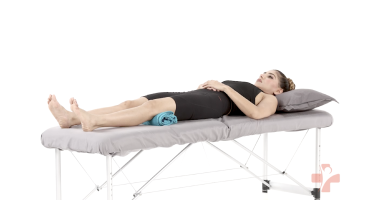 Quad sets (towel under knee)
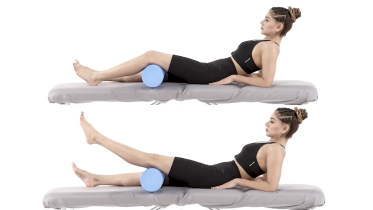 Short arc quads
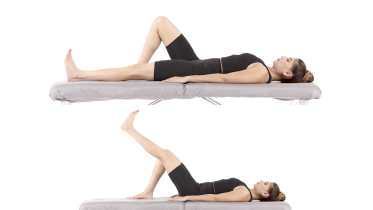 Straight leg raise
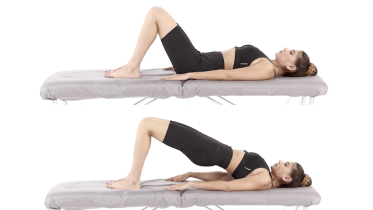 Glute bridge
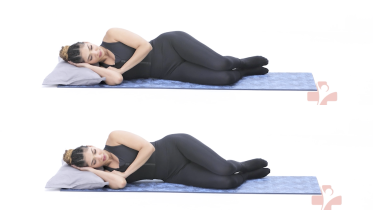 Isometric clamshell
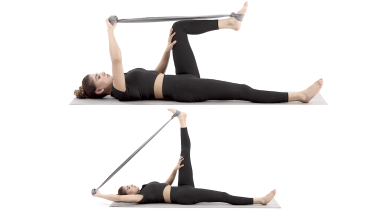 Supine hamstring stretch
Stage 2: Build strength standing up
Move on when stage 1 feels easy and your knee is not sorer the morning after. Sit to stand and the mini squat train two movements that often hurt, getting out of a chair and bending the knees. Use a higher chair at first, and bend only as far as you can before the inner knee pain starts to build. Aim the kneecap over your second toe rather than letting the knee fall in. The ball squeeze works the inner thigh muscles (adductors), and one of them attaches at the sore spot, so squeeze gently and ease off if it brings on pain below the knee. If your balance is not steady, stand next to a kitchen counter for the standing exercises.
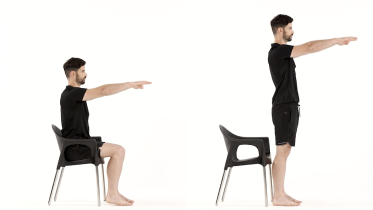 Sit to stand
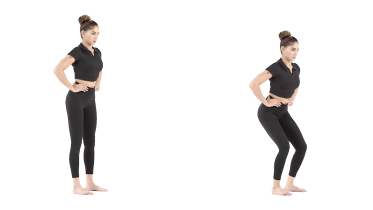 Mini squat
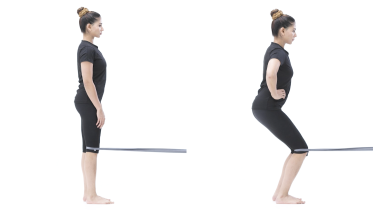 Terminal knee extension with band
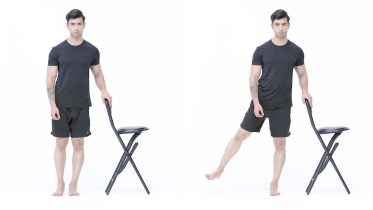 Standing hip abduction
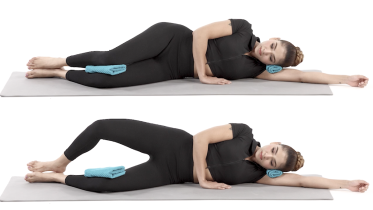 Clamshell
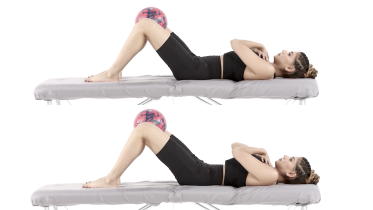 Adductor ball squeeze
Stage 3: Stairs and one leg at a time
Start when stage 2 is comfortable and the knee settles well after sessions. Step ups and backward step downs prepare the knee for stairs, one of the hardest tasks with this problem. Begin on a low step, roughly one stair high, and hold a rail or counter until you feel steady. Do not let the working knee roll inward. Start the split squat with a short range. If one exercise flares the inner knee the next day, go back to the stage 2 version for a week or so.
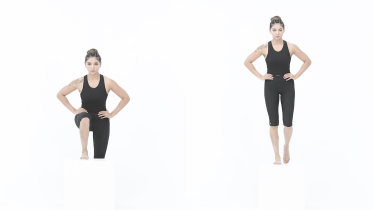 Step up
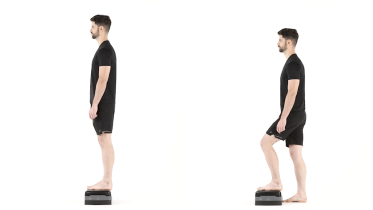 Backward step-down
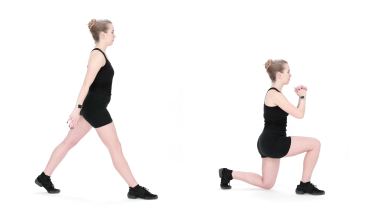 Split squat
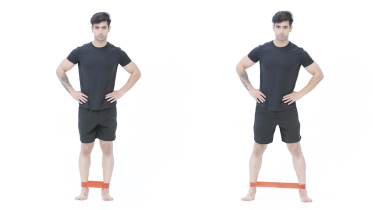 Lateral band walk
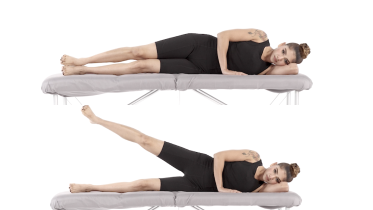 Side lying hip abduction
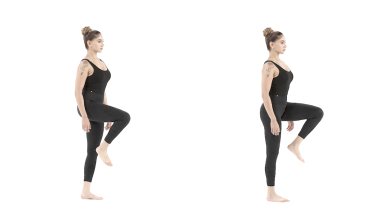 Single leg stance
Injections and other treatments
When the pain does not settle, a steroid injection into the sore spot is a common next step. In a trial of 60 people with knee osteoarthritis and pes anserine pain, one steroid injection and 2 weeks of heat, ultrasound and TENS both improved pain and function at 8 weeks, with no difference between the groups (Sarifakioglu and colleagues, 2016). The physio group in that trial did no exercise, and no scan was used to confirm the diagnosis.
In a trial of 72 people, ultrasound-guided injections of a steroid, oxygen-ozone or a sugar solution (dextrose prolotherapy) all helped (Babaei-Ghazani and colleagues, 2024). Steroid and oxygen-ozone did best at 1 week. By 8 weeks, oxygen-ozone and dextrose were ahead, so the steroid effect seemed to wear off sooner. Both trials were small and short, and neither had a placebo group.
So an injection may get you through a bad spell, but it does not replace the load changes and the exercises. Whether one suits you is a decision for you and your doctor. Tell them if you have diabetes.
When to see a physio or doctor
Book a visit with a physio or doctor if the pain has not improved or is getting worse after 1 to 2 weeks of looking after it at home, if you cannot move the knee, or if the pain is very severe, sharp or shooting. That is the NHS advice for bursitis. Get checked too if the pain stops you sleeping, walking or doing daily tasks, or if you are not sure where it is coming from, since inner knee pain has several causes. And if you have done the exercises regularly for 6 to 8 weeks with no change, a physio (physical therapist) can check the diagnosis and adjust the program.
If your blood pressure is not under control, or you have a heart or lung condition, ask your doctor first. If you have had a fall lately or your balance feels shaky, do the standing work within arm's reach of a kitchen counter. If you are pregnant, check with your midwife, doctor or physio first. Signs that need faster help are in the warning signs list below.
For physiotherapists
Use this page as a starting framework for patients with pes anserine tendino-bursitis syndrome. Diagnosis is usually clinical: tenderness at the insertion on the proximal medial tibia, about 2 to 5 cm below the medial joint line across the two sources. Helfenstein and Kuromoto (2010) point out that the structure at fault is unclear.
Consider medial compartment osteoarthritis, a medial meniscus tear or meniscal cyst, MCL injury, a proximal tibial stress fracture and spontaneous osteonecrosis. Check any lump that is growing or hard, as ganglion cysts, osteochondroma and soft tissue tumors are reported in the same area (Helfenstein and Kuromoto, 2010). Diabetes is an established risk factor. Overweight and knee osteoarthritis are probable ones.
Helfenstein and Kuromoto (2010) recommend stretching and strengthening of the adductors and quadriceps, with quadriceps strengthening especially in the last 30 degrees of extension, stretching of the pes anserinus tendons, weight loss when obesity is present, and a pillow between the thighs at night. The program follows that outline. It adds hip abductor and gluteal work as used in knee osteoarthritis programs, and progresses loading toward stairs and single leg control. Trial evidence for exercise therapy in this condition alone is lacking, so progress on symptom response over 24 hours.
The two injection trials are small. Sarifakioglu and colleagues (2016) allocated 60 patients with knee osteoarthritis and a clinical diagnosis, 30 per group, by a number assigned from appointment dates, to a single palpation-guided injection of 40 mg triamcinolone or 2 weeks of hot packs, therapeutic ultrasound and TENS. They found no difference at 8 weeks, and the diagnosis was not confirmed on imaging. Babaei-Ghazani and colleagues (2024) randomized 72 patients to ultrasound-guided corticosteroid, oxygen-ozone or 20% dextrose and found the corticosteroid effect less durable at 8 weeks. Neither followed patients beyond 8 weeks.
See a doctor promptly if
- Same day: the knee is hot, red and swollen, or you have knee pain with a high temperature or feel hot, cold or shivery. Get medical advice the same day, and go to an emergency department if you feel very unwell. This can be a sign of infection in the joint, which needs treatment quickly.
- Same day: the tender spot below the inner side of your knee becomes hot, red and swollen, especially if the skin over it was recently cut or grazed, or you have diabetes. Get medical advice the same day, and go to an emergency department if you feel very unwell. A bursa can become infected, and then it needs antibiotics.
- Same day: you cannot put weight on the leg after a fall or injury. Get medical advice the same day. If the knee has changed shape, swelled up very quickly or you felt a pop or snap, or your foot turns cold, pale or blue or you have tingling or no feeling in the leg or foot, go to an emergency department straight away, and do not drive yourself.
- Same day: the knee locks and you cannot straighten it, or it keeps giving way under you. Get medical advice the same day.
- Same day: the knee swells up quickly and a lot, with no clear reason, especially if you take medicine to thin your blood. Get medical advice the same day.
- Same day: a calf or thigh that is newly swollen, warm, tender, red or darker than usual, has swollen veins that are sore to touch, or has a throbbing or cramping pain that does not fit your injury or condition, or that feels different from normal muscle soreness after exercise. This can be a sign of a blood clot (deep vein thrombosis), especially after surgery, an injury, time in a cast or boot, a long trip or a spell of being much less mobile than usual. Get medical advice the same day. If you are also short of breath or have chest pain, call emergency services.
- Within a few days: a lump on the inner side of the knee or the top of the shin that no doctor has checked, or a lump that is getting bigger or feels hard. See your doctor within a few days. A swollen bursa can cause a soft lump here, but other problems, such as a fluid cyst or a growth on the bone, can sit in the same spot, so it is worth confirming what it is.
- Within a few days: pain at night or at rest that keeps getting worse. See your doctor within a few days. If you have had cancer, now or in the past, see your doctor sooner, within a day or two, and mention it, even if the pain is not getting worse. Do the same if you have knee pain and are losing weight without trying, even if it does not hurt at night. If you are being treated for cancer now, contact your cancer team the same day.
Common questions
What is the difference between pes anserine bursitis and pes anserine tendinitis?
In practice, often none that changes treatment. The bursa sits under the three tendons, and scans have not settled whether the pain comes from the bursa, the tendons or both. For that reason, Helfenstein and Kuromoto (2010) suggest the simpler name anserine syndrome. You may also see pes anserine tendinopathy or pes anserine tendino-bursitis. The treatment is the same either way.
How long does pes anserine bursitis take to heal?
It varies a lot. A review found recovery times from 10 days to 36 months across studies (Helfenstein and Kuromoto, 2010). The NHS says bursitis in general usually gets better in a few weeks, but the review shows that pain at this spot can last much longer. As a rough guide, give the exercises 6 to 8 weeks before judging them.
Do steroid injections work for pes anserine bursitis?
They can ease the pain, but the evidence is small and short term. In a trial of 60 people with knee osteoarthritis and pain at this spot, one steroid injection worked about as well as 2 weeks of heat, ultrasound and electrical nerve stimulation (TENS) at 8 weeks (Sarifakioglu and colleagues, 2016). In a trial of 72 people, a steroid injection and an oxygen-ozone injection gave the most relief at 1 week, but the oxygen-ozone and sugar solution (dextrose) injections held their effect better at 8 weeks (Babaei-Ghazani and colleagues, 2024). Both trials followed people for only 8 weeks.
How should I sleep with pes anserine bursitis?
If lying on your side hurts because your knees press together, put a pillow between your thighs or knees. The review by Helfenstein and Kuromoto (2010) suggests this. Lying on your back is another option.
Is walking good for pes anserine bursitis?
Usually yes, in amounts your knee can handle. Stairs often flare this pain (Helfenstein and Kuromoto, 2010), and long or hilly walks can too, so keep walks shorter and flatter for a while and build the distance back up as the exercises get easier. Walking can also be part of the aerobic exercise NICE recommends for knee osteoarthritis, which many people with this problem also have.
References
- Helfenstein M Jr, Kuromoto J. Anserine syndrome. Revista Brasileira de Reumatologia. 2010;50(3):313-327. PMID 21125167. https://doi.org/10.1590/S0482-50042010000300011
- Sarifakioglu B, Afsar SI, Yalbuzdag SA, Ustaömer K, Bayramoğlu M. Comparison of the efficacy of physical therapy and corticosteroid injection in the treatment of pes anserine tendino-bursitis. Journal of Physical Therapy Science. 2016;28(7):1993-1997. https://doi.org/10.1589/jpts.28.1993
- Babaei-Ghazani A, Eftekharsadat B, Soleymanzadeh H, ZoghAli M. Ultrasound-guided pes anserine bursitis injection choices: prolotherapy or oxygen-ozone or corticosteroid. American Journal of Physical Medicine and Rehabilitation. 2024;103(4):310-317. PMID 37752656. https://doi.org/10.1097/PHM.0000000000002343
- National Institute for Health and Care Excellence. Osteoarthritis in over 16s: diagnosis and management (NG226). 2022. https://www.nice.org.uk/guidance/ng226
- NHS. Bursitis. Page last reviewed 30 October 2023. https://www.nhs.uk/conditions/bursitis/
Written and checked by the PocketPhysio editorial team. Last updated 2026-09-28.
This page is general education, not a diagnosis or a personal treatment plan. See a physiotherapist or doctor for advice about your own situation.