
Balance and falls prevention exercises for older adults
Why falls become more likely as you get older
Falls are not just bad luck. The NHS lists weaker muscles, balance and walking problems, low blood pressure, side effects of medicines, eyesight or hearing problems and dementia among the common reasons. Conditions such as arthritis, stroke and Parkinson's disease add to the risk. The World Health Organization says adults over 60 have the greatest number of fatal falls.
Several of those reasons can be changed. Weak legs and poor balance respond to training at any age. Your medicines and eyesight can be reviewed, your feet looked at, and your home made safer. That is why a falls plan usually covers more than exercise.
Why strength and balance exercise reduces falls
Balance is a skill, and like any skill it improves with practice that is hard enough to count. Standing with your feet closer together, stepping in different directions and turning all make your ankles and hips work with your eyes to keep you upright. Stronger thigh and hip muscles then help you catch a stumble and get out of a chair.
The Cochrane review of exercise for older people living at home included 108 trials with 23,407 people, who were 76 on average (Sherrington 2019). Overall, exercise reduced the rate of falls by 23% and the number of people who fell by 15%, both rated high-certainty evidence. Programs built mainly on balance and functional exercises reduced the rate of falls by 24%. Programs that combined several types, usually balance and functional work plus strength training, probably reduced it by 34%, with less certainty.
The review was uncertain about strength training on its own, dancing and walking programs. So if you already walk or go to the gym, keep going. Just add exercises that challenge your balance. For more on the strength side, see strength training for older adults.
The Otago program is a well-known example. It is a home program of leg strengthening and balance retraining, set up by a trained health professional. Across four New Zealand trials it reduced falls and fall injuries by 35% (Robertson 2002), and a later review of seven trials also found fewer falls (Thomas 2010).
How much balance exercise do you need?
More than most people expect. The World Falls Guidelines recommend balance-challenging and functional exercise three or more times a week, made harder as you improve, for at least 12 weeks, and continued longer for a bigger effect (Montero-Odasso 2022). The NICE falls guideline asks for programs that are progressive, tailored to the person, work on balance, coordination, strength and power, and are run by trained professionals (NICE NG249).
When researchers compared trials with each other, programs that challenged balance and gave more than 3 hours of exercise a week had larger effects on falls (Sherrington 2017). This comes from comparing different trials, not from one trial testing different amounts, so treat 3 hours as a guide rather than a rule. It can be built up slowly, for example 20 to 30 minutes on most days.
The benefit only lasts while you keep doing the exercises, and that is the hard part. In the Otago trials, only about a third of the people still taking part at 12 months were doing them three or more times a week (Thomas 2010). Pick a set time of day and keep the sessions short enough to fit in. When the program gets easy, ask a physio to update it.
How to use this program
Start at stage 1 if you are not sure, or if you have fallen in the past year. Move up a stage when the current one feels steady and you need less help from the counter. The exercises should make you wobble a little, since that is the training, but never so much that you have to grab hard to stop yourself falling.
Each exercise page gives its own starting range. As a rough guide, balance holds often start at 10 to 30 seconds, repeated a few times with each foot in front, while single leg stance starts with holds of a few seconds. Leg strength work such as the chair squat and sit to stand often starts at 2 to 3 sets of 5 to 12. The walking drills are usually a few lengths of a room or hallway at a time. Your physio will adjust this.
Set up safely every time. Practice next to a kitchen counter or a sturdy chair that cannot slide, on a firm floor with rugs moved out of the way, in flat shoes that fit well and grip. If you have fallen in the past year or feel unsteady, keep one hand on the support for the whole exercise and practice only when someone else is at home.
A sudden loss of balance is different. Call emergency services straight away for any sign of a stroke, even if it goes away: sudden dizziness with unsteadiness or falling over, a face that droops on one side, an arm you cannot lift or keep up, slurred or muddled speech, weakness or numbness on one side of your body or face, sudden blurred vision, double vision or loss of sight, or a sudden severe headache.
Stop at once if you get chest pain or pressure, dizziness or feeling faint, a racing or irregular heartbeat, or being far more out of breath than the effort should cause. If chest pain, pressure or tightness does not ease quickly when you rest, spreads to your arm, neck, jaw, stomach or back, or comes with sweating, feeling sick, feeling light-headed or being short of breath, call emergency services straight away, as this can be a heart attack. If it eases quickly and none of these happen, get medical advice the same day, and do not exercise again until you have been checked. If you have high blood pressure, breathe steadily through every repetition and never hold your breath.
The exercise program
Stage 1: Stronger legs and steady standing, with support
For anyone who feels unsteady, has fallen in the past year or is new to exercise. Every exercise here is done with a kitchen counter or a sturdy chair that cannot slide within easy reach. Standing up with the armrests and the chair squat build the leg strength you use every time you get out of a seat. Semi-tandem stance narrows your base a little, and the forward reach and the turn to look behind train the leaning and turning you do around the house.
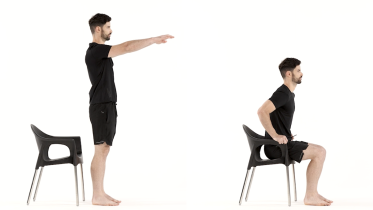 Sit to stand using armrests
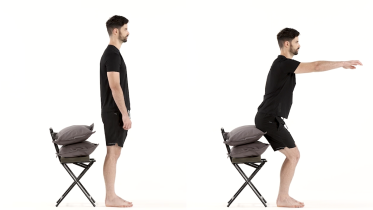 Chair squat
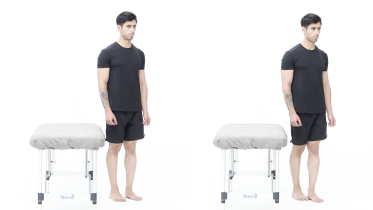 Semi-tandem stance
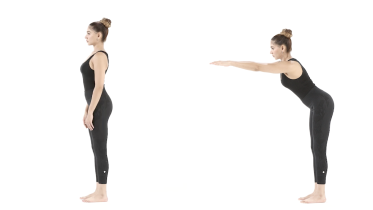 Standing forward reach
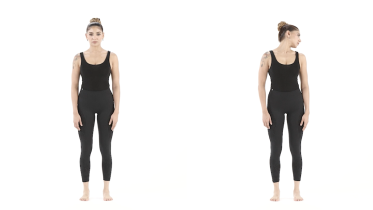 Standing turn to look behind
Stage 2: Narrower stance, stepping and turning
When stage 1 feels steady, often after a few weeks. Sit to stand now goes without your hands, and tandem stance puts one foot directly in front of the other. Clock stepping, turning on the spot, backward walking and figure 8 walking make you shift your weight, change direction and step where you cannot see. Keep a counter, wall or helper within reach for all of them, and clear the floor of rugs and clutter first.
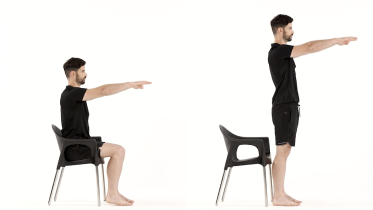 Sit to stand
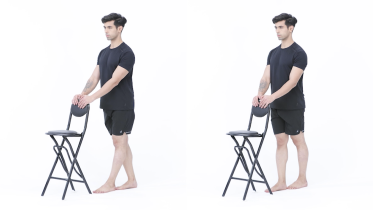 Tandem stance
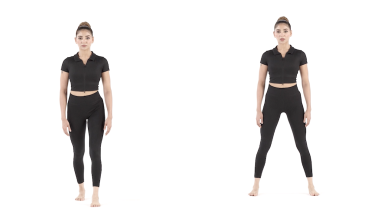 Clock stepping
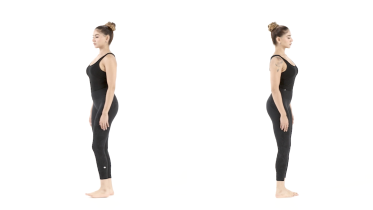 Turning on the spot
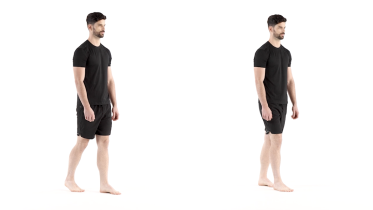 Backward walking
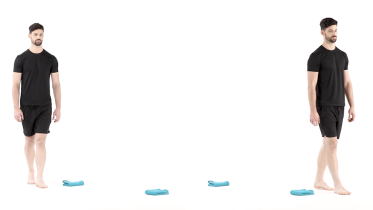 Figure 8 walking
Stage 3: One leg, a narrow line and walking with distractions
When stage 2 feels easy and you can hold tandem stance with only a fingertip on the support. Single leg stance and heel to toe walking along a counter make your base as small as it gets. Walking with head turns and walking while counting backward add the looking around and thinking that real walking involves. The timed up and go practice joins standing up, walking, turning and sitting down into one run.
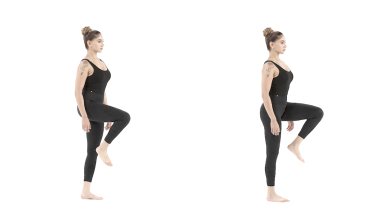 Single leg stance
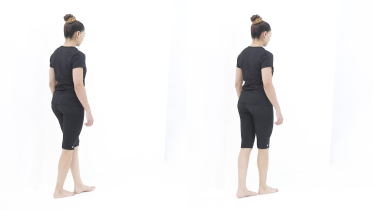 Tandem walking
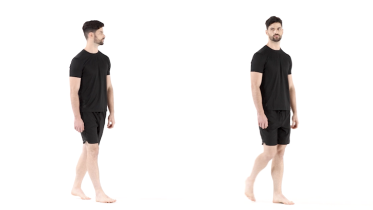 Walking with head turns
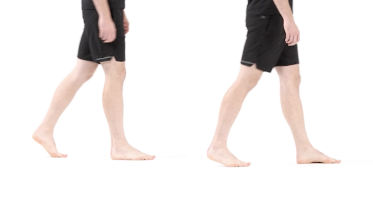 Walking while counting backward
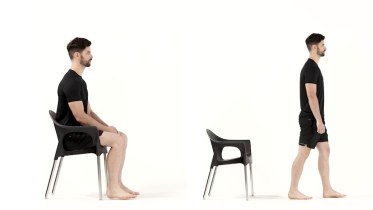 Timed up and go
Alongside any stage: getting up from the floor
Practice this with a physio the first time, and after that only with someone at home. It teaches the route back onto your feet after a fall: onto your side, onto your hands and knees, then up with the help of a sturdy chair. Early on you might practice only part of it, such as kneeling down and getting back up. If you have had a hip or knee replacement, check with your surgeon or physio before you try it.
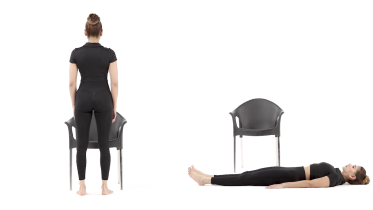 Getting up from the floor
Make your home safer
Small changes at home remove a lot of trip hazards. The NHS advises keeping clutter off the floor and getting rid of things you could trip on, such as loose wires and rugs. Age UK suggests moving rugs and mats away from the top and bottom of the stairs, a night light near the bed for trips to the toilet, handrails where you need them, such as by the bath, and non-slip mats.
The WHO lists home assessment and changes to the home among the ways to prevent falls in older people. If you are not sure what to change, ask your GP about a falls service, which can check your home (NHS). The NICE falls guideline suggests an occupational therapist for this home check where possible (NICE NG249), and the World Falls Guidelines advise that a trained clinician should do it as part of a wider falls plan.
Medicines, eyesight, hearing and feet
These are reasons to see your GP, pharmacist, optician or foot specialist, not things to change on your own. Some medicines can make you drowsy or dizzy and leave you unsteady, especially when you stand up. The NHS advises speaking to a GP or pharmacist if you think your medicines could be affecting your balance. Do not stop or change a medicine without their advice.
The NHS also advises regular eye tests, and getting your ears and hearing checked, as ear problems can affect balance. The World Falls Guidelines include eyesight and the right use of glasses in a falls assessment.
The NHS advises shoes or slippers that fit well, do not slip off and have a good grip. Age UK suggests avoiding high heels and not walking around the house in bare feet, socks or tights. The World Falls Guidelines include foot problems and unsuitable footwear, including going barefoot, in a falls assessment. If your feet are painful or numb, show them to your GP or a foot specialist (podiatrist).
Vitamin D is sometimes suggested for falls. The NICE falls guideline found too little evidence to take it just to prevent falls, and instead points to the usual NHS advice on vitamin D for healthy bones and muscles (NICE NG249). The WHO and the World Falls Guidelines keep it for people who are low in vitamin D or at risk of being low. Ask your GP or pharmacist whether you need it.
What to do if you fall
Do not rush. Stay still for a moment and check whether you are hurt. If you cannot get up, or you think you may have hurt your head, neck, back or hip, stay down. Call emergency services, as the NHS advises.
If you feel able to get up, the NHS steps are these. Roll onto your side, then use your arms to push up onto your hands and knees. Crawl to something stable, such as a heavy chair or sofa, put one foot flat on the floor and stand up slowly while holding on.
Then sit down and rest, and tell your GP about the fall even if you feel fine. If you got up but are in pain, have hurt yourself or feel unwell, get medical advice the same day. If someone else has fallen, keep them comfortable and warm, and carefully help them up if they are able to get up, but do not try to lift them yourself (NHS).
If you cannot get up, use your phone or personal alarm, or shout or bang on the wall or floor to get someone's attention. Cover yourself with anything you can reach, such as a coat, towel or blanket, to keep warm. Roll gently from side to side or move your arms and legs, and try to change position about every 30 minutes to help protect your skin (NHS).
Lying still on the floor for a long time can cause pressure sores (NHS). The World Falls Guidelines link lying on the floor for more than an hour with problems such as dehydration, kidney problems, getting too cold and chest infections, and count it as a sign of high falls risk. If you were on the floor for an hour or more, get medical advice the same day, even if you then managed to get up. A personal alarm worn on a pendant or wristband, or a phone you keep on you, means help can come sooner. The getting up from the floor exercise lets you practice the route in advance, with someone beside you.
When to see a GP or ask about a falls clinic
See your GP after any fall, even if you were not hurt, and whenever you are worried about your balance or walking (NHS). Age UK advises telling your doctor if you have had a fall or have started to feel unsteady, even if you feel fine otherwise. The GP may refer you to a specialist falls service.
A falls service can check for problems such as weak muscles, weak bones (osteoporosis) and eyesight, set up strength and balance training, check your home and review your medicines (NHS). If you have weak bones, the osteoporosis exercise program shows how to bend and lift safely and how to build bone strength. The NICE falls guideline offers a full falls assessment to anyone who has fallen in the past year and is frail, needed medical treatment for an injury from the fall, blacked out, could not get up without help, or has fallen two or more times in the year (NICE NG249). The World Falls Guidelines give a similar list, including lying on the floor for an hour or more.
Clinicians often use short tests of walking and leg strength as part of that check. Two common ones are the Timed Up and Go test and the 30-second chair stand test. Their cut-offs vary between guidelines, and no single test decides your falls risk, so use them with a physio or doctor rather than as a self-test.
Check with your doctor before starting if you have a heart or lung condition, or blood pressure that is not under control, and tell your GP if you get dizzy when you stand up. If you have had a hip or knee replacement or other recent surgery, follow the program from your surgeon and physio instead of this one. If you have had a stroke or have Parkinson's disease or another nerve condition, ask your physio to set your balance program, as your needs will be different.
For physiotherapists
The 2022 World Falls Guidelines use opportunistic case finding (asking older adults about falls in the past 12 months) and stratify risk (Montero-Odasso 2022). A fall with an injury needing medical treatment, 2 or more falls in 12 months, frailty, a long lie of at least one hour or suspected transient loss of consciousness puts a person at high risk and calls for a multifactorial falls risk assessment, with syncope work-up where a syncopal fall is suspected. NICE NG249 uses similar criteria for a full falls assessment, counts any inability to get up independently rather than a one-hour lie, and advises against using falls risk prediction tools to predict risk.
For gait and balance, the World Falls Guidelines recommend gait speed with a cut-off below 0.8 m/s, or the TUG with a cut-off above 15 seconds, while noting the TUG evidence is mixed. People at intermediate risk are offered a strength and balance exercise intervention. It also recommends assessing concern about falling, for example with the FES-I or Short FES-I.
For dosing, the World Falls Guidelines recommend balance-challenging and functional exercise (for example sit to stand and stepping) three or more times a week. The program is individualized and progressed for at least 12 weeks, with tai chi or progressive resistance training added where feasible. Sherrington 2017 found that the combination of more than 3 hours a week and a high balance challenge explained much of the variation between trials, with a 39% reduction in falls. That was a meta-regression, so it points to dose rather than proving it. Adherence is the weak link: across the Otago trials, 36.7% of those still enrolled at 12 months were exercising three or more times a week (Thomas 2010).
See a doctor promptly if
- Emergency: call emergency services straight away for any sign of a stroke, even if it goes away: sudden dizziness with unsteadiness or falling over, a face that droops on one side, an arm you cannot lift or keep up, slurred or muddled speech, weakness or numbness on one side of your body or face, sudden blurred vision, double vision or loss of sight, or a sudden severe headache.
- Emergency: you have just fallen and cannot get up, or you think you may have hurt your head, neck, back or hip. Stay where you are, keep warm and call emergency services, or get someone to call for you. If you got up and walked without trouble and only notice pain later, use the lines below.
- Emergency: you fell and cannot remember the fall or how it happened. Go to an emergency department straight away, and do not drive yourself. You may have blacked out or hit your head without knowing it.
- Emergency: you have had a fall or an injury and now have severe hip pain, or you cannot walk or put weight on the leg. Call emergency services or go to an emergency department. This can be a sign of a broken hip (hip fracture).
- Emergency: after a knock to the head, being very drowsy or finding it hard to keep your eyes open, confusion, a fit (seizure), new weakness or numbness anywhere in your body, new trouble understanding, speaking, walking or keeping your balance, new problems seeing or hearing, clear fluid coming from your ears or nose, bleeding from your ears or bruising behind them, a black eye when your eye was not hit, a dent in your head or a wound with something stuck in it, or a change in behavior. Call emergency services straight away. These can be signs of an injury to the brain.
- Emergency: after a knock to the head, you were knocked out, even for a moment, you cannot remember what happened just before or after, you have had a headache ever since, or you are being sick (vomiting). The same applies, even if you feel fine, if you take medicine that thins your blood, other than aspirin on its own, have a bleeding or clotting condition, have had brain surgery in the past, or had been drinking alcohol or taking drugs when it happened. Go to an emergency department straight away, and do not drive yourself.
- If chest pain, pressure or tightness does not ease quickly when you rest, spreads to your arm, neck, jaw, stomach or back, or comes with sweating, feeling sick, feeling light-headed or being short of breath, call emergency services straight away, as this can be a heart attack. If it eases quickly and none of these happen, get medical advice the same day, and do not exercise again until you have been checked.
- Same day: after a fall, you are in pain, have hurt yourself or feel unwell, or you were on the floor for an hour or more, without any of the emergency signs above. Get medical advice the same day, even if you managed to get up.
- Same day: you blacked out or fainted, even for a moment. Get medical advice the same day. Call emergency services instead if the person cannot be woken within 1 minute, has not fully recovered or has trouble speaking or moving, has chest pain or a pounding, fluttering or irregular heartbeat, fainted while exercising or lying down, is shaking or jerking, or was badly hurt.
- Same day: sudden new dizziness, or feeling faint or unsteady, without any of the stroke signs above. Stop, sit down and get medical advice the same day. If you faint, it does not settle within a few minutes of sitting still, or you cannot stand or walk steadily, call emergency services.
- Same day: new hip or groin pain after a fall, even a small one, if you are older, have low bone density (osteoporosis) or have taken steroid tablets for a long time, even if you can still walk. Get medical advice the same day. A broken hip is not always obvious at first.
- Emergency: new neck or back pain after a fall, a knock or a jolt, even a minor one such as a trip or a sudden stop in a car, if you have a condition that stiffens the spine, such as ankylosing spondylitis. Call emergency services or go to an emergency department straight away, do not drive yourself, and tell the staff about your spine condition, so they keep your neck and back in their usual position. A stiff spine can break after a small injury, and the break is easy to miss at first. If the pain started straight after the injury, or you also have numbness, tingling or weakness in your arms or legs, keep still and call emergency services.
- Neck pain after a car accident or a fall, even a minor one, if you are 65 or older, have low bone density (osteoporosis) or have taken steroid tablets for a long time. Get your neck checked by a doctor the same day, for example at an emergency department, before you start these exercises. At 65 or older, doctors usually want an X-ray or scan of the neck after an accident.
- Within a few days: you have fallen two or more times in the past year, or you keep tripping, stumbling or feeling that your legs might give way. Book an appointment with your GP within a few days and ask about a falls assessment. Tell them about every fall, even the ones where you were not hurt.
Common questions
What are the best exercises to prevent falls in older adults?
Exercises that challenge your balance while you are standing, together with leg strengthening. The Cochrane review found the strongest evidence for programs built mainly on balance and functional exercises, and good but less certain evidence for programs that add strength exercises to them (Sherrington 2019). The World Falls Guidelines give sit to stand and stepping as examples of functional exercise. The program on this page is built the same way.
How often should older adults do balance exercises?
The World Falls Guidelines recommend three or more sessions a week, getting harder over at least 12 weeks and carrying on after that for a bigger effect (Montero-Odasso 2022). When trials were compared, programs that challenged balance and gave more than 3 hours of exercise a week had larger effects on falls (Sherrington 2017). That can be built up slowly, for example short sessions on most days. Your physio will adjust this to what you can manage.
Does walking prevent falls?
On its own, walking has not been shown to prevent falls. The Cochrane review was uncertain about the effect of walking programs on falls (Sherrington 2019). Keep walking if you enjoy it, and add balance and strength exercises for falls.
Is it too late to improve balance at 80 or 90?
No. In the review of the Otago home exercise program, the people in the trials were almost 82 on average, and the program still reduced falls (Thomas 2010). An earlier analysis found that people aged 80 and over gained more protection from fall injuries than people aged 65 to 79 (Robertson 2002). Start with support and at the easiest stage, and build up slowly.
Does tai chi help prevent falls?
It may. The Cochrane review found that tai chi may reduce the rate of falls, but the evidence was less certain than for balance and functional exercise (Sherrington 2019). The World Health Organization lists it among the ways to prevent falls in older people. If you enjoy it, it can be one of your weekly balance sessions.
References
- Sherrington C, Fairhall NJ, Wallbank GK, et al. Exercise for preventing falls in older people living in the community. Cochrane Database of Systematic Reviews. 2019;(1):CD012424. doi:10.1002/14651858.CD012424.pub2
- Sherrington C, Michaleff ZA, Fairhall N, et al. Exercise to prevent falls in older adults: an updated systematic review and meta-analysis. British Journal of Sports Medicine. 2017;51(24):1750-1758. doi:10.1136/bjsports-2016-096547
- Montero-Odasso M, van der Velde N, Martin FC, et al. World guidelines for falls prevention and management for older adults: a global initiative. Age and Ageing. 2022;51(9):afac205. doi:10.1093/ageing/afac205
- National Institute for Health and Care Excellence. Falls: assessment and prevention in older people and in people 50 and over at higher risk (NG249). 2025. https://www.nice.org.uk/guidance/ng249
- Robertson MC, Campbell AJ, Gardner MM, Devlin N. Preventing injuries in older people by preventing falls: a meta-analysis of individual-level data. Journal of the American Geriatrics Society. 2002;50(5):905-911. doi:10.1046/j.1532-5415.2002.50218.x
- Thomas S, Mackintosh S, Halbert J. Does the 'Otago exercise programme' reduce mortality and falls in older adults?: a systematic review and meta-analysis. Age and Ageing. 2010;39(6):681-687. doi:10.1093/ageing/afq102
- World Health Organization. Falls. Fact sheet. 2021. https://www.who.int/news-room/fact-sheets/detail/falls
- NHS. Falls. https://www.nhs.uk/conditions/falls/
- NHS. Fainting. https://www.nhs.uk/symptoms/fainting/
- NHS. Head injury and concussion. https://www.nhs.uk/conditions/head-injury-and-concussion/
- National Institute for Health and Care Excellence (NICE). Head injury: assessment and early management. NICE guideline NG232. 2023. https://www.nice.org.uk/guidance/ng232
- Age UK. Fall prevention for the elderly. https://www.ageuk.org.uk/information-advice/health-wellbeing/exercise/falls-prevention/
Written and checked by the PocketPhysio editorial team. Last updated 2026-09-26.
This page is general education, not a diagnosis or a personal treatment plan. See a physiotherapist or doctor for advice about your own situation.