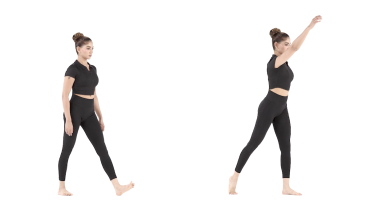
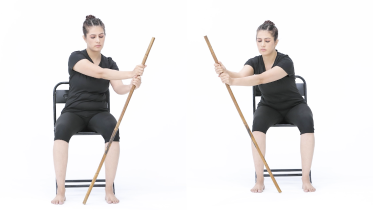
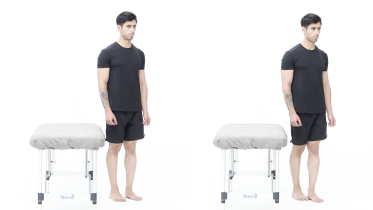
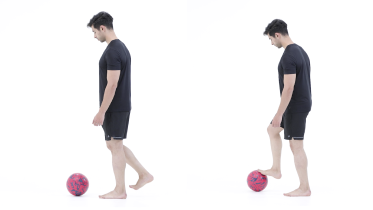
Timed up and go
This exercise practices the timed up and go sequence: stand up from a chair, walk about 3 meters, turn around, walk back and sit down again. Getting up, walking, turning and sitting down are joined together, just as they are when you get up to answer the door. Physios often use the same sequence as a mobility test, and practicing it at home lets you work on each part.
How to do the timed up and go
- Set a sturdy chair with armrests against a wall, and mark a line on the floor about 3 meters (10 feet) in front of it, with tape if you like. Keep the path between them clear.
- Sit back in the chair with your feet flat and your hands resting on the armrests or your thighs. If you use a walking aid, keep it within reach.
- Lean forward and push up through your legs, using your hands on the armrests or your thighs to help you stand. Pause for a moment until you feel balanced.
- Walk at your normal, safe pace to the line. Turn around with several small steps rather than spinning on one foot, then walk back to the chair.
- Turn so your back faces the chair and step back until you feel the seat touch the back of your legs. Reach back for the armrests, or place your hands on your thighs if you are steady, and lower yourself down with control.
What you should feel
Work in your thighs as you stand up and sit down, and your balance working hardest through the turns. Notice which part feels least steady. That is worth telling your physio.
Common mistakes
- Setting off the moment you stand, before you have your balance.
- Pivoting on one foot at the line or in front of the chair.
- Sitting before you can feel the chair against your legs, or dropping onto the seat.
- Rushing to beat a time instead of moving safely.
How often
Many programs use 3 to 5 rounds with a rest between each, once or twice a day. Your physio will adjust this.
Stop and check with your physio if
- You feel dizzy, lightheaded or faint as you get up. Sit back down and wait for it to pass. If it does not pass within a minute or two, or it keeps happening, get medical advice the same day before you practice again. If you faint, or it does not settle within a few minutes of keeping still, call emergency services.
- You feel dizzy, lightheaded, faint or sick, or the room seems to spin. Stop, sit down and get medical advice the same day before you exercise again. If you faint, it does not settle within a few minutes of sitting still, your vision suddenly blurs or goes double, or you cannot stand or walk steadily, call emergency services.
- A knee or hip buckles, or you come close to falling.
- Pain in your hip, knee or back that changes how you move.
- You have had a fall or an injury and now have severe hip pain, or you cannot walk or put weight on the leg. Call emergency services or go to an emergency department. This can be a sign of a broken hip (hip fracture).
From the clinic
The voice guide suggests timing each round with a stopwatch, from the moment you start to stand until you are sitting again. Timing is optional at home. If you do time it, move at a pace that feels safe rather than as fast as you can, and let someone else hold the stopwatch. The Timed Up and Go test page explains how physios run the test and how the times are read. A time on its own does not show your falls risk, so talk it through with your physio rather than using it as a self-test.
Set the walking path alongside a wall or counter if you can, and have someone stay close the first few times. Use your usual stick or walker for the walking part, and stand it where you can grab it from the chair before you get up. If you have had falls, feel unsteady when you turn, or get dizzy when you first stand up, only practice with another person nearby and talk to your physio before starting. Wear flat shoes that fit well and grip the floor, not socks, tights or bare feet.
If you have had a hip replacement, get the go-ahead from your surgeon or physio before you try this exercise. Sitting down in a low chair and turning on the spot can bend the hip past a right angle or twist it, and many surgeons ask you to avoid that for the first months after some operations. Once you have the go-ahead, use a firm chair high enough that your hips stay level with or above your knees.
A sudden loss of balance is different. Call emergency services straight away for any sign of a stroke, even if it goes away: sudden dizziness with unsteadiness or falling over, a face that droops on one side, an arm you cannot lift or keep up, slurred or muddled speech, weakness or numbness on one side of your body or face, sudden blurred vision, double vision or loss of sight, or a sudden severe headache.
If getting up is the hardest part, sit to stand works on that move on its own.
Written and checked by the PocketPhysio editorial team. Last updated 2026-09-28.
This page is general education, not a diagnosis or a personal treatment plan. If you have pain, an injury or a health condition, see a physiotherapist or doctor before starting new exercises.