
Part of Strength and balance exercises for seniors: where to start
How to get up from a fall: what to check before you stand
Warning signs, and when to get help
If you have just fallen, check this first
If you are reading this on the floor, how to get up from a fall is the second question. The first is whether you should get up at all. Lie still for a moment. Nothing gets worse in that minute, and a great deal can get worse if you stand on a hip that is broken or walk away from a head injury.
Work through these before you move at all. Stay down, and get help brought to you, if any one of them is true:
- You hit your head, or you might have without noticing.
- You cannot remember the fall, or what happened just before it.
- You take a medicine that thins your blood and your head took a knock, or you cannot be sure that it did not.
- Your hip, groin or thigh hurts, or that leg will not take your weight.
- Your neck or your back hurts.
- You have new weakness, numbness or tingling in an arm or a leg, or a limb you cannot move.
- You feel dizzy, lightheaded, faint or sick, or the room seems to spin.
- You blacked out or fainted, even for a moment.
- You have chest pain or pressure, a racing or irregular heartbeat, or you are far more short of breath than usual.
- You cannot get up, or you are not confident you can with nobody there to help.
Here are the emergency warnings behind that list, and they come before any instruction to stand. The ones that matter in the days afterward rather than on the floor, including the lines for a replaced hip or knee after a smaller knock and for a blood clot, are in the warning signs on this page.
- Emergency: you have just fallen and cannot get up, or you think you may have hurt your head, neck, back or hip. Stay where you are, keep warm and call emergency services, or get someone to call for you. If you got up and walked without trouble and only notice pain later, use the same-day lines in this list instead.
- Emergency: you fell and cannot remember the fall or how it happened. Go to an emergency department straight away, and do not drive yourself. You may have blacked out or hit your head without knowing it.
- Emergency: you have had a fall or an injury and now have severe hip pain, or you cannot walk or put weight on the leg. Call emergency services or go to an emergency department. This can be a sign of a broken hip (hip fracture).
- Emergency: you have had a hip replacement and have sudden severe pain in your hip or groin, sometimes with a clunk or pop, and you cannot move the leg or put weight on it, or the leg suddenly looks shorter or turned in or out. Do not try to walk on it or push it back into place. Keep still and call emergency services or go to an emergency department, and do not drive yourself. Your new hip may have come out of its socket (dislocated), and a medical team needs to put it back.
- Emergency: your operated leg looks shorter than it did, or its foot turns in or out more than before, or the hip moves in an unusual way, even if the pain is not severe. Keep your weight off it and go to an emergency department straight away, and do not drive yourself. If you are in severe pain or cannot move the leg, call emergency services.
- Emergency: you have had a knee replacement and, after a fall or a knock, you cannot put weight on the leg, your knee or thigh is very painful, or the leg looks out of shape or shorter than the other. Go to an emergency department straight away, and do not drive yourself. If you cannot get up, call emergency services. A broken bone around a knee replacement is rare, but it needs treatment in hospital. If a smaller fall or knock leaves the knee newly painful, swollen or bruised, even if you can still walk on it and the leg looks normal, stop the exercises, go back to your crutches or sticks and keep your full weight off that leg, and get it checked by your surgical team the same day. A break in the bone around a new knee is not always obvious at first, and walking normally on one can move the broken ends apart.
- Emergency: pain, tingling, numbness or weakness in both legs, numbness or altered feeling around your genitals or bottom, or new trouble peeing or controlling your bladder or bowels. The same applies if you lose feeling in one leg. Call emergency services or go to an emergency department straight away. These can be signs of pressure on the nerves at the base of the spine (cauda equina syndrome).
- Emergency: after a knock to the head, being very drowsy or finding it hard to keep your eyes open, confusion, a fit (seizure), new weakness or numbness anywhere in your body, new trouble understanding, speaking, walking or keeping your balance, new problems seeing or hearing, clear fluid coming from your ears or nose, bleeding from your ears or bruising behind them, a black eye when your eye was not hit, a dent in your head or a wound with something stuck in it, or a change in behavior. Call emergency services straight away. These can be signs of an injury to the brain.
- Emergency: after a knock to the head, you were knocked out, even for a moment, you cannot remember what happened just before or after, you have had a headache ever since, or you are being sick (vomiting). The same applies, even if you feel fine, if you take medicine that thins your blood, other than aspirin on its own, have a bleeding or clotting condition, have had brain surgery in the past, or had been drinking alcohol or taking drugs when it happened. Go to an emergency department straight away, and do not drive yourself.
- Emergency: if chest pain, pressure or tightness does not ease quickly when you rest, spreads to your arm, neck, jaw, stomach or back, or comes with sweating, feeling sick, feeling light-headed or being short of breath, call emergency services straight away, as this can be a heart attack. If it eases quickly and none of these happen, get medical advice the same day, and do not exercise again until you have been checked.
- Same day: you blacked out or fainted, even for a moment. Get medical advice the same day. Call emergency services instead if the person is not breathing, cannot be woken within 1 minute, has not fully recovered or has trouble speaking or moving, has chest pain or a pounding, fluttering or irregular heartbeat, fainted while exercising or lying down, is shaking or jerking, or was badly hurt.
A sudden loss of balance is a different problem again. Call emergency services straight away for any sign of a stroke, even if it goes away: sudden dizziness with unsteadiness or falling over, a face that droops on one side, an arm you cannot lift or keep up, slurred or muddled speech, weakness or numbness on one side of your body or face, sudden blurred vision, double vision or loss of sight, trouble swallowing, a sudden severe headache, or a sudden fall where your legs give way but you do not black out (a drop attack).
If you do fall and cannot get up, or you think you may have hurt your head, neck, back or hip, stay where you are, keep warm and call emergency services, or get someone to call for you. Do not let anyone haul you up first. That line, and what to do if you got up fine and only hurt later, are both in the warning signs below.
One thing we see often enough to say plainly: a broken hip does not always announce itself. People walk into clinic days after a fall with a cracked hip, limping and apologetic, because the pain was bearable and nothing looked wrong. That is why new hip or groin pain after even a small fall is a same-day call if you are older or have osteoporosis, whether or not you can still walk on it. Worth knowing where it is felt, too. A cracked hip is often felt in the groin or down the thigh rather than over the bony point at the side, and a crack that has not shifted may only hurt when you put weight through the leg, so new groin or thigh pain after a fall gets the same same-day check as hip pain does.
How to get up from a fall, step by step
One more check before the route, and it is a surgical one. If you have had a hip replacement, a knee replacement, a broken hip that was pinned or replaced, an operation on your shoulder or arm, surgery on your spine, or heart or chest surgery, the climb described below is not automatically yours to use, and the reasons are in getting up with painful knees, after a hip replacement, or when kneeling is not an option further down. Read that first. If you are on the floor now and still within the weeks or months your team gave you, get help brought to you rather than forcing your own way up through kneeling and twisting, and get the fall itself checked whether or not you manage to stand. Practicing it waits for your surgeon's or physio's go-ahead.
If the checks above are clear and you feel able, the order matters more than strength does. Rolling is the movement that still works when legs will not, so you go onto your side first. From there your arms bring you up onto your hands and knees, which is a position almost everyone can hold even when standing feels impossible.
Then you need something to climb. Pick the heaviest thing within reach that will not slide or tip when you press on it: a bed, a firm sofa, or a sturdy chair with its back against a wall. If it is across the room, crawl to it rather than standing without it.
Put both hands on it, bring your better leg forward and plant that foot flat on the floor, so you are kneeling on one knee. Press down through your hands and through the front foot together, and come up slowly. If you feel at all dizzy or faint on the way up, stop there and wait, and read the paragraph below before you try again. Keep hold until you feel steady. Then turn, sit down and rest for a few minutes before you walk anywhere. That sequence is the NHS advice for getting up after a fall, and the usual mistake is trying to go straight from lying on your back to standing, which almost nobody can do.
Rising is also the moment blood pressure can catch you out. You feel dizzy, lightheaded or faint as you get up. Stay down or sit on the chair and wait for it to pass. If it does not pass within a minute or two, or it keeps happening, get medical advice the same day before you practice again. If you faint, or it does not settle within a few minutes of keeping still, call emergency services.
The numbered route, the setup, what each stage should feel like, the common mistakes and how often to practice all live on our getting up from the floor exercise page, with a video of the whole thing. That page is for a good day, with someone in the room. This one is for the day it is not a rehearsal.
What if you cannot get up?
Then the job changes from getting up to getting help to you, and that is not a failure. Plenty of people who can walk around the block cannot get off a floor, because the two have almost nothing in common.
If you cannot get up, use your phone or personal alarm, or shout or bang on the wall or floor to get someone's attention. Cover yourself with anything you can reach, such as a coat, towel or blanket. If you can move without pain, shift onto a soft surface such as a rug or carpet, and away from drafts. Roll gently from side to side or move your arms and legs, and change position about every 30 minutes to help protect your skin.
Time on the floor is itself the danger, separate from whatever you hurt in the fall. If you were on the floor for an hour or more, get medical advice the same day, even if you then managed to get up. The World Falls Guidelines link lying on the floor for more than an hour with dehydration, disturbed body chemistry, kidney failure, getting too cold, pneumonia, urine infections, damage to the skin and pain, and they count being unable to rise for at least an hour as a marker of high falls risk (Montero-Odasso 2022). So the time on the floor gets reported even when you got yourself up in the end and feel fine about it.
This is the argument for a personal alarm worn on a pendant or wristband, or a phone kept in a pocket rather than on a table. Not because either stops a fall, but because they decide how long you lie there. Our balance and falls prevention program covers the rest of the plan, including home safety and the falls clinic route.
How should someone else help you up?
By steadying, never by lifting. The NHS tells a helper to keep the person comfortable and warm, and to help them up carefully only if they are able to get up, and not to try to lift them. That instruction protects both people: a lift from the armpits can injure a shoulder, and a helper who is pulling cannot feel the hip that is already broken.
So if you are the helper, do the checks on this page first and ask the questions out loud. Did you hit your head. Can you remember falling. Does your hip or groin hurt. Does your neck or back hurt.
Then kneel beside them, put a hand where they want it, and let them do the work in their own time while you keep the chair or the sofa from moving. If they cannot do it, stop. That is the point at which you call emergency services, not the point at which you try harder.
Afterwards, keep them warm and sitting down, and get them checked as quickly as the warning signs on this page say, even if they seem fine. Tell the doctor you had to help, because needing help to get up changes what the assessment should cover.
Why practicing before you need it works
The honest case for rehearsing this is narrow, and worth making properly. What practice has been shown to improve is the thing it trains: getting up. In a pilot trial that added five short floor-rise sessions to weekly exercise classes, everyone in the trained group could rise from lying on their back afterward, against about two thirds of the group who only watched a demonstration, and their rise times fell, although the trial's main measure, fear of falling, did not change (Seeley 2026). A review of seven small studies of the same step-by-step teaching method, in people whose average age was 82, found it improved getting up from the floor unassisted, and reported better mobility and fewer falls alongside that, with the study quality varying widely and the authors calling the evidence promising rather than settled (Leonhardt 2020).
Read that second claim carefully, because it is the thin one. Seven small studies of mixed quality are not grounds to promise anyone that rehearsing the floor transfer will stop them falling, stop them getting hurt or shorten a lie on the floor, so nobody should sell it that way. What it does is turn an unfamiliar problem into a route your hands and knees already know, on the one occasion you are down there alone and frightened and have to work it out.
Most adults have no recent memory of getting down to the floor on purpose, so on the day it happens by accident, every part of it is new at once. That is why the rehearsal includes going down as well as coming up. It is also why practicing with the furniture you actually own beats practicing on a clinic chair that is taller and steadier than anything in your living room.
The exercise that does have falls evidence behind it is balance and functional training. The Cochrane review of exercise for older people living at home found that programs built mainly on balance and functional work reduce falls (Sherrington 2019), and the figures and the staged program are on our balance and falls prevention page. Think of the floor transfer as the skill you keep alongside that program, not instead of it.
If you have fallen in the past year, feel unsteady on your feet, or take medicines that make you dizzy, keep both hands on a heavy chair or sofa that cannot slide for the whole climb up, practice only when someone else is at home, and ask your doctor or physio about a falls check.
Stop at once if you get chest pain or pressure, dizziness or feeling faint, a racing or irregular heartbeat, or being far more out of breath than the effort should cause. If chest pain, pressure or tightness does not ease quickly when you rest, spreads to your arm, neck, jaw, stomach or back, or comes with sweating, feeling sick, feeling light-headed or being short of breath, call emergency services straight away, as this can be a heart attack. If it eases quickly and none of these happen, get medical advice the same day, and do not exercise again until you have been checked.
What makes getting up from a fall possible: leg strength and a route you know
Two things decide whether the climb up is there when you need it. One is the route, which you can learn in an afternoon. The other is the strength to rise from half kneeling with your weight shared between one leg and both arms, and that takes months rather than an afternoon.
The leg strength involved is the same strength you use getting out of a low chair, so that is where it is built. Sit to stand using armrests and the chair squat are the starting points, and the step up and stair climbing load one leg at a time, which is what half kneeling asks for. The supported lunge is the closest standing match to the position you rise from. Those last three sit in stage 3 of that program, which starts once the earlier stages feel easy and your balance is steady, so they are not where anyone begins. If you use a walker, sit to stand with a walker is the version to work with instead.
Our strength training for older adults program puts those in order and progresses them, and each exercise page carries its own starting point and warning signs. Take the dose from those pages, not from this one.
Exercises that can help
The rehearsal, and the leg strength the last part of the climb asks for. Each page gives its own starting point and its own warning signs, and those come before anything on this page. Practice the floor transfer with someone else at home, never for the first time on your own. If you have had a hip or knee replacement, a broken hip that was pinned or replaced, an operation on your shoulder or arm, surgery on your spine, or heart or chest surgery, get the go-ahead from your surgeon or physio before you practice it, for the reasons set out further down this page. These are not six exercises to take up at once: sit to stand using the armrests comes first, the chair squat after it, and the step up, stair climbing and the supported lunge are stage 3 of our strength program, for when the earlier stages feel easy and your balance is steady. Your physio will adjust this.
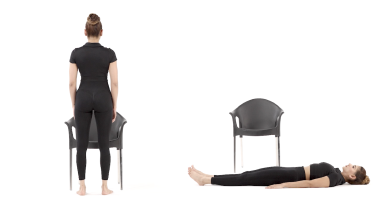 Getting up from the floor
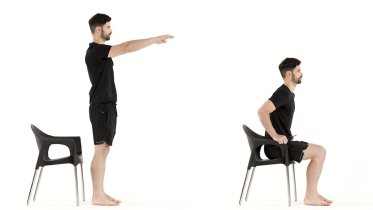 Sit to stand using armrests
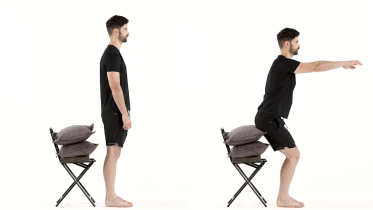 Chair squat
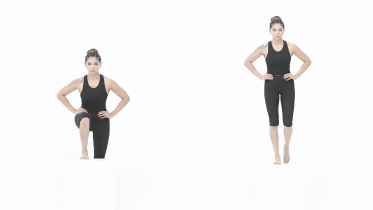 Step up
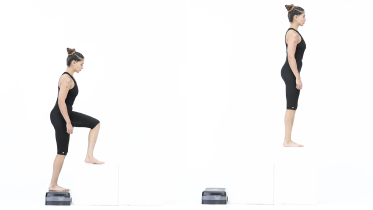 Stair climbing
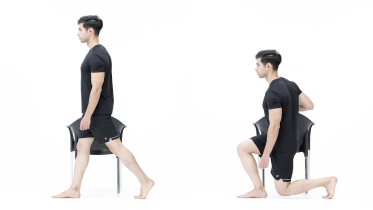 Supported lunge
Getting up with painful knees, after a hip replacement, or when kneeling is not an option
Sore knees are the most common reason the standard route fails, and the first fix is padding rather than a different method. A folded towel, a cushion, a kneeling pad or a folded blanket under the knee changes it for a lot of people. The second is which knee goes down and which foot comes forward, and that is worth working out with a physio while you are well rather than on the floor.
Surgery changes the answer, and these are not decisions to make from a web page. If you have had a hip replacement, get the go-ahead from your surgeon or physio before you try getting up from the floor, and do not use the route above to work it out for yourself. The depth of the hip bend is only part of it. The route passes through three positions and each one touches a different restriction. Sitting on one hip with your legs folded to the side bends the hip, brings the leg across the middle of your body and rolls it inward, which is the combination a hip reached from the back is least steady against. Hands and knees holds the hip at about the right angle most of those leaflets draw a line at. Half kneeling leaves the back leg behind you with the foot turning out, which is the direction a hip reached from the front is least steady in.
So there is no version of this that suits every new hip, and which of those directions matters to you depends on the approach your surgeon used and on the list you were handed. Your physio can teach you a route up that fits your operation, and hip precautions after a hip replacement goes through why the lists differ so much.
Two things are worth knowing while you wait for that answer. How long precautions last is genuinely unsettled, with hospitals that use them putting them at six weeks, at 6 to 12 weeks, or longer for some people, and some surgeons giving none at all. A meta-analysis of 9,599 hip replacements done from the back found the same dislocation rate, 2.2% in each group, whether people were given movement precautions or minimal restrictions (Reimert 2022). That is a reason to follow the list your own team gave you rather than a page like this one, not a reason to set the list aside. The second thing matters more here. In that same review, falls caused more of the dislocations than anything else did, about a quarter of them. The fall is a bigger threat to a new hip than the movement rules are, which is why the precautions and a falls plan belong together rather than one instead of the other.
After a knee replacement, do not kneel on the new knee until your doctor says you can, which is what the NHS advises after that operation. Ask your surgeon or physio for a route up that does not need kneeling in the meantime, and pad the floor well once you have been cleared to kneel. Kneeling is not the whole question, though. The same NHS advice asks you not to sit with your legs crossed for the first 6 weeks and not to lift or move anything heavy for the first 3 months, and getting off a floor lifts your whole body weight through one leg and both arms. So the transfer waits for the same go-ahead the kneeling does, not just the kneeling part of it.
If you have had surgery on your spine in recent months, get the go-ahead from your surgical team or physio first. Getting down to the floor, kneeling and pushing back up bend and load the back, and after some spine operations your team will not want you down there yet. How long that lasts depends on what was done and on who did it, so the date comes from them. One thing does not wait for an appointment: new weakness or numbness in both legs, altered feeling around your genitals or bottom, or new trouble controlling your bladder or bowels is an emergency at any time after spine surgery or after a fall, and the line for it is in the warning signs on this page.
After recent heart or chest surgery, get your surgeon's or surgical team's okay first, because getting down to the floor and back up takes your weight through your hands and arms, including time on your hands and knees. That is the loading the breastbone rules exist to limit. If your chest was opened down the middle, the bone was wired back together and takes months to knit, typical protocols limit loaded lifting, pushing and pulling with the arms for 6 to 8 weeks (El-Ansary 2019), and the NHS asks for no heavy lifting for 3 months after a bypass. Hospitals differ, so the rule that counts is the one your surgeon gave you, and cardiac rehab sets out the rest. If the breastbone clicks, grinds, shifts or feels as if it is moving while you do it, stop, and contact your surgical team the same day. A breastbone that moves is a surgical question, not something to work around by changing how you do the exercise.
An operation on a shoulder, elbow, wrist or hand belongs on the same list, for a reason the hip and knee lists leave out: most of this climb runs through your arms. You push up onto your hands and knees, you may crawl on them, and then you press down hard through both hands to rise out of half kneeling. A repaired tendon, a plated wrist or a new shoulder can be weeks or months away from taking that, and the team that did it is the one who knows when. Ask them, and ask what you may lean on in the meantime.
Where kneeling is not available at all, there are other routes up, and which one suits you depends on your hips, knees, shoulders and arms and on what furniture is in the room. Have a physiotherapist or an occupational therapist watch you try it in your own home, rather than picking a method off a list. Ask for it by name at your next appointment. If you have had a stroke, or you have Parkinson's disease or multiple sclerosis, your program sets the floor transfer differently again, and those pages are the place to start. After a broken hip the surgical team's protocol decides when floor work returns at all, and if your falls come from dizziness or BPPV, treating the dizziness comes first.
After a fall: what to tell your doctor, and what to ask for
Report the fall even if nothing hurt and nobody saw it. The NHS asks you to see a GP after a fall and whenever you are worried about your balance or walking, and Age UK says the same about feeling newly unsteady. Under-reporting is the pattern we see most: people say they have not fallen, then describe a slip on the stairs in March and an afternoon spent sitting on the bathroom floor. If your feet left their place and you ended up down, it counts.
Take four facts with you, because they change what happens next. How long you were on the floor. Whether you could get up without help. Whether you remember the fall. Whether you hit your head.
Being unable to rise for an hour or more puts you in the high risk group in the World Falls Guidelines, alongside an injury needing treatment, two or more falls in a year, frailty and a suspected blackout, and that group is the one offered a full multifactorial falls assessment (Montero-Odasso 2022). The NICE falls guideline covers the same ground for adults 65 and over, and for people aged 50 to 64 at higher risk (NICE NG249).
Then ask for the parts of the assessment by name: your medicines reviewed, your blood pressure checked lying and standing, your eyesight, your feet and footwear, your bone health, and a strength and balance program you can keep up. Clinicians often use a short walking test such as the Timed Up and Go test as part of that check. No single test decides your risk, so do it with a professional rather than on your own. The rest of this topic, including the tests themselves, is in older adults: strong and steady and balance tests for older adults.
Related exercise programs
- Balance and falls prevention
- Strength training for older adults
- Hip fracture rehab
- Osteoporosis
- Dizziness and BPPV
Warning signs
Get emergency help now
- Emergency: call emergency services straight away for any sign of a stroke, even if it goes away: sudden dizziness with unsteadiness or falling over, a face that droops on one side, an arm you cannot lift or keep up, slurred or muddled speech, weakness or numbness on one side of your body or face, sudden blurred vision, double vision or loss of sight, trouble swallowing, a sudden severe headache, or a sudden fall where your legs give way but you do not black out (a drop attack).
- Emergency: you have just fallen and cannot get up, or you think you may have hurt your head, neck, back or hip. Stay where you are, keep warm and call emergency services, or get someone to call for you. If you got up and walked without trouble and only notice pain later, use the same-day lines in this list instead.
- Emergency: you fell and cannot remember the fall or how it happened. Go to an emergency department straight away, and do not drive yourself. You may have blacked out or hit your head without knowing it.
- Emergency: you have had a fall or an injury and now have severe hip pain, or you cannot walk or put weight on the leg. Call emergency services or go to an emergency department. This can be a sign of a broken hip (hip fracture).
- Emergency: you have had a hip replacement and have sudden severe pain in your hip or groin, sometimes with a clunk or pop, and you cannot move the leg or put weight on it, or the leg suddenly looks shorter or turned in or out. Do not try to walk on it or push it back into place. Keep still and call emergency services or go to an emergency department, and do not drive yourself. Your new hip may have come out of its socket (dislocated), and a medical team needs to put it back.
- Emergency: your operated leg looks shorter than it did, or its foot turns in or out more than before, or the hip moves in an unusual way, even if the pain is not severe. Keep your weight off it and go to an emergency department straight away, and do not drive yourself. If you are in severe pain or cannot move the leg, call emergency services.
- Emergency: you have had a knee replacement and, after a fall or a knock, you cannot put weight on the leg, your knee or thigh is very painful, or the leg looks out of shape or shorter than the other. Go to an emergency department straight away, and do not drive yourself. If you cannot get up, call emergency services. A broken bone around a knee replacement is rare, but it needs treatment in hospital. If a smaller fall or knock leaves the knee newly painful, swollen or bruised, even if you can still walk on it and the leg looks normal, stop the exercises, go back to your crutches or sticks and keep your full weight off that leg, and get it checked by your surgical team the same day. A break in the bone around a new knee is not always obvious at first, and walking normally on one can move the broken ends apart.
- Emergency: pain, tingling, numbness or weakness in both legs, numbness or altered feeling around your genitals or bottom, or new trouble peeing or controlling your bladder or bowels. The same applies if you lose feeling in one leg. Call emergency services or go to an emergency department straight away. These can be signs of pressure on the nerves at the base of the spine (cauda equina syndrome).
- Emergency: since your operation, you suddenly become short of breath, you get chest pain or pain in your upper back that may be worse when you breathe in, you cough up blood, your heart is beating very fast, or you faint. Call emergency services straight away, even if your leg looks normal. These can be signs of a blood clot in the lungs (pulmonary embolism).
- Emergency: after a knock to the head, being very drowsy or finding it hard to keep your eyes open, confusion, a fit (seizure), new weakness or numbness anywhere in your body, new trouble understanding, speaking, walking or keeping your balance, new problems seeing or hearing, clear fluid coming from your ears or nose, bleeding from your ears or bruising behind them, a black eye when your eye was not hit, a dent in your head or a wound with something stuck in it, or a change in behavior. Call emergency services straight away. These can be signs of an injury to the brain.
- Emergency: after a knock to the head, you were knocked out, even for a moment, you cannot remember what happened just before or after, you have had a headache ever since, or you are being sick (vomiting). The same applies, even if you feel fine, if you take medicine that thins your blood, other than aspirin on its own, have a bleeding or clotting condition, have had brain surgery in the past, or had been drinking alcohol or taking drugs when it happened. Go to an emergency department straight away, and do not drive yourself.
- Emergency: if chest pain, pressure or tightness does not ease quickly when you rest, spreads to your arm, neck, jaw, stomach or back, or comes with sweating, feeling sick, feeling light-headed or being short of breath, call emergency services straight away, as this can be a heart attack. If it eases quickly and none of these happen, get medical advice the same day, and do not exercise again until you have been checked.
- Emergency: new neck or back pain after a fall, a knock or a jolt, even a minor one such as a trip or a sudden stop in a car, if you have a condition that stiffens the spine, such as ankylosing spondylitis. Call emergency services or go to an emergency department straight away, do not drive yourself, and tell the staff about your spine condition, so they keep your neck and back in their usual position. A stiff spine can break after a small injury, and the break is easy to miss at first. If the pain started straight after the injury, or you also have numbness, tingling or weakness in your arms or legs, keep still and call emergency services.
Get help today
- Same day: after a fall, you are in pain, have hurt yourself or feel unwell, or you were on the floor for an hour or more, without any of the emergency signs above. Get medical advice the same day, even if you managed to get up.
- Same day: you blacked out or fainted, even for a moment. Get medical advice the same day. Call emergency services instead if the person is not breathing, cannot be woken within 1 minute, has not fully recovered or has trouble speaking or moving, has chest pain or a pounding, fluttering or irregular heartbeat, fainted while exercising or lying down, is shaking or jerking, or was badly hurt.
- Same day: dizziness, lightheadedness, blurred vision or feeling faint when you stand up that is new for you, does not pass within a minute or two, keeps happening, or has made you fall. Sit or lie down, and get medical advice the same day. This can be a drop in blood pressure on standing (postural hypotension), a type of low blood pressure, which the NHS lists among the causes of falls, and your doctor can check it. Tell them about your medicines, because some can cause it. If it does not settle within a few minutes of sitting or lying still, call emergency services. If you faint, use the fainting line above.
- Same day: sudden new dizziness, or feeling faint or unsteady, other than the brief lightheadedness as you stand up covered in the line above, without any of the stroke signs above. Stop, sit down and get medical advice the same day. If you faint, it does not settle within a few minutes of sitting still, or you cannot stand or walk steadily, call emergency services.
- Same day: new hip or groin pain after a fall, even a small one, if you are older, have low bone density (osteoporosis) or have taken steroid tablets for a long time, even if you can still walk. Get medical advice the same day. A broken hip is not always obvious at first.
- Same day: you have had a hip replacement and, after a fall or a knock, even a small one, your hip, groin or thigh is newly painful, bruised or swollen, even if you can still walk and your leg looks normal. Stop the exercises, go back to your crutches or frame and keep your full weight off that leg, and contact your surgical team or get medical advice the same day. A break in the bone around a new hip is not always obvious at first, and walking normally on one can move the broken ends apart.
- Same day: a calf or thigh that is newly swollen or getting more swollen, warm, tender, red or darker than usual, has swollen veins that are sore to touch, or has a throbbing or cramping pain that does not fit your injury or condition, or that feels different from normal muscle soreness after exercise. This can be a sign of a blood clot (deep vein thrombosis), especially after surgery, an injury, time in a cast or boot, a long trip or a spell of being much less mobile than usual. Get medical advice the same day. If you are also short of breath or have chest pain, call emergency services.
- Neck pain after a car accident or a fall, even a minor one, if you are 65 or older, have low bone density (osteoporosis) or have taken steroid tablets for a long time. Get your neck checked by a doctor the same day, for example at an emergency department, before you start these exercises. At 65 or older, doctors usually want an X-ray or scan of the neck after an accident.
Book an appointment
- Within a few days: you have had a fall, even if you were not hurt, or you keep tripping, stumbling or feeling that your legs might give way. Book an appointment with your doctor within a few days and ask about a falls assessment. Tell them about every fall, even the ones where you were not hurt.
Common questions
Should you get up straight away after a fall?
No. The NHS advice is not to get up too quickly, and the reason is that a few seconds of lying still is the only chance you get to notice an injury before you load it. Check your head, your neck and back, and your hips and legs first. If you hit your head, cannot remember the fall, knocked your head while taking a medicine that thins your blood, have severe hip or groin pain, or cannot put weight on a leg, stay down and call emergency services rather than trying to stand.
What should I do if I hit my head when I fell?
Treat it as a head injury rather than a bump. Go to an emergency department straight away if you were knocked out even for a moment, cannot remember what happened just before or after, have had a headache ever since, or are being sick. The same applies even if you feel fine when you take medicine that thins your blood, other than aspirin on its own, have a bleeding or clotting condition, have had brain surgery in the past, or had been drinking alcohol or taking drugs when it happened. Do not drive yourself. The full list, including the signs that mean emergency services rather than a department visit, is in the warning signs on this page.
How long on the floor is too long?
An hour is the figure the World Falls Guidelines work to. If you were on the floor for an hour or more, get medical advice the same day, even if you then managed to get up. Those guidelines link lying on the floor for more than an hour with dehydration, disturbed body chemistry, kidney failure, getting too cold, pneumonia, urine infections, damage to the skin and pain, and they count being unable to rise for at least an hour as a marker of high falls risk that should lead to a full falls assessment (Montero-Odasso 2022). Shorter than an hour still counts if you are in pain, have hurt yourself or feel unwell.
Should a family member lift me up off the floor?
No. The NHS tells a helper to keep the person comfortable and warm and to help them up carefully only if they are able to get up, and not to try to lift them. A helper's job is to steady someone who is doing the work themselves, not to take their weight. If you cannot get yourself up, that is the moment to call emergency services, not the moment for someone to try harder.
Can I practice getting up from the floor on my own?
Not at first, and for many people not at all. Practice it with a physiotherapist the first time if you can, and after that only when someone else is at home, on a day you feel well. If you have had a hip or knee replacement, a broken hip that was pinned or replaced, an operation on your shoulder or arm, spine surgery or heart or chest surgery, the answer is not yet: the positions this transfer passes through run into the limits set after those operations, so the go-ahead comes from your surgeon or physio first. If you have fallen in the past year, feel unsteady on your feet, or take medicines that make you dizzy, keep both hands on a heavy chair or sofa that cannot slide for the whole climb up, practice only when someone else is at home, and ask your doctor or physio about a falls check. The route, the setup, the common mistakes and the warning signs are on our getting up from the floor exercise page.
References
- NHS. Falls. https://www.nhs.uk/conditions/falls/
- Montero-Odasso M, van der Velde N, Martin FC, et al. World guidelines for falls prevention and management for older adults: a global initiative. Age and Ageing. 2022;51(9):afac205. doi:10.1093/ageing/afac205
- National Institute for Health and Care Excellence. Falls: assessment and prevention in older people and in people 50 and over at higher risk (NG249). 2025. https://www.nice.org.uk/guidance/ng249
- NHS. Head injury and concussion. https://www.nhs.uk/conditions/head-injury-and-concussion/
- NHS. Knee replacement: recovery. https://www.nhs.uk/conditions/knee-replacement/recovery/
- Reimert J, Lockwood KJ, Hau R, Taylor NF. Are hip movement precautions effective in preventing prosthesis dislocation post hip arthroplasty using a posterior surgical approach? A systematic review and meta-analysis. Disability and Rehabilitation. 2022;44(12):2560-2566. doi:10.1080/09638288.2020.1845404
- El-Ansary D, LaPier TK, Adams J, et al. An evidence-based perspective on movement and activity following median sternotomy. Physical Therapy. 2019;99(12):1587-1601. doi:10.1093/ptj/pzz126
- NHS. Coronary artery bypass graft: recovery. https://www.nhs.uk/conditions/coronary-artery-bypass-graft-cabg/recovery/
- National Institute for Health and Care Excellence. Head injury: assessment and early management. NICE guideline NG232. 2023. https://www.nice.org.uk/guidance/ng232
- Sherrington C, Fairhall NJ, Wallbank GK, et al. Exercise for preventing falls in older people living in the community. Cochrane Database of Systematic Reviews. 2019;(1):CD012424. doi:10.1002/14651858.CD012424.pub2
- Seeley SC, Skelton DA, Tan CW, Stansfield B, Dall PM. Comparing the impact of active floor-rise training with video demonstration on fear of falling and independent floor-rise ability in older adults living in the community: a pilot cluster randomised controlled trial. Age and Ageing. 2026;55(3):afag064. doi:10.1093/ageing/afag064
- Leonhardt R, Becker C, Gross M, Mikolaizak AS. Impact of the backward chaining method on physical and psychological outcome measures in older adults at risk of falling: a systematic review. Aging Clinical and Experimental Research. 2020;32(6):985-997. doi:10.1007/s40520-019-01459-1
- NHS. Symptoms of a stroke. https://www.nhs.uk/conditions/stroke/symptoms/
- NHS. Fainting. https://www.nhs.uk/symptoms/fainting/
- NHS. Low blood pressure (hypotension). Page last reviewed 11 July 2023. https://www.nhs.uk/conditions/low-blood-pressure-hypotension/
- Age UK. Fall prevention for the elderly. https://www.ageuk.org.uk/information-advice/health-wellbeing/exercise/falls-prevention/
Written and checked by the PocketPhysio editorial team. Last updated 2026-10-18.
This page is general education, not a diagnosis or a personal treatment plan. See a physiotherapist or doctor for advice about your own situation.