
Stroke rehab exercises and physiotherapy
What a stroke does to movement
A stroke is when blood stops flowing to a part of your brain, and it can affect things like speech and movement (NHS). Weakness on one side of the body affects about 8 in 10 people after a stroke (Stroke Association). Many people also have changes in feeling, balance problems, a foot that drops and catches the ground, fatigue, or trouble swallowing. Recovery can take a long time, and no two people follow the same path.
Use the program below alongside the plan from your stroke team. It does not replace them.
Your stroke team's plan comes first
Stroke rehab is a team job. NICE recommends that people with movement problems after a stroke are treated by physiotherapists with the right skills and training (NICE NG236). Occupational therapists help with everyday tasks. Speech and language therapists work on speech and communication, and on swallowing. NICE also recommends training family members and carers in care, for example how to help someone move or get dressed.
When you leave hospital, your healthcare team should give you a home recovery plan (NHS). If your team has given you different exercises, follow theirs. Bring this page to your next session and ask which parts fit you.
Does physiotherapy help after a stroke?
Yes, although the evidence has limits. A Cochrane review of 267 trials with 21,838 people found that physical rehabilitation made up of a mix of different treatments likely improves recovery of function and mobility after a stroke (Todhunter-Brown 2025). Approaches built around practicing functional tasks may help more than others, while approaches based on neurophysiological techniques may be no better, or less effective, for independence in daily activities. Trials that gave less than 2.5 hours a week showed a smaller benefit, but the trials were small and varied, so the certainty is low for most of these results.
NICE now recommends needs-based rehabilitation for at least 3 hours a day, on at least 5 days a week, shared between the physio, the occupational therapist and the speech and language therapist (NICE NG236). For people who cannot manage that much, or do not want to, it still recommends therapy on at least 5 days a week. The UK and Ireland stroke guideline gives the same 3 hours for people with movement recovery goals (National Clinical Guideline for Stroke 2023).
How to use this program
Start at the stage that matches what you can do now, and ask your physio or occupational therapist if you are not sure. Many people move through the stages at different speeds for different skills, for example walking short distances while the hand is still weak. Each exercise page gives its own starting range. As a rough guide, the sitting balance exercises often start at 5 to 10 reaches, leans or crosses with a short hold, the sit to stand exercises at 1 to 3 sets of 5 to 10, the standing weight shifts at 2 to 3 rounds of 10 slow shifts, and practice walks with a cane at 2 to 5 minutes, once or twice a day or on most days. Your physio will adjust this.
Practice with a helper nearby until your physio says you can practice alone, and ask your team to teach your helper. Use a firm bed or chair that cannot move, with the brakes on if it has wheels, and keep a counter or sturdy chair within reach for standing work. Wear flat shoes that fit well and grip the floor, not socks, tights or bare feet. If you have a splint for your ankle, wrist or hand, wear it as your team advised and check the skin under it for red or sore areas (NICE NG236).
A sudden loss of balance is different. Call emergency services straight away for any sign of a stroke, even if it goes away: sudden dizziness with unsteadiness or falling over, a face that droops on one side, an arm you cannot lift or keep up, slurred or muddled speech, weakness or numbness on one side of your body or face, sudden blurred vision, double vision or loss of sight, or a sudden severe headache. If one side is already weak or numb from an earlier stroke, new or suddenly worse weakness or numbness is a sign, and every other sign in this list still counts. The same applies if speech or vision problems from your stroke suddenly get worse (Stroke Association).
Stop at once if you get chest pain or pressure, dizziness or feeling faint, a racing or irregular heartbeat, or being far more out of breath than the effort should cause. If chest pain, pressure or tightness does not ease quickly when you rest, spreads to your arm, neck, jaw, stomach or back, or comes with sweating, feeling sick, feeling light-headed or being short of breath, call emergency services straight away, as this can be a heart attack. If it eases quickly and none of these happen, get medical advice the same day, and do not exercise again until you have been checked. If you have high blood pressure, breathe steadily through every repetition and never hold your breath.
For the exercises where you stand, balance or walk, use this stop rule. You feel dizzy, lightheaded, faint or sick, or the room seems to spin. Hold your support, sit down and get medical advice the same day before you practice again. If you faint, it does not settle within a few minutes of sitting still, your vision suddenly blurs or goes double, or you cannot stand or walk steadily, call emergency services.
Getting up from the bed or a chair has its own rule. You feel dizzy, lightheaded or faint as you get up. Sit back down and wait for it to pass. If it does not pass within a minute or two, or it keeps happening, get medical advice the same day before you practice again. If you faint, or it does not settle within a few minutes of keeping still, call emergency services.
Moving in bed has a similar rule. You feel dizzy, lightheaded or faint, or the room seems to spin, as you move in bed or sit on its edge. Stop, lie back down on the bed if you can, and keep still until it passes. If it does not pass within a minute or two, or it keeps happening, get medical advice the same day before you practice again. If you faint, it does not settle within a few minutes of keeping still, or your vision suddenly blurs or goes double, call emergency services.
The exercise program
Stage 1: Moving in bed
For the early days, or whenever getting in and out of bed is hard. Rolling onto your side is the usual first step to getting out of bed, and bridging lifts your hips so you can shift across the bed. Propping up on your elbows starts the move from lying to sitting, and the long sitting forward lean trains your trunk while you sit in bed with your legs out straight. Before you roll, place the weaker arm where it cannot be trapped or pulled, as your physio shows you. Learn each one with your physio or occupational therapist first, and have someone with you until they say you can practice alone.
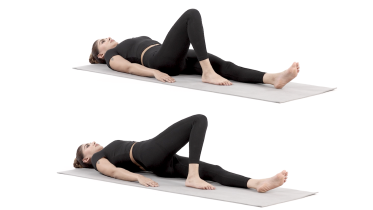 Rolling onto your side in bed
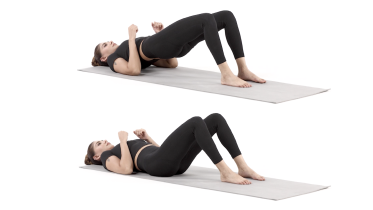 Bridging across the bed
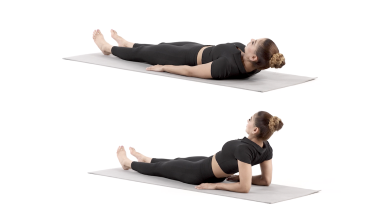 Propping up on your elbows in bed
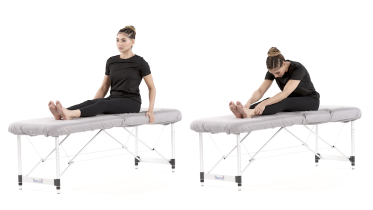 Long sitting forward lean
Stage 2: Sitting balance and moving from bed to chair
Start when you can sit on the edge of the bed with your feet flat on the floor. Lifting one hip, scooting sideways and scooting forward and back teach you to shift your weight, which every transfer needs. Reaching up and out to the side, leaning onto a ball with your weaker arm and crossing one leg over the other challenge your balance the way washing, dressing and putting on shoes do. The sliding board and squat pivot transfers get you from bed to chair, and your physio or occupational therapist will choose the one that suits you, set up the equipment and teach anyone who helps you. Do not try a transfer at home until they have practiced it with you and your helper.
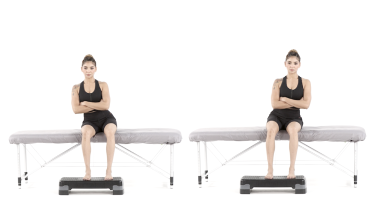 Seated weight shift lifting one hip
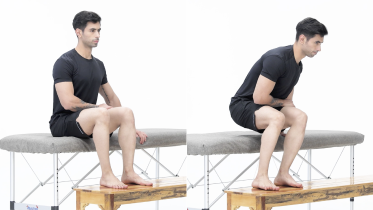 Scooting sideways on the bed
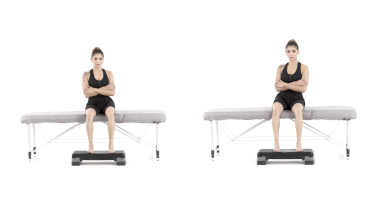 Scooting forward and back in sitting
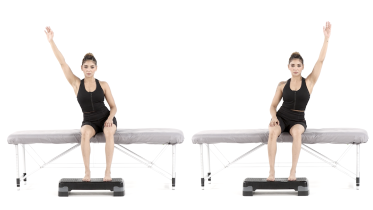 Seated reach up and out to the side
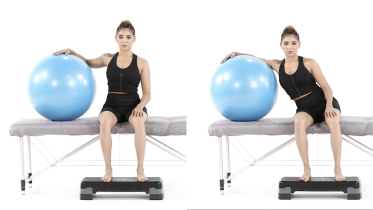 Seated side lean onto a ball
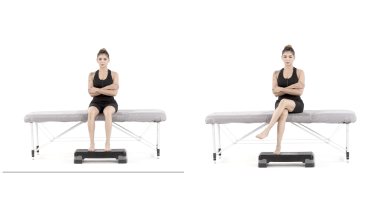 Seated leg cross balance
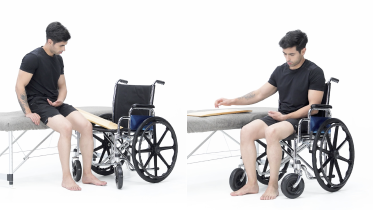 Sliding board transfer
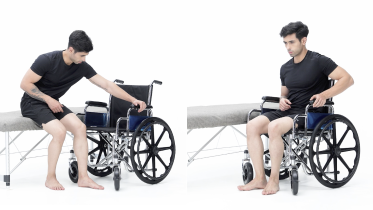 Squat pivot transfer
Stage 3: Standing up and standing balance
When you can sit steadily without holding on. Standing up from a high surface, such as a raised bed, needs less strength than a low chair, so many people start there and lower the seat as they get stronger. Standing up with the armrests, with staggered feet and with a side reach all practice the lean forward and push up. Setting the weaker foot a little back, or reaching the weaker arm out to that side, makes the weaker leg take more of your weight. Once you are up, the weight shifts and the forward reach train standing balance, and marching on the spot lifts each leg in turn. Keep a kitchen counter or a sturdy chair within reach, try to share your weight between both legs, and have someone beside you until your physio says you can practice alone.
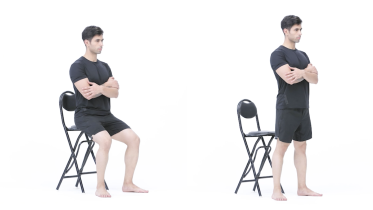 Sit to stand from a high surface
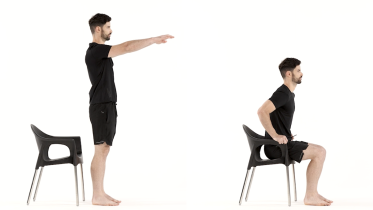 Sit to stand using armrests
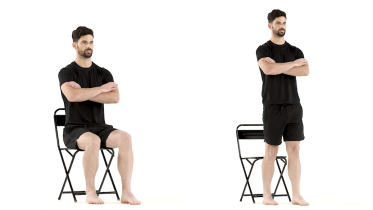 Sit to stand with staggered feet
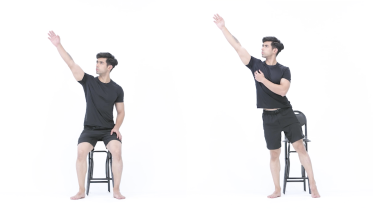 Sit to stand with a side reach
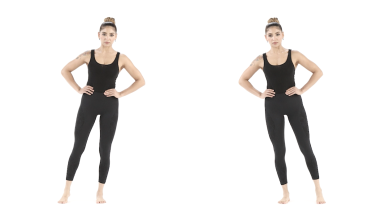 Side to side weight shift
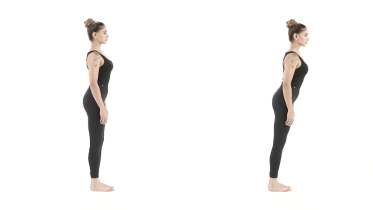 Forward and backward weight shift
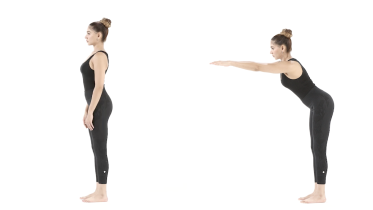 Standing forward reach
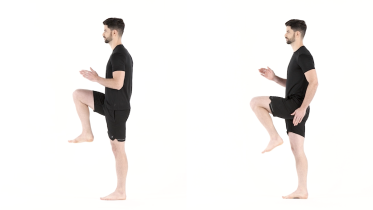 Marching on the spot
Stage 4: Walking, stairs and fitness
When you can stand steadily and walk a few steps, with or without an aid. Side stepping and walking with a cane practice stepping with the aid your physio has chosen, and sit to stand without your hands builds leg strength. Step-ups and stair practice prepare you for stairs, always with a rail to hold. Many people go up leading with the stronger leg and come down leading with the weaker one, bringing both feet onto each step, as your physio shows you. Brisk walking starts your aerobic exercise once your physio agrees you can walk safely outside. Practice getting up from the floor with a physio first, who can adapt it for a weaker side, and after that only with a helper there until your physio says you can do it alone. Use your walking aid, and any splint for a dropped foot, exactly as your team showed you.
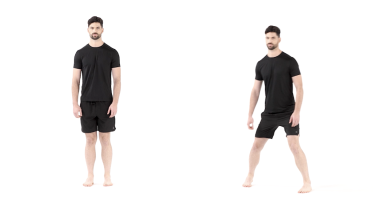 Side stepping
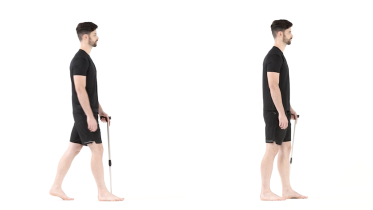 Walking with a cane
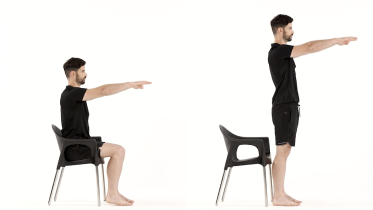 Sit to stand
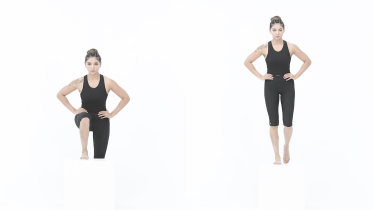 Step up
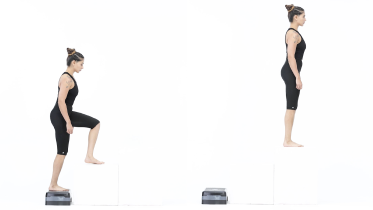 Stair climbing
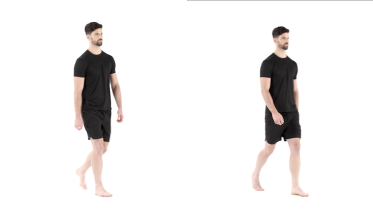 Brisk walking
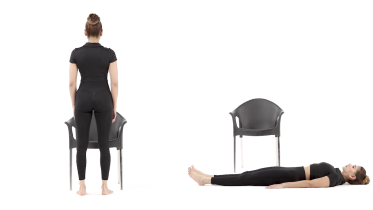 Getting up from the floor
Alongside any stage: the weaker arm and hand
Arm and hand practice runs alongside every stage, from the early days if your team agrees. Reaching for a cup and placing it trains the whole arm in a real task, while turning over small discs, picking up small objects, key grip with putty and pencil grip work on finger and thumb control. Identifying objects by touch trains feeling in the hand, which can change after a stroke. Sit at a table with the weaker forearm supported, and spread many short practice spells through the day rather than one long session. If the shoulder starts to hurt, stop and tell your physio.
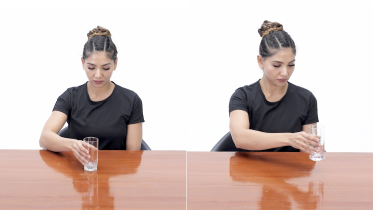 Reach, grasp and place a cup
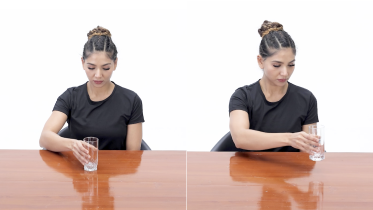 Turning over small discs
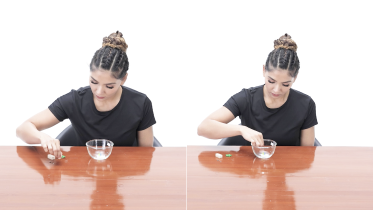 Picking up small objects
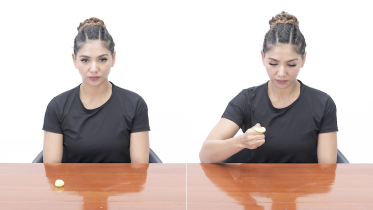 Key grip with putty
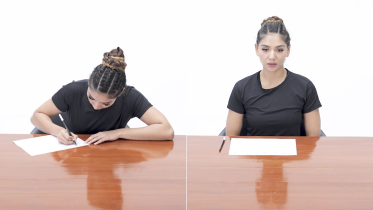 Pencil grip practice
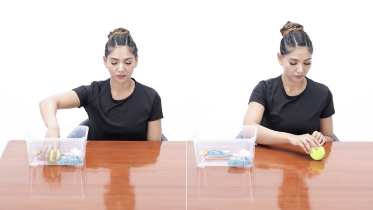 Identifying objects by touch
Practice everyday tasks, many times
The stroke guidelines put practice at the center of rehab. The UK and Ireland guideline recommends repetitive task practice, a high number of repetitions of real, useful movements both in and outside therapy sessions, as the main approach for the arm and for balance and walking, ahead of other approaches such as Bobath (National Clinical Guideline for Stroke 2023). NICE recommends it for the arm, with tasks such as reaching, grasping, pointing, moving and handling objects, and for the legs, with standing up, walking or using the stairs (NICE NG236). A Cochrane review of 33 trials with 1,853 people found low to moderate quality evidence that this kind of training improves arm and leg function, with the strongest evidence for walking distance, and the gains lasted up to 6 months (French 2016).
That is why the exercises in the program are everyday tasks broken into parts. The Stroke Association notes that practicing between therapy sessions helps you make progress, and the UK and Ireland guideline recommends building the skills you practice in therapy into your daily routine. Stand up a few extra times before you sit down, or reach for your cup with the weaker hand when you can. Rest when you need to, and come back to it later in the day.
Looking after a weak shoulder
Shoulder pain is common after a stroke, usually on the weaker side (Stroke Association). When the muscles around the shoulder are weak, the weight of the arm can pull the top of the arm bone partly out of its socket (subluxation), and the shoulder can also become stiff and painful (frozen shoulder, or capsulitis). NICE recommends that people after a stroke, and their families and carers, are told how to prevent pain or injury to the shoulder (NICE NG236).
The UK and Ireland guideline advises supporting the weight of the arm when you sit or lie, making sure everyone who helps you handles the arm correctly, and not using overhead arm slings or pulleys (National Clinical Guideline for Stroke 2023). An NHS leaflet advises always resting the weaker arm on a pillow when you sit, rather than letting it hang over the side of the chair (North Tees and Hartlepool NHS). To move the arm yourself, hold it under the elbow with your stronger hand and slide that hand toward the wrist to support it. Nobody should lift or move the weaker arm from under the shoulder, or lift you under that arm, so ask your physio to show your helpers how to hold the arm and help you move.
So this program has no pulley or overhead stick exercises for the arm. Keeping the shoulder and arm muscles active helps stop stiffness getting worse, and your physio can show you how to protect the shoulder when you reach and dress (Stroke Association). Tell your physio about any shoulder pain: the UK and Ireland guideline advises asking about it regularly, and NICE recommends finding the cause before deciding how to treat it. A shoulder that becomes very painful or changes shape after a fall or a pull is different, and the warning signs below say what to do.
The weaker arm and hand
For the arm and hand, the guidelines favor lots of practice of real tasks, such as reaching for an object, holding it, then letting it go (NICE NG236). Constraint-induced movement therapy, where the stronger hand is kept out of use so the weaker one does the work, is an option for people with some movement at the wrist and fingers. NICE warns it can lead to falls, low mood or fatigue, so the stroke team sets it up. Mirror therapy may be added in the first 6 months after a stroke, with supervision at first (NICE NG236). Do not start either one on your own.
Feeling in the arm or leg can change too. It can go numb, stop noticing heat and cold, or lose its sense of where it is (Stroke Association). Test the water with your stronger hand, keep a numb hand away from heat, and check a numb arm or leg each day for cuts, pressure marks, redness or swelling you may not have felt. Physios and occupational therapists use sensory retraining, such as feeling different textures, and identifying objects by touch is one form of it.
If you wear a wrist or hand splint, NICE advises that a trained professional fits it, and that you and your family learn to put it on, take it off and check for redness and sore skin (NICE NG236).
Fitness and strength after a stroke
Three Cochrane reviews look at fitness training after a stroke. Aerobic (cardiorespiratory) training may bring small gains in fitness and walking speed, and in balance and disability, but the evidence is uncertain and it is not clear the gains are big enough to notice in daily life (Kramer 2026). Mixed aerobic and strength training may bring similar small gains (Saunders 2025b), and strength training probably makes the arm and leg muscles stronger and may improve balance slightly (Saunders 2025a). None of the reviews found that training increased deaths, and the strength and mixed training reviews reported no serious harms.
NICE recommends encouraging physical activity, considering strength training for weak muscles, and assessing people who can walk and are medically stable for aerobic and strength training, started by a physio who teaches them how to carry on alone (NICE NG236). An American Heart Association statement recommends low to moderate intensity aerobic activity and muscle strengthening for stroke survivors (Billinger 2014).
The UK and Ireland guideline advises exercise for fitness and strength for people who use wheelchairs or have poor mobility too, unless there is a reason not to. For more severe weakness it suggests exercise that raises the heart rate in other ways, such as arm cycling or seated exercise groups (National Clinical Guideline for Stroke 2023). For getting active at home, the Stroke Association suggests chair-based movement, walking or the stairs, and your physio can tell you how hard to work. Your physio will adjust this.
Fatigue: pace yourself
Fatigue after a stroke is different from ordinary tiredness. It does not seem to get better with rest, and it is not always caused by doing more (Stroke Association). Rehab is tiring too, because you are learning to do things in a new way. The Stroke Association suggests pacing, planning and prioritizing: take things step by step at a speed that does not set off your fatigue, rest before or after activities, and do first what matters most. For exercise, it suggests starting gently, such as a very short walk or a few minutes on an exercise bike, and building up slowly without overdoing it.
A diary of what you do each day helps you learn how much you can manage and what sets off your fatigue (Stroke Association). Talk to your GP or stroke nurse about fatigue, as they can check for causes that can be treated, such as medicine side effects, an infection, anemia, thyroid problems, diabetes, pain, sleep apnea or depression. Take your medicines as prescribed, and do not stop or change them on your own.
Tiredness can also make old problems look worse for a while. When you are tired, unwell or stressed, the new connections your brain has built can struggle, so at the end of a long day you may drag your weaker leg more than usual (Stroke Association). This should ease after a rest. If it does not, get medical advice the same day. A change that comes on suddenly, or anything new, is different: call emergency services straight away and do not wait to see if it settles.
Balance, walking and falls
Falls are more likely after a stroke. The Stroke Association lists weakness on one side, a foot that drops and catches the ground (foot drop), reduced feeling in the leg, problems with vision, and fatigue among the reasons, along with trouble concentrating or doing several things at once. The UK and Ireland guideline recommends a falls risk assessment as part of stroke rehab, with training for you and your family or carers in how to get up after a fall. For people at high risk of falling, it advises exercise that includes balance and coordination at least twice a week. A Cochrane review found that exercise may reduce the rate of falls after a stroke, but the evidence was low quality, and it was very uncertain whether exercise reduces the number of people who fall (Denissen 2019).
If your foot drops or catches, ask about an ankle-foot orthosis, a splint that holds the foot up, which NICE suggests considering for people who trip because the foot does not clear the ground (NICE NG236). Walking aids can help if your standing balance or confidence is limited, and your physio should train you to use them (National Clinical Guideline for Stroke 2023). The Stroke Association also mentions functional electrical stimulation for foot drop, which needs a specialist assessment.
If you fall
Do not rush. Take a couple of minutes to check whether you are hurt (NHS). If you cannot get up, or you may have hurt your head, neck, back or hip, stay where you are and call emergency services, or use a phone or personal alarm to get help. If you feel able to get up, roll onto your side, push up onto your hands and knees and stand up slowly while holding something stable (NHS), in the way your physio has adapted for your weaker side. If you are stuck on the floor, cover yourself to keep warm, keep moving your arms and legs gently, and change position about every 30 minutes.
If you are helping someone who has fallen, keep them warm and comfortable. Help them get up carefully if they can, but do not try to lift them yourself (NHS). After any fall, see your GP, even if you were not hurt (NHS). If you take medicine that thins your blood, other than aspirin on its own, and you knock your head, go to an emergency department straight away, even if you feel fine.
Swallowing, speech and other help
A stroke can affect swallowing (dysphagia). Signs include coughing or choking when you eat or drink, bringing food back up, sometimes through the nose, a croaky or wet-sounding voice, and taking a long time to swallow (Stroke Association). If food or drink goes into the airway, the germs from the mouth can cause a chest infection (pneumonia). A speech and language therapist assesses swallowing, may change food and drinks or teach swallowing techniques and exercises, and also helps with speech (NHS; Stroke Association). The warning signs below say when swallowing trouble needs help the same day or straight away.
When to contact your stroke team, GP or physio
Contact your stroke team, physio or GP if walking, balance, getting in and out of bed or using your arm gets harder. The same goes if you are tripping or nearly falling more often, or your shoulder starts to hurt. NICE recommends a review of your health and care needs, and your carer's, at 6 months after the stroke and then every year, including how you manage everyday activities (NICE NG236). Ask about more rehab at those reviews if you need it. The UK and Ireland guideline also recommends checking for fear of falling, with psychological support if needed, so mention it.
Low mood and worry are common after a stroke too, and so is losing confidence. Tell your GP or stroke team if these do not lift, as talking about them and getting help can make a difference (Stroke Association).
Check with your doctor before starting if you have a heart or lung condition, or blood pressure that is not under control. If you have had a hip or knee replacement or other recent surgery, follow the program from your surgeon and physio instead of this one. With low bone density (osteoporosis), ask your physio how far to lean and reach before you start the sitting and standing balance exercises.
For physiotherapists
NICE NG236 (2023) recommends needs-based rehabilitation for at least 3 hours a day on at least 5 days a week across the multidisciplinary team (1.2.16), with therapy on at least 5 days a week for people who cannot or do not wish to do 3 hours (1.2.17). It recommends repetitive task training for upper limb weakness (reaching, grasping, pointing, moving and manipulating objects) and lower limb weakness (sit to stand, walking, stairs) (1.13.20), walking training for people who can walk with or without assistance (1.13.21), and considering treadmill training (1.13.22), group circuit training (1.13.23) and ankle-foot orthoses (1.13.25). Constraint-induced movement therapy is for people with 20 degrees of wrist extension and 10 degrees of finger extension, with awareness of falls, low mood and fatigue (1.13.19). Mirror therapy is an adjunct started within 6 months, about 30 minutes at least 5 times a week for 4 weeks (1.13.30 and 1.13.31). Shoulder recommendations cover information on prevention, assessment of the cause of pain and positioning (1.14.1 to 1.14.3), and NICE advises a review at 6 months and then annually (1.17.5).
The UK and Ireland guideline (Intercollegiate Stroke Working Party 2023) sets a minimum of 3 hours of multidisciplinary therapy a day, at least 5 days out of 7, for people with motor recovery goals (4.2 A), with frequent, short mobility interventions every day in the first two weeks, typically starting 24 to 48 hours after onset (4.2 C). Repetitive task practice is the principal approach for the arm (4.18 A), balance (4.20 C) and mobility (4.22 C), in preference to other approaches including Bobath. Its evidence summary puts the effective dose for the arm likely in the order of several hundred repetitions a day. For the shoulder, it advises supported positioning, correct handling by staff and carers, and avoiding overhead arm slings or shoulder supports and pulleys (4.23.3 A), asking regularly about pain (4.23.3 B) and considering neuromuscular electrical stimulation for inferior subluxation within 6 months (4.23.3 E). For falls, it recommends risk assessment with training in getting up for the person and carers (4.21 A) and balance and coordination exercise at least twice a week for those at high risk (4.21 E).
For fitness, the guideline recommends cardiorespiratory or mixed training once medically stable, regardless of age, time since stroke and severity (4.17 E). Its dose is at least 30 to 40 minutes, 3 to 5 times a week for 10 to 20 weeks, with facilities for high-intensity training above 70% of peak heart rate, and mixed programs at 40% to 60% of heart rate reserve plus strength training at 50% to 70% of one-repetition maximum, at least 3 days a week for 20 weeks. For intensive walking training it gives 60% to 85% of heart rate reserve for at least 40 minutes, three times a week for 10 weeks (4.22 E).
Todhunter-Brown 2025 (267 studies, 21,838 participants, half from China) found that physical rehabilitation compared with none may improve independence in ADL (SMD 1.32, 95% CI 1.08 to 1.56; 52 studies, 5,403 participants; low certainty) and motor function (SMD 1.01, 95% CI 0.80 to 1.22; 50 studies, 5,669 participants; low certainty) and likely improves gait velocity (SMD 0.23; moderate certainty). Compared with other approaches, functional task training may improve ADL (SMD 0.58, 95% CI 0.29 to 0.87; low certainty) and neurophysiological approaches may be less effective for ADL (SMD -0.34, 95% CI -0.63 to -0.06; low certainty); studies giving less than 2.5 hours a week had a smaller effect on ADL, with considerable heterogeneity. French 2016 (33 trials, 1,853 participants) found low-quality evidence that repetitive task training improves arm, hand and lower limb function and moderate-quality evidence for walking distance and functional ambulation, sustained up to 6 months.
The fitness evidence is now split across three Cochrane reviews. Kramer 2026 (cardiorespiratory, 53 studies, 2,672 participants) found that disability may improve slightly at the end of intervention, but the evidence is very uncertain (SMD 0.35, 95% CI 0.12 to 0.57; 17 studies, 1,073 participants; very low certainty), and probably slight gains in VO2 peak (MD 2.37 mL/kg/min; moderate certainty) and comfortable walking speed (MD 0.08 m/s; moderate certainty, below the MCID of 0.13). Saunders 2025b (combined training) found that disability may improve slightly (SMD 0.20, 95% CI 0.04 to 0.36; 13 studies, 789 participants; low certainty), with little or no effect at follow-up, and Saunders 2025a (resistance training) found that strength probably improves (moderate certainty), balance may improve slightly, and data on disability were too few. No review found an effect on mortality. Denissen 2019 (14 studies, 1,358 participants) found that exercise may reduce the rate of falls (rate ratio 0.72, 95% CI 0.54 to 0.94; low quality), with a very uncertain effect on the number of fallers (risk ratio 1.03, 95% CI 0.90 to 1.19; very low quality).
The home program leaves out overhead pulleys and self-assisted overhead arm exercises, in line with 4.23.3 A. Constraint-induced movement therapy and mirror therapy are left to supervised sessions, along with electrical stimulation and treadmill work. Transfers, getting up from the floor and the first unsupported standing practice are meant to be taught to the person and their carer before they are done at home.
See a doctor promptly if
- Emergency: call emergency services straight away for any sign of a stroke, even if it goes away: sudden dizziness with unsteadiness or falling over, a face that droops on one side, an arm you cannot lift or keep up, slurred or muddled speech, weakness or numbness on one side of your body or face, sudden blurred vision, double vision or loss of sight, or a sudden severe headache.
- Emergency: stroke signs that last a few minutes or hours and then go away completely. This can be a transient ischemic attack (TIA, or mini-stroke), a warning that a stroke may follow. The same applies if weakness, numbness, speech or vision problems from your stroke suddenly get worse. Call emergency services straight away, even if the signs have gone, and do not drive yourself to hospital. Remember FAST: face, arms, speech, time to call emergency services.
- Emergency: swallowing suddenly becomes hard, over minutes or hours rather than slowly over months. Call emergency services straight away, even if it goes away, as this can be a sign of a stroke.
- Emergency: sudden confusion, for example you, or the person you care for, suddenly become muddled, much drowsier than usual or unable to follow what is said. Call emergency services or go to an emergency department straight away, without driving yourself. Sudden confusion can come from an infection, a stroke, a head injury or other causes that need treating quickly.
- Emergency: severe choking, where you cannot breathe, cough or speak. If the airway is still blocked after trying to clear it, someone should call emergency services straight away and follow the operator's instructions.
- Emergency: someone has a fit (seizure) and it is their first one, it lasts more than 5 minutes or longer than is usual for them, they have several without waking up in between, they do not wake up fully, or they are badly hurt or have trouble breathing afterward. Call emergency services. Do not hold them down or put anything in their mouth, cushion their head, and turn them onto their side once the shaking stops. If they are in a wheelchair, put the brakes on, leave any seatbelt on and support their head, but do not try to move them. Seizures can happen after a stroke, most often in the first few days, but also months or years later.
- Emergency: you have just fallen and cannot get up, or you think you may have hurt your head, neck, back or hip. Stay where you are, keep warm and call emergency services, or get someone to call for you. If you got up and walked without trouble and only notice pain later, use the lines below.
- Emergency: you fell and cannot remember the fall or how it happened. Go to an emergency department straight away, and do not drive yourself. You may have blacked out or hit your head without knowing it.
- Emergency: you have had a fall or an injury and now have severe hip pain, or you cannot walk or put weight on the leg. Call emergency services or go to an emergency department. This can be a sign of a broken hip (hip fracture).
- Emergency: after a knock to the head, being very drowsy or finding it hard to keep your eyes open, confusion, a fit (seizure), new weakness or numbness anywhere in your body, new trouble understanding, speaking, walking or keeping your balance, new problems seeing or hearing, clear fluid coming from your ears or nose, bleeding from your ears or bruising behind them, a black eye when your eye was not hit, a dent in your head or a wound with something stuck in it, or a change in behavior. Call emergency services straight away. These can be signs of an injury to the brain.
- Emergency: after a knock to the head, you were knocked out, even for a moment, you cannot remember what happened just before or after, you have had a headache ever since, or you are being sick (vomiting). The same applies, even if you feel fine, if you take medicine that thins your blood, other than aspirin on its own, have a bleeding or clotting condition, have had brain surgery in the past, or had been drinking alcohol or taking drugs when it happened. Go to an emergency department straight away, and do not drive yourself.
- Emergency: new neck or back pain after a fall, a knock or a jolt, even a minor one such as a trip or a sudden stop in a car, if you have a condition that stiffens the spine, such as ankylosing spondylitis. Call emergency services or go to an emergency department straight away, do not drive yourself, and tell the staff about your spine condition, so they keep your neck and back in their usual position. A stiff spine can break after a small injury, and the break is easy to miss at first. If the pain started straight after the injury, or you also have numbness, tingling or weakness in your arms or legs, keep still and call emergency services.
- Back pain after a minor fall or strain if you are older, have low bone density (osteoporosis) or have taken steroid tablets for a long time. Get medical advice the same day.
- Emergency: after a fall, a knock, or the weaker arm being pulled or trapped, the shoulder on that side becomes very painful, swollen or bruised, suddenly looks out of place or a different shape, or you can move the arm much less than before, or the hand on that side turns pale, blue or much colder than usual. Go to an emergency department straight away, without driving yourself, and do not try to put the shoulder back in yourself. The shoulder may be dislocated or broken.
- Emergency: you suddenly become short of breath, you get chest pain or pain in your upper back that may be worse when you breathe in, you cough up blood, your heart is beating very fast, or you faint. Call emergency services straight away, even if your leg looks normal. These can be signs of a blood clot in the lungs (pulmonary embolism).
- If chest pain, pressure or tightness does not ease quickly when you rest, spreads to your arm, neck, jaw, stomach or back, or comes with sweating, feeling sick, feeling light-headed or being short of breath, call emergency services straight away, as this can be a heart attack. If it eases quickly and none of these happen, get medical advice the same day, and do not exercise again until you have been checked.
- Same day: after a fall, you are in pain, have hurt yourself or feel unwell, or you were on the floor for an hour or more, without any of the emergency signs above. Get medical advice the same day, even if you managed to get up.
- Same day: new hip or groin pain after a fall, even a small one, if you are older, have low bone density (osteoporosis) or have taken steroid tablets for a long time, even if you can still walk. Get medical advice the same day. A broken hip is not always obvious at first.
- Neck pain after a car accident or a fall, even a minor one, if you are 65 or older, have low bone density (osteoporosis) or have taken steroid tablets for a long time. Get your neck checked by a doctor the same day, for example at an emergency department, before you start these exercises. At 65 or older, doctors usually want an X-ray or scan of the neck after an accident.
- Same day: you blacked out or fainted, even for a moment. Get medical advice the same day. Call emergency services instead if the person cannot be woken within 1 minute, has not fully recovered or has trouble speaking or moving, has chest pain or a pounding, fluttering or irregular heartbeat, fainted while exercising or lying down, is shaking or jerking, or was badly hurt.
- Same day: sudden new dizziness, or feeling faint or unsteady, without any of the stroke signs above. Stop, sit down and get medical advice the same day. If you faint, it does not settle within a few minutes of sitting still, or you cannot stand or walk steadily, call emergency services.
- Same day: dizziness, lightheadedness, blurred vision or feeling faint when you stand up that is new for you, does not pass within a minute or two, keeps happening, or has made you fall. Sit or lie down, and get medical advice the same day. If it does not settle within a few minutes of sitting or lying still, call emergency services. If you faint, use the fainting line above.
- Same day: a calf or thigh that is newly swollen, warm, tender, red or darker than usual, has swollen veins that are sore to touch, or has a throbbing or cramping pain that does not fit your injury or condition, or that feels different from normal muscle soreness after exercise. This can be a sign of a blood clot (deep vein thrombosis), especially after surgery, an injury, time in a cast or boot, a long trip or a spell of being much less mobile than usual. Get medical advice the same day. If you are also short of breath or have chest pain, call emergency services.
- Same day: the weaker arm or hand suddenly becomes more swollen, or swells with pain, warmth, red or darker skin, or swollen veins that are sore to touch. A blood clot can sometimes form in the arm. Get medical advice the same day. If you are also short of breath or have chest pain, call emergency services.
- Same day: over several days rather than suddenly, you can do less than before, for example your weaker side, your walking or your speech is getting worse, you are far more tired or unsteady than usual, or you have a headache that keeps getting worse. Get medical advice the same day so the cause can be found. If you have had a fall or a knock to the head in the past few weeks, go to an emergency department straight away instead, and do not drive yourself, as bleeding inside the head can build up slowly after a head injury (subdural hematoma). If the change came on suddenly, over minutes or hours, treat it as an emergency, as above.
- Same day: a cough that brings up phlegm, a high temperature, chest pain when you breathe or cough, or feeling short of breath. Get medical advice the same day, or straight away if you have any trouble swallowing, as food or drink can slip into the lungs without making you cough and cause a chest infection (aspiration pneumonia). If you are struggling to breathe, your lips or skin turn pale, blue or blotchy, you cough up blood, your heart is beating very fast or you suddenly feel confused, call emergency services. If you have a very high or very low temperature, shivering you cannot control, you are breathing very fast or finding it hard to breathe, you are confused or your speech is slurred, your skin, lips or tongue look blue, gray, pale or blotchy (on brown or black skin this can be easier to see on the palms of the hands or soles of the feet), or you have a rash that does not fade when you press it, call emergency services, as this can be sepsis.
- Same day: swallowing problems that are new or getting worse, such as coughing or choking when you eat or drink, food sticking in your throat or chest, a wet or gurgly voice after you swallow, or trouble swallowing your tablets. Get medical advice the same day, and ask your GP or stroke team about a speech and language therapist. If you also have a cough with phlegm, a high temperature or shortness of breath, use the line above.
- Same day: you think you may have had a seizure that nobody saw, and you have fully recovered. Contact your GP for an urgent appointment the same day. Until a doctor has checked you, do not drive, swim, climb ladders or work at heights, and have showers rather than baths.
- Same day: thoughts of suicide or of harming yourself, even if you do not plan to act on them. Get urgent help the same day from your GP or NHS 111 in the UK, and you can also talk to Samaritans on 116 123. If you have harmed yourself or feel you may be about to, call emergency services or go to an emergency department straight away.
- Within a few days: new or worsening pain in the weaker shoulder without an injury, or shoulder pain that disturbs your sleep or stops you practicing. Tell your physio, stroke team or GP within a few days, so they can find the cause and change how the arm is supported and positioned.
- Within a few days: you have had a fall, even if you were not hurt, or you are tripping, catching your foot or nearly falling more often than before. Book an appointment with your GP or stroke team within a few days and ask about a falls assessment. A splint that holds up a dropped foot (ankle-foot orthosis) or a walking aid may help.
Common questions
What are the best exercises after a stroke?
The ones that practice the tasks you want to get back, repeated many times. A Cochrane review of 267 trials found that physical rehabilitation likely improves function and mobility, and that approaches focused on practicing functional tasks may be useful, although the certainty of the evidence was limited (Todhunter-Brown 2025). The UK and Ireland stroke guideline recommends repetitive task practice as the main approach for the arm, balance and walking (National Clinical Guideline for Stroke 2023). NICE lists reaching, grasping and handling objects for the arm, and standing up, walking and stairs for the legs (NICE NG236). Your stroke team will pick the tasks that match your goals.
How soon after a stroke can you start exercising?
Rehabilitation usually starts in hospital. The UK and Ireland stroke guideline says that in the first two weeks, therapy for mobility should be frequent, short sessions every day, typically starting 24 to 48 hours after the stroke (National Clinical Guideline for Stroke 2023). NICE describes intensive therapy that starts as soon as it is safe (NICE NG236). The stroke team decides when to start and what is safe for you, so start a home program only with their agreement.
How much exercise should you do after a stroke?
NICE recommends at least 3 hours of rehabilitation a day, on at least 5 days a week, across physiotherapy, occupational therapy and speech and language therapy, for people who need it and can manage it (NICE NG236). In a Cochrane review, trials that gave less than 2.5 hours of physical rehabilitation a week showed a smaller benefit for independence in daily activities, although the trials were too different from each other for firm conclusions (Todhunter-Brown 2025). At home, several short spells spread through the day are easier to fit around fatigue than one long one. Your physio will adjust this.
Can you still improve years after a stroke?
Many people can. The UK and Ireland stroke guideline describes practice of everyday tasks over months or years as a key part of recovery. It recommends offering fitness training once people are medically stable, regardless of age, time since the stroke or how severe it was, and intensive walking training at any stage after a stroke for people who can walk, even with help (National Clinical Guideline for Stroke 2023). Cochrane reviews found that aerobic training, and mixed aerobic and strength training, may bring small gains in fitness, walking speed and balance, although the evidence is uncertain (Kramer 2026; Saunders 2025b). NICE recommends a review of your needs at 6 months and then every year, a good time to ask about more rehab (NICE NG236).
How can I get my arm working again after a stroke?
Practice real tasks with the weaker arm many times a day, such as reaching for, holding and letting go of objects (NICE NG236). The UK and Ireland stroke guideline suggests the amount of practice that helps is likely to be several hundred repetitions a day, far more than most people get in therapy sessions alone (National Clinical Guideline for Stroke 2023). If you have some movement at the wrist and fingers, your team may offer constraint-induced movement therapy, and in the first 6 months they may add mirror therapy (NICE NG236). Your team sets up both, so do not start them on your own. Protect the shoulder while you work on the arm, and tell your physio about any shoulder pain.
Why am I so tired after a stroke?
Fatigue after a stroke is common, and unlike ordinary tiredness it does not seem to get better with rest (Stroke Association). Healing and relearning everyday tasks take a lot of energy. Pacing, planning and prioritizing help, as does starting exercise gently and building up slowly. Talk to your GP or stroke nurse, who can check for causes that can be treated, such as medicine side effects, anemia, thyroid problems, sleep apnea or depression (Stroke Association).
References
- Intercollegiate Stroke Working Party. National Clinical Guideline for Stroke for the UK and Ireland. 2023 edition. Published 4 May 2023. https://www.strokeguideline.org/
- Intercollegiate Stroke Working Party. National Clinical Guideline for Stroke for the UK and Ireland 2023. Rehabilitation and recovery: principles of rehabilitation (sections 4.2, 4.4 and 4.6). https://www.strokeguideline.org/chapter/rehabilitation-and-recovery-principles-of-rehabilitation/
- Intercollegiate Stroke Working Party. National Clinical Guideline for Stroke for the UK and Ireland 2023. Motor recovery and physical effects of stroke (sections 4.17 to 4.23). https://www.strokeguideline.org/chapter/motor-recovery-and-physical-effects-of-stroke/
- National Institute for Health and Care Excellence. Stroke rehabilitation in adults. NICE guideline NG236. Published 18 October 2023. https://www.nice.org.uk/guidance/ng236
- Todhunter-Brown A, Sellers CE, Baer GD, Choo PL, Cowie J, Cheyne JD, Langhorne P, Brown J, Morris J, Campbell P. Physical rehabilitation approaches for the recovery of function and mobility following stroke. Cochrane Database of Systematic Reviews. 2025;(2):CD001920. https://doi.org/10.1002/14651858.CD001920.pub4
- French B, Thomas LH, Coupe J, et al. Repetitive task training for improving functional ability after stroke. Cochrane Database of Systematic Reviews. 2016;(11):CD006073. https://doi.org/10.1002/14651858.CD006073.pub3
- Kramer S, Cheyne JD, Fawkner S, et al. Cardiorespiratory training for people with stroke. Cochrane Database of Systematic Reviews. 2026;(9):CD016000. https://doi.org/10.1002/14651858.CD016000
- Saunders DH, Baker G, Cheyne JD, et al. Resistance training for people with stroke. Cochrane Database of Systematic Reviews. 2025;(9):CD016001. Cited as Saunders 2025a. https://doi.org/10.1002/14651858.CD016001
- Saunders DH, Carstairs SA, Cheyne JD, et al. Combined cardiorespiratory and resistance training for people with stroke. Cochrane Database of Systematic Reviews. 2025;(9):CD016002. Cited as Saunders 2025b. https://doi.org/10.1002/14651858.CD016002
- Denissen S, Staring W, Kunkel D, et al. Interventions for preventing falls in people after stroke. Cochrane Database of Systematic Reviews. 2019;(10):CD008728. https://doi.org/10.1002/14651858.CD008728.pub3
- Billinger SA, Arena R, Bernhardt J, et al. Physical activity and exercise recommendations for stroke survivors: a statement for healthcare professionals from the American Heart Association/American Stroke Association. Stroke. 2014;45(8):2532-2553. https://doi.org/10.1161/STR.0000000000000022
- Stroke Association. Muscle weakness after stroke. https://www.stroke.org.uk/stroke/effects/physical/muscle-weakness
- Stroke Association. Shoulder pain after stroke. https://www.stroke.org.uk/stroke/effects/physical/pain/shoulder
- Stroke Association. Changes in sensation after stroke. https://www.stroke.org.uk/stroke/effects/changes-sensation
- Stroke Association. Post-stroke fatigue and tiredness. https://www.stroke.org.uk/stroke/effects/physical/tiredness-and-fatigue
- Stroke Association. Fatigue after stroke guide. Published April 2024. https://www.stroke.org.uk/fatigue_after_stroke_guide.pdf
- Stroke Association. Getting active after a stroke. Published January 2025. https://www.stroke.org.uk/resources/exercise-and-stroke
- Stroke Association. Balance problems after stroke. https://www.stroke.org.uk/stroke/effects/physical/balance-problems-after-stroke
- Stroke Association. Foot drop. https://www.stroke.org.uk/stroke/effects/physical/foot-drop
- Stroke Association. Swallowing problems after stroke. https://www.stroke.org.uk/stroke/effects/physical/swallowing-problems
- Stroke Association. Seizures and epilepsy after stroke. https://www.stroke.org.uk/stroke/effects/physical/seizures-and-epilepsy-after-stroke
- Stroke Association. Neuroplasticity: re-wiring the brain. https://www.stroke.org.uk/stroke/effects/neuroplasticity-rewiring-the-brain
- Stroke Association. Emotional changes after stroke. https://www.stroke.org.uk/stroke/effects/emotional-changes
- American Stroke Association. Recognizing a second stroke and making an emergency action plan. Last reviewed 15 April 2024. https://www.stroke.org/en/life-after-stroke/preventing-another-stroke/recognizing-a-second-stroke-and-making-an-emergency-action-plan
- North Tees and Hartlepool NHS Foundation Trust. How to position your arm after a stroke. Patient leaflet PIL1353. https://www.nth.nhs.uk/resources/how-to-position-your-arm-after-a-stroke/
- NHS. Stroke. https://www.nhs.uk/conditions/stroke/
- NHS. Stroke: symptoms. https://www.nhs.uk/conditions/stroke/symptoms/
- NHS. Stroke: recovery. https://www.nhs.uk/conditions/stroke/recovery/
- NHS. Transient ischaemic attack (TIA). https://www.nhs.uk/conditions/transient-ischaemic-attack-tia/
- NHS. What to do if someone has a seizure (fit). https://www.nhs.uk/symptoms/what-to-do-if-someone-has-a-seizure-fit/
- St John Ambulance. Choking. https://www.sja.org.uk/first-aid-advice/choking/
- NHS. Dysphagia (swallowing problems). https://www.nhs.uk/symptoms/swallowing-problems-dysphagia/
- NHS. Pneumonia. https://www.nhs.uk/conditions/pneumonia/
- NHS. Sudden confusion (delirium). https://www.nhs.uk/symptoms/confusion/
- NHS. Help for suicidal thoughts. https://www.nhs.uk/mental-health/feelings-symptoms-behaviours/behaviours/help-for-suicidal-thoughts/
- NHS. Falls. https://www.nhs.uk/conditions/falls/
- NHS. Fainting. https://www.nhs.uk/symptoms/fainting/
- NHS. Head injury and concussion. https://www.nhs.uk/conditions/head-injury-and-concussion/
- NHS. Subdural haematoma. https://www.nhs.uk/conditions/subdural-haematoma/
- National Institute for Health and Care Excellence (NICE). Head injury: assessment and early management. NICE guideline NG232. Published 18 May 2023. https://www.nice.org.uk/guidance/ng232
- NHS. Deep vein thrombosis (DVT). https://www.nhs.uk/conditions/deep-vein-thrombosis-dvt/
- NHS. Dislocated shoulder. https://www.nhs.uk/conditions/dislocated-shoulder/
Written and checked by the PocketPhysio editorial team. Last updated 2026-09-29.
This page is general education, not a diagnosis or a personal treatment plan. See a physiotherapist or doctor for advice about your own situation.