Seated weight shift lifting one hip
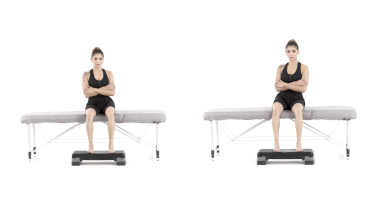
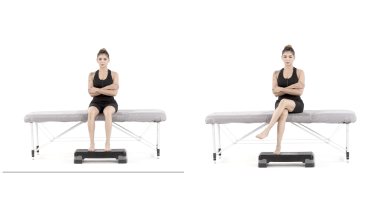
The seated weight shift trains the trunk control you need for moving about while sitting on the edge of a bed. You sit tall with your arms crossed, move your weight onto one side so the opposite hip lifts slightly off the bed, hold, then repeat to the other side. The shoulders stay upright rather than leaning over. The same shift is the first part of scooting along a bed.
How to do the seated weight shift lifting one hip
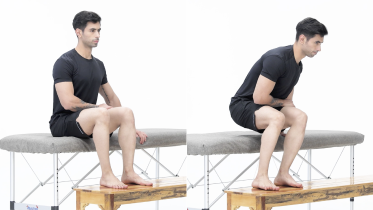
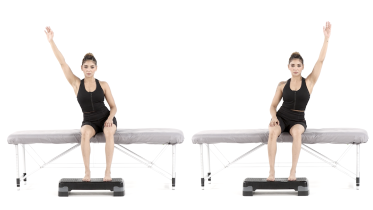
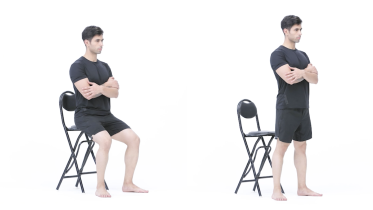
- Sit tall on a firm bed or bench with your feet flat on the floor or a firm step, about hip width apart. Fold your arms across your chest, as in the video.
- Move your weight onto one buttock so the opposite hip lifts just off the bed.
- Keep your head and shoulders upright and level rather than leaning your whole body over. The movement comes from your waist and pelvis.
- Hold for a few seconds, then lower the hip and come back to the middle.
- Repeat to the other side.
What you should feel
Work along the side of your waist on the side that lifts, and pressure through the buttock you are sitting on. The lift only needs to be small.
Common mistakes
- Tipping the head and shoulders far to one side instead of lifting the hip.
- Lifting so high that you roll toward the edge.
- Letting the feet slide or come off the floor.
- Holding your breath while one hip is lifted.
How often
Many programs start with 5 to 10 shifts to each side, holding for a few seconds, once or twice a day. Your physio will adjust this.
Stop and check with your physio if
- You tip further than you can bring yourself back from, or feel you might fall. Uncross your arms, press your stronger hand down beside you and settle back to the middle.
- Sharp pain in your back or hip as you shift.
- You feel dizzy, lightheaded or faint, or the room seems to spin, as you move in bed or sit on its edge. Stop, lie back down on the bed if you can, and keep still until it passes. If it does not pass within a minute or two, or it keeps happening, get medical advice the same day before you practice again. If you faint, it does not settle within a few minutes of keeping still, or your vision suddenly blurs or goes double, call emergency services.
- Your calf or thigh is getting more swollen, or becomes warm, tender, red or darker than usual, or has a new throbbing or cramping pain. This can be a blood clot, especially after an operation, an injury, time in a cast, boot or brace, or a spell of being much less mobile than usual, and after an operation it can also be an infection. Stop and contact your medical team or get medical advice the same day. If you are also short of breath or have chest pain, call emergency services.
- You suddenly become short of breath, get chest pain or pain in your upper back that may be worse when you breathe in, cough up blood, your heart beats very fast, or you faint. Call emergency services straight away, even if your leg looks normal, as this can be a blood clot in the lungs (pulmonary embolism).
From the clinic
This page covers the general exercise, not a stroke rehab program. If you have one-sided weakness from a stroke or another condition, your physio or occupational therapist sets the exercise up for you and says whether someone should help. Keep a weak arm resting across your lap instead of crossing it over, and do not let anyone pull on it to steady you.
Sit on a surface that cannot move, brakes on if it has wheels, and not right at the edge. Have someone beside you at first, and if crossed arms feel too wobbly, keep your stronger hand down on the surface next to you. If you have fallen in the past year, ask your physio to watch you do it before you practice alone. Once the shift feels steady, it leads into scooting forward and back in sitting and scooting sideways on the bed. The standing version is the side to side weight shift.
If you have had a hip replacement, get the go-ahead from your surgeon or physio before you try the seated weight shift. On a low bed or bench your hips sit bent past a right angle while you shift, and many surgeons ask you to avoid that for the first months after some operations. A surface high enough for your hips to sit a little above your knees keeps that bend smaller.
A slight wobble at the end of each shift is part of the training. A sudden loss of balance is different. Call emergency services straight away for any sign of a stroke, even if it goes away: sudden dizziness with unsteadiness or falling over, a face that droops on one side, an arm you cannot lift or keep up, slurred or muddled speech, weakness or numbness on one side of your body or face, sudden blurred vision, double vision or loss of sight, or a sudden severe headache. If one side is already weak or numb from an earlier stroke, new or suddenly worse weakness or numbness is a sign, and every other sign in this list still counts.
Written and checked by the PocketPhysio editorial team. Last updated 2026-09-26.
This page is general education, not a diagnosis or a personal treatment plan. If you have pain, an injury or a health condition, see a physiotherapist or doctor before starting new exercises.