
Lower limb amputation rehab: exercises before and after a prosthetic leg
Warning signs, and when to get help
What does lower limb amputation rehab involve?
Four jobs, running at the same time rather than one after another. Looking after the stump (your surgical team will call it the residual limb) so it heals and keeps its shape. Keeping the hip and knee from tightening, because that decides what a prosthesis can do later. Getting strong enough in the hips, trunk and arms to move yourself around. And then, when the limb-fitting team says so, learning to stand and walk again.
The teams who run this are named in the VA/DoD guideline: a rehabilitation physician, a physical therapist (physiotherapist), an occupational therapist, a prosthetist, a social worker, a nurse and a rehabilitation psychologist. That list tells you something useful about the exercises on this page. They are one part of a job that several people share, and the timing of each stage belongs to the people who can see your wound.
One separation matters more than anything else on this page. A leg lost through poor circulation or a diabetic foot infection, and a leg lost in an accident, are two different situations with two different timelines. The vascular or diabetic reader is usually older, often has heart or kidney disease alongside, and has a remaining foot that is at risk too. The reader who had a trauma amputation is usually younger and healthier, and the national guidance written for them, NICE NG211, was written specifically for rehabilitation after traumatic injury. Where this page quotes NICE, it is quoting a trauma guideline, and we say so each time.
Stump exercises and the first weeks
The first weeks are mostly positioning, bed mobility and transfers, and they look unimpressive next to what you probably expected rehabilitation to be.
Timing varies by country and by source, and it is worth knowing the spread rather than a single number. The NHS says rehabilitation usually starts the day after your operation, beginning with exercises done lying or sitting, then wheelchair work and transfer techniques. NICE, for a trauma population, says to start as early as possible and ideally the day after surgery. healthdirect in Australia says a physiotherapist starts working with you a few days after surgery. Your team's answer beats all three, because they know your wound and your other health problems.
What the VA/DoD routine care tool asks for in its peri-operative phase is a full body range of motion program, education on positioning to prevent contractures of the hip, knee and ankle, transfers, and a start on cardiovascular work. That is exactly what stage 1 below is. The one addition after that, in its post-amputation phase, is lengthening the hip and knee flexors and strengthening the hip and knee muscles, the trunk, and the areas that take the overuse, which it names as the shoulders and the low back.
Two honest limits about our own library. There is no exercise here filmed for a stump specifically, no stump board position and nothing for putting a prosthesis on, so the program below is general lower limb, trunk and upper body work applied to this situation. And NICE's advice for a below-knee amputation, to keep the limb raised on a stump board when you are in a wheelchair, is equipment your team provides rather than an exercise.
Residual limb care and the daily check
Check the stump every day, and know what you are looking for. The NHS lists skin that is warm, red and tender, fluid or pus leaking from it, and swelling that is increasing, as the signs of infection to look for on a daily check. Redness can be harder to see on brown or black skin, so look for heat, tenderness and change as well as color. Washing is daily, with mild unscented soap and warm water. If any of those signs turn up, use the wound warning in the list at the foot of this page rather than waiting for your next appointment, and the link under the summary at the top takes you straight to it.
Once a prosthesis arrives, the rule the VA/DoD residual limb tool gives for a red mark is a practical one: if the redness has not settled within 15 to 20 minutes of taking the limb off, wear time needs limiting. A wound means resting the prosthesis until it has healed, and the tool pairs that with a question your team has to answer, which is how you will get about safely in the meantime. Going back to wearing it is gradual, and the volume of the stump may have changed while it was off.
Compression, socks and skin desensitization are team instructions rather than exercises, and they change week by week as swelling settles. The NHS describes compression garments worn daily and taken off at bedtime, with at least two garments so one can be washed, and desensitization by tapping the skin with a face cloth and rubbing and pulling the skin around the bone. Follow the version your own team gave you.
If the amputation was needed because of diabetes or poor circulation, the remaining foot is the next thing at risk and deserves the same daily look. The NHS recommends a podiatrist and a regular foot review for exactly that reason. Our page on peripheral neuropathy covers the numb foot in more detail, and the same-day warning about a new blister, cut or sore is in the list at the foot of this page.
How to use this program
Start at the stage your team has cleared you for, not the stage you feel ready for, because stage 3 puts load through a stump that only they can judge. If you are in hospital or newly home, that is stage 1.
Nothing on this page was written for a child. If you are reading it for one, their rehabilitation, their positioning and their prosthetic care belong with their own pediatric team, who work to a growing body rather than to the program here.
Each exercise page gives a typical starting dose and the ranges are wide on purpose. As a rough guide, the lying and sitting work in stage 1 is done little and often through the day, the strength work in stage 2 sits at 2 to 3 sets on most days, at whatever repetitions its own exercise page gives, with rest days for the harder items, and the balance and walking practice in stage 3 is short and frequent.
Prone lying is the one where the number on our exercise page is a starting point and not a target. That page begins at 2 to 5 minutes at a time, a few times a day. No guideline we can read sets a duration for it, and the published rehabilitation protocols that do are much longer: one lower limb amputee protocol, from a service treating mostly traumatic amputations, asks for 30 minutes three times a day (Demir and Aydemir, 2020). So build up toward what your own team asks for rather than stopping at the starting figure, and theirs is the number to use.
Build it the way you would build any other dose. Add a few minutes at a time rather than jumping from five to thirty, and each time you get up, look at the end of your stump and at the skin over your knee, your hip bones and the front of your pelvis, because a long spell face down presses on all of them and the warning list below carries the signs a pressure sore gives first. The same protocol sets out the positioning that goes with it, and it matters as much as the minutes: nothing propped under the thigh, the knee or the stump, the head of the bed down rather than raised, and not a soft mattress, because each of those holds the hip or the knee in the bend you are lying face down to prevent (Demir and Aydemir, 2020). If lying face down is not possible for you, ask your physio what to put in its place rather than dropping the aim. Your physio will adjust all of it, and after surgery their plan replaces anything here.
Breathe normally through every repetition rather than holding your breath, especially if you have high blood pressure. Check with your doctor or team before you start if you have a heart or lung condition, which is common in this group, and see cardiac rehab or COPD and breathing if you are already under one of those programs. For the two sit to stands in stage 2 and all the standing work in stage 3, have a counter or a sturdy chair in front of you, have another adult at home, and treat taking your hand off the support as a change to make with your physio rather than on your own.
The exercise program
The exercises below carry their own stop signs and precautions. Open the line under an exercise and read them before you try it.
Stage 1: Bed, chair and the first transfers
A physio usually starts these on the ward, and your surgical team sets what you may and may not do. Prone lying is the one to take seriously: a hip or knee that settles into a bend is the thing most likely to make a prosthesis hard to fit and harder to walk on, and lying flat on your front is how the teams prevent it, starting at a few minutes at a time and building up to whatever length your own team asks for, which is usually a good deal longer. One limit on it belongs to your surgeon rather than to you: if lying on your front presses on the wound or the dressing, or makes the end of the stump hurt, come off it and ask the team how they want you positioned instead, because the stitch line and what sits under it are theirs to protect. The bed and transfer practice is here because getting onto your side, up to sitting and across to a chair comes before every other goal. Read the four bed and transfer exercises with one rule in front of them: keep your weight off the stump in all four until your team tells you otherwise, so where a step says push through both feet, it means the foot you have, with your arms taking the rest. Quad sets suit a below-knee stump and the intact leg, and ankle pumps are for the intact leg only. On a below-knee stump there is no heel to rest and no toes to point, so ignore those two lines on the quad sets page and work from the one that matters, which is tightening the front of the thigh and pressing the back of the knee down into the towel. Breathing control is the gentle conditioning part, inside whatever heart and lung limits your team has set.
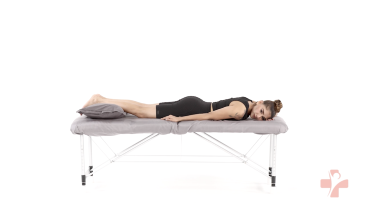 Prone lying
Stop signs and precautions for the prone lying
Before you start
- If you have had recent heart or chest surgery, do not lie face down on a healing chest wound. The weight of your chest presses on the wound for as long as you are down there, and pushing up through your arms to get off the bed pulls across the breastbone. Ask your surgeon or surgical team when lying on your front is allowed, and until then leave this one out, because lying face down is the exercise itself and there is no other way to do it. If the breastbone clicks, grinds, shifts or feels as if it is moving while you do it, stop, and contact your surgical team the same day.
- Check with your physio before lying face down if you are pregnant, have had recent stomach or spine surgery, or have a heart or lung condition that makes lying flat on your front hard. The same applies with narrowing of the spinal canal (spinal stenosis), where some people find lying flat on the front uncomfortable.
When to stop and get help
- Pain spreads out into your buttock or down a leg, or numbness or tingling comes on.
- Your back pain gets steadily worse the longer you lie there.
- Lying face down makes it harder to breathe comfortably.
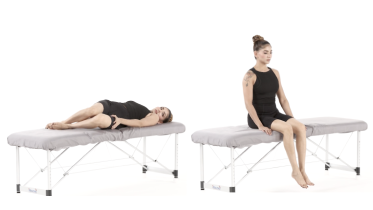 Log roll out of bed
Stop signs and precautions for the log roll out of bed
Before you start
- After a broken wrist, hand or forearm, or surgery on any of them such as a tendon repair, start only when your doctor, surgeon, physio or hand therapist says the bone or repair is ready for this, and follow their plan for how much to do.
- After shoulder surgery, including a rotator cuff repair, or after a shoulder fracture or dislocation, follow your surgeon's or physio's plan, and do only the movements and range they have cleared. Many plans allow only passive movement at first, where the arm is moved for you and its muscles stay relaxed.
- After spinal surgery, follow your surgeon's instructions for getting out of bed. They may want you to use a particular method, wear a brace or have someone help you at first. Their advice comes before this page.
- If you have had a hip replacement, get the go-ahead from your surgeon or physio before you try the log roll. The bent knees tip across as you roll, which can take the top leg across the middle of your body, and many surgeons ask you to avoid that for the first months after some operations. Your surgical team may show you their own way of turning, sometimes with a pillow between the knees.
- After recent heart or chest surgery, get your surgeon's or surgical team's okay first, because pushing up to sitting takes your upper body weight through your arms, and your surgical team decides when that is allowed. Rolling onto your side to get up, rather than sitting straight up, is usually the method they teach, so ask how much your arms may push. If the breastbone clicks, grinds, shifts or feels as if it is moving while you do it, stop, and contact your surgical team the same day.
- If you are pregnant, check with your midwife or physio before you start.
- If you are pregnant and the pain over your pubic bone came on in a single moment, with a crack, pop or tearing feeling, or you suddenly cannot stand, walk or put weight on one or both legs, do not use this page to get yourself out of bed. Contact your maternity unit straight away and ask them to check the joint at the front of your pelvis. While you wait, stay on your side with your knees together and a pillow between them, and get help to move rather than standing on one leg or letting your legs come apart.
When to stop and get help
- Getting up brings on sharp or severe back pain that does not settle when you keep still.
- You feel dizzy, lightheaded or faint, or the room seems to spin, as you move in bed or sit on its edge. Stop, lie back down on the bed if you can, and keep still until it passes. If it does not pass within a minute or two, or it keeps happening, get medical advice the same day before you practice again. If you faint, it does not settle within a few minutes of keeping still, or your vision suddenly blurs or goes double, call emergency services.
- Numbness around your genitals or bottom, new trouble with your bladder or bowels, pain, tingling, numbness or weakness in both legs, or loss of feeling in one leg. Call emergency services or go to an emergency department straight away, and do not drive yourself.
- Your leg or foot gets weaker, for example your foot drags, catches on the ground or slaps down when you walk (foot drop). Get medical advice the same day. If the weakness is getting worse by the hour, go to an emergency department.
- Your calf or thigh is getting more swollen, or becomes warm, tender, red or darker than usual, or has a new throbbing or cramping pain. This can be a blood clot, especially after an operation, an injury, time in a cast, boot or brace, or a spell of being much less mobile than usual, and after an operation it can also be an infection. Stop and contact your medical team or get medical advice the same day. If you are also short of breath or have chest pain, call emergency services.
- You suddenly become short of breath, get chest pain or pain in your upper back that may be worse when you breathe in, cough up blood, your heart beats very fast, or you faint. Call emergency services straight away, even if your leg looks normal, as this can be a blood clot in the lungs (pulmonary embolism).
- You are pregnant and notice bleeding or fluid leaking from your vagina, regular painful tightenings, tummy pain that does not settle when you rest or comes with lower back pain, or a change in your baby's usual movements, such as moving less than usual. Stop and contact your midwife or maternity unit straight away. Do the same for a severe headache, problems with your vision such as blurring or flashing lights, pain just below your ribs, or sudden swelling of your face, hands or feet, which can be signs of pre-eclampsia. Call emergency services if the bleeding is heavy, the tummy pain is severe, bleeding or tummy pain comes with pain in your shoulder or feeling sick, faint or dizzy, or a headache comes on suddenly and is very severe.
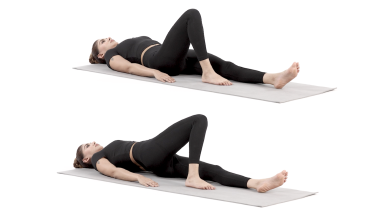 Rolling onto your side in bed
Stop signs and precautions for the rolling onto your side in bed
Before you start
- If you have had surgery on your spine in recent months, get the go-ahead from your surgical team or physio first. This roll turns your pelvis while your shoulders stay put, which twists the back, and after spine surgery most teams ask you to keep your shoulders and hips turning together instead, the way the log roll out of bed does.
- If one side of your body is weak after a stroke or another nerve condition, ask your physio or occupational therapist to set this up with you first and show you where to put the weak arm, because it can be left behind or trapped under you as you turn.
- If you have had a hip replacement, get the go-ahead from your surgeon or physio before you try rolling onto your side in bed. As the pelvis turns, the bent knee can drift in across the middle of your body while the hip turns inward, and many surgeons ask you to avoid that for the first months after some operations. Your surgical team may ask you to keep a pillow between your knees whenever you turn. If you are pregnant and past the first three months, check with your physio before exercising flat on your back.
When to stop and get help
- Sharp pain in your back or hip, or pain that builds with each lift.
- The shoulder of a weak arm hurts, or the arm gets caught under you as you turn.
- You feel dizzy, lightheaded or faint, or the room seems to spin, as you move in bed or sit on its edge. Stop, lie back down on the bed if you can, and keep still until it passes. If it does not pass within a minute or two, or it keeps happening, get medical advice the same day before you practice again. If you faint, it does not settle within a few minutes of keeping still, or your vision suddenly blurs or goes double, call emergency services.
- Your calf or thigh is getting more swollen, or becomes warm, tender, red or darker than usual, or has a new throbbing or cramping pain. This can be a blood clot, especially after an operation, an injury, time in a cast, boot or brace, or a spell of being much less mobile than usual, and after an operation it can also be an infection. Stop and contact your medical team or get medical advice the same day. If you are also short of breath or have chest pain, call emergency services.
- You suddenly become short of breath, get chest pain or pain in your upper back that may be worse when you breathe in, cough up blood, your heart beats very fast, or you faint. Call emergency services straight away, even if your leg looks normal, as this can be a blood clot in the lungs (pulmonary embolism).
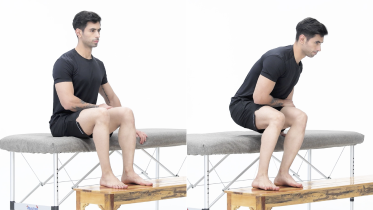 Scooting sideways on the bed
Stop signs and precautions for the scooting sideways on the bed
Before you start
- If you have had a hip replacement, get the go-ahead from your surgeon or physio before you try scooting sideways on the bed. Leaning well forward to lift your bottom bends the hips past a right angle, especially on a low bed, and many surgeons ask you to avoid that for the first months after some operations.
- If the arm you push with has had surgery or a fracture, ask your surgical team or physio before you put weight through it.
- After recent heart or chest surgery, get your surgeon's or surgical team's okay first, because lifting your bottom clear of the bed puts your weight through one arm and pulls across the healing breastbone. If the breastbone clicks, grinds, shifts or feels as if it is moving while you do it, stop, and contact your surgical team the same day.
- Have a helper beside you while you are learning, and if you have fallen in the past year, or feel less steady than usual today, wait until they are there. If a stroke or another condition has weakened one side of your body, ask your physio or occupational therapist first how to do it and whether you need someone with you.
When to stop and get help
- The wrist or shoulder you push with hurts, or the shoulder of a weak arm starts to ache.
- You feel yourself sliding off the bed or about to fall. Stop, sit back and let the person helping you steady you.
- You feel dizzy, lightheaded or faint, or the room seems to spin, as you move in bed or sit on its edge. Stop, lie back down on the bed if you can, and keep still until it passes. If it does not pass within a minute or two, or it keeps happening, get medical advice the same day before you practice again. If you faint, it does not settle within a few minutes of keeping still, or your vision suddenly blurs or goes double, call emergency services.
- Your calf or thigh is getting more swollen, or becomes warm, tender, red or darker than usual, or has a new throbbing or cramping pain. This can be a blood clot, especially after an operation, an injury, time in a cast, boot or brace, or a spell of being much less mobile than usual, and after an operation it can also be an infection. Stop and contact your medical team or get medical advice the same day. If you are also short of breath or have chest pain, call emergency services.
- You suddenly become short of breath, get chest pain or pain in your upper back that may be worse when you breathe in, cough up blood, your heart beats very fast, or you faint. Call emergency services straight away, even if your leg looks normal, as this can be a blood clot in the lungs (pulmonary embolism).
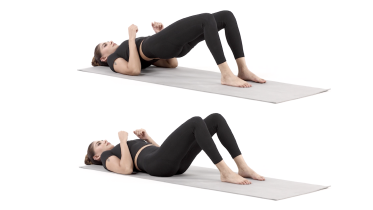 Bridging across the bed
Stop signs and precautions for the bridging across the bed
Before you start
- If you have had a hip replacement, get the go-ahead from your surgeon or physio before you try bridging across the bed. Shifting your hips sideways while your feet stay put angles the thigh on that side in toward the middle of your body, and many surgeons ask you to avoid that for the first months after some operations. If you have had surgery on your spine in recent months, get the go-ahead from your surgical team or physio first. After an operation on your knee, your surgical team's instructions for moving in bed come first too. If you are pregnant and past the first three months, check with your physio before exercising flat on your back.
- If a stroke or another condition has left one side of your body weak, ask your physio or occupational therapist before you try this, because they decide how you do it and whether you need a helper.
When to stop and get help
- Your back, hip or knee hurts sharply, or an ache lingers once you stop.
- The backs of your thighs cramp. Lower your hips, rest, and start the next one with your heels nearer your bottom.
- You feel dizzy, lightheaded or faint, or the room seems to spin, as you move in bed or sit on its edge. Stop, lie back down on the bed if you can, and keep still until it passes. If it does not pass within a minute or two, or it keeps happening, get medical advice the same day before you practice again. If you faint, it does not settle within a few minutes of keeping still, or your vision suddenly blurs or goes double, call emergency services.
- Your calf or thigh is getting more swollen, or becomes warm, tender, red or darker than usual, or has a new throbbing or cramping pain. This can be a blood clot, especially after an operation, an injury, time in a cast, boot or brace, or a spell of being much less mobile than usual, and after an operation it can also be an infection. Stop and contact your medical team or get medical advice the same day. If you are also short of breath or have chest pain, call emergency services.
- You suddenly become short of breath, get chest pain or pain in your upper back that may be worse when you breathe in, cough up blood, your heart beats very fast, or you faint. Call emergency services straight away, even if your leg looks normal, as this can be a blood clot in the lungs (pulmonary embolism).
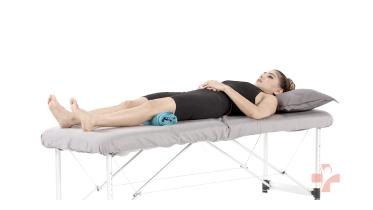 Quad sets (towel under knee)
Stop signs and precautions for the quad sets (towel under knee)
Before you start
- After a knee fracture or knee surgery, including a knee replacement, follow your surgeon's or physio's plan, and start this exercise only when they have cleared you.
When to stop and get help
- Your knee pain goes up sharply.
- Your calf or thigh is getting more swollen, or becomes warm, tender, red or darker than usual, or has a new throbbing or cramping pain. This can be a blood clot, especially after an operation, an injury, time in a cast, boot or brace, or a spell of being much less mobile than usual, and after an operation it can also be an infection. Stop and contact your medical team or get medical advice the same day. If you are also short of breath or have chest pain, call emergency services.
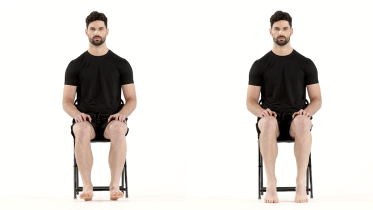 Ankle pumps
Stop signs and precautions for the ankle pumps
Before you start
- Had surgery on your foot or ankle, or wearing a cast or boot? Check which movements are allowed before you start.
When to stop and get help
- Your calf or thigh is getting more swollen, or becomes warm, tender, red or darker than usual, or has a new throbbing or cramping pain. This can be a blood clot, especially after an operation, an injury, time in a cast, boot or brace, or a spell of being much less mobile than usual, and after an operation it can also be an infection. Stop and contact your medical team or get medical advice the same day. If you are also short of breath or have chest pain, call emergency services.
- You suddenly become short of breath, get chest pain or pain in your upper back that may be worse when you breathe in, cough up blood, your heart beats very fast, or you faint. Call emergency services straight away, even if your leg looks normal, as this can be a blood clot in the lungs (pulmonary embolism).
- Any sharp pain in the foot or ankle.
- Emergency: while you are in a cast or boot, your toes turn blue, white or pale, or feel cold. Do not wait to see if raising your leg helps. Go to an emergency department straight away, and do not drive yourself. The cast or boot may be cutting off the blood supply, or pressure may be building up inside the leg (compartment syndrome), and both need checking quickly.
- In a cast or boot, the pain gets worse, your toes feel numb, tingle or burn or look more swollen, or the cast or boot feels too tight. Stop, raise your foot to about hip level and no higher, keep moving your toes and contact your fracture clinic or get medical advice straight away. If you wear a boot, loosen the straps but keep it on. Do not prop the foot higher than that and do not put ice on it, because if pressure is building up inside the lower leg both of those cut down the blood reaching your foot. If you cannot move your toes, the pain is severe even after painkillers, or the numbness, tingling, burning or swelling has not settled within 30 minutes of raising your foot, go to your fracture clinic or an emergency department straight away, and do not drive yourself.
- Since the fracture or cast, the foot or ankle is getting more painful rather than less, the skin becomes very sensitive to light touch, or the foot changes color, temperature, swelling or sweating compared with the other one, or looks shiny. See your doctor or physio as soon as you can, within a few days at most, as this can be complex regional pain syndrome (CRPS) and early treatment may help.
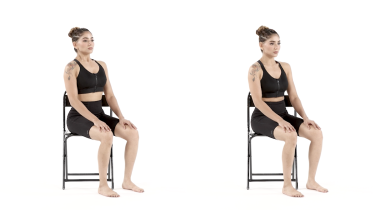 Breathing control
Stop signs and precautions for the breathing control
Before you start
- If you are pregnant and past the first three months, check with your physio before exercising flat on your back.
When to stop and get help
- Your fingers or the skin around your mouth start to tingle, or you feel light-headed or spaced out. This can mean you are breathing too fast or too deeply, so stop and let your breathing go back to normal. If it has not settled within a few minutes, get medical advice the same day. If you faint, or the numbness or tingling is on one side of your face or body, call emergency services, even if it goes away.
- You suddenly become short of breath, your chest feels tight or heavy, or you are far more short of breath than usual. Stop, rest and use your breathing control. Call emergency services if the breathlessness came on suddenly, your chest feels tight or heavy, your breathing does not go back to normal, you are gasping, choking or cannot get your words out, you have pain that spreads to your arms, back, neck or jaw, you feel suddenly confused or very drowsy, or your lips or skin turn very pale, blue or gray (on brown or black skin this can be easier to see on the palms of the hands). If everything settles quickly, get medical advice the same day before you do these exercises again.
Stage 2: Hips, trunk and the arms that now do more of the work
These start when your team says so, usually while you are still in hospital or just home, and none of them puts weight through the stump. NICE names hip flexors, hip abductors and knee flexors as the muscles to keep long and strong after limb loss, which is why the lying hip flexor stretch and the side lying work are in here rather than later. The standing hip flexor stretch is deliberately not in this list: it is a lunge held on one leg, which is not something to try before the limb-fitting team has you standing, so the lying version and prone lying do that job instead. Wall push-ups come out for the same reason. That exercise has you walk your feet back and lean your weight into your hands with the heels lifting, which is standing work on one leg before anybody has watched you stand, so the seated row carries the upper body in this stage and pushing up through the armrests gets the arms working as you rise. The VA/DoD routine care tool asks for trunk and core work and for strengthening the areas that take the overuse, naming the shoulders and the low back, because your arms now do the transfers and the pushing up. Two of these need a knee on the side you are working, the clamshell and the straight leg raise, so if your amputation is above the knee do those on your intact leg and let your physio set the side lying hip abduction, the prone hip extension and the dead bug to the length of limb you have, because all three are described with a knee, a shin or a foot in the picture. In the bridge, push through the foot you have, let the stump rest, and ask your physio how to keep your hips level. Sit to stand with armrests or with a walker is standing up on the intact leg with support, not a test of the stump. Keep your weight off the stump in all of these until the limb-fitting team tells you otherwise.
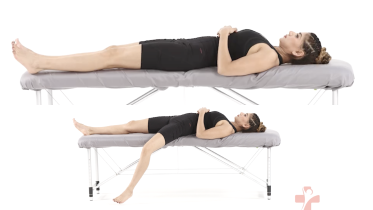 Lying hip flexor stretch
Stop signs and precautions for the lying hip flexor stretch
Before you start
- If you have had a hip replacement, get the go-ahead from your surgeon or physio before you try this stretch. Letting the leg hang below the edge of the bed takes that hip back past straight, and many surgeons ask you to avoid that for the first months after some operations. If you are pregnant and past the first three months, check with your physio before exercising flat on your back.
When to stop and get help
- Pinching in the groin, or sharp pain where the thigh meets the body.
- Your lower back starts to ache or pinch while the leg hangs.
- Pins and needles, numbness or a burning feeling over the front of the thigh.
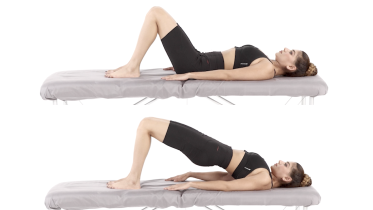 Glute bridge
Stop signs and precautions for the glute bridge
Before you start
- After hip, knee or back surgery, your surgeon's protocol decides when you can start bridges. Once you are past the first three months of pregnancy, check with your physio before exercising flat on your back.
- A bridge needs the knee bent to about 90 degrees before you lift, so if you have had knee surgery and been given a limit on how far the knee may bend, leave this one out and ask your surgeon or physio whether the bend it needs is allowed yet.
When to stop and get help
- You feel back pain rather than buttock work, even when you lift a little lower.
- Pain spreads down the leg or you get numbness or tingling.
- Your hamstrings (the back of the thighs) cramp. This is a common complaint with bridges, and bringing your feet a little closer to your bottom often eases it.
- Pain in the knee itself, or a knee that swells or is clearly more painful the next morning. The position holds the knee bent throughout, so after knee surgery stop and check with your surgeon or physio before you try it again.
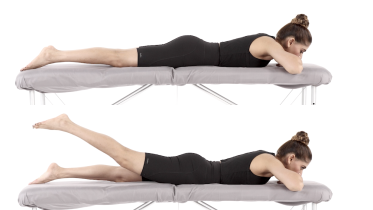 Prone hip extension
Stop signs and precautions for the prone hip extension
Before you start
- If you have had a hip replacement or other hip surgery, get the go-ahead from your surgeon or physio before you try prone hip extension. Lifting the leg takes the hip back behind the line of your body, and many surgeons ask you to avoid that for the first months after some operations, especially when the hip was replaced from the front (anterior approach).
- If you have had recent heart or chest surgery, do not lie face down on a healing chest wound. The weight of your chest presses on the wound for as long as you are down there, and pushing up through your arms to get off the bed pulls across the breastbone. Ask your surgeon or surgical team when lying on your front is allowed, and until then ask your physio for another way to do this while you lie on your side, sit or stand. If the breastbone clicks, grinds, shifts or feels as if it is moving while you do it, stop, and contact your surgical team the same day.
When to stop and get help
- Sharp or pinching pain in the lower back, or back pain that builds with each lift.
- Pain goes down the leg, or you notice numbness or tingling.
- Sharp pain at the front of the hip or in the groin.
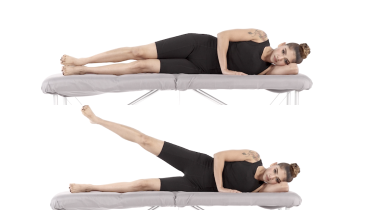 Side lying hip abduction
Stop signs and precautions for the side lying hip abduction
Before you start
- If you have had a hip replacement or other hip surgery, get the go-ahead from your surgeon or physio before you try side-lying hip abduction. Some operations limit this kind of work for the first months, so the timing depends on your surgery. With some surgical approaches, side leg lifts wait until the tissues at the side of the hip have healed.
When to stop and get help
- You feel sharp pain in the side of the hip, the groin or the lower back.
- Pain spreads down the leg or you get numbness or tingling.
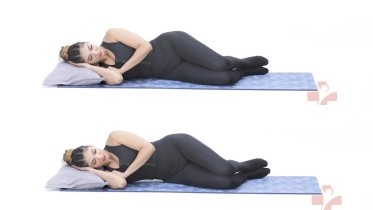 Isometric clamshell
Stop signs and precautions for the isometric clamshell
Before you start
- If you have had a hip replacement or other hip surgery, get the go-ahead from your surgeon or physio before you try the isometric clamshell. Some operations limit this kind of work for the first months, so the timing depends on your surgery. Lying on your side and turning the leg outward are both limited after some operations, and your surgical team will tell you which side you can lie on and whether you need a pillow between your knees.
When to stop and get help
- Sharp or pinching pain in the hip, groin or buttock.
- Pain, numbness or tingling that travels down your leg.
- The outside of your hip aches more with each hold, or feels sorer the next day.
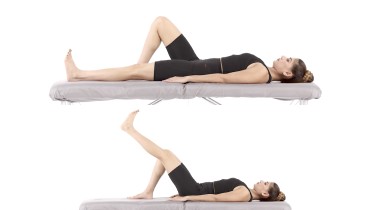 Straight leg raise
Stop signs and precautions for the straight leg raise
Before you start
- After a knee fracture or knee surgery, including a knee replacement, follow your surgeon's or physio's plan, and start this exercise only when they have cleared you.
- If you have had a hip replacement or other hip surgery, get the go-ahead from your surgeon or physio before you try this exercise. Some operations limit this kind of work for the first months, so the timing depends on your surgery. Lifting a straight leg is the heaviest way to use the muscles at the front of the hip, and after a periacetabular osteotomy a North American physiotherapy consensus panel asks for this exact movement, a straight leg lift while you are on your back, to be left out for 8 to 12 weeks.
- If you are pregnant and past the first three months, check with your physio before exercising flat on your back.
When to stop and get help
- Your lower back hurts.
- Knee pain increases during the set.
- You feel sharp pain in the front of the hip or groin.
- Your calf or thigh is getting more swollen, or becomes warm, tender, red or darker than usual, or has a new throbbing or cramping pain. This can be a blood clot, especially after an operation, an injury, time in a cast, boot or brace, or a spell of being much less mobile than usual, and after an operation it can also be an infection. Stop and contact your medical team or get medical advice the same day. If you are also short of breath or have chest pain, call emergency services.
- Your wound becomes more red, hot, swollen or painful, or starts to leak. Contact your medical team the same day.
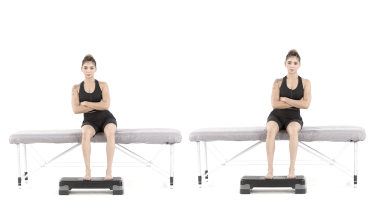 Seated weight shift lifting one hip
Stop signs and precautions for the seated weight shift lifting one hip
Before you start
- If you have had a hip replacement, get the go-ahead from your surgeon or physio before you try the seated weight shift. On a low bed or bench your hips sit bent past a right angle while you shift, and many surgeons ask you to avoid that for the first months after some operations. A surface high enough for your hips to sit a little above your knees keeps that bend smaller.
- Sit on a surface that cannot move, brakes on if it has wheels, and not right at the edge. Have someone beside you for the first sessions, and if you have fallen in the past year, ask your physio to watch you do it before you practice alone. If crossed arms feel too wobbly, keep your stronger hand down on the surface next to you.
- If a stroke or another condition has weakened one side of your body, ask your physio or occupational therapist first, because they set the exercise up and say whether someone should help.
When to stop and get help
- You tip further than you can bring yourself back from, or feel you might fall. Uncross your arms, press your stronger hand down beside you and settle back to the middle.
- Sharp pain in your back or hip as you shift.
- You feel dizzy, lightheaded or faint, or the room seems to spin, as you move in bed or sit on its edge. Stop, lie back down on the bed if you can, and keep still until it passes. If it does not pass within a minute or two, or it keeps happening, get medical advice the same day before you practice again. If you faint, it does not settle within a few minutes of keeping still, or your vision suddenly blurs or goes double, call emergency services.
- Your calf or thigh is getting more swollen, or becomes warm, tender, red or darker than usual, or has a new throbbing or cramping pain. This can be a blood clot, especially after an operation, an injury, time in a cast, boot or brace, or a spell of being much less mobile than usual, and after an operation it can also be an infection. Stop and contact your medical team or get medical advice the same day. If you are also short of breath or have chest pain, call emergency services.
- You suddenly become short of breath, get chest pain or pain in your upper back that may be worse when you breathe in, cough up blood, your heart beats very fast, or you faint. Call emergency services straight away, even if your leg looks normal, as this can be a blood clot in the lungs (pulmonary embolism).
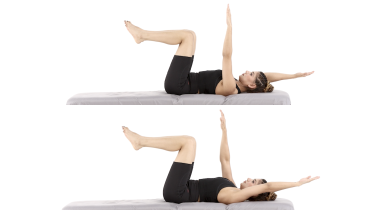 Dead bug
Stop signs and precautions for the dead bug
Before you start
- If you have had surgery on your stomach, or a hernia repair, get the go-ahead from your surgeon or physio before you start, and ask which version to begin with.
When to stop and get help
- Your back hurts and the pain does not settle after the set.
- You get numbness, tingling or pain spreading down a leg.
- Your stomach wall bulges or you feel pressure there. Tell your physio about it.
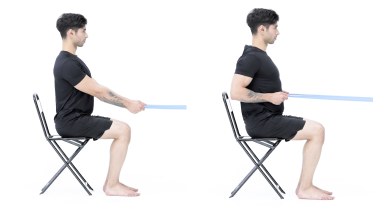 Seated row with band
Stop signs and precautions for the seated row with band
Before you start
- After shoulder surgery, rows with a band usually wait until later in rehab, so check with your surgeon or physio first.
- After heart or chest surgery, pulling against a band usually waits until your breastbone has had time to heal, so ask your surgeon or surgical team when to start: only the team that wired it can clear loaded pulling. If the breastbone clicks, grinds, shifts or feels as if it is moving while you do it, stop, and contact your surgical team the same day.
- If you have high blood pressure, breathe steadily through every repetition and never hold your breath.
- Do not lean forward to reach the band or twist to one side as you pull, and if you have had a fracture in your spine, check with your physio before you start.
When to stop and get help
- A sharp pain or catching feeling in your shoulder as you pull.
- Pain, tingling or numbness spreading down an arm.
- Pins and needles in your arm or hand that do not go away after you stop, or part of your arm or hand goes numb. Get medical advice the same day. If one side of your face or body suddenly goes numb or weak, or your speech becomes slurred or muddled, call emergency services, even if it goes away.
- A sudden pop or snap at the front of your elbow, sudden sharp pain there, or the muscle at the front of your upper arm bunches up or changes shape. Stop and go to an urgent care center or emergency department the same day, even if you can still bend the elbow, as this can be a torn biceps tendon.
- Chest pain or pressure, dizziness or feeling faint, a racing or irregular heartbeat, or being far more out of breath than the effort should cause.
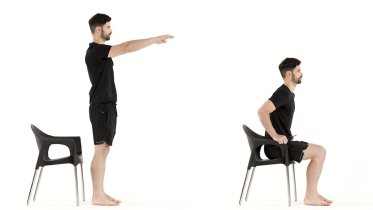 Sit to stand using armrests
Stop signs and precautions for the sit to stand using armrests
Before you start
- If you have had a hip replacement or other hip surgery, get the go-ahead from your surgeon or physio before you try sit to stand using armrests. Lowering into a chair and rising from it takes the hip beyond a right angle when the seat is low, and many surgeons ask you to avoid that for the first months after some operations.
- After recent heart or chest surgery through the breastbone, ask your surgeon or surgical team before you push up through the armrests, because pushing down through your hands loads the healing breastbone. If they have asked you to keep your hands off the armrests, stand up with your arms held out in front instead. If the breastbone clicks, grinds, shifts or feels as if it is moving while you do it, stop, and contact your surgical team the same day.
- If knee pain builds as you go, or you have had knee surgery, check with your physio what seat height to use.
- If balance is a worry or you have fallen before, have someone nearby and place the chair next to a counter or wall you can reach once upright. If you have osteoporosis, set the chair up the same way, next to a counter or wall, though thin bones on their own are not a reason to wait until someone is at home before you stand up out of a chair. Wear flat shoes that fit well and grip the floor, not socks, tights or bare feet.
When to stop and get help
- You feel dizzy, lightheaded or faint as you get up. Sit back down and wait for it to pass. If it does not pass within a minute or two, or it keeps happening, get medical advice the same day before you practice again. If you faint, or it does not settle within a few minutes of keeping still, call emergency services. A drop in blood pressure on standing, or a side effect of a medicine, can cause this, so mention your medicines when you get advice.
- Your knee, hip or back hurts sharply, or a wrist or shoulder hurts as you push on the armrests.
- A leg buckles, or you feel close to falling.
- Chest pain or pressure, dizziness or feeling faint, a racing or irregular heartbeat, or being far more out of breath than the effort should cause.
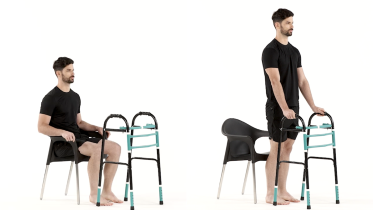 Sit to stand with a walker
Stop signs and precautions for the sit to stand with a walker
Before you start
- After a hip or knee operation, a broken leg or a stroke, your physio or occupational therapist may teach you a different way to place your feet and hands, or limit how much weight one leg can take, and their method comes first. If you have had a hip replacement, get the go-ahead from your surgeon or physio before you try sit to stand with a walker. Getting up from a low chair bends the hip well past a right angle, and many surgeons ask you to avoid that for the first months after some operations.
- Have someone with you while you are learning, especially if you have fallen before. Wear flat shoes that fit well and grip the floor, not socks, tights or bare feet.
When to stop and get help
- You feel dizzy, lightheaded or faint as you get up. Sit back down and wait for it to pass. If it does not pass within a minute or two, or it keeps happening, get medical advice the same day before you practice again. If you faint, or it does not settle within a few minutes of keeping still, call emergency services. A drop in blood pressure on standing, or a side effect of a medicine, can cause this, so mention your medicines when you get advice.
- A leg gives way or you feel you are about to fall. Sit back down with control if you can, and practice only with someone beside you until your physio has checked you.
- Sharp pain in your hip, knee or back, or in a wrist or shoulder as you push on the armrests.
- Chest pain or pressure, dizziness or feeling faint, a racing or irregular heartbeat, or being far more out of breath than the effort should cause.
- Your calf or thigh is getting more swollen, or becomes warm, tender, red or darker than usual, or has a new throbbing or cramping pain. This can be a blood clot, especially after an operation, an injury, time in a cast, boot or brace, or a spell of being much less mobile than usual, and after an operation it can also be an infection. Stop and contact your medical team or get medical advice the same day. If you are also short of breath or have chest pain, call emergency services.
- You suddenly become short of breath, get chest pain or pain in your upper back that may be worse when you breathe in, cough up blood, your heart beats very fast, or you faint. Call emergency services straight away, even if your leg looks normal, as this can be a blood clot in the lungs (pulmonary embolism).
- You have had a fall or an injury and now have severe hip pain, or you cannot walk or put weight on the leg. Call emergency services or go to an emergency department. This can be a sign of a broken hip (hip fracture).
Stage 3: Standing, balance and walking, which waits for the limb-fitting team
This is the stage that waits. Do not start it until your prosthetist and physio have fitted a limb, set your wear time and watched you stand and step with it, because the load it puts through the stump is theirs to allow. Single leg stance here means standing on your intact limb, not on the stump or the prosthesis, and that is how it should be practiced unless your physio has said otherwise and is watching. The two weight shifts are the work that teaches you to let the prosthetic side take its share, which the VA/DoD tool describes as equalizing weight between the two legs, and the walking exercises go in the order most teams use: hand support, then a walker, then a cane. Getting up from the floor is in this stage because it is part of what the guideline's prosthetic training phase covers, and it is the one to learn with a physio in the room rather than alone at home.
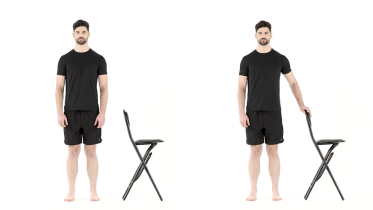 Standing balance at a chair
Stop signs and precautions for the standing balance at a chair
Before you start
- After a knee replacement or other knee surgery, a hip replacement, or a broken hip or leg fixed with screws, a nail or a plate, follow your surgeon's or physio's weight-bearing plan, and start this exercise only when they have cleared you. Taking your hand off the chair puts your full body weight through both legs, so if you have been told to put only part of your weight through that leg, or none of it, or to keep using a frame or crutches for now, this exercise is not yours yet, whatever the leg feels able to do. Keep the hand on the chair until they tell you it can come off.
When to stop and get help
- You feel dizzy, lightheaded, faint or sick, or the room seems to spin. Hold your support, sit down and get medical advice the same day before you practice again. If you faint, it does not settle within a few minutes of sitting still, your vision suddenly blurs or goes double, or you cannot stand or walk steadily, call emergency services.
- You start to tip and need the chair to catch yourself. Put your hand back on it, rest, then try a shorter hold.
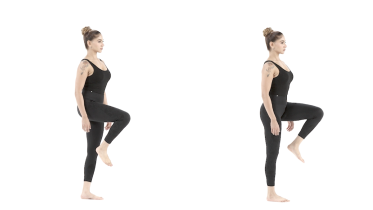 Single leg stance
Stop signs and precautions for the single leg stance
Before you start
- If you have had a hip or knee replacement, or other hip or knee surgery, get the go-ahead from your surgeon or physio before you try single leg stance. Standing on the operated leg alone comes at a set stage of rehab, and some hip operations limit how high the knee can lift in the first months after surgery.
When to stop and get help
- You feel dizzy, lightheaded, faint or sick, or the room seems to spin. Hold your support, sit down and get medical advice the same day before you practice again. If you faint, it does not settle within a few minutes of sitting still, your vision suddenly blurs or goes double, or you cannot stand or walk steadily, call emergency services.
- You lose your balance and cannot steady yourself with your support.
- Sharp pain in the hip, knee or ankle of the standing leg.
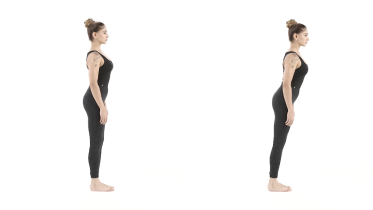 Forward and backward weight shift
Stop signs and precautions for the forward and backward weight shift
Before you start
- After an ankle fracture or ankle surgery, follow your surgeon's or physio's weight-bearing plan, and start this exercise only when they have cleared you.
- If you have had a hip or knee replacement, or other hip or knee surgery, get the go-ahead from your surgeon or physio before you try forward and backward weight shifts, and ask how much weight you are allowed to put through the operated leg first.
When to stop and get help
- You feel dizzy, lightheaded, faint or sick, or the room seems to spin. Hold your support, sit down and get medical advice the same day before you practice again. If you faint, it does not settle within a few minutes of sitting still, your vision suddenly blurs or goes double, or you cannot stand or walk steadily, call emergency services.
- Your calf or thigh becomes swollen, warm, tender, red or darker than usual, or has a throbbing or cramping pain that feels different from normal muscle ache. Stop and get medical advice the same day, as this can be a blood clot. If you are also short of breath or have chest pain, call emergency services.
- Sharp pain in your ankle or foot as your weight moves onto your toes or heels.
- Since the fracture or cast, the foot or ankle is getting more painful rather than less, the skin becomes very sensitive to light touch, or the foot changes color, temperature, swelling or sweating compared with the other one, or looks shiny. See your doctor or physio as soon as you can, within a few days at most, as this can be complex regional pain syndrome (CRPS) and early treatment may help.
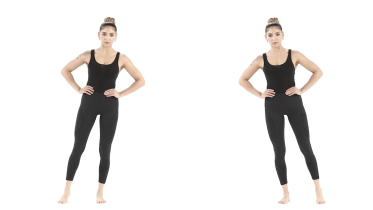 Side to side weight shift
Stop signs and precautions for the side to side weight shift
Before you start
- If you have had a hip or knee replacement, or other hip or knee surgery, get the go-ahead from your surgeon or physio before you try side to side weight shifts. Some operations limit this kind of work for the first months, so the timing depends on your surgery. Ask them how much weight you are allowed to put through the operated leg before you shift fully onto it.
When to stop and get help
- You feel dizzy, lightheaded, faint or sick, or the room seems to spin. Hold your support, sit down and get medical advice the same day before you practice again. If you faint, it does not settle within a few minutes of sitting still, your vision suddenly blurs or goes double, or you cannot stand or walk steadily, call emergency services.
- You start to lose your balance and need to grab your support to stay up.
- Sharp pain in the hip, knee or ankle.
- Since the fracture or cast, the foot or ankle is getting more painful rather than less, the skin becomes very sensitive to light touch, or the foot changes color, temperature, swelling or sweating compared with the other one, or looks shiny. See your doctor or physio as soon as you can, within a few days at most, as this can be complex regional pain syndrome (CRPS) and early treatment may help.
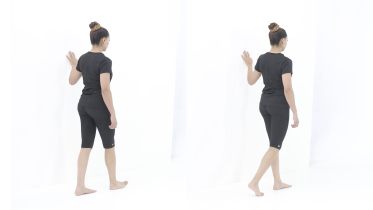 Walking with hand support
Stop signs and precautions for the walking with hand support
Before you start
- After a broken leg or leg surgery, stick to the amount of weight your surgeon or physio has said the leg can take.
When to stop and get help
- You feel dizzy, lightheaded, faint or sick, or the room seems to spin. Hold your support, sit down and get medical advice the same day before you practice again. If you faint, it does not settle within a few minutes of sitting still, your vision suddenly blurs or goes double, or you cannot stand or walk steadily, call emergency services.
- You trip, a knee or ankle gives way, or you need the wall to stop yourself falling. Stop and sit down on the chair.
- New or sharper pain in a hip, knee or ankle that makes you limp.
- Your calf or thigh becomes swollen, warm, tender, red or darker than usual, or has a throbbing or cramping pain that feels different from normal muscle ache. Stop and get medical advice the same day, as this can be a blood clot. If you are also short of breath or have chest pain, call emergency services.
- You have had a fall or an injury and now have severe hip pain, or you cannot walk or put weight on the leg. Call emergency services or go to an emergency department. This can be a sign of a broken hip (hip fracture).
- Chest pain or pressure, dizziness or feeling faint, a racing or irregular heartbeat, or being far more out of breath than the effort should cause.
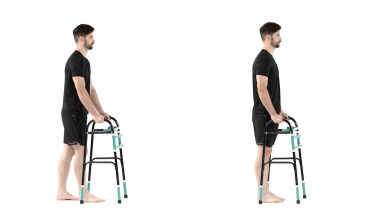 Step to walking with a walker
Stop signs and precautions for the step to walking with a walker
Before you start
- After an operation or a broken bone in the leg, walk only in the way your surgeon or physio has taught you. Some weight-bearing plans let the weaker leg take only part of your weight for a time, and the frame is how you keep to that. If you have been told to keep all your weight off the leg, this pattern is not the right one, and your physio will teach you a different way to use the frame. After a hip replacement, also follow the movement advice your surgical team gave you.
- If you have fallen in the past year or feel unsteady, have another adult walk beside you until your physio says you can practice alone.
When to stop and get help
- You feel dizzy, lightheaded, faint or sick, or the room seems to spin. Hold your support, sit down and get medical advice the same day before you practice again. If you faint, it does not settle within a few minutes of sitting still, your vision suddenly blurs or goes double, or you cannot stand or walk steadily, call emergency services.
- You stumble, the weaker leg gives way or the frame tips. Stop and sit down, and tell your physio before your next walk.
- New or much worse pain in the hip, knee or ankle, or pain that makes you limp more than before.
- You have had a fall or an injury and now have severe hip pain, or you cannot walk or put weight on the leg. Call emergency services or go to an emergency department. This can be a sign of a broken hip (hip fracture).
- Your calf or thigh is getting more swollen, or becomes warm, tender, red or darker than usual, or has a new throbbing or cramping pain. This can be a blood clot, especially after an operation, an injury, time in a cast, boot or brace, or a spell of being much less mobile than usual, and after an operation it can also be an infection. Stop and contact your medical team or get medical advice the same day. If you are also short of breath or have chest pain, call emergency services.
- You suddenly become short of breath, get chest pain or pain in your upper back that may be worse when you breathe in, cough up blood, your heart beats very fast, or you faint. Call emergency services straight away, even if your leg looks normal, as this can be a blood clot in the lungs (pulmonary embolism).
- Chest pain or pressure, dizziness or feeling faint, a racing or irregular heartbeat, or being far more out of breath than the effort should cause.
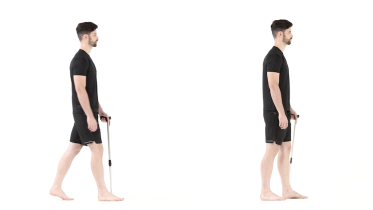 Walking with a cane
Stop signs and precautions for the walking with a cane
Before you start
- If you have broken a bone in your leg or had an operation on it, follow the weight-bearing plan your surgeon or physio gave you. Do not swap crutches or a frame for a single cane until they tell you that you are ready.
When to stop and get help
- You feel dizzy, lightheaded, faint or sick, or the room seems to spin. Hold your support, sit down and get medical advice the same day before you practice again. If you faint, it does not settle within a few minutes of sitting still, your vision suddenly blurs or goes double, or you cannot stand or walk steadily, call emergency services.
- You stumble, your leg gives way, or you have to grab something to stay upright. Stop and sit down.
- Your calf or thigh becomes swollen, warm, tender, red or darker than usual, or has a throbbing or cramping pain that feels different from normal muscle ache. Stop and get medical advice the same day, as this can be a blood clot. If you are also short of breath or have chest pain, call emergency services.
- New or much worse pain in your hip, knee or ankle that changes the way you walk.
- Since the fracture or cast, the foot or ankle is getting more painful rather than less, the skin becomes very sensitive to light touch, or the foot changes color, temperature, swelling or sweating compared with the other one, or looks shiny. See your doctor or physio as soon as you can, within a few days at most, as this can be complex regional pain syndrome (CRPS) and early treatment may help.
- You have had a fall or an injury and now have severe hip pain, or you cannot walk or put weight on the leg. Call emergency services or go to an emergency department. This can be a sign of a broken hip (hip fracture).
- Chest pain or pressure, dizziness or feeling faint, a racing or irregular heartbeat, or being far more out of breath than the effort should cause.
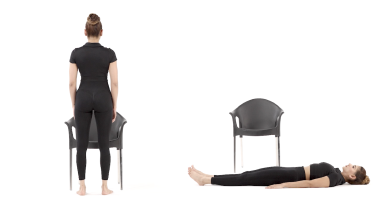 Getting up from the floor
Stop signs and precautions for the getting up from the floor
Before you start
- If you have just fallen and cannot get up, this page is not where to start. Stay where you are, keep warm and call emergency services, or get someone to call for you. Nobody should try to lift you off the floor. The practice on this page is for another day.
- Practice with a family member, friend or caregiver in the room, on a day when you feel well, and keep a phone or a personal alarm on you, because the one time you need this skill you may be alone. If you have fallen in the past year or feel unsteady, ask your physio to go through it with you the first time.
- If you have had surgery on your spine in recent months, get the go-ahead from your surgical team or physio first. Getting down to the floor, kneeling and pushing back up bend and load the back, and after some spine operations your team will not want you down there yet.
- After recent heart or chest surgery, get your surgeon's or surgical team's okay first, because getting down to the floor and back up takes your weight through your hands and arms, including time on your hands and knees. If the breastbone clicks, grinds, shifts or feels as if it is moving while you do it, stop, and contact your surgical team the same day.
- If you have had surgery on a shoulder, elbow, wrist or hand in recent months, or are still healing from a broken wrist, arm or collarbone, get the go-ahead from your surgeon or physio before you try getting up from the floor. Getting down and back up takes your weight through your hands, wrists, elbows and shoulders, including time on your hands and knees and a push up from one forearm, and some operations and fractures limit that for the first months. Your physio can teach you a route up that keeps the weight off the healing side.
- If you have had a hip replacement, get the go-ahead from your surgeon or physio before you try getting up from the floor. Kneeling down and pushing up from half kneeling bend the hip well past a right angle, and many surgeons ask you to avoid that for the first months after some operations. Your physio can teach you a way to get up that fits your surgery. After a knee replacement, do not kneel on the new knee until your doctor says you can, which is what the NHS advises after that operation, and ask your surgeon or physio for a route up that does not need kneeling in the meantime. Once you have been cleared to kneel, pad the floor well.
- If you have had a broken hip fixed with screws, a nail or a plate, or had part or all of the hip replaced, get the go-ahead from your surgeon or physio before you try getting up from the floor. Some operations limit this kind of work for the first months, so the timing depends on your surgery.
When to stop and get help
- Sharp pain in your hip, knee or back, or pain that stays after you rest.
- You feel dizzy, lightheaded or faint as you get up. Stay down or sit on the chair and wait for it to pass. If it does not pass within a minute or two, or it keeps happening, get medical advice the same day before you practice again. If you faint, or it does not settle within a few minutes of keeping still, call emergency services. Even if it passes quickly, tell your physio before you practice again.
- Chest pain or pressure, dizziness or feeling faint, a racing or irregular heartbeat, or being far more out of breath than the effort should cause.
- You cannot get back up, even with the chair, or you think you may have hurt your head, neck, back or hip. Stay where you are, keep warm and call emergency services, or get someone to call for you. If you got up and walked without trouble and only notice pain later, without any of the emergency signs above, use the same-day lines in this list instead. Nobody should try to lift you.
- After a fall, you are in pain, have hurt yourself or feel unwell, or you were on the floor for an hour or more, without any of the emergency signs above. Get medical advice the same day, even if you managed to get up.
- You have had a hip replacement, or a broken hip fixed with screws, a nail or a plate, and after a fall or a knock, even a small one, your hip, groin or thigh is newly painful, bruised or swollen, even if you can still walk and your leg looks normal. Stop the exercises and keep your full weight off that leg, using your stick, frame or crutches if you have them and asking someone for help to move about, then contact your surgical team or get medical advice the same day. A break in the bone around a new hip, or around metalwork left in the bone, is not always obvious at first, and walking normally on one can move the broken ends apart.
- A calf or thigh that is newly swollen or getting more swollen, warm, tender, red or darker than usual, has swollen veins that are sore to touch, or has a throbbing or cramping pain that does not fit your injury or condition, or that feels different from normal muscle soreness after exercise. This can be a sign of a blood clot (deep vein thrombosis), especially after surgery, an injury, time in a cast or boot, a long trip or a spell of being much less mobile than usual. Get medical advice the same day. If you are also short of breath or have chest pain, call emergency services.
How do you learn to walk with a prosthetic leg?
The order most teams use is the order our library happens to hold: hand support at a counter, then a walker, then a cane, then nothing. Earlier than that, in hospital, the first steps are taken with your physiotherapist and whatever support they choose, and that part is not something to copy at home. Each step down in support is a decision your physio makes with you, and going back up a step for a week is normal rather than a setback.
Floor recovery, meaning getting up from the floor after a fall, is a task in its own right in the VA/DoD prosthetic training phase. Given how common falls are in this group, learn it with a physio watching before you practice it alone, and ask them to set up what you practice on. The same tool also puts floor recovery strategies in the earlier post-amputation phase, before a prosthesis exists, so it is worth asking about then rather than waiting for one, because a fall does not wait for the limb. Getting up from the floor shows the sequence, and our page on it for older adults goes into the same problem from a different direction.
Falls, and what the evidence does and does not show
This is the point where most pages on this subject overpromise, so here is the position as plainly as we can put it. Falls are common, they are more common at some stages than others, and no source we have been able to read shows that an exercise program reduces them after a lower limb amputation.
The falls figures and their risk factors are in the common questions at the foot of this page, from two systematic reviews. The VA/DoD guideline's only falls-related recommendation is about microprocessor knee units rather than exercise, and it sits at Weak for. So the case for the balance work in stage 3 is that it is what the guideline's rehabilitation recommendation and its routine care tool both describe, not that it has been shown to stop you falling.
What to do with that is practical rather than discouraging. Ask your doctor or physio for a falls assessment, which is a service in its own right in most of our markets, and read balance and falls prevention for what one involves. If you have had a fall, report it even if you were not hurt, as the warning list at the foot of this page says.
How weak the evidence is, said once and plainly
The guideline covering this subject is the VA/DoD Clinical Practice Guideline for Rehabilitation of Individuals with Lower Limb Amputation, version 3.0, December 2024. Its recommendation table holds 26 recommendations. Sixteen of them are Weak for, ten are Neither for nor against, and none is Strong for.
The one that covers what this page is, recommendation 12, suggests an individualized and skilled rehabilitation program with exercise and gait training to improve function, walking ability and quality of life. It is Weak for, and the discussion attached to it records the work group's confidence in the quality of the evidence as very low.
Better to read that here than find it later. It does not mean the program is pointless, and it does not mean the alternative is better, because nobody has shown that either. It means the strength of the recommendation is honest about how thin the trials are, and it is a reason to work with a physiotherapist who can adjust things to you rather than to follow any page, including this one, as though the numbers were settled. One related figure often quoted on this subject, the extra energy cost of walking on a prosthesis, has no source we could trace, so it is not on this page.
What this page does not decide
Four things belong to other people and a page cannot take them on.
The level of the amputation and the surgical technique are the surgeon's, and the guideline's first recommendation says there is insufficient evidence to recommend one amputation procedure over another. On the dressing that goes over the stump it does take a side, at Weak for: after a below-knee amputation it suggests a rigid or semi-rigid dressing rather than a soft one, while its own discussion found no new evidence and sets out the advantages and the disadvantages of each type beside each other, so which one you get is a surgical judgement rather than a settled answer. Several of the component questions it leaves at Neither for nor against, including which above-knee socket design to use. The prosthesis itself, which components, how long to wear it each day, sock ply and how fast to build wear time, belongs to your prosthetist and physio. Any load through the stump before they have said so belongs to them too. And the share of amputations that trauma accounts for is worth one line: the guideline reports it as a minority of amputations in the United States, but we traced the figure behind that sentence and part of the chain ends at a review article on a medical website rather than a study, so this page gives the direction and not the number.
When to see a physio or doctor
Everybody in this situation should be under a specialist amputee rehabilitation service, and NICE's advice for trauma is to refer to one as soon as possible. If you are at home and not in touch with one, ask your doctor to refer you rather than working from a website.
Get in touch sooner rather than at your next review if your stump is changing shape or volume quickly, if the socket has started rubbing, if you are putting less weight through the prosthesis than you were a fortnight ago, if your hip or knee is getting harder to straighten, or if you have had a fall. If you are low in mood or not sleeping, say that too: the NHS names the psychological impact of amputation, and the raised risk of post-traumatic stress after a traumatic amputation, in the same breath as the physical recovery.
Some stump problems are not training problems and no amount of exercise settles them. A hard lump at the end of the stump that the socket keeps catching on, which the team may call extra bone growth or heterotopic ossification. Skin that breaks down in the same spot however the socket is adjusted. A soft swelling that keeps filling up again. Loose soft tissue that slides in the socket. A sharp, electric pain in one place that jumps when you press it. For problems like these the VA/DoD residual limb tool works through the socket, the alignment, the liner and how you put the limb on first, and then raises a surgeon's opinion, including revision surgery, when wearing a prosthesis is still blocked. So ask your amputee service for a review rather than wearing the limb through it or carrying on with the program and hoping. A page cannot tell you which of those you have.
For the warning signs that need the same day or an emergency department, the list at the foot of this page is the one to go by. Red flags in physiotherapy explains how those tiers work.
For physiotherapists
This page is a patient-facing framework, built from the VA/DoD routine care tool's five phases collapsed into the three a condition page holds, with NICE NG211 1.14.16 setting the muscle priorities and the trauma scope flagged where it applies.
Two things are worth knowing about our library before you hand this to someone. There is no stump-specific, stump board or prosthesis donning content in it, so what you see is general lower limb, trunk and upper limb work applied to this population. And nothing here is written for the pre-prosthetic loading decision, which is why stage 3 is gated on the limb-fitting team by its own text rather than by a timeframe.
Warning signs
Get emergency help now
- Emergency: since your operation, you suddenly become short of breath, you get chest pain or pain in your upper back that may be worse when you breathe in, you cough up blood, your heart is beating very fast, or you faint. Call emergency services straight away, even if your leg looks normal. These can be signs of a blood clot in the lungs (pulmonary embolism).
- If chest pain, pressure or tightness does not ease quickly when you rest, spreads to your arm, neck, jaw, stomach or back, or comes with sweating, feeling sick, feeling light-headed or being short of breath, call emergency services straight away, as this can be a heart attack. If it eases quickly and none of these happen, get medical advice the same day, and do not exercise again until you have been checked.
- Emergency: sudden confusion, for example you, or the person you care for, suddenly become muddled, much drowsier than usual, unable to follow what is said, unsure where you are, or you see or hear things that are not there. Call emergency services or go to an emergency department straight away, without driving yourself, and take your medicines or a list of them with you. Sudden confusion can come from an infection, a stroke, a head injury, a low blood sugar level in someone with diabetes or other causes that need treating quickly.
- Emergency: any sign of a stroke, even if it goes away. That means a face that droops on one side, an arm you cannot lift or keep up, slurred or muddled speech, weakness or numbness on one side of your body or face, sudden blurred vision, double vision or loss of sight, trouble swallowing, sudden dizziness with unsteadiness or falling over, a sudden severe headache, or a sudden fall where your legs give way but you do not black out (a drop attack). Call emergency services straight away.
- Emergency: a wound from an operation that splits or gapes open, bleeds heavily, suddenly leaks a gush of pink, watery fluid, or has anything bulging or coming out of it. Call emergency services or go to an emergency department straight away, and do not drive yourself. Do not push anything back in and do not try to pull the wound closed; cover it with a clean dressing or a clean towel and lie down until help comes. A wound that is coming apart needs a surgeon rather than a dressing change, and it does not wait for a fever or for the next clinic appointment.
- Emergency: the skin on your stump, the skin around the wound, or a patch at the end of the stump turns cold, pale, blue, gray or black. Call emergency services or go to an emergency department straight away, and do not drive yourself, as the blood supply to the limb may be blocked. This one matters most if the amputation was done for poor circulation or a diabetic foot infection, because the tissue the surgeon left behind lives on the same circulation as the part that was removed.
- Emergency: a wound or sore on your foot deep enough that you can see bone, tendon or the inside of a joint in it, a toe or part of your foot that has gone red, hot and swollen all over, or a wound with black or gray dead-looking tissue in it. Go to an emergency department the same day, keep your weight off that foot, and do not wait for your next clinic appointment. A foot that cannot feel pain can carry an infection down to the bone while it still feels like very little, and an infection that deep is treated in hospital rather than with a change of dressing (NICE NG19). The same applies if you feel feverish, shivery or very unwell with any wound on your foot.
- Emergency: you have just fallen and cannot get up, or you think you may have hurt your head, neck, back or hip. Stay where you are, keep warm and call emergency services, or get someone to call for you. Nobody should try to lift you off the floor, and nobody should pull you up by the arms: being hauled upright can move a broken bone that has not slipped yet and can make an injured neck or back worse. Someone helping should call for help, keep you warm and stay with you. If you got up and walked without trouble and only notice pain later, without any of the emergency signs in this list, use the same-day lines in it instead.
- Emergency: you fell and cannot remember the fall or how it happened. Go to an emergency department straight away, and do not drive yourself. You may have blacked out or hit your head without knowing it.
Get help today
- Same day: your wound becomes more red, hot, swollen or painful, starts to leak or ooze, is still leaking in the second week or has never stopped, has pus coming out of it or its edges start to come apart, or you have a high temperature or feel hot, cold or shivery. Contact your surgical team or get medical advice the same day. Redness can be harder to see on brown or black skin. If you feel very unwell, go to an emergency department. If you have a very high or very low temperature, shivering you cannot control, you are breathing very fast or finding it hard to breathe, you are confused or your speech is slurred, your skin, lips or tongue look blue, gray, pale or blotchy (on brown or black skin this can be easier to see on the palms of the hands or soles of the feet), or you have a rash that does not fade when you press it, call emergency services, as this can be sepsis.
- Same day: a sore, a blister, a cut or broken skin anywhere on your stump, or a red mark from the socket that has not faded within 15 to 20 minutes of taking the prosthesis off. Stop wearing the prosthesis and contact your prosthetist or limb-fitting team the same day, and ask them at the same time how you are meant to get about safely while it is off. The VA/DoD residual limb guidance limits wear time when redness does not settle in that time, rests the prosthesis until a wound has healed, and then builds wear time back up gradually, and all three of those are decisions for your team rather than for you alone. If the skin is also hot, the redness is spreading, fluid or pus is coming out, the wound or the skin starts to smell, or you have a high temperature, feel hot, cold or shivery, or feel sick or are being sick with it, follow the wound warning in this list instead.
- Same day: a calf or thigh that is newly swollen or getting more swollen, warm, tender, red or darker than usual, has swollen veins that are sore to touch, or has a throbbing or cramping pain that does not fit your injury or condition, or that feels different from normal muscle soreness after exercise. This can be a sign of a blood clot (deep vein thrombosis), especially after surgery, an injury, time in a cast or boot, a long trip or a spell of being much less mobile than usual. Get medical advice the same day. If you are also short of breath or have chest pain, call emergency services.
- Same day: since your operation, a new or worsening cough, phlegm, a high temperature, chest pain when you breathe or cough, or feeling more short of breath than you did a few days ago. Get medical advice the same day. A chest infection can show up as a cough, breathlessness, a high temperature, chest pain, wheezing, an aching body, loss of appetite and tiredness, and the NHS notes that feeling confused is common in older people who have pneumonia, so the first sign is not always a cough. If you are struggling to breathe, your lips, skin or tongue turn pale, blue or blotchy, you cough up blood, your heart is beating very fast or you suddenly feel confused, call emergency services. If you have a very high or very low temperature, shivering you cannot control, you are breathing very fast or finding it hard to breathe, you are confused or your speech is slurred, your skin, lips or tongue look blue, gray, pale or blotchy (on brown or black skin this can be easier to see on the palms of the hands or soles of the feet), or you have a rash that does not fade when you press it, call emergency services, as this can be sepsis.
- Same day: you are taking tablets or having injections to lower your risk of a blood clot and you notice blood in your urine, black or bloody stools, bleeding gums, a nosebleed that goes on and on, bruising far beyond what the knock would explain, or you are being sick or coughing up blood. Get medical advice the same day, and do not stop the medicine on your own. Bleeding more easily is the known trade-off of these medicines (NHS), and the dose or the type may need looking at. Go to an emergency department if the bleeding will not stop, you feel faint, or you bang your head while you are taking it, even if you feel fine, because the NHS advises getting urgent advice after a head injury on medicine that thins your blood and only a hospital can scan for a bleed inside the head.
- Same day: you have diabetes or numb feet and find a new blister, cut or sore on your foot, especially one you did not feel, a wound that smells or is leaking, or new pain in your foot that you cannot explain. Get it seen by your doctor or foot team the same day. If you also have a fever or feel very unwell, redness is spreading up your foot or leg, or part of your foot or a toe turns black, go to an emergency department.
- Same day: a sore, a blister or broken skin over a bony area such as a heel, hip, bottom, tailbone or elbow that is hot, swollen, red or darker than usual, has pus coming from it, is severely painful or getting more painful, or comes with a high temperature. Get medical advice the same day, from your doctor, a nurse or NHS 111 in the UK. An infected pressure sore (pressure ulcer) needs treating, and the risk is higher while you move less than usual and in the weeks after an operation (NHS). If you feel very unwell, or you have any of the sepsis signs listed above, call emergency services.
- Same day: sudden new dizziness, or feeling faint or unsteady, without any of the stroke signs above. Stop, sit down and get medical advice the same day. If you faint, it does not settle within a few minutes of sitting still, or you cannot stand or walk steadily, call emergency services.
- Same day: after a fall, you are in pain, have hurt yourself or feel unwell, or you were on the floor for an hour or more, without any of the emergency signs above. Get medical advice the same day, even if you managed to get up.
- Pain at night or at rest that keeps getting worse. If you are being treated for cancer now, contact your cancer team the same day.
- Same day: pain at night or at rest that keeps getting worse. If you have had cancer, now or in the past, get medical advice the same day and mention it, even if the pain is not getting worse. Do the same if you have back, hip or pelvic pain and are losing weight without trying, even if it does not hurt at night.
Book an appointment
- Within a few days: a patch of skin over a bony area, such as a heel, hip, bottom, tailbone or elbow, that is discolored and does not change color when you press it (usually red on white skin, purple or blue on brown or black skin), that feels warm, spongy or hard, or that is sore or itchy. Book an appointment with your doctor or nurse within a few days, keep the pressure off it until then and change position often. That is how a pressure sore (pressure ulcer) starts, and the risk is higher while you move less than usual, in the weeks after an operation, and where you sit or lie in one position for long (NHS). If it is already broken, weeping or painful, use the same day line above.
- Within a few days: you have had a fall, even if you were not hurt, or you keep tripping, stumbling or feeling that your legs might give way. Book an appointment with your doctor within a few days and ask about a falls assessment. Tell them about every fall, even the ones where you were not hurt.
- Pain at night or at rest that keeps getting worse. See your doctor within a few days.
Common questions
How long do leg amputations take to heal?
The honest answer splits into two timelines. The wound is the shorter one and your surgical team judges it, while getting back to walking and to ordinary life is the longer one: healthdirect in Australia puts recovering from and adjusting to an amputation at 6 to 12 months. Swelling in the stump settles over weeks and months rather than days, which is why sock numbers and socket fit keep changing early on. Healing also depends on why the amputation was done, because a limb removed for poor circulation or a diabetic foot infection heals in a body with poor circulation, and that is a different situation from a healthy leg lost in an accident.
When will I get a prosthetic leg?
Nobody can give you a date from a web page, and the NHS is blunt about the reason: it can be several weeks before a first prosthetist appointment, depending on what is available where you live. What decides your own timing is wound healing, the shape and volume of the stump, your general health and how much hip and knee movement you have kept. That last one is partly yours, which is the argument for stage 1 and stage 2. Ask your team directly at each review where you are on their list and what they want to see before the next step.
What exercises can I do before I have a prosthetic leg?
Most of the program, which surprises people. NICE's rehabilitation guideline says not to wait for a prosthesis to be fitted before rehabilitation starts, and stages 1 and 2 on this page are deliberately built to be done with no prosthesis and no weight through the stump. The work is positioning to stop the hip and knee tightening, bed mobility and transfers, hip and trunk strength, and the shoulder and arm strength your transfers now demand. Your team sets which of these you start and when.
Is walking with a prosthetic leg hard?
It is learned rather than automatic, and the figures for how many people get there are sobering. In one US university hospital series of 206 patients and 256 major lower limb amputations, done mostly for poor circulation, infection or critical limb ischemia, 46.1 percent were walking a year later, and the authors concluded that patients should be told fewer than half of people are walking after this operation (Chopra 2018). That is a vascular and infection population at one hospital, so it is not the number for a young person who lost a leg in an accident. What the figure is useful for is the argument against waiting: strength, hip movement and balance built before the limb arrives are the part you can influence.
Is it different above the knee and below the knee?
Yes, and the difference shows up in how much the prosthesis gets used. A review that pooled 29 studies and 4,814 people with lower limb loss found average prosthesis use of 9.6 hours a day overall, with a standard deviation of 5.3, and 6.4 days a week. Split by level, it averaged 14.0 hours a day after a below-knee amputation, 12.9 after an above-knee amputation and 6.0 after a hemipelvectomy or hip disarticulation (Paquette 2024). Walking with a higher amputation asks more of the hip, which is one reason the hip work in stage 2 matters more the higher the level.
Why am I told to lie on my stomach?
Because of what a tight hip does to walking later. If the hip settles into a bend, a prosthesis becomes harder to fit and harder to walk on, and the VA/DoD routine care tool puts positioning to prevent contractures of the hip, knee and ankle into its peri-operative phase, which is the first days after surgery. Lying flat on your front puts the hip into the opposite position to sitting, and most of your day after this operation is spent sitting. See prone lying for how it is set up. How long for is not settled by any guideline we can read: our exercise page starts at 2 to 5 minutes at a time and published rehabilitation protocols go up to 30 minutes three times a day (Demir and Aydemir, 2020), so your team's figure is the one to follow. If lying on your front is not possible for you, ask your physio what to do instead rather than skipping the aim.
What can I do about phantom limb pain?
Treat it as something to report rather than something to push through. Feeling the limb that is gone, and pain in it, are both common after amputation, and the NHS amputation page covers them as part of normal recovery rather than as a complication. The VA/DoD guideline names phantom limb pain in five of its 26 recommendations, numbers 3, 11, 21, 22 and 23, which is more than it gives to exercise, and not one recommendation in that whole guideline reaches Strong for, so there is no single answer to copy here. Tell your team early, because what helps is usually a combination set up with them, and no exercise program on its own is the treatment for it.
What makes a fall more likely after a leg amputation?
Falls are common and the rate depends on where you are in recovery. A review of 12 studies reported falls in 20.8 percent of people during the acute hospital stay, rising to 58 percent among people living in the community years after amputation, with 40 to 60 percent of fallers injured (Hunter 2017). The risk factors that belong to amputation specifically were poor circulation as the reason for the operation, a below-knee level in the period just after surgery, an above-knee level after rehabilitation, and reduced vibration sense; weak leg muscles, age, other health conditions and the number of medicines you take are shared with older adults generally. A second review of 18 studies added the first 4 years after amputation, having four or more health problems, a more variable walking pattern, being over-confident about your balance and walking, and taking stairs less carefully (Steinberg 2019). Those are risk factors rather than treatments, and no source we can read shows that a home exercise program reduces falls after amputation.
References
- Department of Veterans Affairs, Department of Defense. VA/DoD Clinical Practice Guideline for Rehabilitation of Individuals with Lower Limb Amputation. Version 3.0. December 2024. https://www.healthquality.va.gov/HEALTHQUALITY/guidelines/Rehab/amp/LLA-CPG_2024-Guideline_final_20250110.pdf
- Department of Veterans Affairs, Department of Defense. VA/DoD Lower Limb Amputation Clinical Support Tool 1: Routine Care. April 2025. https://www.healthquality.va.gov/HEALTHQUALITY/guidelines/Rehab/amp/LLA-CST-01-04072025-Routine-Care-Final-Draft-508.pdf
- Department of Veterans Affairs, Department of Defense. VA/DoD Lower Limb Amputation Clinical Support Tool 2: Residual Limb Management. April 2025. https://www.healthquality.va.gov/HEALTHQUALITY/guidelines/Rehab/amp/LLA-CST-02-04152025-Residual-Limb-Management-Final-Draft-508.pdf
- National Institute for Health and Care Excellence. Rehabilitation after traumatic injury (NG211). Published 18 January 2022, section 1.14 on rehabilitation after limb reconstruction, limb loss or amputation. https://www.nice.org.uk/guidance/ng211
- NHS. Amputation. Page last reviewed 17 February 2023. https://www.nhs.uk/conditions/amputation/
- healthdirect. Amputation. Last reviewed February 2025. https://www.healthdirect.gov.au/amputation
- National Institute for Health and Care Excellence. Diabetic foot problems: prevention and management. NICE guideline NG19. Published 26 August 2015, last updated 11 October 2019. https://www.nice.org.uk/guidance/ng19
- Hunter SW, Batchelor F, Hill KD, Hill AM, Mackintosh S, Payne M. Risk factors for falls in people with a lower limb amputation: a systematic review. PM and R. 2017;9(2):170-180. https://doi.org/10.1016/j.pmrj.2016.07.531
- Steinberg N, Gottlieb A, Siev-Ner I, Plotnik M. Fall incidence and associated risk factors among people with a lower limb amputation during various stages of recovery: a systematic review. Disability and Rehabilitation. 2019;41(15):1778-1787. https://doi.org/10.1080/09638288.2018.1449258
- Paquette R, Highsmith MJ, Carnaby G, Reistetter T, Phillips S, Hill O. Duration, frequency, and factors related to lower extremity prosthesis use: systematic review and meta-analysis. Disability and Rehabilitation. 2024;46(20):4567-4585. https://doi.org/10.1080/09638288.2023.2276838
- Chopra A, Azarbal AF, Jung E, Abraham CZ, Liem TK, Landry GJ, Moneta GL, Mitchell EL. Ambulation and functional outcome after major lower extremity amputation. Journal of Vascular Surgery. 2018;67(5):1521-1529. https://doi.org/10.1016/j.jvs.2017.10.051
- Demir Y, Aydemir K. Gülhane lower extremity amputee rehabilitation protocol: a nationwide, 123-year experience. Turkish Journal of Physical Medicine and Rehabilitation. 2020;66(4):373-382. https://doi.org/10.5606/tftrd.2020.7637. Cited here for its prone lying duration only.
Written and checked by the PocketPhysio editorial team. Last updated 2026-11-06.
This page is general education, not a diagnosis or a personal treatment plan. See a physiotherapist or doctor for advice about your own situation.