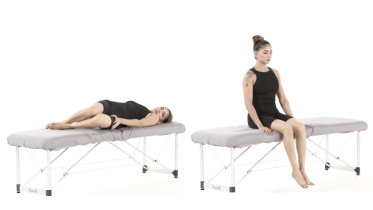
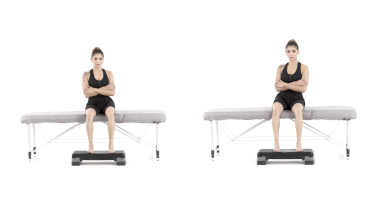
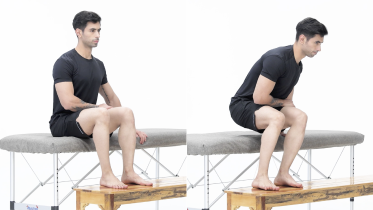
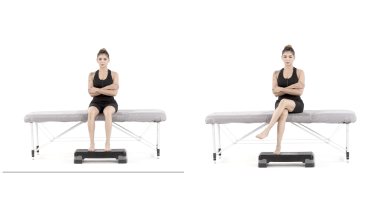
Long sitting forward lean
The long sitting forward lean is done sitting on a bed with both legs straight out in front. You start leaning back a little on your hands, then walk your hands forward along the bed beside your legs and let your body bend forward with them, as far as is comfortable. You pause there, then walk your hands back to where you started. It practices moving your weight forward and back in this position, the one you are in when you sit up in bed, and it gently stretches the backs of your thighs.
How to do the long sitting forward lean
- Sit in the middle of a firm bed with both legs straight out in front and your hands on the bed just behind your hips, taking a little of your weight.
- Walk or slide your hands forward along the bed, beside your hips and then your thighs.
- Let your trunk bend forward as your hands travel, so your body and hands move together. Keep your legs relaxed along the bed.
- Go as far as is comfortable, toward your knees, shins or feet, and relax there for a few breaths.
- Walk your hands back the same way until you are sitting up and leaning on them behind you again.
What you should feel
A stretch along the backs of your thighs and knees, and sometimes your lower back, as you lean. The muscles of your back and buttocks work to control the lean and to bring you back up.
Common mistakes
- Bouncing or forcing yourself further to reach your toes.
- Pulling on your ankles or feet to drag yourself forward.
- Holding your breath at the end of the lean.
- Dropping back onto your hands in one go instead of walking them back.
How often
Programs often use 5 to 10 slow leans with a pause of a few breaths at the farthest point, once or twice a day. Your physio will adjust this.
Stop and check with your physio if
- Pain, pins and needles or numbness spreading into your buttock or down one leg or foot.
- Numbness around your genitals or bottom, new trouble with your bladder or bowels, pain, tingling, numbness or weakness in both legs, or loss of feeling in one leg. Call emergency services or go to an emergency department straight away.
- Your leg or foot gets weaker, for example your foot drags, catches on the ground or slaps down when you walk (foot drop). Get medical advice the same day. If the weakness is getting worse by the hour, go to an emergency department.
- Sharp pain in your lower back, or back pain that stays after you sit up.
- You feel dizzy, faint or unsteady. Stop and get medical advice the same day. If you faint, it does not settle within a few minutes of sitting still, or you cannot stand or walk steadily, call emergency services.
From the clinic
You do not need to reach your toes. The model in the video gets there, with her head dropped toward her knees, but stopping at your knees or shins is fine, because the forward and back shift of your weight is the main job. Tight hamstrings make the lean harder, and a rolled towel under the knees takes some of the pull away. Rounding the back and dropping the head also put tension on the large nerve at the back of the leg (sciatic nerve), so come out of the lean if a leg starts to tingle. For a chair version, see the seated hamstring stretch.
Sit well away from the edge of the bed. Tip back or sideways near the edge and you can end up on the floor. A firm mattress is steadier than a soft one. If your sitting balance is poor, or you have one-sided weakness from a stroke or another cause, have your physio check this with you first and have someone with you while you practice.
A sudden loss of balance is different. Call emergency services straight away for any sign of a stroke, even if it goes away: sudden dizziness with unsteadiness or falling over, a face that droops on one side, an arm you cannot lift or keep up, slurred or muddled speech, weakness or numbness on one side of your body or face, sudden blurred vision, double vision or loss of sight, or a sudden severe headache. If one side is already weak or numb from an earlier stroke, new or suddenly worse weakness or numbness is a sign, and every other sign in this list still counts.
If you have had a hip replacement, get the go-ahead from your surgeon or physio before you try this exercise. Leaning forward over straight legs bends the hips well past a right angle, and many surgeons ask you to avoid that for the first months after some operations.
With low bone density (osteoporosis), ask your physio before you start. Curling your back all the way down toward your feet, holding it there and repeating it is the kind of bending the Royal Osteoporosis Society advises changing or avoiding, so keep your back long, lean forward from your hips and stop at your thighs or knees. If you have had a fracture in your spine, check with your physio before you begin.
Written and checked by the PocketPhysio editorial team. Last updated 2026-09-26.
This page is general education, not a diagnosis or a personal treatment plan. If you have pain, an injury or a health condition, see a physiotherapist or doctor before starting new exercises.