Seated leg cross balance
The seated leg cross balance is a sitting exercise where you fold your arms, lift one leg and cross it over the other, then hold still without using your hands. Taking one foot off the floor shrinks your base, so the muscles of your trunk have to keep you upright over a smaller area. The voice guide has you lift the stronger leg over the weaker one, which puts more of your weight onto the weaker side of the seat. It is often used when sitting balance needs work, for example after a stroke or a long illness.
How to do the seated leg cross balance
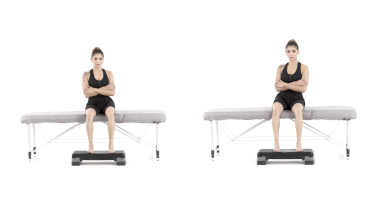
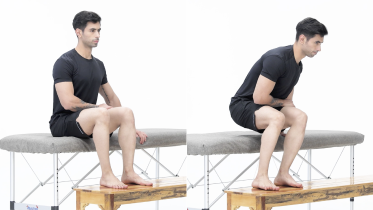
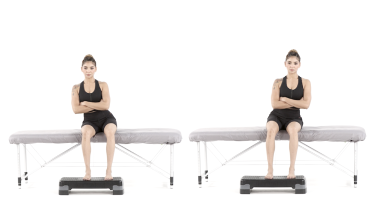
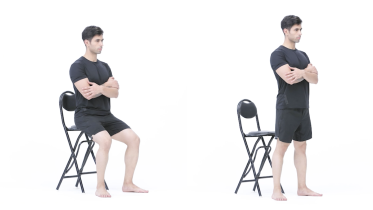
- Sit on a firm bed or a sturdy chair, far enough back that your thighs rest on the seat. Keep your feet flat, about hip width apart. If your feet do not reach the floor, rest them on a firm step or box, as in the video.
- Sit up tall and fold your arms across your chest, so your hands are off the seat.
- Lift your stronger leg and cross it over the weaker one, thigh over thigh, the way you might cross your legs at a desk. If neither side is weaker, cross each leg in turn.
- Hold still for a few seconds with your back straight and your head level. Let your trunk do the steadying, not your arms.
- Uncross slowly, place the foot back down flat and settle before the next one.
What you should feel
Your stomach and back muscles working to keep you upright, and more of your weight on the buttock of the leg that stays down. The front of the hip on the crossing leg works as you lift it over.
Common mistakes
- Unfolding your arms to grab the seat each time you wobble.
- Leaning back or to the side to get the leg across.
- Slumping while you hold the cross.
- Letting the leg drop down heavily instead of placing the foot back.
How often
Start with around 5 to 10 crosses, holding each for 5 to 15 seconds, once or twice a day. The video holds each cross for about 12 seconds. Your physio will adjust this.
Stop and check with your physio if
- You feel dizzy, faint or unsteady. Stop and get medical advice the same day. If you faint, it does not settle within a few minutes of sitting still, or you cannot stand or walk steadily, call emergency services.
- You start to tip sideways or backward and need your hands to catch yourself.
- Sharp pain in your hip, groin or low back.
From the clinic
Folded arms are what make this a balance exercise. If you cannot hold the cross yet, rest one hand lightly on the seat beside you and take it away once you feel steady. End each hold once you start to sway. A few steady seconds are enough at first. For other ways to move the trunk from a seat, try the seated trunk rotation or the seated side bend.
You can still fall from a seat, so set up with care. Use a seat that does not roll, tip or sink, such as a firm chair or the edge of a firm bed, not a soft sofa or a wheelchair with the brakes off. Keep both feet flat, move anything hard or sharp away from around you, and have another adult beside you for the first sessions, or every time if your sitting balance is poor.
This page explains the general technique, not a stroke rehab program. If one side of your body is weaker after a stroke or from another condition, check with your physio before you practice this at home. If one arm is weak, rest it on your lap or cradle it in your other arm rather than letting it hang, and nobody should pull on it to steady you.
A sudden loss of balance is different. Call emergency services straight away for any sign of a stroke, even if it goes away: sudden dizziness with unsteadiness or falling over, a face that droops on one side, an arm you cannot lift or keep up, slurred or muddled speech, weakness or numbness on one side of your body or face, sudden blurred vision, double vision or loss of sight, or a sudden severe headache. If one side is already weak or numb from an earlier stroke, new or suddenly worse weakness or numbness is a sign, and every other sign in this list still counts.
If you have had a hip replacement, get the go-ahead from your surgeon or physio before you try this exercise. Crossing your legs brings the thigh across the middle of your body, and many surgeons ask you to avoid that for the first months after some operations.
Written and checked by the PocketPhysio editorial team. Last updated 2026-09-26.
This page is general education, not a diagnosis or a personal treatment plan. If you have pain, an injury or a health condition, see a physiotherapist or doctor before starting new exercises.