Reach, grasp and place a cup
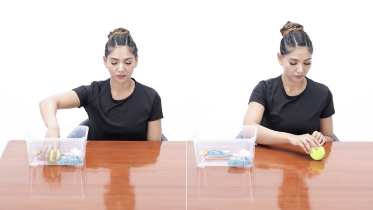
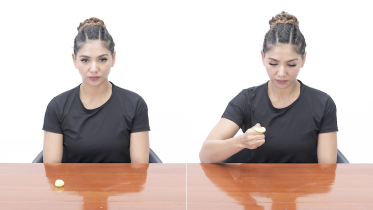
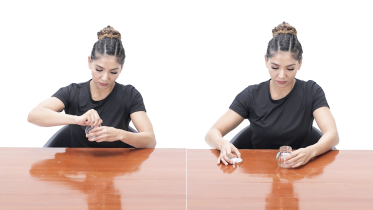
This reach and grasp task is an arm and hand exercise done sitting at a table. You reach for a cup, wrap your hand around it and lift it, then set it down in a new spot: out to one side, back to the middle, then across to the other side. Your body stays still and your shoulder stays down while the arm does the work. It practices the reach and grip you use at mealtimes, and the voice guide has you use the weaker arm.
How to do the reach, grasp and place a cup
- Sit upright on a sturdy chair pulled close to a table, with your feet flat on the floor. Place an empty cup on the table in front of you, within easy reach.
- Reach toward the cup with your weaker arm, opening your fingers wide before your hand gets there.
- Wrap your fingers and thumb around the cup, lift it just clear of the table and set it down a little way out to one side.
- Pick it up again and bring it back to the middle, then carry it across to the other side of the table. Keep moving it between these spots.
- Keep your trunk still and your shoulder down away from your ear throughout. Let the arm reach rather than leaning your body toward the cup.
What you should feel
Work in the front of your shoulder, in the back of your upper arm as the elbow straightens, and in your forearm and fingers as you open and close your hand around the cup.
Common mistakes
- Hitching the shoulder toward your ear as you reach.
- Leaning or twisting your body to get to the cup.
- Closing the hand before the fingers have opened, so you knock the cup over.
- Sliding the cup along the table instead of lifting it.
How often
A session is often 10 to 20 moves of the cup, in short rounds with rests in between, once or twice a day. Your physio will adjust this.
Stop and check with your physio if
- Sharp pain or a catch in your shoulder, elbow or wrist, or pain that lasts after you stop.
- You feel dizzy, faint or unsteady. Stop and get medical advice the same day. If you faint, it does not settle within a few minutes of sitting still, or you cannot stand or walk steadily, call emergency services.
From the clinic
The video uses a glass, but a light plastic cup is the safer choice at home, since a weak grip can let it slip. Start with the cup empty. Once the task feels easy, the voice guide suggests adding water, and a small amount is enough at first. Never practice with a hot drink. The hand grip squeeze works grip strength on its own.
Sitting at a table feels steady, but leaning out after a cup can still tip you off a chair. Use a chair with a back, and with armrests if your sitting balance is poor, set it so your feet rest flat, and ask someone to stay close for your first few sessions.
A sudden loss of balance is different. Call emergency services straight away for any sign of a stroke, even if it goes away: sudden dizziness with unsteadiness or falling over, a face that droops on one side, an arm you cannot lift or keep up, slurred or muddled speech, weakness or numbness on one side of your body or face, sudden blurred vision, double vision or loss of sight, or a sudden severe headache. If one side is already weak or numb from an earlier stroke, new or suddenly worse weakness or numbness is a sign, and every other sign in this list still counts.
This page explains the general technique, not a stroke rehab program. If a stroke or another condition has weakened one side of your body, get your physio's advice before you do this at home, including how to position the arm. A weak shoulder copes badly with being dragged or hauled into place, so reach only as far as you can control and rest your forearm on the table between moves when the arm tires. If the shoulder is sore, or you have been told it sits partly out of its socket (subluxation), your physio can show you how far to reach and how to support it.
Written and checked by the PocketPhysio editorial team. Last updated 2026-09-26.
This page is general education, not a diagnosis or a personal treatment plan. If you have pain, an injury or a health condition, see a physiotherapist or doctor before starting new exercises.