Eating with a knife and fork
Eating with a knife and fork is an everyday task practiced in rehab when grip or hand control is weak. Sitting at a table, you hold a knife in one hand and a fork in the other, pin the food with the fork, cut it with a back and forth sawing action, then lift a piece to your mouth. The video uses ordinary cutlery. Thicker handles, which occupational therapists often suggest, can be easier to hold when your fingers do not close fully or your grip is weak, and the steps stay the same. The voice guide adds that you can practice the cutting with therapy putty or play dough instead of food.
How to do the eating with a knife and fork
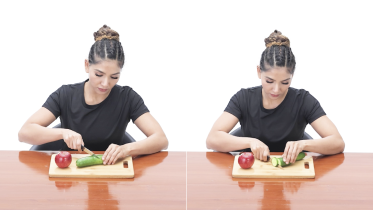
- Sit on a sturdy chair pulled in close to the table, with your feet flat and your forearms able to rest near the table edge. Put the food on a plate or board in front of you. The video uses slices of a green vegetable on a wooden board.
- Pick up the knife in one hand and the fork in the other. In the video the knife is in the right hand and the fork in the left, with the prongs pointing down and each index finger resting along the top of the handle to press down. If your grip is weak, wrapping all your fingers around a thick handle can be easier.
- Press the fork into the food to hold it still.
- Cut with a slow back and forth sawing action, close to the fork, until the piece comes free.
- Lift the piece to your mouth with the fork. In the video the knife stays in the other hand, ready for the next cut. If your hands tire, rest the cutlery on the plate between mouthfuls.
What you should feel
Steady work in both hands and forearms, most of all in the hand doing the cutting. It takes concentration, and a weak hand may tire before the meal is finished.
Common mistakes
- Gripping the handles so tightly that your hand cramps.
- Hunching over the plate or lifting the elbows high to cut.
- Pressing straight down hard instead of sawing back and forth.
- Loading big pieces on the fork, which are harder to control and to swallow.
How often
Many people practice during one meal a day, or for 5 to 10 minutes at a time with putty or play dough. Your physio will adjust this.
Stop and check with your physio if
- You cough or choke while you eat or drink, food feels stuck in your throat or comes back up, your voice sounds wet or gurgly as you eat, or you get short of breath after eating. Stop eating, get medical advice the same day and do not practice with food again until your swallowing has been checked. If trouble swallowing comes on suddenly, call emergency services, as it can be a sign of a stroke. If you or anyone eating with you is choking and cannot cough, speak or breathe, call emergency services straight away.
- Pain, cramp or aching in your hand or wrist that comes back each time you grip the cutlery.
- Your fingers start to tingle or go numb, or tingling you already have gets worse. If it stays after you stop, or keeps getting worse, get medical advice the same day.
- Call emergency services straight away for any sign of a stroke, even if it goes away: sudden dizziness with unsteadiness or falling over, a face that droops on one side, an arm you cannot lift or keep up, slurred or muddled speech, weakness or numbness on one side of your body or face, sudden blurred vision, double vision or loss of sight, or a sudden severe headache.
- If one side is already weak or numb from an earlier stroke, new or suddenly worse weakness or numbness is a sign, and every other sign in this list still counts.
From the clinic
Cutlery with built-up handles is sold for this, and foam tubing slipped over ordinary cutlery makes the handle thicker too. An occupational therapist can help you choose the size and shape that suits your hand. A non-slip mat under the plate stops it sliding, as the voice guide suggests, and a plate with a raised rim or a clip-on plate guard helps you push food onto the fork. While you are learning, an ordinary table knife is safer than a sharp steak knife. Cutting vegetables practice trains the same two-handed control with a kitchen knife, and hand grip squeeze builds grip strength on its own.
Sit upright while you eat and for a while after, and start with foods that are easy to cut and swallow, in small pieces. If you have had trouble swallowing, for example after a stroke, eat only the food textures your speech and language therapist has advised. Until eating is safe for you, practice the cutting with putty or play dough, as the voice guide suggests. Pencil grip practice is another everyday task that trains finer control of the fingers.
This page explains the general technique, not a stroke rehab program. After a stroke, or with a condition that affects your hands such as arthritis, a tremor or reduced feeling, your occupational therapist or physio can advise which cutlery to use and which hand should hold the knife. After a broken wrist, hand or forearm, or surgery on any of them such as a tendon repair, start only when your doctor, surgeon, physio or hand therapist says the bone or repair is ready for this, and follow their plan for how much to do.
Written and checked by the PocketPhysio editorial team. Last updated 2026-09-28.
This page is general education, not a diagnosis or a personal treatment plan. If you have pain, an injury or a health condition, see a physiotherapist or doctor before starting new exercises.