Identifying objects by touch
Identifying objects by touch is a hand exercise for feeling rather than strength. With your eyes closed, you reach into a box or pillowcase of everyday objects, handle one at a time, describe how it feels and name it. You keep your eyes closed until you have been through them all, then open them to check. Recognizing things by touch alone is called stereognosis. Occupational therapists and physios use it when hand feeling has changed after a stroke or a nerve injury.
How to do the identifying objects by touch
- Sit on a steady chair, or in a wheelchair with the brakes on, with your back supported, both feet flat on the floor and a table close in front of you.
- Put a few everyday objects in a box or pillowcase on the table, on the side of the hand you are working with, close enough that you can reach into it without leaning over. A coin, a toothbrush, a soft ball and a sponge are good first choices. Someone else can fill it, so you do not know what is inside.
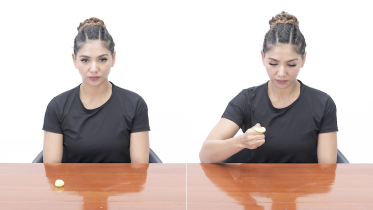
- Close your eyes. Reach into the box with the hand you are working with and take hold of one object.
- Turn it over in your fingers and describe what you feel: hard or soft, smooth or rough, cool or warm, heavy or light. Then name it.
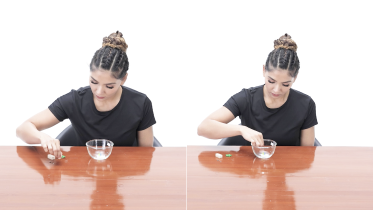
- Put the object on the table in front of you and, with your eyes still closed, reach for the next one. When you have named them all, open your eyes and check each one against what you said, as in the video.
What you should feel
Little muscle effort. The work is in paying attention to what your fingers tell you. The hand may tire a little from turning objects over, and some textures can feel strange or hard to read at first.
Common mistakes
- Opening your eyes, or glancing down, before you have named the object.
- Naming the object the moment you grab it, before you have felt its shape and texture all over.
- Starting with objects that feel too alike, such as two coins of a similar size.
- Putting anything sharp, hot or breakable in the box.
How often
Many programs use a set of 5 to 10 objects per session, once or twice a day. Your physio will adjust this.
Stop and check with your physio if
- You find a cut, scratch, blister or red mark on your hand that you did not feel happen. Stop, look after the skin and tell your physio.
- New or worse numbness or tingling in your hand or fingers. If it stays after you stop, or keeps getting worse, get medical advice the same day.
- Pain in your hand or wrist that builds as you go.
- Pain in the shoulder of the arm you reach with. Stop, rest that arm on the table and tell your physio.
- Since the stroke or nerve injury, the hand is getting more painful rather than less, the skin becomes very sensitive to light touch, or the hand changes color, temperature, swelling or sweating compared with the other one, or looks shiny. See your doctor or physio as soon as you can, within a few days at most, as this can be complex regional pain syndrome (CRPS) and early treatment may help.
- Call emergency services straight away for any sign of a stroke, even if it goes away: sudden dizziness with unsteadiness or falling over, a face that droops on one side, an arm you cannot lift or keep up, slurred or muddled speech, weakness or numbness on one side of your body or face, sudden blurred vision, double vision or loss of sight, or a sudden severe headache. If one side is already weak or numb from an earlier stroke, new or suddenly worse weakness or numbness is a sign, and every other sign in this list still counts.
From the clinic
When feeling is reduced, the hand can be hurt without you noticing. Nothing sharp or breakable goes in the box (no knives, scissors, pins, needles or glass), and nothing hot or straight from the freezer. Look over your hand for marks when you finish. Small items such as coins or buttons are a choking risk, so keep the box away from young children. If the person doing this has trouble swallowing or tends to put things in their mouth, someone should stay with them the whole time, and every object should be too big to swallow.
Begin with objects that feel very different from each other, like a spoon, a sponge and a ball, and move on to ones that are closer in shape and size as you get better at telling them apart. Let the hand you are working with do the reaching and the feeling. The woman in the video steadies an object with her other hand at times, which is fine, as long as the working hand does most of the exploring.
This page explains the general technique, not a stroke rehab program. After a stroke or a nerve injury, including surgery to repair a nerve, an occupational therapist, physio or hand therapist sets the level for you and decides when to start. If you cannot yet sit steadily without holding on, have someone stay beside you while your eyes are closed. For hand movement practice, see picking up small objects.
Written and checked by the PocketPhysio editorial team. Last updated 2026-09-29.
This page is general education, not a diagnosis or a personal treatment plan. If you have pain, an injury or a health condition, see a physiotherapist or doctor before starting new exercises.