Opening a jar
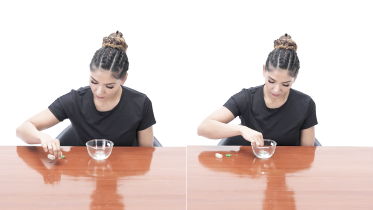
Opening a jar is practiced as a hand exercise because it needs two things at once: a grip firm enough to hold, and forearm rotation to turn. Sitting at a table, one hand steadies the jar while the other takes the lid off and screws it back on, so the two hands are doing opposite jobs. Physios reach for it when grip strength and forearm turning are what need the work, rather than fingertip precision. The voice guide also reminds you to keep your body still and your shoulders down.
How to do the opening a jar
- Sit upright at a table with a jar in front of you, plastic rather than glass if your grip is weak or your hand tires quickly, so a slip does not end in broken glass. Start with a lid that is closed only lightly.
- Hold the body of the jar with one hand to keep it steady, as in the video.
- Grip the lid with the fingers and thumb of your other hand and turn it until it comes off. Set the lid down on the table.
- Pick the lid up again, place it back on the jar and screw it closed.
- Keep your body still and your shoulders relaxed the whole time, then repeat.
What you should feel
Effort in the fingers, thumb and forearm of the hand that turns the lid, and a steady squeeze in the hand holding the jar.
Common mistakes
- Hunching or lifting the shoulder of the turning arm.
- Twisting your whole body instead of turning at the hand and forearm.
- Starting with a lid screwed on too tightly.
- Pinching a stiff lid with just the fingertips instead of using the whole hand.
How often
There is no fixed dose for task practice like this. A reasonable starting point is 5 to 10 openings and closings, once or twice a day, with a loose lid that you tighten a little as your hand gets stronger. Your physio will adjust this.
From the clinic
The hand tasks in this library divide roughly into the ones that need force and the ones that need accuracy. This is firmly a force task, with rotation on top, and the rotation is the part a plain squeezing exercise never covers. Nothing about it is delicate: the whole hand wraps the lid, the forearm supplies the turn, and the other hand resists everything the first one does.
A single condition program here names it, by the count of 11 October 2026: strength training for older adults, where it shares a stage with towel wringing and the hand grip squeeze. That grouping says plainly what it is for.
A lid you cannot budge teaches nothing. All it does is let you strain a thumb against an immovable object, and it is why the first step asks for a lid closed only lightly. A lid that turns, turned again and again and tightened a little as the weeks pass, is the exercise. The other way it gets wasted is pinching a stiff lid with the fingertips, which puts the whole job through the base of the thumb instead of across the hand.
The jar in the video is glass, which is why the first step asks for plastic if your grip is weak. The hand gripper exercise and thumb opposition build some of the strength and control this task needs.
For painful arthritic joints, joint protection advice often suggests turning a lid with the palm of the hand rather than the fingertips, or using a jar opener. With rheumatoid arthritis in your hands, joint protection advice is to turn the lid in whichever direction pushes your fingers toward your thumb rather than toward your little finger, the direction the knuckles tend to drift, or to use a jar opener and leave the twist out altogether. Your physio or occupational therapist can show you which suits your hands.
Before you start
- After a broken wrist, hand or forearm, or surgery on any of them such as a tendon repair, start only when your doctor, surgeon, physio or hand therapist says the bone or repair is ready for this, and follow their plan for how much to do. Gripping and twisting a lid against resistance is usually one of the later steps, so ask where it sits in your plan.
- If you have arthritis in your hands, especially at the base of the thumb, check with your physio first, and give this a miss while a joint is hot, swollen or flaring.
- With carpal tunnel syndrome, ask before you start, and stop if your fingers begin to tingle.
- After recent heart or chest surgery, get your surgeon's or surgical team's okay first, because holding the jar in one hand and twisting the lid with the other closes a turning force between your two hands in front of the chest, which pulls across the healing breastbone. If the breastbone clicks, grinds, shifts or feels as if it is moving while you do it, stop, and contact your surgical team the same day.
- If feeling in your hand is reduced, use a plastic jar whatever your grip is like, and look your hand over for cuts, red marks or blisters when you finish, because you may not feel a chipped rim or a small nick.
When to stop and get help
- Sharp pain at the base of the thumb or in the wrist as you turn the lid.
- Pins and needles or numbness in your fingers. If one side of your face or body suddenly goes numb or weak, or your speech becomes slurred or muddled, call emergency services, even if it goes away.
- Hand joints that are swollen, warm or noticeably stiffer later that day or the next morning.
Written and checked by the PocketPhysio editorial team. Last updated 2026-10-11.
This page is general education, not a diagnosis or a personal treatment plan. If you have pain, an injury or a health condition, see a physiotherapist or doctor before starting new exercises.