Cutting vegetables practice
Cutting vegetables practice is a kitchen task used in rehab to train grip, hand control and the teamwork between your two hands. Sitting at a table, you hold a knife firmly in one hand, keep a vegetable steady on a chopping board with the other, and slice it. Occupational therapists and physios often use real tasks like this while hand strength or control is coming back, for example after a hand injury or a stroke, or with another condition that affects the hands. The voice guide adds that knives with thick handles are easier to hold, and a foam tube slipped over a thin handle makes it thicker.
How to do the cutting vegetables practice
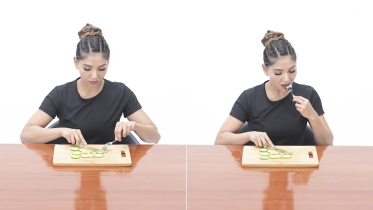
- Sit on a sturdy chair at a table with your feet flat on the floor. Put a chopping board in front of you with a vegetable that is easy to cut on it, such as the cucumber in the video.
- Hold the knife firmly by the handle in one hand, with all your fingers wrapped around it and none of them on the blade. In the video the right hand holds the knife and the left hand steadies the food.
- Steady the vegetable with your other hand. In the video the fingers rest on top of the cucumber, a little way back from the blade. Curling those fingertips under, so your knuckles face the blade, keeps them farther from the edge and is the safer habit to learn.
- Cut slowly, one slice at a time, moving the steadying hand back a little after each cut.
- Whenever you pause or need to move the food or a cut piece, lay the knife flat on the board with the blade pointing away from you first. The video moves a piece with the knife still in hand; putting it down is safer.
What you should feel
Steady work in the gripping hand and forearm, and in the fingers holding the food. It takes attention more than strength, and the gripping hand may tire before you finish.
Common mistakes
- Rushing. Slow, controlled cuts matter more than speed.
- Holding the vegetable with flat fingers close to the blade.
- Using a blunt knife and pressing hard, which makes the blade more likely to slip.
- Starting with round foods that roll, before firm, flat-sided ones feel easy.
How often
Many programs start with 5 to 10 minutes of cutting at a time, once a day, often while making a real meal. Your physio will adjust this.
Stop and check with your physio if
- You cut yourself. Stop, press on the cut with a clean cloth and raise your hand. Call emergency services or go to an emergency department, without driving yourself, if the bleeding will not stop, the blood spurts out, the cut is large or deep or is a bad cut on your palm, something is stuck in it, or you lose feeling or cannot move a finger properly near the cut. If a cut later becomes swollen, red and more painful, or leaks pus, or you feel unwell or have a high temperature, get medical advice the same day.
- Pain, cramping or aching in the gripping hand that comes back every time you pick up the knife again.
- New or worse numbness or tingling in your fingers. If it stays after you stop, or keeps getting worse, get medical advice the same day.
- Call emergency services straight away for any sign of a stroke, even if it goes away: sudden dizziness with unsteadiness or falling over, a face that droops on one side, an arm you cannot lift or keep up, slurred or muddled speech, weakness or numbness on one side of your body or face, sudden blurred vision, double vision or loss of sight, or a sudden severe headache.
- If one side is already weak or numb from an earlier stroke, new or suddenly worse weakness or numbness is a sign, and every other sign in this list still counts.
From the clinic
A gentle way to begin is a soft food, such as a banana, with an ordinary table knife, and to move on to a kitchen knife and firmer foods once your grip and control feel steady. When you do, a sharp knife of a size you can control is safer than a blunt one, because a blunt blade needs more force and slips more easily. A damp cloth or a non-slip mat under the board stops it sliding. With a kitchen knife, start with firm foods that sit flat, such as a cucumber cut in half along its length, and leave round or soft ones like tomatoes until your grip is steadier. If your grip is weak, a knife with a thick or angled handle, or a board with small spikes to hold the food, can make the job easier and safer, and an occupational therapist can advise you on these.
If your fingertips have reduced feeling, or one hand is weak, you may not notice a small nick straight away, so look over both hands when you finish. If you take a blood thinner, even a small cut can bleed for longer, so keep a clean cloth within reach. Stay seated, keep the floor around you clear, and have someone nearby for your first few sessions. Pencil grip practice and picking up small objects train finer hand control, and the hand grip squeeze builds grip strength on its own.
This page explains the general technique, not a stroke rehab program. After a stroke, or with a condition that affects your hands, such as reduced feeling in your fingers, a weak grip, a tremor or poor coordination, ask your occupational therapist or physio before you practice with a sharp knife. They can also tell you which hand should hold the knife and which should steady the food. After a broken wrist, hand or forearm, or surgery on any of them such as a tendon repair, start only when your doctor, surgeon, physio or hand therapist says the bone or repair is ready for this, and follow their plan for how much to do.
Written and checked by the PocketPhysio editorial team. Last updated 2026-09-28.
This page is general education, not a diagnosis or a personal treatment plan. If you have pain, an injury or a health condition, see a physiotherapist or doctor before starting new exercises.