Pencil grip practice
Pencil grip practice trains the hand position used for writing. Sitting at a table with your forearms resting on it, you hold a pencil between your thumb and index finger, let it rest on your middle finger, and write letters, words or short phrases while your other hand steadies the paper. It is often part of occupational therapy or physio when writing has become hard after a stroke, a nerve injury or a hand injury.
How to do the pencil grip practice
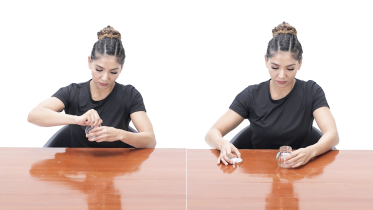
- Sit at a table with a sheet of paper in front of you and a pencil within reach. Rest both forearms on the table for support.
- Pick up the pencil with your writing hand. Hold it between the pads of your thumb and index finger, a little way up from the point, and let it rest against the side of your middle finger. Your ring and little fingers can curl lightly underneath.
- Lay your other hand flat on the paper to keep it steady. The woman in the video turns the page slightly, so angle it however feels natural for your writing hand.
- Write single letters first, then words, then short phrases, holding the pencil lightly.
- Every so often, put the pencil down and let your hand open and relax before you carry on.
What you should feel
The thumb and index finger do most of the work, with some effort in the front of the forearm. The hand may tire after a few minutes, especially when writing is new again.
Common mistakes
- Squeezing the pencil hard or pressing so firmly that the lead snaps or your fingertips go white.
- Wrapping the thumb over the fingers, or holding the pencil in the fist.
- Holding the pencil so far from the point that the tip wobbles.
- Lifting the forearm off the table or hunching the shoulder of the writing arm.
How often
Many programs start with 5 to 10 minutes of writing, once or twice a day, beginning with large letters. Your physio will adjust this.
Stop and check with your physio if
- Cramping or aching in the hand that comes back every time you start writing again.
- New or worse numbness or tingling in your thumb or fingers.
- Call emergency services straight away for any sign of a stroke, even if it goes away: sudden dizziness with unsteadiness or falling over, a face that droops on one side, an arm you cannot lift or keep up, slurred or muddled speech, weakness or numbness on one side of your body or face, sudden blurred vision, double vision or loss of sight, or a sudden severe headache.
- Sharp pain in your thumb or finger joints.
- Since the fracture or cast, the hand is getting more painful rather than less, the skin becomes very sensitive to light touch, or the hand changes color, temperature, swelling or sweating compared with the other one, or looks shiny. See your doctor or physio as soon as you can, within a few days at most, as this can be complex regional pain syndrome (CRPS) and early treatment may help.
From the clinic
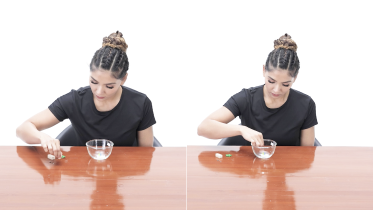
A thicker pencil, a chunky marker or a foam grip slipped over the pencil is easier to hold, so start there if a normal pencil feels too thin. Lined paper and large letters make it simpler to see how you are doing. If your fingertips have reduced feeling, check them afterward for red marks, which can mean you are pressing too hard without noticing. Picking up small objects and turning over small discs build the fingertip control that writing needs.
After a stroke or a nerve injury, ask your occupational therapist or physio which hand to practice with and what to write, as they set the level for you. After a broken wrist, hand or forearm, or surgery on any of them such as a tendon repair, start only when your doctor, surgeon, physio or hand therapist says the bone or repair is ready for this, and follow their plan for how much to do. This page is for adults. If a child finds holding a pencil hard, ask their doctor about a referral to a children's occupational therapist.
Written and checked by the PocketPhysio editorial team. Last updated 2026-09-26.
This page is general education, not a diagnosis or a personal treatment plan. If you have pain, an injury or a health condition, see a physiotherapist or doctor before starting new exercises.