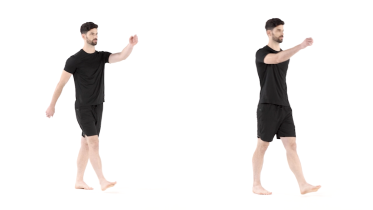
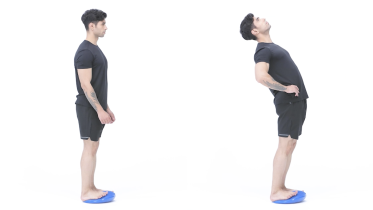
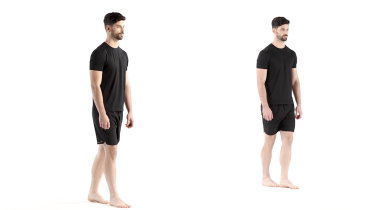
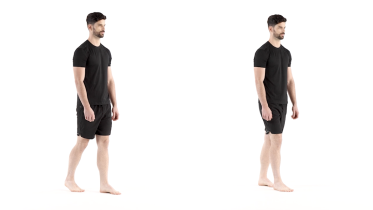
Standing forward reach
The standing forward reach is a balance exercise where you stretch both arms out in front and lean forward as far as you can without moving your feet. Your weight travels toward your toes, close to the edge of your balance. The muscles along the back of your body, from your calves up to your low back, hold you there and then bring you back. It is the same lean you make to reach a high shelf or the back of a cupboard.
How to do the standing forward reach
- Stand side on to a wall or kitchen counter, close enough to take hold of it with the nearer hand. Place your feet about shoulder width apart on a firm, non-slip floor.
- Lift both arms straight out in front of you to shoulder height and stand tall. Start every reach from here.
- Lean forward slowly, letting the lean come from your hips and ankles, and reach your hands out as far as you can. Keep your head up, your arms level and both heels on the floor.
- Hold at the farthest point you can control for a few seconds, then come back upright slowly and lower your arms.
- To see your progress, as the voice guide suggests, fix a tape measure along the wall at shoulder height and note where your fingertips get to each time.
What you should feel
Your calves and the backs of your thighs working to stop you tipping, with your weight moving onto the balls of your feet. Near the end of the reach your toes may grip the floor.
Common mistakes
- Rising onto your toes or stepping forward to get farther.
- Letting the arms drift down as you lean.
- Dropping your head to look at the floor.
- Twisting to push one arm farther than the other.
How often
A common starting range is 5 to 10 slow reaches, holding the farthest point for 3 to 5 seconds, once or twice a day. Your physio will adjust this.
Stop and check with your physio if
- You feel dizzy, lightheaded, faint or sick, or the room seems to spin. Hold your support, sit down and get medical advice the same day before you practice again. If you faint, it does not settle within a few minutes of sitting still, your vision suddenly blurs or goes double, or you cannot stand or walk steadily, call emergency services.
- You start to tip forward and need the counter, or a step, to catch yourself.
- Sharp pain in your low back, or new pain in a hip, knee or ankle.
From the clinic
This exercise is about how far you can move your weight forward before you have to step. That is a different job from holding still in tandem stance or on one leg, where the aim is to stay quiet over a narrow base. Start with short, slow reaches and go farther only when you can come back upright smoothly. Keep your back long rather than curling forward.
Set up with a wall, counter or sturdy chair within reach before you start, and clear the space in front of you. A lost balance here usually goes forward, so never reach toward a hard edge such as a table corner. If you have fallen over in the last year, feel wobbly when you walk, or use medicines that can leave you drowsy or lightheaded, keep your nearer hand resting on the counter, reach with the other arm only, and practice while another adult is in the house. A falls assessment from your doctor or physio may also be worth asking for.
A sudden loss of balance is different. Call emergency services straight away for any sign of a stroke, even if it goes away: sudden dizziness with unsteadiness or falling over, a face that droops on one side, an arm you cannot lift or keep up, slurred or muddled speech, weakness or numbness on one side of your body or face, sudden blurred vision, double vision or loss of sight, or a sudden severe headache.
Written and checked by the PocketPhysio editorial team. Last updated 2026-09-26.
This page is general education, not a diagnosis or a personal treatment plan. If you have pain, an injury or a health condition, see a physiotherapist or doctor before starting new exercises.