Back extension on a wobble cushion
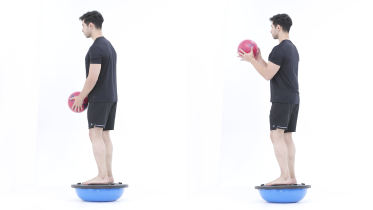
A back extension on a wobble cushion is a slow backward bend of the lower back done with both feet on a wobble cushion, a round, air-filled pad that moves a little under you. While your lower back arches, your feet and ankles keep making small corrections to stop the cushion tipping. So you are doing back mobility and balance work at once, which is why it usually comes after the plain standing back extension feels easy on a firm floor.
How to do the back extension on a wobble cushion
- Place the cushion on a firm floor that does not slip, right beside a kitchen counter or the back of a sturdy chair.
- Hold your support and step onto the cushion one foot at a time, with both feet in the middle. Let your arms hang by your sides and wait for the wobbling to settle.
- Put your hands on your hips at waist level, as in the video. If the cushion feels too lively, keep one hand on the counter and the other on your hip.
- Squeeze your buttocks lightly and lean back slowly from your lower back, letting your hips ease forward a little. Keep your head moving with your trunk and look up only slightly.
- Pause for a few seconds at a comfortable point while you hold your balance, then come back up to standing tall. Let the cushion settle before the next one.
- To get off, take hold of the counter or chair again and step down to the floor one foot at a time.
What you should feel
A mild stretch or pressure across your lower back that eases as soon as you come upright, with lots of small, busy movements in your feet and ankles as the cushion shifts.
Common mistakes
- Tipping your head right back so you are staring at the ceiling.
- Leaning back so far that your weight rolls onto your heels and the cushion tips backward.
- Bending your knees to get further back instead of moving through your lower back.
- Getting on or off the cushion without a hand on your support.
- Holding your breath during the bend.
How often
Many programs use 5 to 10 slow backward bends with a pause of a few seconds at the end of each, once or twice a day, holding on at first. Your physio will adjust this.
Stop and check with your physio if
- You feel dizzy, lightheaded, faint or sick, or the room seems to spin. Hold your support, sit down and get medical advice the same day before you practice again. If you faint, it does not settle within a few minutes of sitting still, your vision suddenly blurs or goes double, or you cannot stand or walk steadily, call emergency services.
- Things look double, your vision suddenly blurs or goes, your speech slurs or becomes muddled, swallowing becomes hard, your face or lips go numb, one side of your face droops or one side of your body goes weak or numb, you suddenly become so dizzy or unsteady that you fall or cannot stand or walk, your legs suddenly give way but you do not black out (a drop attack), or you get a sudden severe headache. Stop and call emergency services, even if it goes away.
- You lose your balance and need to grab the counter to stay up. Step off carefully and rest before you decide whether to carry on.
- A sharp, pinching pain in your lower back that does not ease when you straighten up.
- Pain travels into your buttock or leg, or your leg tingles or goes numb.
From the clinic
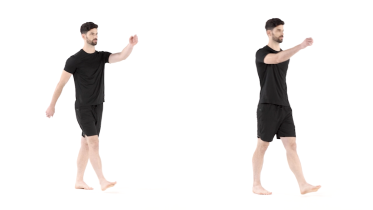
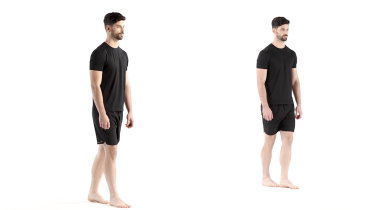
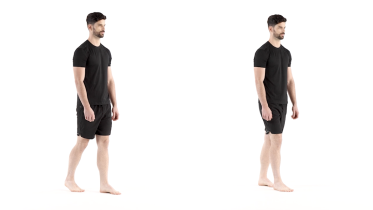
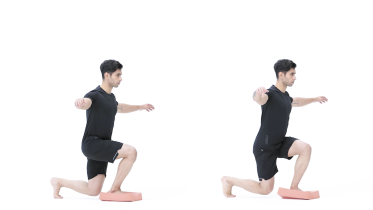
The app calls the equipment a balance board, but the video shows a round, inflatable wobble cushion under both feet, and he bends back barefoot with nothing to hold. At home, keep a counter or sturdy chair within reach every time, and hold it as you step on and off. Wear flat shoes that fit well and grip the floor, not socks, tights or bare feet. Clear any rugs and clutter from around the cushion before you start. He also tips his head a long way back, which is more likely to make you dizzy on a moving surface, so this page keeps the head in line with the trunk.
Learn the standing back extension on a firm floor first, then practice simply standing still on the cushion. Put the two together only once both feel easy. If you have had a fall in the past year or you often feel shaky on your feet, ask your physio before you try it. If they agree, hold the counter with one hand the whole time, and wait until someone else is in the house before you practice. The squat on a wobble cushion uses the same cushion for leg strength.
A sudden loss of balance is different. Call emergency services straight away for any sign of a stroke, even if it goes away: sudden dizziness with unsteadiness or falling over, a face that droops on one side, an arm you cannot lift or keep up, slurred or muddled speech, weakness or numbness on one side of your body or face, sudden blurred vision, double vision or loss of sight, or a sudden severe headache.
Bending backward often stirs up symptoms from a narrowed spinal canal (spinal stenosis) or a vertebra that has slipped forward (spondylolisthesis), so with either diagnosis check with your physio first. With low bone density (osteoporosis), a fall is the bigger worry, so ask your physio whether an unstable surface is right for you. If you are pregnant, check with your midwife or physio before you start.
If you have had a hip replacement, get the go-ahead from your surgeon or physio before you try the back extension on a wobble cushion. Leaning back pushes the hips forward past straight, and many surgeons ask you to avoid that for the first months after some operations.
Written and checked by the PocketPhysio editorial team. Last updated 2026-09-28.
This page is general education, not a diagnosis or a personal treatment plan. If you have pain, an injury or a health condition, see a physiotherapist or doctor before starting new exercises.