
Multiple sclerosis exercises and physiotherapy
What MS does to movement
Multiple sclerosis (MS) is a condition that affects the brain and spinal cord (NHS). The symptoms the NHS lists include extreme tiredness (fatigue), blurred vision or eye pain, numbness or tingling, feeling off balance, dizzy or clumsy, muscle cramps, spasms or stiffness, and bladder problems. In relapsing remitting MS, symptoms flare up in relapses and then ease, while in progressive MS they are there all the time and slowly get worse (NHS). Everyone's MS is different, and symptoms can change from one day to the next.
If your MS team or physio has given you exercises, follow their plan first. The program below is something to take to a physio (physical therapist in the US) who knows MS, not a substitute for seeing one. If you do not have MS and want general balance work, the balance and falls prevention program is the better fit.
Is exercise safe with MS?
Yes. People with MS used to be told to avoid exertion because of fatigue, but that advice has changed, and the evidence now supports exercise (MS Trust). NICE advises encouraging people with MS to exercise, and says regular exercise does not have any harmful effects on their MS (NICE NG220). An expert panel convened by the US National MS Society recommends that every person with MS hears about the benefits and safety of exercise, and that a physical or occupational therapist or exercise specialist helps set up a plan early (Kalb 2020).
A Cochrane review of 45 trials with 2,250 people concluded that exercise can be prescribed in MS without harm (Heine 2015). The trials reported 25 relapses in the exercise groups and 26 in the groups that did not exercise, so exercise did not seem to raise the risk of a relapse, and only one fall was reported across all of them.
Does exercise help MS?
Exercise can help people with MS manage symptoms and regain function, and it can improve quality of life, although the research still has gaps in quality and scope (Motl 2017). For fatigue, the Cochrane review pooled 26 trials against no exercise and found that exercise may reduce it, most clearly with endurance or mixed training, or other types such as yoga, but the trials varied a lot (Heine 2015). NICE lists aerobic and strength exercise, as well as balance work such as yoga or Pilates, as options that may help MS fatigue. It also suggests supervised programs of moderate strength training and aerobic exercise for people with MS who have mobility problems or fatigue (NICE NG220). For falls, a Cochrane review found that the effect of exercise on the number of falls is uncertain, with some evidence that it improves balance and mobility (Hayes 2019).
How much exercise do you need with MS?
For adults with mild to moderate disability, Canadian guidelines suggest at least 30 minutes of moderate aerobic activity 2 times a week, plus strength training for the major muscle groups 2 times a week, for fitness benefits (Latimer-Cheung 2013). Meeting these targets may also reduce fatigue and improve mobility. The National MS Society panel suggests working gradually toward 150 minutes or more a week of exercise, everyday activity such as walking or gardening, or both, allowing for other health problems and for symptoms that come and go (Kalb 2020). For people who walk, with or without an aid, it recommends aerobic exercise 2 to 3 times a week for 10 to 30 minutes at moderate effort, strength training 2 to 3 times a week with 1 to 3 sets of 8 to 15 repetitions, and stretching every day. Your physio will adjust this.
People who cannot walk, or use a wheelchair most of the time, are advised to have shorter daily sessions, and exercise helped by a trained assistant when movement is very limited (Kalb 2020). This program is not built for them, so ask a physio for one that is.
Heat: why symptoms can flare when you warm up
Many people with MS find that their symptoms get worse for a while when their body temperature rises, including during exercise. This is called heat sensitivity, or Uhthoff's phenomenon, and the MS Trust says around 6 in 10 people with MS report it. Fatigue, blurred vision (especially if you have had optic neuritis), numbness and tingling, heavy or weak legs and poorer balance are among the symptoms that can flare. They should improve within a few hours once you cool down, and they are not usually a sign of new MS damage (MS Trust).
The MS Trust suggests exercising at cooler times of day, choosing activities that keep you cooler, such as swimming or strength training rather than running, and wearing breathable clothing. Cooling down before you start helps too, for example with an iced drink or a cool shower. Keep a cold drink beside you, and stop to rest and cool off if symptoms start to build.
A stroke can cause some of the same symptoms. On its MS page, the NHS says to get emergency help for sudden weakness or numbness in one arm, sudden loss or blurring of vision, or sudden problems with balance and coordination, because they can be signs of a stroke. So if a symptom comes on suddenly, is new for you, or you are not sure it comes from the heat, call emergency services. If you already know that heat brings on a symptom for you, ask your MS team ahead of time how to tell your usual pattern from a warning sign. Contact your MS team or GP the same day if heat symptoms do not start to ease within a few hours of cooling down, last longer than usual, or come with a fever or signs of an infection, as it may be a relapse or an infection (MS Trust).
Fatigue: pace yourself
MS fatigue is not ordinary tiredness. The MS Trust describes it as an overwhelming exhaustion that can stop you carrying on with your usual activities, and it can affect thinking as well as the body. Its advice includes planning ahead and pacing activities with regular breaks, along with good sleep and staying cool. Fatigue can also come from an infection or a relapse, so tell your MS team or GP if it gets clearly worse.
For exercise, the MS Trust warns against working through fatigue, which can leave your symptoms worse for days afterward. It suggests starting with just two exercises a day and adding more as you go, and it notes that people with MS often need longer to recover after exercise. On days when fatigue is a problem, strength exercises may suit you better than aerobic work.
How to use this program
If you are unsure where to begin, start at stage 1. Move on when a stage feels steady and you rely less on your support. On a bad day, or in hot weather, drop back a stage or do only the stretches. Keep up your walking or other aerobic activity too. The program sits on top of it and does not replace it.
Every exercise page lists its own starting dose. As a rough guide, the strength exercises often start at 2 to 3 sets of 8 to 15, sit to stand at 2 to 3 sets of 5 to 10, and balance holds at a few seconds up to 30 seconds, repeated a few times. Brisk walking often starts at 10 to 20 minutes. Rest between sets for as long as you need. Your physio will adjust this.
Stretches often start at holds of 20 to 30 seconds, 2 to 4 times. For stiff muscles, your physio may build these up to 30 to 60 seconds, the hold the National MS Society panel suggests for daily stretching (Kalb 2020).
Before each session, clear the rugs off a firm floor and stand beside a kitchen counter, or a sturdy chair that will not slide. Wear flat shoes that fit well and grip the floor, not socks, tights or bare feet. If you have fallen in the past year, or your legs feel numb, weak or heavy, keep a hand on the support throughout and only practice when someone else is in the house. If you cannot feel your feet well, watch where you place them, and check your feet for rubs or marks afterward.
Stop the exercise if your legs start to feel heavy or weak, your foot starts to drag or catch, or your balance gets worse as you go. Sit down and cool off, then let it settle before you carry on, or stop for the day. If the symptom is new for you, came on suddenly or does not settle, use the warning signs below.
A sudden loss of balance is different. Call emergency services straight away for any sign of a stroke, even if it goes away: sudden dizziness with unsteadiness or falling over, a face that droops on one side, an arm you cannot lift or keep up, slurred or muddled speech, weakness or numbness on one side of your body or face, sudden blurred vision, double vision or loss of sight, or a sudden severe headache. With MS, any of these that is new for you, or comes on suddenly over minutes, still counts, even if it is like a symptom you have had before.
Stop at once if you get chest pain or pressure, dizziness or feeling faint, a racing or irregular heartbeat, or being far more out of breath than the effort should cause. If chest pain, pressure or tightness does not ease quickly when you rest, spreads to your arm, neck, jaw, stomach or back, or comes with sweating, feeling sick, feeling light-headed or being short of breath, call emergency services straight away, as this can be a heart attack. If it eases quickly and none of these happen, get medical advice the same day, and do not exercise again until you have been checked. If you have high blood pressure, breathe steadily through every repetition and never hold your breath.
For every exercise you do standing or walking, this is the stop rule. You feel dizzy, lightheaded, faint or sick, or the room seems to spin. Hold your support, sit down and get medical advice the same day before you practice again. If you faint, it does not settle within a few minutes of sitting still, your vision suddenly blurs or goes double, or you cannot stand or walk steadily, call emergency services.
Standing up from a chair has a rule of its own. You feel dizzy, lightheaded or faint as you get up. Sit back down and wait for it to pass. If it does not pass within a minute or two, or it keeps happening, get medical advice the same day before you practice again. If you faint, or it does not settle within a few minutes of keeping still, call emergency services.
The exercise program
Stage 1: Seated strength and first standing practice
A starting point for everyone, and the stage to come back to on days when fatigue is high or standing for long is hard. The seated exercises work the front of the thigh, the front of the hip and the muscles between your shoulder blades without asking anything of your balance. Standing up with the armrests, the side to side weight shift and marching on the spot then bring in standing strength and balance, with a kitchen counter or sturdy chair within reach. Rest between sets for as long as you need, and sit down whenever your legs start to feel heavy. Stop each set while you can still move well, rather than pushing on through fatigue.
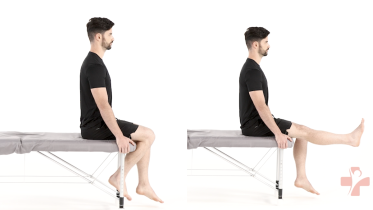 Seated knee extension
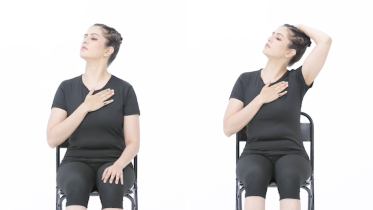 Seated hip flexion
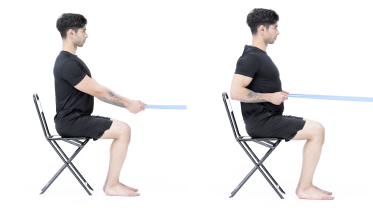 Seated row with band
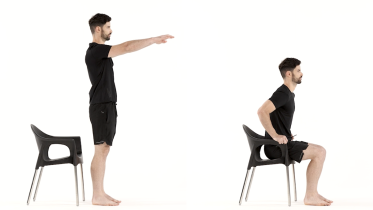 Sit to stand using armrests
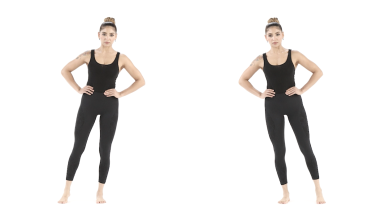 Side to side weight shift
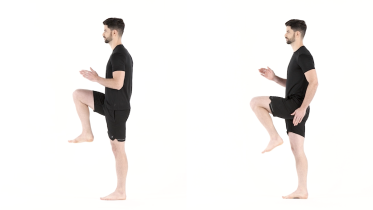 Marching on the spot
Stage 2: Standing strength, balance and walking
Once stage 1 feels steady, which often takes a few weeks. Calf raises, sit to stand without your hands, standing hip abduction and the glute bridge build the leg and hip muscles you need for walking and stairs. Wall push-ups work the arms and chest. If getting down to the floor is hard, do the glute bridge lying on a firm bed. Semi-tandem stance narrows your base, while the forward reach and side stepping train how far you can lean and step before you lose balance. Brisk walking starts your aerobic exercise, at a pace where you can still talk. Keep your support within reach for every standing exercise, and walk somewhere cool, flat and well lit.
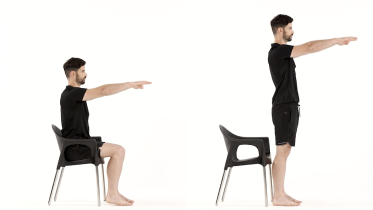 Sit to stand
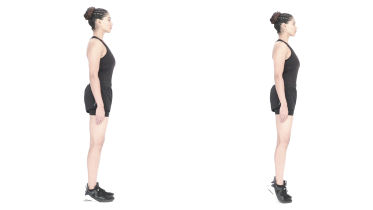 Calf raises
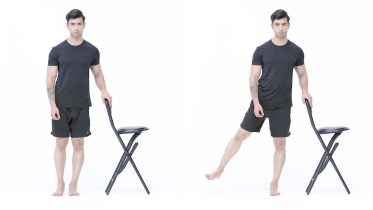 Standing hip abduction
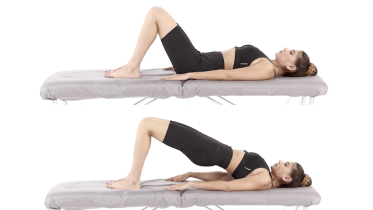 Glute bridge
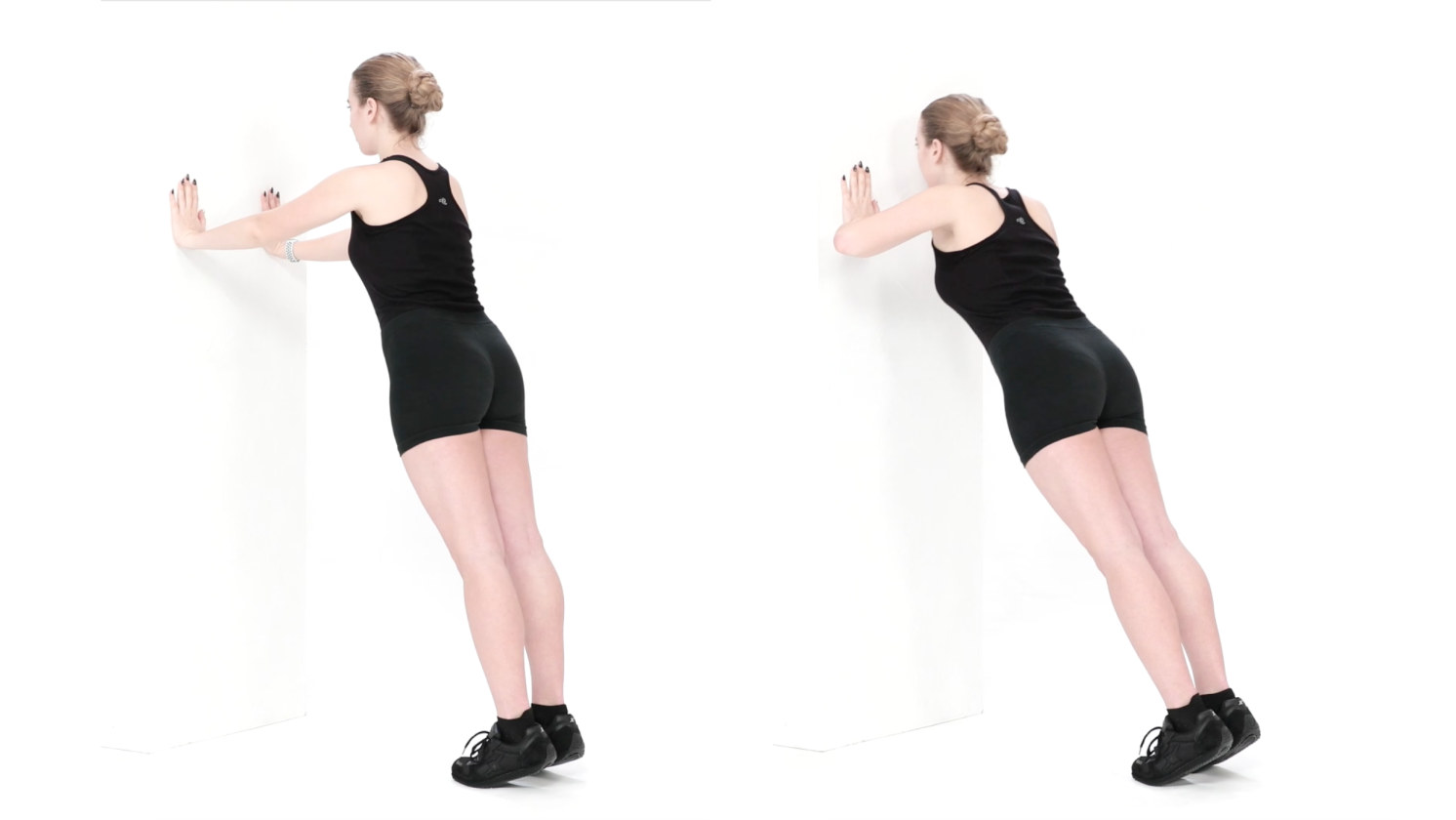 Wall push-ups
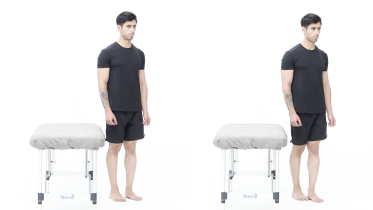 Semi-tandem stance
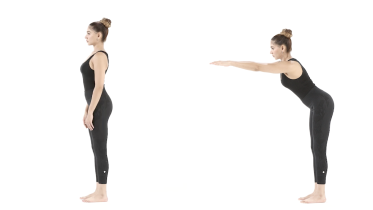 Standing forward reach
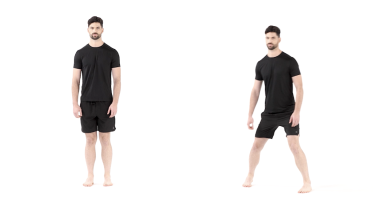 Side stepping
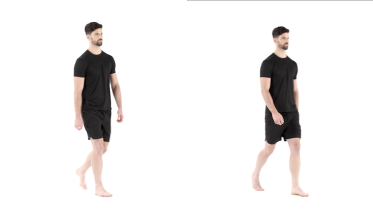 Brisk walking
Stage 3: Narrower balance, quick steps and stairs
Once stage 2 is easy and you can stand and walk steadily without holding on. Tandem stance and single leg stance narrow your base further, while clock stepping trains fast steps forward, sideways and back. Figure 8 walking has you turning left and right without stopping. The step-ups and stairs build leg strength, with a rail or counter in your hand every time. Have someone nearby for these until your physio is happy for you to practice on your own. Leave them out on days when heat or fatigue has made your legs weaker than usual.
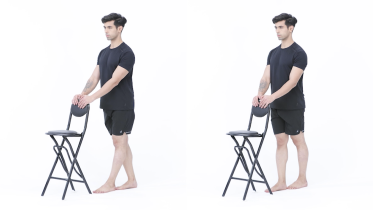 Tandem stance
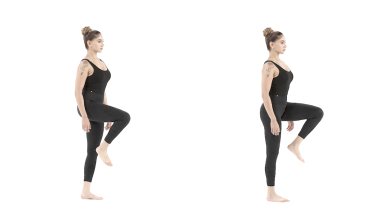 Single leg stance
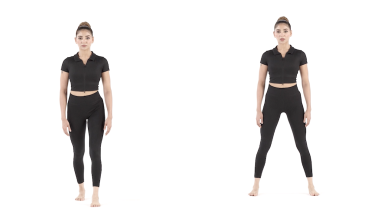 Clock stepping
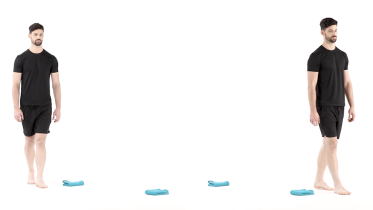 Figure 8 walking
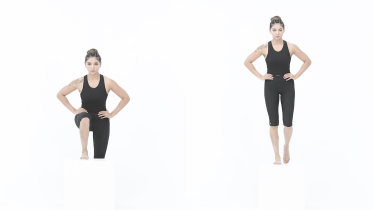 Step up
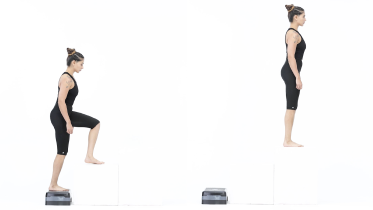 Stair climbing
Alongside any stage: stretches for stiff muscles
Stretching and moving through the range you have is one of the main ways to manage stiff muscles (spasticity) at home. These four work on the calf, the back of the thigh, the front of the hip and the inner thigh. Spasticity tightens more with fast movement, so ease slowly into each stretch and hold it still, without bouncing. Stretch only within the range you have, and stop if it hurts (MS Trust). A spasm can throw you off balance, so keep a hand on a counter or chair for the standing hip flexor stretch. The butterfly stretch is done sitting on a mat with your back against a wall, or on a firm bed if getting down to the floor is hard. Your physio can show you which stretches suit your stiffness and add others.
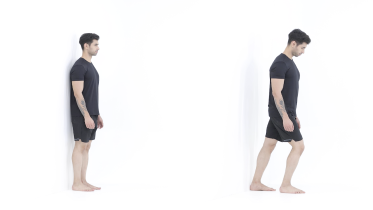 Calf stretch
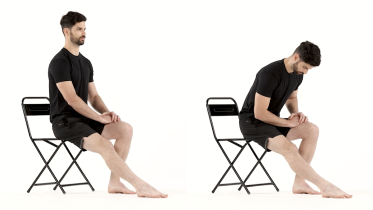 Seated hamstring stretch
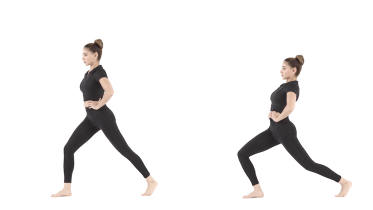 Hip flexor stretch
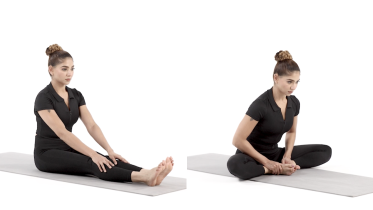 Butterfly stretch
Alongside any stage: getting up from the floor
The first time you practice getting up from the floor, do it with a physio, and after that only when someone else is home. It breaks the way back up after a fall into steps: roll onto your side, come up onto your hands and knees, then stand with the help of a sturdy chair. Choose a day when you feel fresh, and do it early in the session rather than when you are already tired. If you have had a hip replacement, get the go-ahead from your surgeon or physio before you try getting up from the floor, and after a knee replacement ask them when you can kneel.
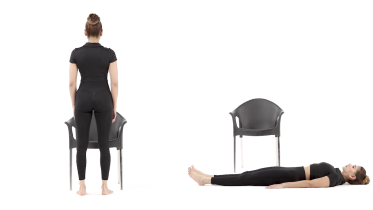 Getting up from the floor
Stiff muscles and spasms (spasticity)
Spasticity makes muscles feel stiff and heavy and hard to bend, and it gets worse with faster movement (MS Trust). Spasms are sudden jerky movements, where a leg may shoot up or kick out, or the legs clamp together. The MS Trust calls self-management one of the most important parts of managing them. That means regular stretching within the range you have, moving every part of your body each day and getting to know your triggers, with a physio to assess you and show you what suits you. The trials of exercise and physical activity programs for spasticity are small and at high risk of bias, so the evidence is still low level (Amatya 2013).
Many things can make spasticity worse for a while. The MS Trust lists bladder infections or bowel problems such as constipation, blisters or pressure sores, poor posture, tight clothing or very hot or cold temperatures. If your stiffness or spasms get worse over a few days, look for one of these first and tell your MS team or GP. Muscle relaxant medicines are one of the treatments the NHS lists for muscle spasms, cramps or stiffness, so ask your doctor if stretching is not enough. Do not stop a medicine or change the dose without talking to your doctor first.
Balance, walking and falls
MS can affect balance in many ways (MS Trust). Stiff or weak muscles can play a part, as can numbness or tremor, vision problems or dizziness, and fatigue makes balance worse as muscles tire. Foot drop can happen too: the foot hangs down, drags or catches on the ground as you walk, which makes stairs, curbs or uneven ground harder and trips more likely (MS Trust). A splint that holds the foot up (ankle-foot orthosis) or functional electrical stimulation can help, and a physio can assess you for both. Rushing to the toilet because of bladder urgency is another cause of falls, and most falls happen inside the home (MS Trust).
The MS Trust suggests regular eye tests, good lighting at home, using your walking aid and sturdy furniture for support, flat supportive shoes, and taking your time when you get up or change position. A physio can set balance exercises, and an occupational therapist can look at your home for ways to lower the risk of falling. If dizziness or a spinning feeling is part of your MS, ask about vestibular rehabilitation, specialist exercises that retrain the brain to make sense of balance signals (MS Trust). There is more on preventing falls in the balance and falls prevention program.
If you fall
Before you try to move, lie still for a moment and work out whether you are hurt. If you cannot get up, or you think you may have hurt your head, neck, back or hip, stay where you are and call emergency services with your phone or an alarm, or get someone to call for you. Cover yourself to keep warm while you wait (NHS). Unless you think you have broken a bone or hurt your neck or back, gently move your arms and legs while you wait, and shift your position roughly every 30 minutes so your skin does not get sore (NHS; MS Trust).
If you feel able to get up, take your time, use sturdy furniture to help you stand slowly, then rest (NHS; MS Trust). You can rehearse the way up in advance with your physio, using the getting up from the floor exercise. After any fall, tell your GP or MS team, even if you do not seem hurt, so the cause can be looked into.
Relapses: when to pause
A relapse is the sudden start, or clear worsening, of MS symptoms that lasts at least 24 hours and has no other cause, such as an infection, heat, stress or fatigue (MS Trust). To count as a new relapse, your MS must have been stable for at least 30 days before. Relapses can last from a few days to several weeks or even months. Symptoms that get worse for a while because of an infection such as a bladder infection, heat, stress or tiredness usually settle once the cause passes, and are sometimes called a pseudo-relapse (MS Trust).
If you think you are having a relapse, pause the harder parts of your program and contact your MS team as the warning signs below describe. Early on, the MS Trust suggests resting as much as you need to and avoiding anything that makes your symptoms worse. As you improve, build back up slowly to your usual routine, including gentle exercise if you can do it safely. Recovery typically takes a few weeks or months, sometimes up to 12, and a physio can help you build your strength and stamina back up (MS Trust). Start again at an easier stage than before, and ask your physio when to move back up.
When to see a physio, your MS team or GP
Ask for a physio assessment early, before you start a new program, as the National MS Society panel recommends (Kalb 2020), and again whenever your walking, balance, stiffness or fatigue changes. The panel notes that supervised training generally gives better results than training on your own. See your physio again after any fall, or if trips and near falls are happening more than before. Low mood and anxiety can come with MS. The NHS lists talking therapy (cognitive behavioral therapy) among the treatments for anxiety and depression, and for fatigue, so tell your GP or MS team if your mood does not lift.
If you have a heart or lung condition, or your blood pressure is not under control, get your doctor's advice before you start. If you are pregnant, check with your midwife or physio before you start. After a hip or knee replacement or any other recent operation, your surgeon's and physio's program comes first, not this one. For bladder problems, see your doctor or MS team rather than starting pelvic floor exercises on your own, as the pelvic floor weakness page explains.
For physiotherapists
Kalb 2020, a consensus convened by the National MS Society across EDSS 0 to 9.0, recommends that providers endorse the benefits and safety of exercise for every person with MS, arrange early evaluation by a physical or occupational therapist or exercise professional, and encourage 150 minutes or more a week of exercise and/or lifestyle physical activity, progressed gradually, with referral as disability increases and a trained assistant when mobility is very limited. For EDSS 0 to 4.5 it gives aerobic training 2 to 3 times a week for 10 to 30 minutes at 40% to 60% of maximum heart rate or aerobic capacity (RPE 11 to 13 on the 6 to 20 scale), resistance training 2 to 3 times a week at 1 to 3 sets of 8 to 15, daily flexibility work of 2 to 3 sets held 30 to 60 seconds, and neuromotor training 3 to 6 times a week for 20 to 60 minutes. For EDSS 5.0 to 6.5 the same applies, with adaptive modifications and cooling where heat sensitivity limits exercise. For EDSS 7.0 to 7.5 it suggests up to 20 minutes a day on 3 to 7 days a week, falling to 10 to 15 minutes for EDSS 8.0 to 8.5 and up to 10 minutes for EDSS 9.0. Latimer-Cheung 2013 (Canadian guidelines) sets at least 30 minutes of moderate aerobic activity 2 times a week and strength training for major muscle groups 2 times a week for mild to moderate disability.
Heine 2015 (45 trials, 69 interventions, 2,250 participants, mostly relapsing remitting MS with EDSS below 6.0) pooled 26 trials with a non-exercise control and found an effect on fatigue in favor of exercise (SMD -0.53, 95% CI -0.73 to -0.33), with significant heterogeneity (I2 above 58%) and moderate overall quality. By type, endurance training (SMD -0.43, 95% CI -0.69 to -0.17), mixed training (SMD -0.73, 95% CI -1.23 to -0.23) and other training (SMD -0.54, 95% CI -0.79 to -0.29) favored exercise. Relapses (25 exercise, 26 control, poorly defined and reported) and a single reported fall gave no signal of harm. Hayes 2019 found the effect of exercise on falls rate and number of fallers uncertain (very low to low certainty), with some evidence for balance and self-reported mobility. Amatya 2013 rated the evidence for physical activity programs on spasticity as low level, with all included studies at high risk of bias.
NICE NG220 recommends encouraging exercise and advising that it has no harmful effects on MS (1.4.1), that aerobic, resistive or balance exercise, including yoga and Pilates, may help MS fatigue (1.5.7), and supervised moderate progressive resistance and aerobic training for mobility problems or fatigue (1.5.20). It suggests vestibular rehabilitation where fatigue or mobility problems come with limited standing balance (1.5.19). For spasticity it asks for assessment of aggravating factors (1.5.25), and notes that some people use their spasticity to stand, walk or transfer, which muscle relaxants may reduce (1.5.26). A relapse is new or worse symptoms lasting over 24 hours without infection or another cause after at least 1 month of stability, with urinary and respiratory infection ruled out first (1.7.1, 1.7.2).
The exercise pages give stretch holds of 20 to 30 seconds, shorter than Kalb's 30 to 60, so lengthen them where spasticity and tolerance allow. The home program is aimed at people who walk, with or without an aid (roughly EDSS 6.5 or below). It leaves out high intensity interval training and dual-task walking, as well as vestibular exercises and cycling or aquatic work, which suit supervised or community settings. Before progressing, check for heat sensitivity and the person's fatigue pattern. Also ask about recent relapses, falls history, foot drop or bladder urgency.
See a doctor promptly if
- Emergency: call emergency services straight away for any sign of a stroke, even if it goes away: sudden dizziness with unsteadiness or falling over, a face that droops on one side, an arm you cannot lift or keep up, slurred or muddled speech, weakness or numbness on one side of your body or face, sudden blurred vision, double vision or loss of sight, or a sudden severe headache.
- Emergency: with MS, some of these signs, such as numbness, blurred vision or unsteadiness, may already be part of your usual symptoms. A sign that is new for you, or one that comes on or gets much worse suddenly, over minutes, still means calling emergency services straight away, even if it goes away. The NHS lists sudden weakness or numbness in one arm, sudden loss or blurring of vision and sudden problems with balance and coordination among the MS symptoms that need emergency help, because they can be signs of a stroke. If you are not sure whether it is heat, a relapse or a stroke, call emergency services.
- Emergency: you suddenly cannot see out of one or both eyes, you get sudden severe eye pain, or eye pain keeps you awake at night. Go to an emergency department straight away, and do not drive yourself.
- Emergency: swallowing suddenly becomes hard, over minutes or hours rather than slowly over months. Call emergency services straight away, even if it goes away, as this can be a sign of a stroke.
- Emergency: severe choking, where you cannot breathe, cough or speak. If the airway is still blocked after trying to clear it, someone should call emergency services straight away and follow the operator's instructions.
- Emergency: sudden confusion, for example you, or the person you care for, suddenly become muddled, much drowsier than usual or unable to follow what is said. Call emergency services or go to an emergency department straight away, without driving yourself. Sudden confusion can come from an infection, a stroke, a head injury or other causes that need treating quickly.
- Emergency: you have just fallen and cannot get up, or you think you may have hurt your head, neck, back or hip. Stay where you are, keep warm and call emergency services, or get someone to call for you. If you got up and walked without trouble and only notice pain later, use the lines below.
- Emergency: you fell and cannot remember the fall or how it happened. Go to an emergency department straight away, and do not drive yourself. You may have blacked out or hit your head without knowing it.
- Emergency: you have had a fall or an injury and now have severe hip pain, or you cannot walk or put weight on the leg. Call emergency services or go to an emergency department. This can be a sign of a broken hip (hip fracture).
- Emergency: after a knock to the head, being very drowsy or finding it hard to keep your eyes open, confusion, a fit (seizure), new weakness or numbness anywhere in your body, new trouble understanding, speaking, walking or keeping your balance, new problems seeing or hearing, clear fluid coming from your ears or nose, bleeding from your ears or bruising behind them, a black eye when your eye was not hit, a dent in your head or a wound with something stuck in it, or a change in behavior. Call emergency services straight away. These can be signs of an injury to the brain.
- Emergency: after a knock to the head, you were knocked out, even for a moment, you cannot remember what happened just before or after, you have had a headache ever since, or you are being sick (vomiting). The same applies, even if you feel fine, if you take medicine that thins your blood, other than aspirin on its own, have a bleeding or clotting condition, have had brain surgery in the past, or had been drinking alcohol or taking drugs when it happened. Go to an emergency department straight away, and do not drive yourself.
- Emergency: you suddenly become short of breath, you get chest pain or pain in your upper back that may be worse when you breathe in, you cough up blood, your heart is beating very fast, or you faint. Call emergency services straight away, even if your leg looks normal. These can be signs of a blood clot in the lungs (pulmonary embolism).
- If chest pain, pressure or tightness does not ease quickly when you rest, spreads to your arm, neck, jaw, stomach or back, or comes with sweating, feeling sick, feeling light-headed or being short of breath, call emergency services straight away, as this can be a heart attack. If it eases quickly and none of these happen, get medical advice the same day, and do not exercise again until you have been checked.
- Same day: over hours or days, weakness makes it hard to walk or stand, your foot starts to drag, catch or slap down when you walk (foot drop), you have new trouble speaking or swallowing, or you lose control of your bladder or bowels. Contact your MS team straight away, without waiting 24 hours to see if it settles. If you cannot reach them the same day, or the weakness is getting worse by the hour, go to an emergency department, and do not drive yourself. If any of these came on suddenly, over minutes, call emergency services. If they come with new back pain, or with new numbness around your genitals or bottom, call emergency services or go to an emergency department straight away, as this can be pressure on the nerves at the base of the spine (cauda equina syndrome). If you have had a fall or a knock to the head in the past few weeks, go to an emergency department straight away, and do not drive yourself, as bleeding inside the head can build up slowly after a head injury (subdural hematoma).
- Same day: pain in or behind one eye that is often worse when you move the eye, or vision in one eye that becomes blurred or patchy, with blind spots or colors that look faded, coming on over hours or days. Contact your MS team the same day, or get an urgent appointment the same day with your GP, an optician or an eye emergency service. This can be inflammation of the nerve at the back of the eye (optic neuritis), which is common in MS. If your sight goes suddenly, use the emergency line above.
- Same day: new MS symptoms, or old ones that get clearly worse, that last more than 24 hours and are not explained by heat, an infection or being overtired. This can be a relapse. Contact your MS team, MS nurse or doctor the same day, and rest from the harder exercises until they have advised you. If you have had a fall or a knock to the head in the past few weeks, go to an emergency department straight away instead, and do not drive yourself, as bleeding inside the head can build up slowly after a head injury (subdural hematoma). If the symptoms came on suddenly, over minutes, or match any line above, use that line instead.
- Same day: symptoms that flared with heat do not start to ease within a few hours of cooling down, last longer than they usually do, or come with a high temperature or signs of an infection. Contact your MS team or GP the same day, as this may be a relapse or an infection rather than heat. If a symptom is new for you, or you are not sure it comes from the heat, use the emergency lines above.
- Same day: signs of a bladder infection (urinary tract infection), such as pain or burning when you pee, needing to pee more often than usual, cloudy or bloody pee, or pain low in your tummy or in your back just under the ribs, especially with a high temperature or feeling hot, cold or shivery. Get medical advice the same day, and go to an emergency department if you feel very unwell. An infection can bring back or worsen MS symptoms for a while, and it needs treating. If you become confused or drowsy, or have trouble speaking, call emergency services. If you have a very high or very low temperature, shivering you cannot control, you are breathing very fast or finding it hard to breathe, you are confused or your speech is slurred, your skin, lips or tongue look blue, gray, pale or blotchy (on brown or black skin this can be easier to see on the palms of the hands or soles of the feet), or you have a rash that does not fade when you press it, call emergency services, as this can be sepsis.
- Same day: a cough that brings up phlegm, a high temperature, chest pain when you breathe or cough, or feeling short of breath. Get medical advice the same day, or straight away if you have any trouble swallowing, as food or drink can slip into the lungs without making you cough and cause a chest infection (aspiration pneumonia). If you are struggling to breathe, your lips or skin turn pale, blue or blotchy, you cough up blood, your heart is beating very fast or you suddenly feel confused, call emergency services. If you have a very high or very low temperature, shivering you cannot control, you are breathing very fast or finding it hard to breathe, you are confused or your speech is slurred, your skin, lips or tongue look blue, gray, pale or blotchy (on brown or black skin this can be easier to see on the palms of the hands or soles of the feet), or you have a rash that does not fade when you press it, call emergency services, as this can be sepsis.
- Same day: swallowing problems that have come on or got worse slowly, over weeks or months, such as coughing or choking when you eat or drink, food sticking in your throat or chest, a wet or gurgly voice after you swallow, or trouble swallowing your tablets. Get medical advice the same day, and ask your GP, MS team or MS nurse about a speech and language therapist. If they came on over hours or days, or suddenly, use the lines above. If you also have a cough with phlegm, a high temperature or shortness of breath, use the chest infection line above.
- Same day: after a fall, you are in pain, have hurt yourself or feel unwell, or you were on the floor for an hour or more, without any of the emergency signs above. Get medical advice the same day, even if you managed to get up.
- Same day: new hip or groin pain after a fall, even a small one, if you are older, have low bone density (osteoporosis) or have taken steroid tablets for a long time, even if you can still walk. Get medical advice the same day. A broken hip is not always obvious at first.
- Emergency: new neck or back pain after a fall, a knock or a jolt, even a minor one such as a trip or a sudden stop in a car, if you have a condition that stiffens the spine, such as ankylosing spondylitis. Call emergency services or go to an emergency department straight away, do not drive yourself, and tell the staff about your spine condition, so they keep your neck and back in their usual position. A stiff spine can break after a small injury, and the break is easy to miss at first. If the pain started straight after the injury, or you also have numbness, tingling or weakness in your arms or legs, keep still and call emergency services.
- Back pain after a minor fall or strain if you are older, have low bone density (osteoporosis) or have taken steroid tablets for a long time. Get medical advice the same day.
- Neck pain after a car accident or a fall, even a minor one, if you are 65 or older, have low bone density (osteoporosis) or have taken steroid tablets for a long time. Get your neck checked by a doctor the same day, for example at an emergency department, before you start these exercises. At 65 or older, doctors usually want an X-ray or scan of the neck after an accident.
- Same day: you blacked out or fainted, even for a moment. Get medical advice the same day. Call emergency services instead if the person cannot be woken within 1 minute, has not fully recovered or has trouble speaking or moving, has chest pain or a pounding, fluttering or irregular heartbeat, fainted while exercising or lying down, is shaking or jerking, or was badly hurt.
- Same day: sudden new dizziness, or feeling faint or unsteady, without any of the stroke signs above. Stop, sit down and get medical advice the same day. If you faint, it does not settle within a few minutes of sitting still, or you cannot stand or walk steadily, call emergency services.
- Same day: a calf or thigh that is newly swollen, warm, tender, red or darker than usual, has swollen veins that are sore to touch, or has a throbbing or cramping pain that does not fit your injury or condition, or that feels different from normal muscle soreness after exercise. This can be a sign of a blood clot (deep vein thrombosis), especially after surgery, an injury, time in a cast or boot, a long trip or a spell of being much less mobile than usual. Get medical advice the same day. If you are also short of breath or have chest pain, call emergency services.
- Same day: thoughts of suicide or of harming yourself, even if you do not plan to act on them. Get urgent help the same day from your GP or NHS 111 in the UK, and you can also talk to Samaritans on 116 123. If you have harmed yourself or feel you may be about to, call emergency services or go to an emergency department straight away.
- Within a few days: your muscles become stiffer, or spasms become stronger or more frequent, over several days. Tell your MS team, physio or GP within a few days. A trigger such as a bladder infection, constipation, a pressure sore or tight clothing can make spasticity worse, and treating it helps. If you also have signs of an infection or a high temperature, use the bladder infection line above.
- Within a few days: you have had a fall, even if you were not hurt, or you are tripping, catching your foot or nearly falling more often than before. Book an appointment with your GP, MS team or physio within a few days and ask about a falls assessment. A splint that holds up a dropped foot (ankle-foot orthosis) or electrical stimulation for foot drop may help.
Common questions
Is it safe to exercise with multiple sclerosis?
Yes. A Cochrane review of 45 trials concluded that exercise can be prescribed in MS without harm. The trials reported 25 relapses in the exercise groups and 26 in the groups that did not exercise, and only one fall across all the studies (Heine 2015). An expert panel convened by the National MS Society in the US recommends that every person with MS is encouraged to exercise, with a plan set up early by a physio or exercise specialist (Kalb 2020). Start gently, keep cool and build up slowly.
What are the best exercises for MS?
The National MS Society panel recommends a mix: aerobic exercise such as walking or cycling, strength training for the major muscle groups, balance training and daily stretching (Kalb 2020). The Canadian guidelines set targets for the aerobic and strength parts (Latimer-Cheung 2013). For fatigue, the Cochrane review found an effect for endurance, mixed and other types of training (Heine 2015). If heat brings your symptoms on, the MS Trust suggests activities that keep you cooler, such as swimming or strength training. The best choice is usually the one you like enough to keep up, shaped to your MS by a physio who knows the condition.
How much exercise should you do with MS?
Canadian guidelines suggest at least 30 minutes of moderate aerobic activity 2 times a week and strength training 2 times a week for adults with mild to moderate disability (Latimer-Cheung 2013). The National MS Society panel suggests working gradually toward 150 minutes or more a week of exercise or everyday activity, allowing for symptoms that come and go (Kalb 2020). Many people start well below that and build up over weeks. Your physio will adjust this.
Why does exercise make my MS symptoms worse?
Heat is a common reason. Many people with MS find their symptoms, such as fatigue, blurred vision, tingling or heavy legs, flare for a while as their body warms up, which is called heat sensitivity or Uhthoff's phenomenon (MS Trust). The symptoms should improve within a few hours once you cool down, and they are not usually a sign of new MS damage. Exercise at cooler times of day, cool down first with a cold drink or a cool shower, and stop to cool off if symptoms build. A symptom that is new for you, comes on suddenly, or does not start to ease within a few hours of cooling down needs the warning signs on this page.
Should you exercise during an MS relapse?
Pause the harder exercises and contact your MS team. Early in a relapse, the MS Trust suggests resting as much as you need to and avoiding anything that makes your symptoms worse. As you improve, build back up slowly to your usual routine, including gentle exercise if you can do it safely. Start again at an easier stage than before, and ask your physio when to move back up.
How long do MS flare-ups last?
A relapse lasts at least 24 hours, and it can go on from a few days to several weeks or even months (MS Trust). Recovery typically happens over a few weeks or months, but it can take up to 12 months. Symptoms that flare with heat, an infection or stress and settle once the cause passes are not a true relapse. Contact your MS team the same day if new or worse symptoms last more than 24 hours.
References
- Heine M, van de Port I, Rietberg MB, van Wegen EE, Kwakkel G. Exercise therapy for fatigue in multiple sclerosis. Cochrane Database of Systematic Reviews. 2015;(9):CD009956. https://doi.org/10.1002/14651858.CD009956.pub2
- Kalb R, Brown TR, Coote S, et al. Exercise and lifestyle physical activity recommendations for people with multiple sclerosis throughout the disease course. Multiple Sclerosis Journal. 2020;26(12):1459-1469. https://doi.org/10.1177/1352458520915629
- Latimer-Cheung AE, Martin Ginis KA, Hicks AL, et al. Development of evidence-informed physical activity guidelines for adults with multiple sclerosis. Archives of Physical Medicine and Rehabilitation. 2013;94(9):1829-1836.e7. https://doi.org/10.1016/j.apmr.2013.05.015
- Motl RW, Sandroff BM, Kwakkel G, et al. Exercise in patients with multiple sclerosis. Lancet Neurology. 2017;16(10):848-856. https://doi.org/10.1016/S1474-4422(17)30281-8
- Hayes S, Galvin R, Kennedy C, et al. Interventions for preventing falls in people with multiple sclerosis. Cochrane Database of Systematic Reviews. 2019;(11):CD012475. https://doi.org/10.1002/14651858.CD012475.pub2
- Amatya B, Khan F, La Mantia L, Demetrios M, Wade DT. Non pharmacological interventions for spasticity in multiple sclerosis. Cochrane Database of Systematic Reviews. 2013;(2):CD009974. https://doi.org/10.1002/14651858.CD009974.pub2
- National Institute for Health and Care Excellence. Multiple sclerosis in adults: management. NICE guideline NG220. Published 22 June 2022, last updated 26 August 2026. https://www.nice.org.uk/guidance/ng220
- NHS. Multiple sclerosis. Last reviewed 16 August 2024. https://www.nhs.uk/conditions/multiple-sclerosis/
- MS Trust. Heat sensitivity and MS (Uhthoff's phenomenon). Last updated 8 July 2026. https://mstrust.org.uk/a-z/uhthoffs-phenomenon
- MS Trust. MS relapses and their management. Last updated 24 August 2026. https://mstrust.org.uk/information-support/ms-symptoms-diagnosis/ms-relapses-and-their-management
- MS Trust. MS fatigue. Last updated 14 May 2026. https://mstrust.org.uk/a-z/fatigue
- MS Trust. MS spasticity and muscle spasms. Last updated 22 March 2025. https://mstrust.org.uk/a-z/spasticity
- MS Trust. Staying active with MS. Last updated 6 February 2025. https://mstrust.org.uk/information-support/exercise-ms/staying-active-ms
- MS Trust. Starting to exercise with MS. https://mstrust.org.uk/information-support/exercise-ms/starting-exercise
- MS Trust. Optic neuritis. Last updated 7 April 2025. https://mstrust.org.uk/a-z/optic-neuritis
- MS Trust. Balance. https://mstrust.org.uk/a-z/balance
- MS Trust. Falls. https://mstrust.org.uk/a-z/falls
- MS Trust. Foot drop. Last updated 11 May 2023. https://mstrust.org.uk/a-z/foot-drop
- MS Trust. Swallowing. Last updated 1 January 2022. https://mstrust.org.uk/a-z/swallowing
- NHS. Urinary tract infections (UTIs). Last reviewed 11 July 2025. https://www.nhs.uk/conditions/urinary-tract-infections-utis/
- NHS. Vision loss. Last reviewed 28 August 2025. https://www.nhs.uk/conditions/vision-loss/
- NHS. Eye pain. Last reviewed 21 October 2025. https://www.nhs.uk/symptoms/eye-pain/
- NHS. Stroke: symptoms. https://www.nhs.uk/conditions/stroke/symptoms/
- NHS. Dysphagia (swallowing problems). https://www.nhs.uk/symptoms/swallowing-problems-dysphagia/
- NHS. Sudden confusion (delirium). https://www.nhs.uk/symptoms/confusion/
- NHS. Pneumonia. Last reviewed 17 July 2026. https://www.nhs.uk/conditions/pneumonia/
- NHS. Pulmonary embolism. Last reviewed 25 May 2023. https://www.nhs.uk/conditions/pulmonary-embolism/
- National Institute for Health and Care Excellence (NICE). Spinal injury: assessment and initial management. NICE guideline NG41. Published 17 February 2016. https://www.nice.org.uk/guidance/ng41
- NHS. Sepsis. https://www.nhs.uk/conditions/sepsis/
- NHS. Chest pain. https://www.nhs.uk/symptoms/chest-pain/
- NHS. Fainting. https://www.nhs.uk/symptoms/fainting/
- NHS. Falls. https://www.nhs.uk/conditions/falls/
- NHS. Head injury and concussion. https://www.nhs.uk/conditions/head-injury-and-concussion/
- National Institute for Health and Care Excellence (NICE). Head injury: assessment and early management. NICE guideline NG232. Published 18 May 2023. https://www.nice.org.uk/guidance/ng232
- NHS. Deep vein thrombosis (DVT). https://www.nhs.uk/conditions/deep-vein-thrombosis-dvt/
- NHS. Help for suicidal thoughts. https://www.nhs.uk/mental-health/feelings-symptoms-behaviours/behaviours/help-for-suicidal-thoughts/
- NHS. Subdural haematoma. https://www.nhs.uk/conditions/subdural-haematoma/
- NHS. Back pain. https://www.nhs.uk/conditions/back-pain/
- St John Ambulance. Choking. https://www.sja.org.uk/first-aid-advice/choking/
Written and checked by the PocketPhysio editorial team. Last updated 2026-09-29.
This page is general education, not a diagnosis or a personal treatment plan. See a physiotherapist or doctor for advice about your own situation.