
Strength and balance exercises for seniors: where to start
Warning signs, and when to get help
Strong and steady: the two halves, and which one to start with
Two different problems get bundled into one phrase, and they need different training. Weak legs are a strength problem: you push off the arms of the chair, and you look at a low sofa twice before you sit down on it. Poor balance is a skill problem. The legs have enough in them, but you wobble turning in a doorway, and at some point you notice your hand has gone onto the wall without being asked.
Keeping them apart matters because the training pulls in opposite directions. Strength work wants load and effort, with the last few repetitions feeling genuinely hard. Balance work wants a narrow base and a small wobble you catch and correct yourself, and straining at it only gets in the way. People who do only one of the two have usually picked the one they were already better at.
So choose by what goes wrong in your own day. Unsteady on your feet, or frightened of falling? Start on the balance side. If it is the chair and the stairs that stop you, start on the strength side.
Both programs are here in full. Balance and falls prevention holds the staged balance program and strength training for older adults holds the staged strength program, with video on every exercise. This page is the signpost, not a third program.
How often should older adults do strength and balance exercises?
The two halves come with different numbers, from different sources, and both ask for more than people expect. For strength, the NHS tells adults aged 65 and over to do activity that improves strength, balance and flexibility on at least 2 days a week, on top of being active in some way every day. For balance, the World Falls Guidelines are more specific and more demanding: balance-challenging and functional exercise, with standing up from a chair and stepping given as their examples, three times a week or more, individualized, made harder over at least 12 weeks and carried on beyond that for a bigger effect (Montero-Odasso 2022).
In practice that usually means short sessions on most days, not three long ones, and it means planning for this to be permanent. Every repetition, hold and set on this site comes from the exercise page it belongs to, and your physio will adjust this to you.
Where to start if you feel unsteady on your feet
Start at the first stage of the balance and falls prevention program, with a kitchen counter or a sturdy chair within easy reach, and tell your doctor you feel unsteady before you do anything else. That page owns the stages, the stance and stepping technique, and the rule for when to move up.
Narrowing your base is where the balance training actually happens. Semi-tandem stance moves one foot forward about half its length, tandem stance puts one foot directly in front of the other, and single leg stance is the far end of that road, not the place to begin. The balance and walking exercises library has all of them if you want to see what exists first, and balance conditions lists the programs that touch balance.
If the unsteadiness is more spinning than wobbling, that is a different problem with a different treatment: see dizziness and BPPV.
Where to start if getting out of a chair is the hard part
Start at the first stage of strength training for older adults, which begins seated or with the armrests taking some of your weight. Sit to stand using the armrests is the one to learn properly, because the fault in it is so common: people try to rise straight upward instead of bringing the head forward over the toes first. The chair squat follows it.
Progress at home is mostly about taking help away, not adding weight, and our guide to how a physical therapist progresses an exercise explains why that order works. If a painful hip is what limits you and not weakness, the gentler seated and standing exercises for older adults set is written for an arthritic hip. If sitting down to a session is what never happens, exercise snacks makes the case for a minute at a time through the day. Readers on a weight-loss medicine have their own page: older adults on GLP-1 medicines.
Does exercise really prevent falls?
The right kind lowers the number of falls, and nobody can promise you will not fall. The Cochrane review of exercise for older people living at home found that exercise cut the rate of falls by around a quarter, a 23% reduction, and cut the number of people who fell at least once by about a sixth, 15%, both rated high-certainty evidence (Sherrington 2019). Programs built mainly on balance and functional exercises reduced the rate of falls by 24%, and programs that combined several types, usually balance and functional work plus strength training, probably reduced it by 34%, with less certainty. The same review was uncertain about strength training on its own, and that is the line we would underline on this page: a gym habit with no balance work has not been shown to cut falls.
Two things belong with those numbers. This is something you keep up rather than something you finish, which is why the World Falls Guidelines ask for a program carried on beyond the first 12 weeks for a bigger effect (Montero-Odasso 2022), and these were trial programs that were supervised, individualized and progressed, not a list printed off and done twice. The full evidence section, including the dose comparisons and what the guidelines ask of a program, is on balance and falls prevention.
Checking your balance, and getting up from the floor
Two questions come up so often that each has its own page in this hub. Balance tests for older adults goes through what the quick clinic tests measure and what they do not, and the two best known have their own pages with their norms and their limits: the Timed Up and Go test and the 30-second chair stand test. No single test decides your falls risk, so read those cut-offs next to a clinician and not on your own.
The second is the one people are most reluctant to raise. Getting up from the floor covers why the route back onto your feet is worth rehearsing before you need it, and the getting up from the floor exercise page has the movement itself with video. Practice it with a physio the first time, and after that only with someone at home.
What a falls plan covers besides exercise
Exercise is the part you control, and it is not the whole plan. The NHS lists weaker muscles, conditions that affect mobility or balance such as arthritis, stroke and Parkinson's disease, low blood pressure, side effects of some medicines, problems with eyesight or hearing, and dementia among the common causes of falls in older people. Most of those are somebody's job, not yours.
Your home comes first, because it is where the trips happen: clutter and loose wires off the floor, rugs dealt with, a light you can reach for the trip to the toilet. Your medicines are a conversation with your doctor or pharmacist, never a change you make yourself, and the same goes for an eye test, a hearing check and a look at painful or numb feet. Weak bones are the other half of the story, since the fall and the fracture are separate risks: see osteoporosis for how to bend, lift and load safely, or muscle and bone loss in midlife if you are earlier in that story. After a broken hip, follow hip fracture rehab rather than this page. Each of those sections is covered properly on the page that owns it, and balance and falls prevention has the home, medicines, eyesight, hearing, feet and vitamin D paragraphs in full.
Before you start: the setup, who needs to ask first, and when to stop
The setup comes first in this section and the stop signs come last, and both of those are for everybody. In between are the paragraphs on who should ask a doctor or physio first and on what to do if you fall, and all of it comes before the four exercises below.
Set up the same way every time, because on the exercises below the setup is the safety. A firm, heavy chair that will not slide or tip, with its back against a wall. A counter or solid worktop within arm's reach for anything done standing. Flat shoes that fit well and grip, not socks, tights or bare feet. The rug, the trailing cable and the pet bowl moved out of the space before you start rather than halfway through a set.
If you have fallen in the past year, feel unsteady on your feet, or take medicines that make you dizzy, keep a hand on the support throughout, practice only when someone else is at home, and ask your doctor or physio about a falls check.
If you have osteoporosis, whether or not you have fallen, have someone nearby for the two balance holds and keep a hand on the support throughout them. For the two chair exercises, put the chair next to a counter or wall you can reach once you are upright. With thin bones it is the fall that breaks something, so the hold where you might wobble is the one that needs another person in the house, and that matters more than how hard an exercise feels. Ask your doctor or physio about a falls check as well, even if you have never fallen, because the World Falls Guidelines say adults with osteoporosis should have their falls risk assessed (Montero-Odasso 2022).
If you live alone, that rule still stands, so plan around it rather than ignoring it. Do the exercises that ask for someone to be at home at your physio appointments or in a falls prevention class instead, keep to the seated and supported work when you are on your own, and ask your physio which of the standing exercises you may do alone. Keep your phone in a pocket rather than in another room, so you can reach it from the floor, and ask about an alarm you wear.
If you do fall and cannot get up, or you think you may have hurt your head, neck, back or hip, stay where you are, keep warm and call emergency services, or get someone to call for you. Do not let anyone haul you up first. That line and the rest of the fall routes, including what to do if you got up fine and only hurt later, are in the warning signs below.
With a heart condition or high blood pressure, check with your doctor before you start. This matters most if your blood pressure is not under control. If you have high blood pressure, breathe steadily through every repetition and never hold your breath. If you have had an operation recently, or have broken a bone that is still healing, follow the program from your surgeon, fracture clinic or physio rather than this one.
If you have had a hip or knee replacement, get the go-ahead from your surgeon or physio before you try the sit to stand exercises, the chair squat, the semi-tandem and tandem stance holds, stairs, step ups or getting up from the floor. Some operations limit this kind of work for the first months, so the timing depends on your surgery. Ask them as well what seat height suits you, because it is a low seat that takes the hip past a right angle.
Getting up from the floor needs that go-ahead after more operations than those two. A broken hip that was pinned or replaced, surgery on your spine, heart or chest surgery, and an operation on your shoulder or arm each set their own limits on kneeling, on bending, or on pushing up through your arms, so after any of them the floor transfer waits for your surgical team. How to get up from a fall sets out which limit belongs to which operation, and what to do if you are on the floor now.
If you have had a hip replacement, or a broken hip or leg fixed with screws, a nail or a plate, ask your surgeon or physio how much of your weight may go through that leg before you try any of the four exercises below. If you have been told to put only part of your weight through that leg, or none of it, or to keep using a frame or crutches for now, these are not yours yet, whatever the leg feels able to do: rising out of the chair sends your weight through both legs even with the armrests taking some of it, and both balance holds are done standing on them.
Stop at once if you get any of these: chest pain or pressure, dizziness or feeling faint, a racing or irregular heartbeat, or being far more out of breath than the effort should cause. Sit or lie down. If chest pain, pressure or tightness does not ease quickly when you rest, spreads to your arm, neck, jaw, stomach or back, or comes with sweating, feeling sick, feeling light-headed or being short of breath, call emergency services straight away, as this can be a heart attack. If it eases quickly and none of these happen, get medical advice the same day, and do not exercise again until you have been checked.
The balance holds have their own stop sign. You feel dizzy, lightheaded, faint or sick, or the room seems to spin. Hold your support, sit down and get medical advice the same day before you practice again. If you faint, it does not settle within a few minutes of sitting still, your vision suddenly blurs or goes double, or you cannot stand or walk steadily, call emergency services.
Rising out of the chair is treated differently, because a brief wooze as you stand is common. You feel dizzy, lightheaded or faint as you get up. Sit back down and wait for it to pass. If it does not pass within a minute or two, or it keeps happening, get medical advice the same day before you practice again. If you faint, or it does not settle within a few minutes of keeping still, call emergency services.
A sudden loss of balance is different. Call emergency services straight away for any sign of a stroke, even if it goes away: sudden dizziness with unsteadiness or falling over, a face that droops on one side, an arm you cannot lift or keep up, slurred or muddled speech, weakness or numbness on one side of your body or face, sudden blurred vision, double vision or loss of sight, trouble swallowing, a sudden severe headache, or a sudden fall where your legs give way but you do not black out (a drop attack).
Exercises that can help
Four exercises to show you what each half feels like, two from the strength side and two from the balance side. Each page gives its own starting numbers: sit to stand using the armrests often starts at 2 to 3 sets of 5 to 10, the chair squat at 2 to 3 sets of 8 to 12, semi-tandem stance at 10 to 30 seconds per hold, 3 to 5 holds with each foot forward, and tandem stance at holds of 10 to 30 seconds, 2 to 3 times with each foot in front. Those numbers are the whole day, not each time you try: the two chair exercises once a day or on most days, the two balance holds once or twice a day. Start with the sit to stand before the chair squat, and with semi-tandem stance before tandem. The setup and the stop signs in the section above come before any of them, the numbers on each exercise page come first, and your physio will adjust this.
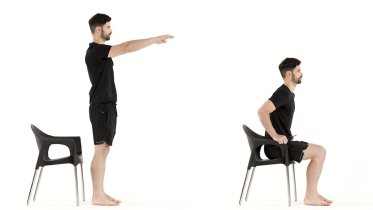 Sit to stand using armrests
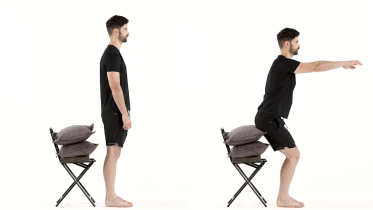 Chair squat
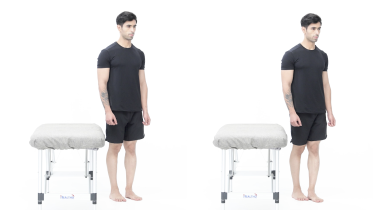 Semi-tandem stance
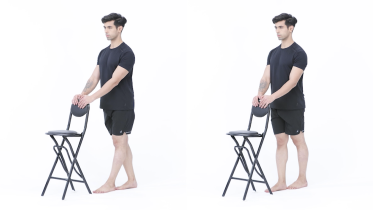 Tandem stance
When to see a physio (physical therapist) or ask about a falls assessment
Book an appointment when getting out of a chair or up the stairs has been getting harder, when you feel unsteady, or when you cannot tell which stage of either program you belong in. The NHS says to see a GP if you are worried about your balance or mobility, or if you have had a fall. A fall counts even when nothing was hurt and nobody saw it. People under-report this almost without meaning to.
A GP can look for the causes that exercise will not fix, check your balance and walking, and refer you to a specialist falls service. A physio or physical therapist will set which stage you start at, which of the standing exercises you may do on your own, and when to take support away. If you want something to work from in the meantime, the home exercise sheet maker will print the exercises you choose with their instructions and warning signs on one page. The warning signs below come first, and each one sets its own timing.
In this topic
- Balance tests for seniors: what a result means and what to do next
What a balance test for seniors can and cannot tell you, how to check your balance at home with support, and when to ask for a falls assessment.
- How to get up from a fall: what to check before you stand
How to get up from a fall: what to check before you move, the safe route onto your feet, what to do if you cannot get up, and how a helper should help.
Related exercise programs
Warning signs
Get emergency help now
- Emergency: any sign of a stroke, even if it goes away. That means a face that droops on one side, an arm you cannot lift or keep up, slurred or muddled speech, weakness or numbness on one side of your body or face, sudden blurred vision, double vision or loss of sight, trouble swallowing, sudden dizziness with unsteadiness or falling over, a sudden severe headache, or a sudden fall where your legs give way but you do not black out (a drop attack). Call emergency services straight away.
- Emergency: you have just fallen and cannot get up, or you think you may have hurt your head, neck, back or hip. Stay where you are, keep warm and call emergency services, or get someone to call for you. If you got up and walked without trouble and only notice pain later, use the same-day lines in this list instead.
- Emergency: you fell and cannot remember the fall or how it happened. Go to an emergency department straight away, and do not drive yourself. You may have blacked out or hit your head without knowing it.
- Emergency: you have had a fall or an injury and now have severe hip pain, or you cannot walk or put weight on the leg. Call emergency services or go to an emergency department. This can be a sign of a broken hip (hip fracture).
- Emergency: you have had a hip replacement and have sudden severe pain in your hip or groin, sometimes with a clunk or pop, and you cannot move the leg or put weight on it, or the leg suddenly looks shorter or turned in or out. Do not try to walk on it or push it back into place. Keep still and call emergency services or go to an emergency department, and do not drive yourself. Your new hip may have come out of its socket (dislocated), and a medical team needs to put it back.
- Emergency: your operated leg looks shorter than it did, or its foot turns in or out more than before, or the hip moves in an unusual way, even if the pain is not severe. Keep your weight off it and go to an emergency department straight away, and do not drive yourself. If you are in severe pain or cannot move the leg, call emergency services.
- Emergency: if chest pain, pressure or tightness does not ease quickly when you rest, spreads to your arm, neck, jaw, stomach or back, or comes with sweating, feeling sick, feeling light-headed or being short of breath, call emergency services straight away, as this can be a heart attack. If it eases quickly and none of these happen, get medical advice the same day, and do not exercise again until you have been checked.
Get help today
- Same day: you blacked out or fainted, even for a moment. Get medical advice the same day. Call emergency services instead if the person is not breathing, cannot be woken within 1 minute, has not fully recovered or has trouble speaking or moving, has chest pain or a pounding, fluttering or irregular heartbeat, fainted while exercising or lying down, is shaking or jerking, or was badly hurt.
- Same day: dizziness, lightheadedness, blurred vision or feeling faint when you stand up that is new for you, does not pass within a minute or two, keeps happening, or has made you fall. Sit or lie down, and get medical advice the same day. This can be a drop in blood pressure on standing (postural hypotension), a type of low blood pressure, which the NHS lists among the causes of falls, and your doctor can check it. Tell them about your medicines, because some can cause it. If it does not settle within a few minutes of sitting or lying still, call emergency services. If you faint, use the fainting line above.
- Same day: dizziness or feeling faint during or after exercise, other than the brief lightheadedness as you stand up covered in the line above, without any of the emergency signs above. Stop the exercises and get medical advice the same day. If you faint, it does not settle within a few minutes of sitting still, or you cannot stand or walk steadily, call emergency services.
- Same day: after a fall, you are in pain, have hurt yourself or feel unwell, or you were on the floor for an hour or more, without any of the emergency signs above. Get medical advice the same day, even if you managed to get up.
- Same day: new hip or groin pain after a fall, even a small one, if you are older, have low bone density (osteoporosis) or have taken steroid tablets for a long time, even if you can still walk. Get medical advice the same day. A broken hip is not always obvious at first.
- Same day: at any time after your operation, even years later, new pain in your new hip along with a high temperature or feeling hot, cold or shivery, or a hip that becomes hot, red or swollen, which counts on its own, with or without pain and with or without a temperature. Contact your surgical team or get medical advice the same day. A new joint can become infected long after the operation, and that needs treating quickly. A normal temperature is not an all clear: OrthoInfo says fever is no longer considered a sign of an infection after a joint replacement, that the signs can be as little as mild redness and swelling and sometimes there are none at all, and that increased pain or stiffness in a joint that had been working well is one of them. So do not wait for a temperature before you report new or increasing pain in your new hip to your surgical team.
- Same day: you have had a hip replacement and your hip clunks and feels as if it partly slipped out of place and went back, even if it settles straight away and your leg looks normal. Stop the exercises, avoid the movement that brought it on, go back to your crutches or frame, and keep away from deep bending, crossing your legs and twisting on that leg until you have been seen. Contact your surgical team or get medical advice the same day. If the leg then looks shorter or turned, or you cannot move it or put weight on it, call emergency services.
- Same day: you have had a hip replacement and, after a fall or a knock, even a small one, your hip, groin or thigh is newly painful, bruised or swollen, even if you can still walk and your leg looks normal. Stop the exercises, go back to your crutches or frame and keep your full weight off that leg, and contact your surgical team or get medical advice the same day. A break in the bone around a new hip is not always obvious at first, and walking normally on one can move the broken ends apart.
Book an appointment
- Within a few days: you have had a fall, even if you were not hurt, or you keep tripping, stumbling or feeling that your legs might give way. Book an appointment with your doctor within a few days and ask about a falls assessment. Tell them about every fall, even the ones where you were not hurt.
- Routine: pain in your new hip that had settled and has come back, or pain that is getting worse month by month, for example in the groin or thigh when you first stand up and start to walk. This is not an emergency, but ask your surgical team for a review, as the parts of a new joint can loosen or wear over the years. Get medical advice the same day instead, not a routine appointment, if the hip also becomes hot, red or swollen, or you have a high temperature or feel hot, cold or shivery, or the pain is building week by week rather than month by month. A new joint can become infected years after the operation, and the two can feel similar at first.
Common questions
What are the best strength and balance exercises for seniors?
The ones that match what you are short of. On the balance side, the strongest evidence in the Cochrane review was for programs built mainly on balance and functional training, meaning work that challenges your balance while you are standing together with everyday movements such as standing up from a chair and stepping (Sherrington 2019). On the strength side, the work that matters most is whatever loads your legs through the movements you actually use: rising from a seat, climbing stairs, getting up off the floor. The staged lists are on balance and falls prevention and strength training for older adults, with video on every exercise.
Can I do this at home without equipment?
Nearly all of it, yes. A firm chair that cannot slide and a kitchen counter within reach will get you through the early stages of both programs, and a resistance band and one light dumbbell cover most of what comes later. What you cannot do at home is work out which stage you belong in if you have fallen or feel unsteady, and that is worth one physio appointment instead of a guess.
Is it too late to start at 70, 80 or 90?
No. The question comes up in clinic almost every week, usually from someone who has already lost more than they needed to while waiting for an answer. Both of our program pages set out what the trials in older people found, and both start at a stage you can do sitting down or with a hand on the counter. Start there and build up slowly, not where you think you ought to be.
Is there a PDF I can print?
Yes. The home exercise sheet maker builds a printable sheet from the exercises you pick, with the instructions and the warning signs on it. It is useful for a fridge door, and it is useful for showing a physio what you have actually been doing.
Where do I start if I feel unsteady on my feet?
At the easiest stage, with a hand on something solid, and with your doctor told. Feeling unsteady is one of the reasons the NHS gives for seeing a GP, because some causes of unsteadiness are treatable and none of them is improved by guessing. Start with stage 1 of the balance and falls prevention program, keep a hand on the support, and practice only when someone else is at home.
References
- Sherrington C, Fairhall NJ, Wallbank GK, Tiedemann A, Michaleff ZA, Howard K, Clemson L, Hopewell S, Lamb SE. Exercise for preventing falls in older people living in the community. Cochrane Database of Systematic Reviews. 2019;(1):CD012424. doi:10.1002/14651858.CD012424.pub2
- Montero-Odasso M, van der Velde N, Martin FC, et al. World guidelines for falls prevention and management for older adults: a global initiative. Age and Ageing. 2022;51(9):afac205. doi:10.1093/ageing/afac205
- NHS. Physical activity guidelines for older adults. https://www.nhs.uk/live-well/exercise/physical-activity-guidelines-older-adults/
- NHS. Falls. https://www.nhs.uk/conditions/falls/
- NHS. Symptoms of a stroke. https://www.nhs.uk/conditions/stroke/symptoms/
- NHS. Fainting. https://www.nhs.uk/symptoms/fainting/
- NHS. Low blood pressure (hypotension). https://www.nhs.uk/conditions/low-blood-pressure-hypotension/
- NHS. Complications of a hip replacement. Page last reviewed 6 March 2024. https://www.nhs.uk/tests-and-treatments/hip-replacement/complications-of-a-hip-replacement/
- American Academy of Orthopaedic Surgeons. Infection after joint replacement. OrthoInfo. https://www.orthoinfo.org/en/diseases--conditions/joint-replacement-infection/
Written and checked by the PocketPhysio editorial team. Last updated 2026-10-18.
This page is general education, not a diagnosis or a personal treatment plan. See a physiotherapist or doctor for advice about your own situation.