
Supported single leg squat
The supported single leg squat is a partial knee bend on one leg while you hold the back of a chair with both hands. The other foot stays lifted behind you. It works the front of the thigh (quadriceps) and the buttock and side hip muscles that keep the knee in line over the foot. The chair looks after your balance, so you can think about bending slowly and smoothly.
How to do the supported single leg squat
- Face the back of a sturdy chair, or a kitchen counter, and rest both hands on top of it. Start with your feet about hip width apart.
- Move your weight onto one leg, then bend the other knee to lift that foot off the floor behind you, as in the video.
- Keep your trunk upright and let your lower back keep its slight inward curve. Slowly bend the standing knee into a partial squat and let your hips go slightly back.
- Go only as low as you can keep the kneecap pointing over your second toe, with no wobble to either side. The woman in the video bends only about a quarter of the way to a full squat, and that is enough to start.
- Push through the whole foot to straighten the knee slowly back up. Finish your reps, then change legs if both are in your program.
What you should feel
Work in the front of the thigh and the buttock of the standing leg, with the side of that hip helping to hold the knee steady. Your hands are there to steady you. They should not be lifting you.
Common mistakes
- Letting the knee roll inward or sway outward as you bend.
- Dropping into the bend quickly, then pushing up with your arms.
- Folding the chest down toward the chair or rounding the back.
- Letting the hip on the side of the lifted foot drop.
How often
Many programs start with 2 to 3 sets of 6 to 10 slow bends on each leg, keeping the depth small at first. Your physio will adjust this.
Stop and check with your physio if
- Sharp pain in the knee, pain at the front of the knee that grows with each bend, or the knee gives way.
- You feel dizzy, lightheaded, faint or sick, or the room seems to spin. Hold your support, sit down and get medical advice the same day before you practice again. If you faint, it does not settle within a few minutes of sitting still, your vision suddenly blurs or goes double, or you cannot stand or walk steadily, call emergency services.
- You nearly fall even with both hands on the chair. Put the lifted foot down and rest.
From the clinic
Use a solid chair that will not slide or tip over, such as a heavy dining chair pushed back against a wall, or stand at a kitchen counter instead. Move rugs and clutter out of the way first. Wear flat shoes that fit well and grip the floor, not socks, tights or bare feet. If you have had a fall in the last 12 months, often feel unsteady, or take a medicine that can make you dizzy, keep both hands on the support throughout and ask your physio to check your balance before you start. If you have high blood pressure, breathe steadily through every repetition and never hold your breath.
A sudden loss of balance is different. Call emergency services straight away for any sign of a stroke, even if it goes away: sudden dizziness with unsteadiness or falling over, a face that droops on one side, an arm you cannot lift or keep up, slurred or muddled speech, weakness or numbness on one side of your body or face, sudden blurred vision, double vision or loss of sight, or a sudden severe headache.
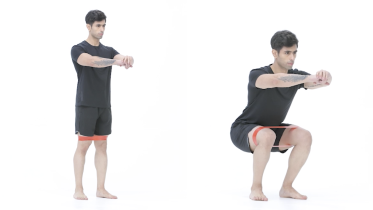
If one leg is too much for now, the two-legged mini squat builds the same bending pattern, and single leg stance trains the balance part on its own. Once this feels steady, your physio may add a band at the knee, as in the single leg mini squat with band, or move you on to the backward step-down.
After a knee fracture or knee surgery, including a knee replacement, follow your surgeon's or physio's plan, and start this exercise only when they have cleared you. After a knee ligament reconstruction or meniscus surgery, ask as well how far you may bend at your stage. If you have had a hip replacement, get the go-ahead from your surgeon or physio before you try the supported single leg squat. Some operations limit this kind of work for the first months, so the timing depends on your surgery.
Written and checked by the PocketPhysio editorial team. Last updated 2026-09-28.
This page is general education, not a diagnosis or a personal treatment plan. If you have pain, an injury or a health condition, see a physiotherapist or doctor before starting new exercises.
.png)