
Total knee replacement rehab: exercises and recovery
What is a total knee replacement?
In a knee replacement, the damaged parts of the knee are replaced with metal and plastic parts (NHS). Most people who have one have pain and movement problems caused by osteoarthritis. The NHS says the operation may be offered when knee pain is having a big effect on your life and other treatments have not worked.
This page is for adults in the weeks and months after a total knee replacement. After a partial knee replacement, a repeat operation on a knee replacement, or a replacement done after a broken bone, your team's plan may be quite different, so follow it rather than this page. If your operation is still ahead of you, NICE recommends exercise advice before surgery as well as after it (NICE NG157). Ask your surgical team whether the knee osteoarthritis program suits you while you wait.
Your surgeon's and physio's plan comes first
Every surgical team has its own plan, built around the operation you had and how you and your knee were before it. It tells you which exercises to do and when to move on to harder ones, and how to use your crutches or sticks. Where it differs from this page, follow your team's plan. If you are not sure what your plan is, ask them before you change what you do.
NICE advises that a physio or occupational therapist starts rehab on the day of surgery if possible, and no later than 24 hours after it. Rehab includes getting you up and moving, a home exercise program and advice on managing daily activities (NICE NG157). Before you go home you are usually given compression stockings and shown your exercises (NHS). A nurse takes out the stitches or clips after about 10 days, and there is usually a check-up about 6 weeks after the operation (NHS).
What recovery usually looks like
Every knee recovers at its own pace, so treat these as typical times, not targets. The NHS says you usually go home 1 to 4 days after the operation. You use crutches or walking sticks at first, go down to one crutch and then a stick when you feel confident, and may try walking without an aid after about 6 weeks if you feel ready.
OrthoInfo says most people can get back to most normal daily activities within 3 to 6 weeks, and that mild to moderate swelling for about 3 to 6 months is common. The NHS says most people return to work after about 6 to 12 weeks, depending on the job, and that full recovery may take several months or longer. How fast you move through the stages below depends on your knee, on what you need to get back to and on how fit you were before the operation.
What is normal in the first months
A few things worry people but are usually part of recovery. OrthoInfo says some pain with activity and at night is common for several weeks after surgery. Most people also have some numbness in the skin around the scar, and most feel or hear some clicking of the metal and plastic parts when they bend the knee or walk, which is normal (OrthoInfo). Swelling down the leg, into the calf and around the scar is also common (South Tees).
What is not normal is a knee or wound that is getting more red, hot, swollen or painful instead of settling, or a calf that is newly swollen, warm or tender. These are in the warning signs below.
Why exercise matters after a knee replacement
The NHS says following your exercises early in your recovery helps the long-term strength and movement in your knee. One NHS leaflet puts getting the range of movement back, both bending and straightening, among the most important things to do first (Torbay and South Devon).
The research behind particular programs is thinner than you might expect. A review of 18 trials with 1,739 people found that physio exercise after a knee replacement improved function and pain at 3 to 4 months compared with minimal physio, but it did not find a long-term benefit, and the result rested on a few small studies (Artz and colleagues, 2015). So the stages below follow NHS patient leaflets and common physio practice. Your own team's plan still comes first.
Swelling, pain relief and blood clots
Taking your pain relief as prescribed makes it easier to move and do your exercises, and ice and raising the leg help with both swelling and pain (South Tees). Wrap ice in a cloth rather than putting it straight on the skin (Torbay and South Devon), keep it on for no more than about 20 minutes at a time, and check the skin every few minutes. Take extra care over the numb skin around your scar, which cannot warn you when it gets too cold. The NHS advises keeping your leg raised as much as possible and not standing for long periods, which can make your ankles swell.
Do not sleep with a pillow under your knee (NHS). Left bent on a pillow for hours, the knee can stiffen that way and undo the work of the straightening exercises.
A leg that has just been operated on is more likely to form a blood clot. The NHS says your doctor may suggest compression stockings or blood-thinning medicine to lower the risk. If you are given stockings, the NHS says to wear them at all times and take them off only to wash them, and most people need them for at least 6 weeks. Moving your feet and ankles is also encouraged straight after surgery (OrthoInfo). Use the stockings, injections or tablets exactly as your team told you.
How to use this program
Start only with the exercises your team has given you or cleared. Stage 1 is for the first weeks. Move to stage 2 when stage 1 feels manageable and your team is happy with your walking, and to stage 3 when you walk steadily and stage 2 feels easy. These signs come from common practice and are a rough guide, not fixed rules.
Each exercise page gives a typical starting dose. As a rough guide, many programs do the early bending and thigh exercises 2 to 4 times a day, often 5 to 15 repetitions with short holds, and one NHS leaflet adds a few knee bends every couple of hours (Torbay and South Devon). The straightening stretches often start with holds of a few minutes, building toward about 10 minutes, 3 or 4 times a day. The standing strength exercises often start at 2 to 3 sets of 5 to 15, once a day. Your physio will adjust this to your knee and your plan.
The bending and straightening exercises are meant to take the knee into a firm stretch, and some discomfort is expected. One NHS leaflet says it is fine to push the range into a little pain or stretch, with ice and painkillers to help (Torbay and South Devon). Sharp pain, pain that keeps building with each repetition, or a knee that is clearly more swollen or sore the next morning usually means you did too much. Drop back a step rather than stopping altogether, and keep breathing normally through every repetition. If the knee is also red and hot, or it does not settle within a day or two, check the warning signs below.
The exercise program
Stage 1: Bend, straighten and switch the thigh on
For the first weeks after the operation, starting with the exercises your physio showed you on the ward. Ankle pumps keep the blood moving in your calves, and quad sets, short arc quads and straight leg raises get the thigh muscle working again. Heel slides and the seated knee bend work on bending. When the seated knee bend is going well, the assisted knee bend lets your other leg nudge the knee a little further, as two NHS knee replacement leaflets show. It crosses your ankles only for the push, which is not the same as sitting with your legs crossed. The knee extension stretch and the seated heel prop let the knee sink straight. Many programs do these several times a day, often 3 or 4, and a firm stretch or some discomfort is expected in the bending and straightening ones. If your knee bends as you try to lift your leg straight, stay with quad sets and short arc quads for now, and tell your physio.
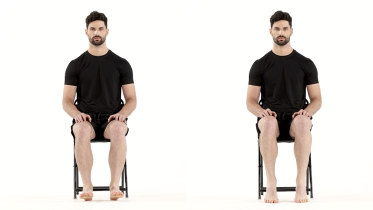 Ankle pumps
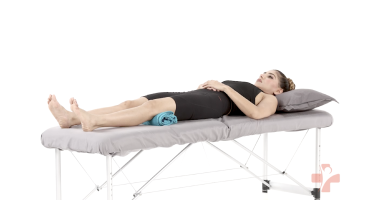 Quad sets (towel under knee)
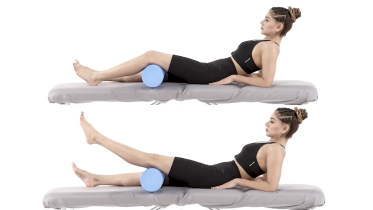 Short arc quads
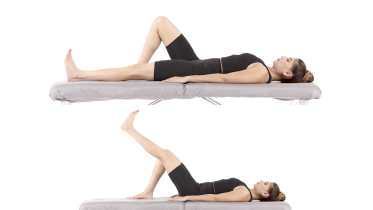 Straight leg raise
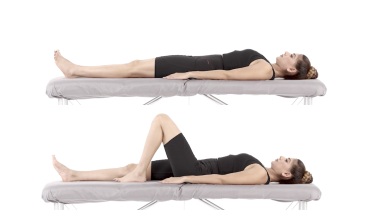 Heel slides
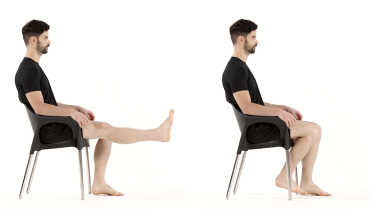 Seated knee bend
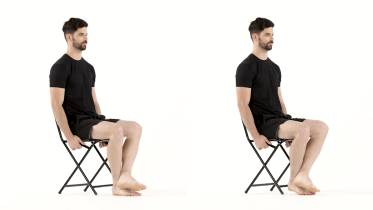 Assisted seated knee bend
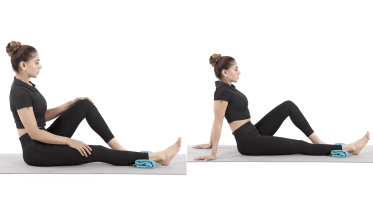 Knee extension stretch
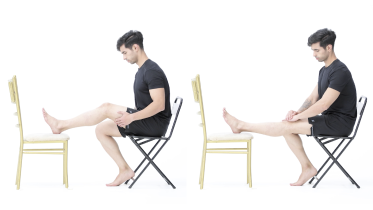 Seated heel prop
Stage 2: Build strength and walk more normally
When the stage 1 exercises feel manageable and your team is happy with how you are walking. Seated knee extension and the straight leg raise with the leg turned out build the thigh further, and sit to stand using armrests practices getting out of a chair. The two weight shifts, calf raises and the mini squat get the leg used to taking your weight, with a kitchen counter to hold and only as much weight as your plan allows. Walking with a cane is for when your team says you can move from crutches to one stick.
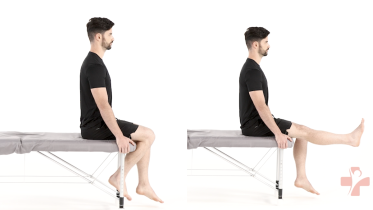 Seated knee extension
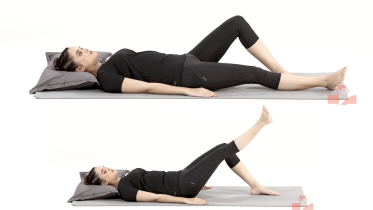 Straight leg raise with the leg turned out
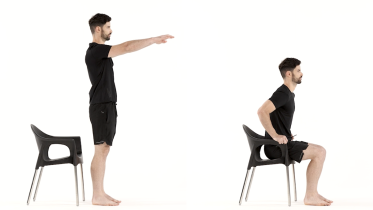 Sit to stand using armrests
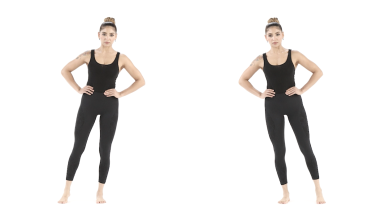 Side to side weight shift
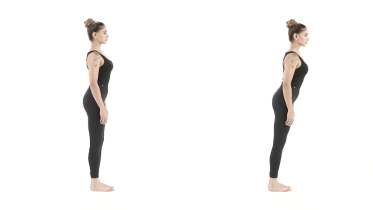 Forward and backward weight shift
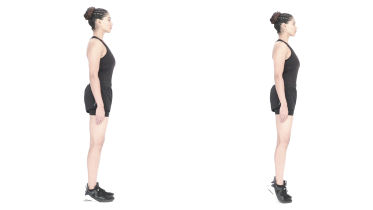 Calf raises
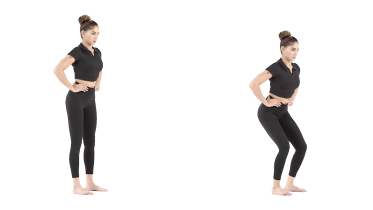 Mini squat
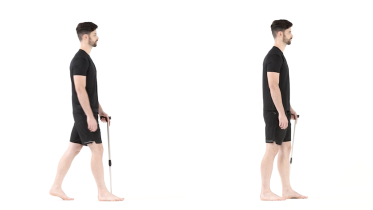 Walking with a cane
Stage 3: Stairs, balance and everyday strength
For when you walk steadily, often with one stick or none, and stage 2 feels easy. Sit to stand without your hands, step-ups and stair practice build strength for stairs, starting on a low step with a rail or counter to hold. Single leg stance, the supported single leg squat and the slow-lowering eccentric squat train balance and control on the operated leg, with a counter or sturdy chair within reach. Ask your surgeon or physio before you start the two squats, and how deep you may go. Walking with longer steps helps if your steps are still short or uneven. If you want to get back to a sport or a physical job, ask your physio to plan the build-up with you.
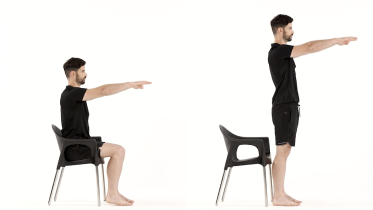 Sit to stand
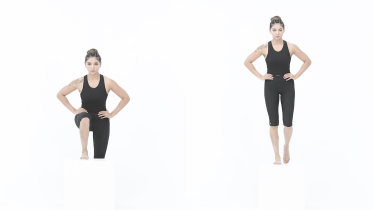 Step up
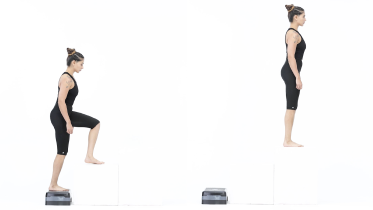 Stair climbing
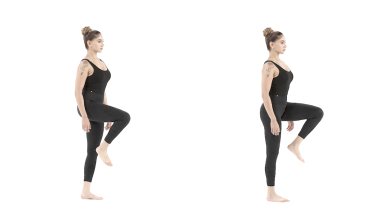 Single leg stance
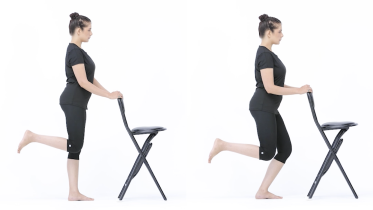 Supported single leg squat
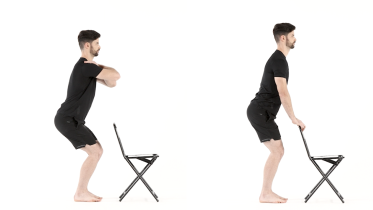 Eccentric squat
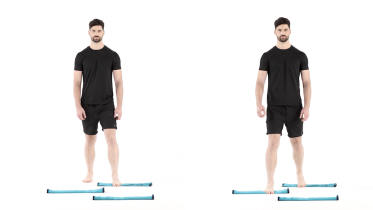 Walking with longer steps
Walking, stairs and falls
Keep using your crutches or stick until your team says you can do without. South Tees physios say it is better to use a walking aid for longer and walk well than to walk unsteadily without one. OrthoInfo warns that a fall in the first few weeks after surgery can damage the new knee, so use your walking aid or a handrail until you are steadier and stronger and the knee moves better.
On stairs, NHS leaflets teach going up with your good leg first, then the operated leg and stick. Coming down, the stick goes first, then the operated leg, then the good leg (Torbay and South Devon). Hold the handrail if there is one.
Clear rugs and trailing cables off the floor at home, and keep a light on at night on the way to the toilet. Wear flat shoes that fit well and grip the floor, not socks, tights or bare feet. If you are older, have fallen before or feel unsteady, the balance and falls prevention program builds on stage 3.
What to avoid or change
In the early months, the NHS advises against sitting with your legs crossed for the first 6 weeks, kneeling on the new knee until your doctor says you can, and heavy household tasks such as vacuuming or carrying shopping for the first 3 months. It also advises that you avoid twisting your knee, bending down or reaching up as much as possible.
For the longer term, OrthoInfo suggests low-impact activities such as swimming, cycling or golf. It says most surgeons advise against high-impact activities such as running and jogging for the rest of your life, because they can speed up wear on the new knee, so ask your surgeon before you take up running. If you have had a hip or knee replacement, get the go-ahead from your surgeon before you try jumping or hopping. Many surgeons advise against jumping and hopping after a joint replacement for good, not just for the first months, because each landing sends high impact through the new joint.
When to see a physio or doctor
NICE says you should know who to contact for advice while you do your exercises at home. It recommends supervised outpatient rehab if you struggle with daily activities, still have problems with function, or find the home program is not working (NICE NG157). If you feel you are not making progress, contact your physio or the knee replacement rehab team rather than waiting for your next appointment (Torbay and South Devon).
Raise it at your 6-week check too if your knee still will not straighten fully or bend far enough for stairs and getting in and out of a car, or if you still cannot walk without a limp. The warning signs below say how quickly to get help.
For physiotherapists
This page gives patients a general framework after primary total knee replacement and defers to the surgical team's protocol throughout. NICE NG157 recommends that rehab starts on the day of surgery if possible and within 24 hours, including mobilization, a home exercise program and advice on activities of daily living. Before discharge, the therapy team advises on self-directed rehab, and people doing it should understand their goals and have a point of contact. Supervised group or individual outpatient rehab is recommended for those with difficulty managing activities of daily living, ongoing functional impairment, or where self-directed rehab is not meeting their goals, and should be considered for people with cognitive impairment.
Artz and colleagues (2015) pooled 18 trials with 1,739 patients and found short-term improvement in physical function (SMD -0.37, 95% CI -0.62 to -0.12) and pain at 3 to 4 months for physiotherapy exercise compared with minimal physiotherapy, with no long-term benefit identified. In the CORKA trial, 621 people judged at risk of a poor outcome were randomized to a home-based program delivered by rehabilitation assistants or to outpatient physiotherapy. There was no clinically or statistically significant difference in the Late Life Function and Disability Instrument function score at 12 months (Barker and colleagues, 2020). The trial's background notes that around 15 to 30% of patients do not report a good outcome after knee arthroplasty.
The 2014 Cochrane review of continuous passive motion found no clinically important effects on active knee flexion, pain, function or quality of life to justify routine use (Harvey and colleagues, 2014). Screen at each visit for signs of deep vein thrombosis and pulmonary embolism, wound and deep infection, an extensor lag or a new loss of active extension (consider quadriceps or patellar tendon rupture), stiffness that is not improving, and common peroneal nerve symptoms. After any fall, consider a periprosthetic fracture. The assisted knee bend sits in stage 1 because both NHS trust leaflets cited here include a knee bend assisted by the other leg among early exercises, and the Torbay and South Devon version crosses the ankles. The brief ankle cross is not the sustained crossed-leg sitting the NHS advises against for 6 weeks.
See a doctor promptly if
- Emergency: since your operation, you suddenly become short of breath, you get chest pain or pain in your upper back that may be worse when you breathe in, you cough up blood, your heart is beating very fast, or you faint. Call emergency services straight away, even if your leg looks normal. These can be signs of a blood clot in the lungs (pulmonary embolism).
- Same day: a calf or thigh that is newly swollen, warm, tender, red or darker than usual, has swollen veins that are sore to touch, or has a throbbing or cramping pain that does not fit your injury or condition, or that feels different from normal muscle soreness after exercise. This can be a sign of a blood clot (deep vein thrombosis), especially after surgery, an injury, time in a cast or boot, a long trip or a spell of being much less mobile than usual. Get medical advice the same day. If you are also short of breath or have chest pain, call emergency services.
- Emergency: after a fall or a knock, you cannot put weight on the leg, your knee or thigh is very painful, or the leg looks out of shape or shorter than the other. Go to an emergency department straight away, and do not drive yourself. If you cannot get up, call emergency services. A broken bone around a knee replacement is rare, but it needs treatment in hospital. If a smaller fall or knock leaves the knee more swollen or bruised, get it checked by your surgical team the same day.
- Same day: your wound becomes more red, hot, swollen or painful, starts to leak or ooze, has pus coming out of it or its edges start to come apart, or you have a high temperature or feel hot, cold or shivery. Contact your surgical team or get medical advice the same day. Redness can be harder to see on brown or black skin. If you feel very unwell, go to an emergency department. If you have a very high or very low temperature, shivering you cannot control, you are breathing very fast or finding it hard to breathe, you are confused or your speech is slurred, your skin, lips or tongue look blue, gray, pale or blotchy (on brown or black skin this can be easier to see on the palms of the hands or soles of the feet), or you have a rash that does not fade when you press it, call emergency services, as this can be sepsis.
- Same day: since your operation, the redness, warmth, swelling or pain in your knee is not getting better or is getting worse, for example the knee pain keeps building both when you move and when you rest. Contact your surgical team or get medical advice the same day, as this can be a sign of infection around the new joint. If you feel very unwell, go to an emergency department.
- Same day: you suddenly cannot straighten your knee or lift your leg straight when you could before, often after a pop, a tearing feeling or a stumble, or you notice a dip just above or below your kneecap, or you suddenly cannot put weight on the leg, even without a fall. Keep your weight off it and contact your surgical team the same day. If you cannot reach them that day, go to an emergency department. A tendon at the front of the knee may have torn, and a repair works better when it is done soon.
- Same day: a leg or foot that is getting weaker, for example your foot drags, catches on the ground or slaps down when you walk (foot drop). Get medical advice the same day. If the weakness is getting worse by the hour, go to an emergency department.
- Same day: new numbness, tingling or burning in your lower leg or foot, beyond the numb patch of skin around your scar. Contact your surgical team or get medical advice the same day. If your foot or toes turn cold, pale, blue or gray, call emergency services or go to an emergency department straight away, and do not drive yourself.
- Within a few days: your knee is not bending or straightening any further from week to week, is getting stiffer, or feels unstable or gives way when you stand or walk. This is not an emergency, but contact your physio or surgical team within the next few days, and keep using your walking aid until they have checked it.
Common questions
How long does it take to recover from a knee replacement?
It varies a lot from person to person. OrthoInfo, from the American Academy of Orthopaedic Surgeons, says most people can get back to most normal daily activities within 3 to 6 weeks. The NHS says you may try walking without an aid after about 6 weeks if you feel ready, that most people go back to work after about 6 to 12 weeks depending on the job, and that you should avoid heavy household tasks for the first 3 months. Full recovery may take several months or longer (NHS).
How far should my knee bend after a knee replacement?
There is no single number that fits everyone, and your surgeon or physio will tell you what they are aiming for with your knee. OrthoInfo says most people can expect to almost fully straighten the new knee and to bend it enough to climb stairs and get in and out of a car. Straightening matters too, and NHS leaflets include a stretch to keep the knee as straight as possible. One of them calls getting the range of movement back one of the most important things to do first (Torbay and South Devon).
Is it normal for my knee to be swollen months after a knee replacement?
Yes, some swelling is normal for quite a while. OrthoInfo says mild to moderate swelling for about 3 to 6 months after surgery is common, and the NHS advises keeping the leg raised and not standing for long periods. Swelling that is getting worse rather than better, or a knee that is also red, hot and more painful, is different. So is a calf that is newly swollen, warm or tender. Both need medical advice the same day.
When can I drive after a knee replacement?
The NHS says to wait at least 6 weeks after a total knee replacement, or 3 weeks after a partial one, and to check with your doctor that you are fit to drive. OrthoInfo adds that in most cases it is safe to start driving again once you no longer take opioid pain medicine and your strength and reflexes are closer to normal. Ask your surgical team before you drive again.
Can I kneel after a knee replacement?
Not until your doctor says you can, according to the NHS. Once you have the go-ahead, OrthoInfo says kneeling is sometimes uncomfortable but not harmful.
Do I need outpatient physio after a knee replacement, or can I exercise at home?
Many people do their rehab at home. NICE says a member of the physio or occupational therapy team should give you advice on doing your rehab yourself before you leave hospital, and that you should know your goals and who to contact for help. It recommends supervised outpatient rehab, in a group or one to one, if you struggle with daily activities, still have problems with function, or the home program is not meeting your goals. In the CORKA trial of 621 people at risk of a poor result after knee replacement, a home program delivered by rehabilitation assistants, with therapists supervising them, worked about as well as outpatient physio at 1 year (Barker and colleagues, 2020).
References
- National Institute for Health and Care Excellence. Joint replacement (primary): hip, knee and shoulder. NICE guideline NG157. Published 4 June 2020. https://www.nice.org.uk/guidance/ng157
- Chartered Society of Physiotherapy. NICE recommends rehab on same day as surgery for joint replacement patients. 10 June 2020. https://www.csp.org.uk/news/2020-06-10-nice-recommends-rehab-same-day-surgery-joint-replacement-patients
- NHS. Why a knee replacement is done. Page last reviewed 9 September 2026. https://www.nhs.uk/tests-and-treatments/knee-replacement/why-its-done/
- NHS. Recovering from a knee replacement. Page last reviewed 9 September 2026. https://www.nhs.uk/tests-and-treatments/knee-replacement/recovery/
- NHS. Complications of a knee replacement. Page last reviewed 9 September 2026. https://www.nhs.uk/tests-and-treatments/knee-replacement/complications/
- NHS. Deep vein thrombosis (DVT). Page last reviewed 30 April 2026. https://www.nhs.uk/conditions/deep-vein-thrombosis-dvt/
- NHS. Pulmonary embolism. Page last reviewed 25 May 2023. https://www.nhs.uk/conditions/pulmonary-embolism/
- NHS. Sepsis. Page last reviewed 14 May 2026. https://www.nhs.uk/conditions/sepsis/
- American Academy of Orthopaedic Surgeons. Total knee replacement. OrthoInfo. https://www.orthoinfo.org/en/treatment/total-knee-replacement/
- American Academy of Orthopaedic Surgeons. Activities after total knee replacement. OrthoInfo. https://www.orthoinfo.org/en/recovery/activities-after-knee-replacement/
- American Academy of Orthopaedic Surgeons. Fracture after total knee replacement. OrthoInfo. https://www.orthoinfo.org/en/diseases--conditions/fracture-after-total-knee-replacement/
- American Academy of Orthopaedic Surgeons. Patellar tendon tear. OrthoInfo. https://www.orthoinfo.org/en/diseases--conditions/patellar-tendon-tear/
- American Academy of Orthopaedic Surgeons. Quadriceps tendon tear. OrthoInfo. https://www.orthoinfo.org/en/diseases--conditions/quadriceps-tendon-tear/
- Torbay and South Devon NHS Foundation Trust. Exercises to do following knee replacement surgery. Patient information 25829, August 2024. https://www.torbayandsouthdevon.nhs.uk/uploads/25829.pdf
- South Tees Hospitals NHS Foundation Trust. Post total knee replacement management. Patient information, 26 February 2025. https://www.southtees.nhs.uk/resources/post-total-knee-replacement-management/
- Artz N, Elvers KT, Lowe CM, Sackley C, Jepson P, Beswick AD. Effectiveness of physiotherapy exercise following total knee replacement: systematic review and meta-analysis. BMC Musculoskeletal Disorders. 2015;16:15. https://doi.org/10.1186/s12891-015-0469-6
- Barker KL, Room J, Knight R, et al. Outpatient physiotherapy versus home-based rehabilitation for patients at risk of poor outcomes after knee arthroplasty: CORKA RCT. Health Technology Assessment. 2020;24(65):1-116. https://doi.org/10.3310/hta24650
- Harvey LA, Brosseau L, Herbert RD. Continuous passive motion following total knee arthroplasty in people with arthritis. Cochrane Database of Systematic Reviews. 2014;(2):CD004260. https://doi.org/10.1002/14651858.CD004260.pub3
Written and checked by the PocketPhysio editorial team. Last updated 2026-09-29.
This page is general education, not a diagnosis or a personal treatment plan. See a physiotherapist or doctor for advice about your own situation.