
Eccentric squat
An eccentric squat puts the work into the lowering part of the squat. You stand behind a chair, lower yourself slowly with your arms crossed in front of you, then take hold of the chair back to help you rise. It trains the front of the thigh (quadriceps) and the buttocks to control a knee bend, much as they do when you sit down or walk down stairs. Your arms help on the way up, so most of the effort goes into the slow way down.
How to do the eccentric squat
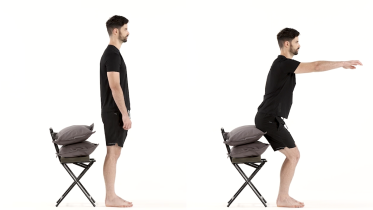
- Stand with a sturdy chair in front of you, close enough to reach its backrest, and set your feet between hip and shoulder width apart.
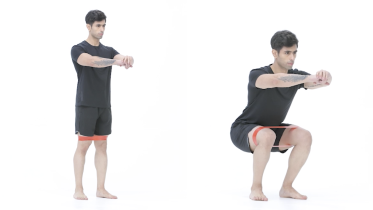
- Cross your arms in front of you at shoulder height, each hand resting on the opposite shoulder, as the man in the video does.
- Send your hips back and bend your knees to lower yourself slowly, keeping your heels down and each knee pointing the same way as its foot. Take several seconds over the way down.
- Stop when your knees are bent to about a right angle, or higher if your physio has set a smaller depth or the knee complains.
- Uncross your arms, put your hands on the chair back and press down on it to help you push back up to standing. Let go, cross your arms again and repeat.
What you should feel
Most of the work comes on the way down, in the front of your thighs and your buttocks. Coming up should feel easier, because your arms share the load.
Common mistakes
- Dropping the last part of the way instead of lowering under control.
- Letting the heels lift or the knees fall inward.
- Pulling back on the chair so it tips toward you. Press down on it instead.
- Going deeper than you can control or than your knees tolerate.
How often
Programs often start with 2 to 3 sets of 6 to 10, lowering over a slow count of about 3 to 5. Your physio will adjust this.
Stop and check with your physio if
- Sharp pain in the knee, or knee pain that builds from one rep to the next.
- Your knee gives way, or you cannot rise even with help from the chair.
- You feel dizzy, lightheaded, faint or sick, or the room seems to spin. Hold your support, sit down and get medical advice the same day before you practice again. If you faint, it does not settle within a few minutes of sitting still, your vision suddenly blurs or goes double, or you cannot stand or walk steadily, call emergency services.
From the clinic
The man in the video lowers with his arms crossed and nothing to hold. If you are less steady, keep your hands hovering just above the chair back instead, so you can grab it at once if you tip backward. Use a heavy chair that cannot slide or tip, or a kitchen counter, and clear the floor behind you. If you have had a fall in the last 12 months or feel unsteady, keep hold of the support on the way down too, and ask your physio before you start. If you have high blood pressure, breathe steadily through every repetition and never hold your breath.
If a right angle is too deep at first, the shallower mini squat, or a chair squat to a raised seat, works the same way with less load. The standard squat is the version with no help on the way up.
If you have had a hip replacement, get the go-ahead from your surgeon or physio before you try the eccentric squat. A squat to this depth bends the hip to about a right angle or further, and many surgeons ask you to avoid that for the first months after some operations. After a knee fracture or knee surgery, including a knee replacement, follow your surgeon's or physio's plan, and start this exercise only when they have cleared you. Ask them as well how deep you may squat at your stage.
Written and checked by the PocketPhysio editorial team. Last updated 2026-09-26.
This page is general education, not a diagnosis or a personal treatment plan. If you have pain, an injury or a health condition, see a physiotherapist or doctor before starting new exercises.
.png)