
Quadriceps tendinopathy (quad tendonitis) exercises and physiotherapy
Warning signs, and when to get help
What is quadriceps tendinopathy?
The quadriceps tendon is the thick band that joins your thigh muscles to the top of your kneecap. Quadriceps tendinopathy is pain in that tendon when it takes load, usually with tenderness you can find with a fingertip at the upper edge of the kneecap rather than the lower one.
It is uncommon, and the figures come with a caveat about who was counted. Sprague and colleagues give the prevalence as 0.2% to 2%, and add that up to one in four athletes with pain in the extensor mechanism have it at the top of the kneecap (Sprague 2019). We followed both figures back to the papers behind them, and both rest on two studies of elite athletes: 613 Norwegian national-level athletes across nine sports, and a prospective cohort of elite junior volleyball players (Lian 2005, Visnes 2015). So those are elite athlete numbers. Nobody has measured how common this is in the general population, and the page below is written for a reader who is probably not an elite athlete.
King and colleagues' review puts the usual sites in order: about 65% to 70% of cases at the origin of the patellar tendon, 20% to 25% at the quadriceps tendon insertion on the upper pole of the kneecap, and 5% to 10% at the patellar tendon's attachment on the shin (King 2019 part 2). That split comes from the review itself with no primary study attached to the sentence, so read it as experienced opinion rather than a measured figure.
Whatever the exact rate, most people with pain at the front of the knee do not have this. That is not an inference from the numbers above, which are about athletes; it is because patellofemoral pain is much the commonest cause of pain at the front of the knee. Which is why the rest of this page spends as much time on what else it could be as on the program.
Is the pain above the kneecap or below it?
Put one finger on the sore spot. If it sits at the top edge of the kneecap, where the thigh muscles run in, this page fits. If it sits at the bottom tip, read patellar tendinopathy instead, and if it is at the bony bump below the knee in someone still growing, read Osgood-Schlatter disease.
Then ask which position hurts. Pain that peaks with springy, fast loading, such as jumping and landing, points at the tendon below the kneecap. Pain that peaks in deep knee bend, when you squat right down, kneel, sit back on your heels or lower yourself slowly down a step, points at this one.
A spread out ache around or behind the kneecap that is worse on stairs and after long sitting is more likely patellofemoral pain. A burning ache below the kneecap that comes on when the knee straightens and locks back is more likely fat pad impingement. A focal spot on the inner side with a snap or catch can be plica syndrome, and there is even a small case series linking tendon pain above the kneecap with a fold in the pouch above the joint: 7 male athletes, 10 tendons, no control group (Alfredson 2022). None of that can be settled from a website, and all of it can be settled in one appointment.
Why this program loads you deeper, not shallower
This is the reason the page exists. Sprague and colleagues set out the mechanics plainly: the quadriceps tendon experiences greater loads than the patellar tendon as the knee moves further into flexion, which may explain why pain in quadriceps tendinopathy is most pronounced in activities involving deep knee bend, so graduated loading programs should include appropriate loading in deep knee flexion (Sprague 2019). Kuwabara and Fredericson say the same in one line: treatment is similar to patellar tendinopathy except that the quadriceps tendon is preferentially loaded in deep flexion, and that should guide the program (Kuwabara 2021).
Compare that with our patellar tendinopathy page, which starts squats and step ups with a shallow knee bend and goes deeper over weeks. Both programs use the same exercises. The difference is the range you are aiming at, and for this tendon depth is the treatment rather than a risk to be managed.
Two limits travel with that instruction, in the source's own words. Caution is advised when loading in end-range knee flexion if there are bony abnormalities at the knee, and in highly symptomatic cases the patient may not tolerate deep knee flexion in the early phases. So depth is where you are heading, not where you start.
Sprague and colleagues also note that adding tibial rotation or hip extension may preferentially load different regions of the tendon, which is why the split squat and the big step up sit in stage 3 rather than being swapped in as variety.
What does the evidence say about treating quadriceps tendinopathy?
Thin is the honest word, and you can see it in the sources themselves. King and colleagues' treatment review for quadriceps tendinopathy tabulates 14 studies, and every one of them studied the patellar tendon or jumper's knee rather than this tendon (King 2019 part 2). Sprague and colleagues explain why: patellar tendinopathy has been researched extensively while this one was largely ignored, so clinicians have resorted to treating it with programs designed for the patellar tendon, and one of their research priorities is simply running the trials (Sprague 2019). Katz and colleagues still reported in 2024 that research on managing quadriceps tendinopathy is limited (Katz 2024). A 2011 systematic review asked in its own title whether this is a forgotten pathology for physiotherapists (Simpson and Smith 2011).
So what you are getting here is a program built on how the tendon loads, from clinicians who study tendons, and not a program that has beaten a placebo. We would rather tell you that than imply more.
One useful principle does come from the research: mild to moderate pain during loading is not harmful. Sprague and colleagues set a ceiling of 5 out of 10 during or immediately after loading, with symptoms settling to their usual level by the next morning and not building week to week, and they add that the threshold may need to be lower if the tendon is highly irritable.
You may notice that our patellar tendinopathy page uses about 3 out of 10 instead, so here is why the two numbers differ rather than one of them being wrong. Sprague's figure is the pain monitoring model, the general tendon rule, and their paper cites the Achilles trial it came from. The 3 out of 10 on the patellar page is the stricter rule written into the specific trial that program copies, used there as the test for moving up a stage. Each protocol sets its own ceiling and they do not agree with each other, which our guide to the model says in as many words. What does not change between them is the part that actually protects you: back to your usual level by the next morning, and no build from week to week. Your physio will set the number that fits your tendon, and a lower one if it is irritable.
How to use this program
Start at the stage that matches your knee now, and begin at stage 1 if you are not sure. Move up when the current stage feels easy and the tendon is no worse the next morning.
Each exercise page gives a typical starting dose. As a guide, the holds in stage 1 are often 3 to 5 repetitions of 10 to 30 seconds, and the strength work in stages 2 and 3 is usually 2 to 3 sets of 8 to 12 on 2 or 3 days a week, with a slow count down and up. Change one thing at a time: either add depth or add weight in a given week, not both. Your physio will adjust the exercises, the depth and the numbers.
On pain while you work: some is expected and is not doing harm. Sprague and colleagues set the limit at 5 out of 10 during or just after the session, lower if the tendon is easily stirred up, and then give you the two checks that matter more than the number. The tendon should be back to its usual level by the next morning, and the pain should not be creeping up from week to week. If either of those fails, the load was too much, whatever the session felt like at the time.
Breathe steadily through every hold and repetition and never hold your breath, especially if you have high blood pressure. With a heart condition or high blood pressure, check with your doctor before you start. After knee surgery, including a knee replacement or a ligament repair, follow your surgical team's program rather than this one. If you are pregnant, check with your midwife or physio before you start. A child or teenager who is still growing needs an assessment before starting.
The exercise program
The exercises below carry their own stop signs and precautions. Open the line under an exercise and read them before you try it.
Stage 1: Held contractions, and depth is the dose
Start here if the tendon above the kneecap is sore on stairs, getting out of a chair, or anything that bends the knee deeply. In these holds the thigh works while the knee stays still, and how low you sit decides the load: a high wall sit asks little of this tendon and a deep one asks a great deal. Begin higher up the wall than feels necessary, hold for less time than you think you can, and go lower only when the tendon is quiet the next morning. Sprague and colleagues note that someone with a very irritable tendon may not tolerate loading in deep bend in the early weeks, so there is no prize for getting low in week one (Sprague 2019). The single leg version comes last, once the two-legged holds feel easy.
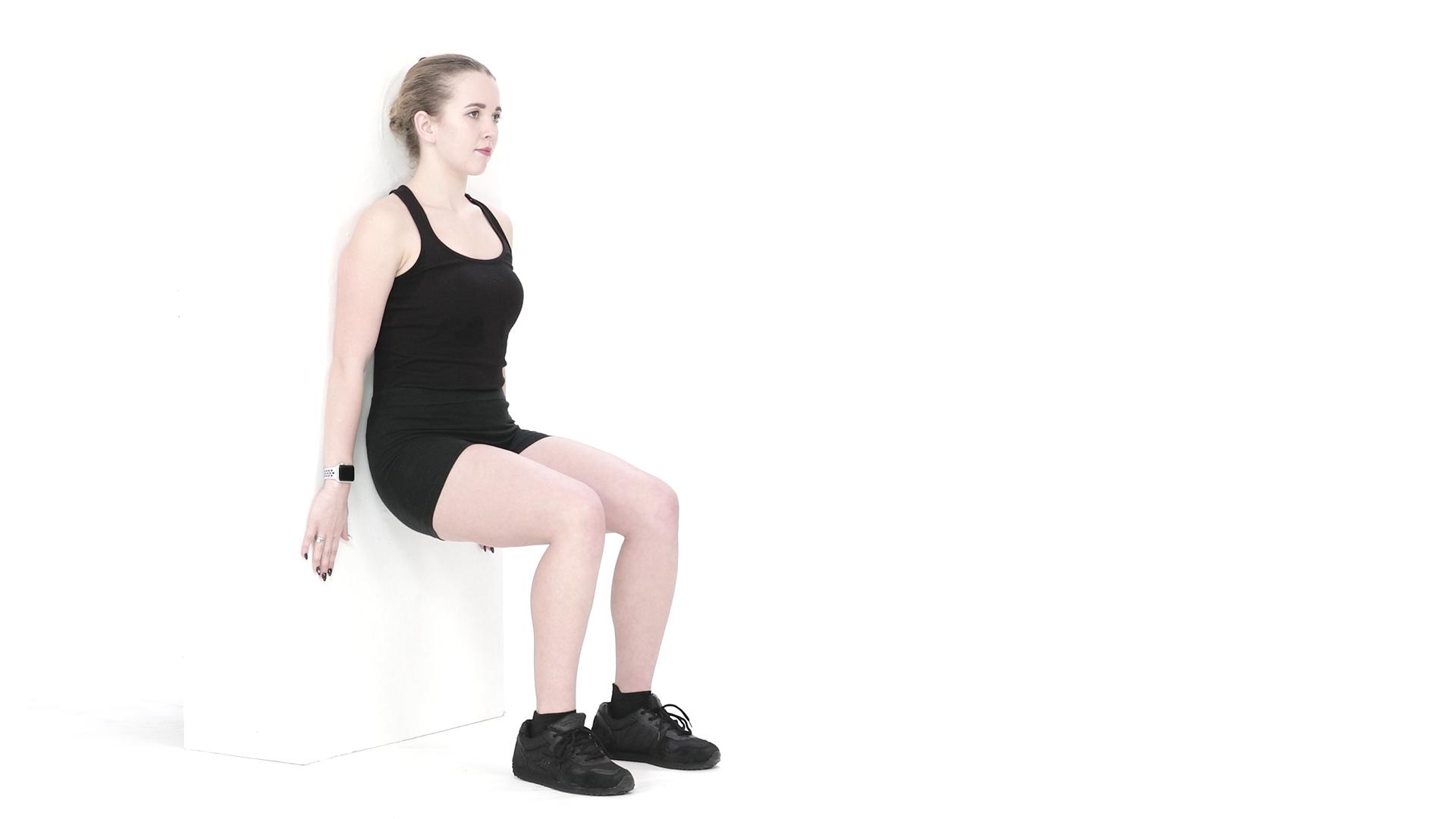 Wall sit
Stop signs and precautions for the wall sit
Before you start
- Holding your breath through a long hold can push your blood pressure up, so if you have high blood pressure or a heart condition, talk to your doctor or physio about long holds first.
When to stop and get help
- Sharp pain in or around the kneecap.
- The knee gives way or you cannot control the slide back up.
- You feel dizzy, lightheaded, faint or sick, or the room seems to spin. Stop, sit down and get medical advice the same day before you exercise again. If you faint, it does not settle within a few minutes of sitting still, your vision suddenly blurs or goes double, or you cannot stand or walk steadily, call emergency services.
- Chest pain or pressure, dizziness or feeling faint, a racing or irregular heartbeat, or being far more out of breath than the effort should cause.
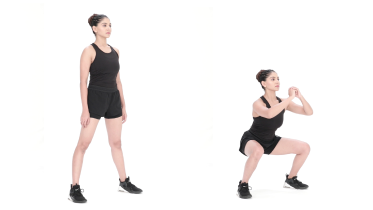 Squat hold
Stop signs and precautions for the squat hold
Before you start
- If you have had a hip replacement, get the go-ahead from your surgeon or physio before you try squat holds. Holding a squat keeps both hips bent to around a right angle or more, and many surgeons ask you to avoid that for the first months after some operations. After a knee replacement or other knee surgery, ask your physio how far you may bend.
- With high blood pressure or a heart condition, ask your doctor or physio whether held squats suit you before you start.
- Keep breathing through every hold, since straining with a held breath can raise your blood pressure.
When to stop and get help
- Sharp pain in your knee, hip or lower back.
- Pain in or around the kneecap that builds as you hold.
- You feel dizzy, lightheaded, faint or sick, or the room seems to spin. Stop, sit down and get medical advice the same day before you exercise again. If you faint, it does not settle within a few minutes of sitting still, your vision suddenly blurs or goes double, or you cannot stand or walk steadily, call emergency services.
- Chest pain or pressure, dizziness or feeling faint, a racing or irregular heartbeat, or being far more out of breath than the effort should cause.
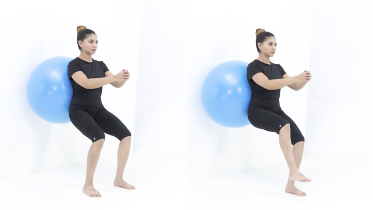 Single leg wall sit with a ball
Stop signs and precautions for the single leg wall sit with a ball
Before you start
- If you have had a hip or knee replacement, get the go-ahead from your surgeon or physio before you try the single leg wall sit. Some operations limit this kind of work for the first months, so the timing depends on your surgery. After other knee surgery, such as a ligament repair or meniscus surgery, ask your physio before you try it and how deep you may go.
- With a heart condition or high blood pressure, check with your doctor before you start.
- If you have high blood pressure, breathe steadily through every hold and never hold your breath.
When to stop and get help
- Sharp pain in or behind the kneecap, or knee pain that builds from one hold to the next.
- The standing knee buckles, or you cannot slide back up under control.
- You feel dizzy, lightheaded, faint or sick, or the room seems to spin. Stop, sit down and get medical advice the same day before you exercise again. If you faint, it does not settle within a few minutes of sitting still, your vision suddenly blurs or goes double, or you cannot stand or walk steadily, call emergency services.
- Chest pain or pressure, dizziness or feeling faint, a racing or irregular heartbeat, or being far more out of breath than the effort should cause.
Stage 2: Heavy, slow strength work, going deeper over the weeks
Move on when the holds are comfortable and the tendon is steady the morning after. This is the main part of the program: slow on the way down, slow on the way up, and more weight as the sets start to feel easy. Depth goes up over the weeks rather than staying shallow, because this tendon takes greater load as the knee moves further into flexion, which is the opposite shape to a program for the tendon below the kneecap. If you have had a hip replacement, get the go-ahead from your surgeon or physio before you try the goblet squat and the step ups. Some operations limit this kind of work for the first months, so the timing depends on your surgery.
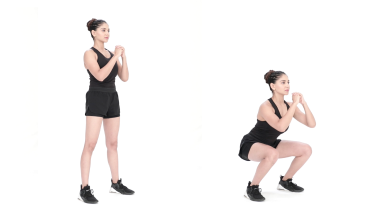 Squat
Stop signs and precautions for the squat
Before you start
- If you have had a hip or knee replacement, get the go-ahead from your surgeon or physio before you try squats. A deeper squat bends the hip well past a right angle, and many surgeons ask you to avoid that for the first months after some operations. Ask them how deep you may go.
When to stop and get help
- Sharp pain in the knee, hip or lower back, or pain that keeps building through the set.
- The knee gives way, locks or catches.
- The knee swells after the session.
- You feel dizzy, lightheaded, faint or sick, or the room seems to spin. Stop, sit down and get medical advice the same day before you exercise again. If you faint, it does not settle within a few minutes of sitting still, your vision suddenly blurs or goes double, or you cannot stand or walk steadily, call emergency services.
- Chest pain or pressure, dizziness or feeling faint, a racing or irregular heartbeat, or being far more out of breath than the effort should cause.
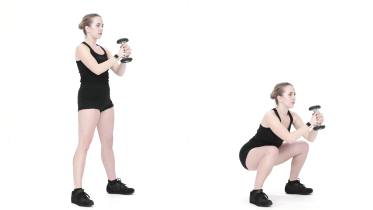 Goblet squat
Stop signs and precautions for the goblet squat
Before you start
- If you have had a hip or knee replacement, get the go-ahead from your surgeon or physio before you try goblet squats. A deep squat bends the hip well past a right angle, and many surgeons ask you to avoid that for the first months after some operations. Your surgical team will also tell you how deep you may go and when you can start adding weight.
When to stop and get help
- Sharp pain in the knee, hip or lower back, or pain that keeps building through the set.
- The knee gives way, locks or catches.
- The knee swells after the session.
- You feel dizzy, lightheaded, faint or sick, or the room seems to spin. Stop, sit down and get medical advice the same day before you exercise again. If you faint, it does not settle within a few minutes of sitting still, your vision suddenly blurs or goes double, or you cannot stand or walk steadily, call emergency services.
- Chest pain or pressure, dizziness or feeling faint, a racing or irregular heartbeat, or being far more out of breath than the effort should cause.
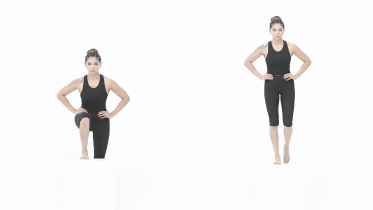 Step up
Stop signs and precautions for the step up
Before you start
- If you have had a hip or knee replacement, or other hip or knee surgery, get the go-ahead from your surgeon or physio before you try step ups. Some operations limit this kind of work for the first months, so the timing depends on your surgery. Your surgeon or physio will also tell you what step height is right for you.
- With a heart condition or high blood pressure, check with your doctor before you start.
- If you have fallen in the past year, have osteoporosis or feel unsteady on your feet, set the step beside a handrail, a kitchen counter or a sturdy chair back, keep one hand on it for every repetition, and ask your physio whether to start with step ups at all or to build up on a single stair first.
When to stop and get help
- You feel sharp pain in the knee or the knee gives way.
- Pain at the front of the knee builds with each rep.
- You feel dizzy, lightheaded, faint or sick, or the room seems to spin. Hold your support, sit down and get medical advice the same day before you practice again. If you faint, it does not settle within a few minutes of sitting still, your vision suddenly blurs or goes double, or you cannot stand or walk steadily, call emergency services.
- You feel unsteady enough that you might fall. Stop and sit down.
- Chest pain or pressure, dizziness or feeling faint, a racing or irregular heartbeat, or being far more out of breath than the effort should cause.
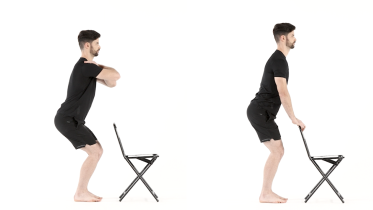 Eccentric squat
Stop signs and precautions for the eccentric squat
Before you start
- If you have had a hip replacement, get the go-ahead from your surgeon or physio before you try the eccentric squat. A squat to this depth bends the hip to about a right angle or further, and many surgeons ask you to avoid that for the first months after some operations. After a knee fracture or knee surgery, including a knee replacement, follow your surgeon's or physio's plan, and start this exercise only when they have cleared you. Ask them as well how deep you may squat at your stage.
- If you have high blood pressure, breathe steadily through every repetition and never hold your breath.
When to stop and get help
- Sharp pain in the knee, or knee pain that builds from one rep to the next.
- Your knee gives way, or you cannot rise even with help from the chair.
- You feel dizzy, lightheaded, faint or sick, or the room seems to spin. Hold your support, sit down and get medical advice the same day before you practice again. If you faint, it does not settle within a few minutes of sitting still, your vision suddenly blurs or goes double, or you cannot stand or walk steadily, call emergency services.
- Chest pain or pressure, dizziness or feeling faint, a racing or irregular heartbeat, or being far more out of breath than the effort should cause.
Stage 3: Deeper bend with the hip extended
When the heavy slow work feels strong and the tendon settles overnight, these take the knee deeper and bring the hip into it. The split squat is here for a reason from the research rather than for variety: in that position the back leg holds its hip extended while its knee is bent, and Sprague and colleagues note that adding hip extension may preferentially load different regions of the tendon (Sprague 2019). Keep the lowering slow on the big step up and the backward step down, and use a step height you can control. Sprague also advises caution about loading in deep knee bend if you have been told you have a bony abnormality at the knee, so check with your physio first in that case. Drop back a stage if the tendon is sorer for more than a day or two after a session.
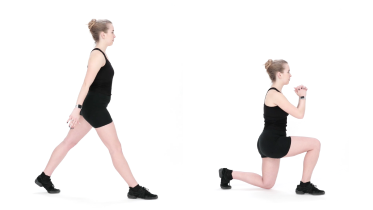 Split squat
Stop signs and precautions for the split squat
Before you start
- If you have had a hip or knee replacement, or other hip or knee surgery, get the go-ahead from your surgeon or physio before you try split squats. Some operations limit this kind of work for the first months, so the timing depends on your surgery.
- If you are pregnant, check with your midwife or physio before you start.
- With a heart condition or high blood pressure, check with your doctor before you start.
- If you have fallen in the past year, have osteoporosis or feel unsteady on your feet, set up beside a kitchen counter, a handrail or a sturdy chair back, keep one hand on it for every repetition, and ask your physio whether to start with split squats at all or to build up with both feet side by side first.
When to stop and get help
- You feel sharp pain in the knee, hip or groin, or the knee gives way.
- Knee pain builds with each rep, or is clearly worse the next morning.
- You feel dizzy, lightheaded, faint or sick, or the room seems to spin. Stop, sit down and get medical advice the same day before you exercise again. If you faint, it does not settle within a few minutes of sitting still, your vision suddenly blurs or goes double, or you cannot stand or walk steadily, call emergency services.
- Chest pain or pressure, dizziness or feeling faint, a racing or irregular heartbeat, or being far more out of breath than the effort should cause.
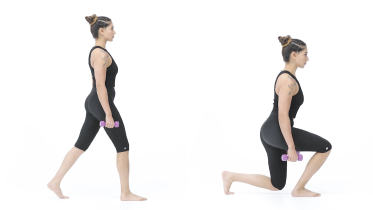 Dumbbell split squat
Stop signs and precautions for the dumbbell split squat
Before you start
- If you have had a hip replacement, get the go-ahead from your surgeon or physio before you try dumbbell split squats. Some operations limit this kind of work for the first months, so the timing depends on your surgery. After a knee fracture or knee surgery, including a knee replacement, follow your surgeon's or physio's plan, and start this exercise only when they have cleared you.
- If you are pregnant, check with your midwife or physio before you start.
- If you have high blood pressure, breathe steadily through every repetition and never hold your breath.
When to stop and get help
- Sharp pain in the front knee, the hip or the groin, or a knee that buckles.
- Knee pain that builds rep after rep, or is worse the next morning.
- You lose your balance with the weights in your hands. Put them down, and next time use a lighter pair or keep one hand on a support.
- You feel dizzy, lightheaded, faint or sick, or the room seems to spin. Stop, sit down and get medical advice the same day before you exercise again. If you faint, it does not settle within a few minutes of sitting still, your vision suddenly blurs or goes double, or you cannot stand or walk steadily, call emergency services.
- Chest pain or pressure, dizziness or feeling faint, a racing or irregular heartbeat, or being far more out of breath than the effort should cause.
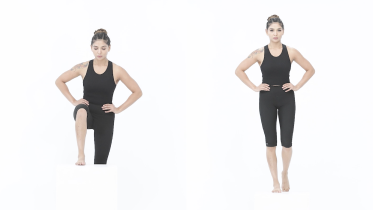 Big step up
Stop signs and precautions for the big step up
Before you start
- If you have had a hip replacement, get the go-ahead from your surgeon or physio before you try the big step up. Placing your foot on a knee-high box and leaning forward to rise bends the hip past a right angle, and many surgeons ask you to avoid that for the first months after some operations. After a knee fracture or knee surgery, including a knee replacement, follow your surgeon's or physio's plan, and start this exercise only when they have cleared you. After an ankle fracture or ankle surgery, follow your surgeon's or physio's weight-bearing plan, and start this exercise only when they have cleared you.
- If you are pregnant, check with your midwife or physio before you start.
- With a heart condition or high blood pressure, check with your doctor before you start.
- If you have high blood pressure, breathe steadily through every repetition and never hold your breath.
When to stop and get help
- Your knee buckles, or you get sharp pain in the knee, hip or ankle.
- Kneecap pain that gets worse with every step up.
- You feel dizzy, lightheaded, faint or sick, or the room seems to spin. Hold your support, sit down and get medical advice the same day before you practice again. If you faint, it does not settle within a few minutes of sitting still, your vision suddenly blurs or goes double, or you cannot stand or walk steadily, call emergency services.
- You lose your balance on top of the box and need the support to stop a fall. Step down and rest.
- Chest pain or pressure, dizziness or feeling faint, a racing or irregular heartbeat, or being far more out of breath than the effort should cause.
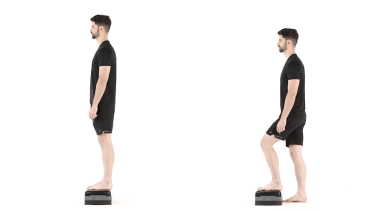 Backward step-down
Stop signs and precautions for the backward step-down
Before you start
- If you have had a hip replacement, get the go-ahead from your surgeon or physio before you try backward step-downs. Some operations limit this kind of work for the first months, so the timing depends on your surgery. The same goes after knee surgery. Your surgeon or physio will also tell you what step height is right for you.
When to stop and get help
- You feel sharp pain in the knee, or the knee gives way.
- Pain at the front of the knee builds with each rep.
- You feel unsteady enough that you might fall. Stop and hold on to something solid.
- You feel dizzy, lightheaded, faint or sick, or the room seems to spin. Hold your support, sit down and get medical advice the same day before you practice again. If you faint, it does not settle within a few minutes of sitting still, your vision suddenly blurs or goes double, or you cannot stand or walk steadily, call emergency services.
- Chest pain or pressure, dizziness or feeling faint, a racing or irregular heartbeat, or being far more out of breath than the effort should cause.
Stage 4: Back to jumping and landing sport, if that is your goal
This stage is optional and exists for readers heading back to a jumping or landing sport. Start on both feet with low hops, keep the landings quiet, and move onto one leg only when the tendon is steady the next morning. Jumping and hopping also load the joints, the bones and the pelvic floor. If you have osteoporosis or have had a fall in the past year, ask your physio before you do any hopping. If you have had a hip or knee replacement, get the go-ahead from your surgeon before you try hopping. Many surgeons advise against jumping and hopping after a joint replacement for good, not just for the first months, because each landing sends high impact through the new joint. If you are pregnant, have had a baby in the past year, or leak urine when you jump, cough or sneeze, check with your midwife or physio before you start this stage. Stop the hopping and speak to your physio if urine leaks while you are doing it, or if you feel pressure or heaviness low in your pelvis. After having a baby, postnatal guidance usually leaves jumping and hopping until at least 3 months after the birth, once a pelvic floor check shows you are ready. With a heart condition or high blood pressure, check with your doctor before you start.
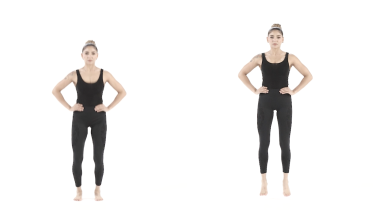 Pogo hops
Stop signs and precautions for the pogo hops
Before you start
- If you have had a hip or knee replacement, get the go-ahead from your surgeon before you try pogo hops. Many surgeons advise against jumping and hopping after a joint replacement for good, not just for the first months, because each landing sends high impact through the new joint.
- After an Achilles tendon injury, a calf tear, a stress fracture in the shin or the foot, or ankle or foot surgery, wait until your physio clears you to hop.
- If you have osteoporosis, a heart condition or high blood pressure, are pregnant, have fallen in the past year, or notice urine leaking when you hop, ask your physio or doctor before you start.
- If you have recently given birth, including by cesarean section, or you have a gap down the middle of your stomach muscles (diastasis recti), ask your physio, midwife or doctor first.
- After having a baby, postnatal guidance usually leaves jumping and hopping until at least 3 months after the birth, once a pelvic floor check shows you are ready.
When to stop and get help
- Sharp pain in the Achilles tendon, heel, shin or knee, on landing or afterward.
- A sudden pop or snap at the back of your ankle or heel, a feeling that someone kicked you there, or sudden pain there after which you cannot push off or rise onto your toes on that leg. Stop, take the weight off that leg carefully and go to an urgent care center or emergency department the same day, even if you can still walk, as this can be a torn Achilles tendon.
- Achilles or shin pain that is clearly worse the next morning, or new swelling in the ankle or knee.
- You feel dizzy, lightheaded, faint or sick, or the room seems to spin. Stop, sit down and get medical advice the same day before you exercise again. If you faint, it does not settle within a few minutes of sitting still, your vision suddenly blurs or goes double, or you cannot stand or walk steadily, call emergency services.
- Chest pain or pressure, dizziness or feeling faint, a racing or irregular heartbeat, or being far more out of breath than the effort should cause.
- Urine leaks as you hop, or you feel heaviness or dragging low in your pelvis.
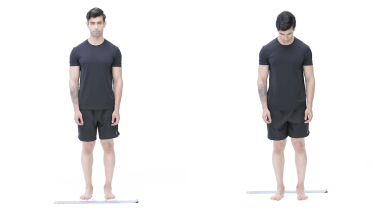 Line jumps
Stop signs and precautions for the line jumps
Before you start
- If you have had a hip or knee replacement, get the go-ahead from your surgeon before you try line jumps. Many surgeons advise against jumping and hopping after a joint replacement for good, not just for the first months, because each landing sends high impact through the new joint. Ask first as well if you are pregnant, have had a baby in the past year, or leak urine when you jump, cough or sneeze.
- After a knee, ankle or foot injury or surgery, including a stress fracture in the foot, wait until your physio clears you to jump.
- Jumping puts load through the pelvic floor and the bones. If you have osteoporosis or have fallen in the past year, ask your physio or doctor before you start.
- With a heart condition or high blood pressure, check with your doctor before you start.
- After having a baby, postnatal guidance usually leaves jumping and hopping until at least 3 months after the birth, once a pelvic floor check shows you are ready.
When to stop and get help
- Sharp pain in the knee, ankle, foot, shin or hip, on landing or afterward.
- A knee that gives way, an ankle that rolls, or swelling later that day or the next morning.
- Chest pain or pressure, dizziness or feeling faint, a racing or irregular heartbeat, or being far more out of breath than the effort should cause.
- Urine leaks as you jump, or you feel pressure or heaviness low in your pelvis.
- A sudden pop or snap at the back of your ankle or heel, a feeling that someone kicked you there, or sudden pain there after which you cannot push off or rise onto your toes on that leg. Stop, take the weight off that leg carefully and go to an urgent care center or emergency department the same day, even if you can still walk, as this can be a torn Achilles tendon.
- You feel dizzy, lightheaded, faint or sick, or the room seems to spin. Stop, sit down and get medical advice the same day before you exercise again. If you faint, it does not settle within a few minutes of sitting still, your vision suddenly blurs or goes double, or you cannot stand or walk steadily, call emergency services.
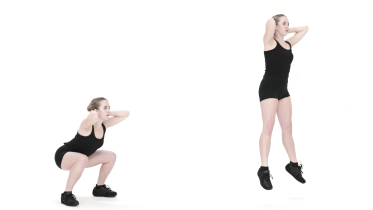 Jump squats
Stop signs and precautions for the jump squats
Before you start
- If you have had a hip or knee replacement, get the go-ahead from your surgeon before you try jump squats. Many surgeons advise against jumping and hopping after a joint replacement for good, not just for the first months, because each landing sends high impact through the new joint. If you are pregnant or have had a baby in the past months, talk to your midwife or physio first.
- Every landing sends force up through your joints, your bones and your pelvic floor. Check with your physio before you start if you leak urine when you cough, sneeze or exercise, if you have osteoporosis, or if you are coming back from a leg injury.
- After having a baby, postnatal guidance usually leaves jumping and hopping until at least 3 months after the birth, once a pelvic floor check shows you are ready.
- With a heart condition or high blood pressure, get your doctor's advice before starting.
When to stop and get help
- Chest pain or pressure, dizziness or feeling faint, a racing or irregular heartbeat, or being far more out of breath than the effort should cause.
- Sharp pain in a knee or ankle, or a knee that gives way.
- Leaking urine, or a heavy or dragging feeling in the pelvis.
- A sudden pop or snap at the back of your ankle or heel, a feeling that someone kicked you there, or sudden pain there after which you cannot push off or rise onto your toes on that leg. Stop, take the weight off that leg carefully and go to an urgent care center or emergency department the same day, even if you can still walk, as this can be a torn Achilles tendon.
- You feel dizzy, lightheaded, faint or sick, or the room seems to spin. Stop, sit down and get medical advice the same day before you exercise again. If you faint, it does not settle within a few minutes of sitting still, your vision suddenly blurs or goes double, or you cannot stand or walk steadily, call emergency services.
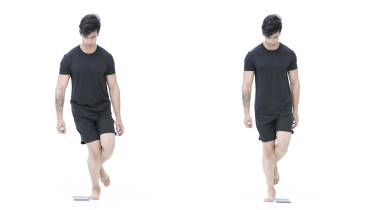 Single leg hops over a line
Stop signs and precautions for the single leg hops over a line
Before you start
- If you have had a hip or knee replacement, get the go-ahead from your surgeon before you try single leg hops over a line. Many surgeons advise against jumping and hopping after a joint replacement for good, not just for the first months, because each landing sends high impact through the new joint.
- After a knee ligament injury, knee surgery or an ankle sprain, wait until your physio clears you to hop.
- If you have osteoporosis or have fallen in the past year, ask your physio or doctor before you do any hopping.
- If you are pregnant, check with your midwife or physio before you start.
- If you have recently given birth, including by cesarean section, or you have a gap down the middle of your stomach muscles (diastasis recti), ask your physio, midwife or doctor first.
- After having a baby, postnatal guidance usually leaves jumping and hopping until at least 3 months after the birth, once a pelvic floor check shows you are ready.
- With a heart condition or high blood pressure, check with your doctor before you start.
When to stop and get help
- Sharp pain in the knee, ankle, foot or shin, on landing or afterward.
- The knee gives way or the ankle rolls.
- Swelling in the knee or ankle later that day or the next morning.
- A sudden pop or snap at the back of your ankle or heel, a feeling that someone kicked you there, or sudden pain there after which you cannot push off or rise onto your toes on that leg. Stop, take the weight off that leg carefully and go to an urgent care center or emergency department the same day, even if you can still walk, as this can be a torn Achilles tendon.
- You feel dizzy, lightheaded, faint or sick, or the room seems to spin. Stop, sit down and get medical advice the same day before you exercise again. If you faint, it does not settle within a few minutes of sitting still, your vision suddenly blurs or goes double, or you cannot stand or walk steadily, call emergency services.
- Chest pain or pressure, dizziness or feeling faint, a racing or irregular heartbeat, or being far more out of breath than the effort should cause.
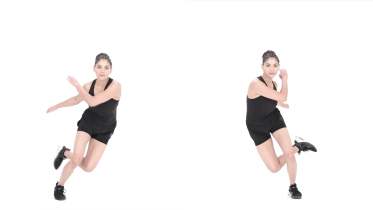 Skater hops
Stop signs and precautions for the skater hops
Before you start
- If you have had a hip or knee replacement, get the go-ahead from your surgeon before you try skater hops. Many surgeons advise against jumping and hopping after a joint replacement for good, not just for the first months, because each landing sends high impact through the new joint. After any other hip, knee or ankle surgery, such as a ligament repair, ask your surgical team or physio before doing any hopping. After a broken bone or a stress fracture in the foot, or surgery on the foot or toes, wait until your surgeon or physio clears you to hop.
- Check with your physio or doctor before you start if you leak urine when you cough, sneeze or exercise, have osteoporosis, or have fallen in the past year.
- Pregnant, or had a baby in the past months? Talk to your midwife or physio first.
- After having a baby, postnatal guidance usually leaves jumping and hopping until at least 3 months after the birth, once a pelvic floor check shows you are ready.
- With a heart condition or high blood pressure, get your doctor's advice before you start.
When to stop and get help
- Chest pain or pressure, dizziness or feeling faint, a racing or irregular heartbeat, or being far more out of breath than the effort should cause.
- Sharp pain in the hip, knee or ankle, a knee that gives way, or an ankle that rolls.
- Leaking urine, or a feeling of pressure or heaviness low in the pelvis.
- A sudden pop or snap at the back of your ankle or heel, a feeling that someone kicked you there, or sudden pain there after which you cannot push off or rise onto your toes on that leg. Stop, take the weight off that leg carefully and go to an urgent care center or emergency department the same day, even if you can still walk, as this can be a torn Achilles tendon.
- You feel dizzy, lightheaded, faint or sick, or the room seems to spin. Stop, sit down and get medical advice the same day before you exercise again. If you faint, it does not settle within a few minutes of sitting still, your vision suddenly blurs or goes double, or you cannot stand or walk steadily, call emergency services.
Will the tendon tear?
You will find pages saying that untreated quadriceps tendinopathy leads to rupture. We traced that claim. It rests on a 1984 retrospective series of 13 athletes who had already ruptured a tendon, 10 of them the patellar tendon and only 3 the quadriceps tendon, reviewed to report the results of repairing them (Kelly 1984). There is no untreated comparison group and no denominator in that paper, so it cannot tell you the chance of a tendon tearing if tendinopathy is left alone. We are not going to state a risk that nobody has measured.
What is true is that quadriceps tendon rupture exists, happens suddenly, and is an emergency rather than a slow decline. The signs are in the first warning sign on this page: a pop or tearing feeling at the front of the knee, a dip you can feel, the kneecap sitting in an odd position, or being suddenly unable to straighten the knee or lift the leg out straight. That needs an emergency department the same day, because repairs generally do better early.
What jumper's knee actually covers
The name hides the whole problem. Jumper's knee has been used for pain at either tendon since at least 1985, when Ferretti and colleagues titled a natural history paper on it patellar or quadriceps tendonitis (Ferretti 1985). The best known prevalence study of jumper's knee, in 613 Norwegian elite athletes, found current symptoms in 14.2%, highest in volleyball at 44.6% and basketball at 31.9%, and none in cycling or orienteering (Lian 2005). Those numbers describe jumper's knee at both tendons, not quadriceps tendinopathy on its own.
That matters when you read advice online. A program labeled jumper's knee is usually a patellar tendon program, because that is where most of the cases and almost all of the research sit. If your pain is at the top of the kneecap, the label fits you and the program may not.
When to see a physio or doctor
See a physio or doctor if the pain is not settling after a few weeks of changing what provokes it, if it stops you training or working, or if you are not sure which structure is sore. That last one is reason enough by itself, since the whole point of this page is that the program for the tendon above the kneecap is not the program for the one below it. The assessment is mostly where it hurts, what position reproduces it, and how much the thigh can do. A physio can set your starting depth and your pain limit from that.
King and colleagues describe this problem as initially managed without surgery, with surgery typically reserved for later stages or for people who have not responded to first-line non-operative treatment (King 2019 part 2). We do not give rehabilitation after quadriceps tendon surgery on this page: if you have had an operation, your surgeon's plan comes first.
For any of the warning signs below, get help within the time given there.
For physiotherapists
Sprague and colleagues 2019 is the spine of this page, and their table of key principles is the clinical content: controlled tendon loading is central, activity modification may be needed, loading in end-range knee flexion may maximize load in the quadriceps tendon with caution for bony abnormalities, adding tibial rotation or hip extension may preferentially load different tendon regions, mild to moderate pain during loading is not detrimental, and electrical stimulation may help restore quadriceps function. Their pain guidance is 5 out of 10 or less during and immediately after loading, back to baseline by the following morning, no week to week increase, modified for irritability.
Note what the treatment literature is. King and colleagues' part 2 treatment table is 14 studies of the patellar tendon or jumper's knee, counted row by row in the table on 2026-11-06, and we found no randomized controlled trial of any treatment for quadriceps tendinopathy. Four attributions on this page are deliberate: the 15-year prognosis figures belong to jumper's knee rather than to quadriceps tendinopathy, the site distribution is attributed to King's review rather than presented as epidemiology, the prevalence figures are labelled as elite athlete data, and the non-athlete risk factors are labelled as borrowed. On that last one, Sprague's 0.2% to 2% and the one in four with superior pole pain both cite Lian 2005 and Visnes 2015, which are 613 Norwegian national-level athletes and a cohort of elite junior volleyball players, so neither figure describes a general or recreational population. Sprague's comparator sentence labels the 14% patellar tendinopathy figure as recreational while citing the same Lian elite study twice, where 14.2% is the overall elite figure, so that comparison is not reproduced here. On the borrowed risk factors: King's part 1 ends its epidemiology section by stating that quadriceps tendinopathy exists in non-athletes with associations to obesity, heavier weight and increased height, and Kuwabara and Fredericson repeat it citing King. The studies under that sentence are Fairley 2014 and Toppi 2015, both MRI-defined patellar tendinopathy in community adults recruited with no history of knee pain or injury, plus Zwerver 2011 on jumper's knee in non-elite athletes. None of the three examined the quadriceps tendon, and two of them measured an imaging finding rather than a painful condition, so the page states the non-athlete observation and labels the risk factors as borrowed. The rupture risk claim in King's part 2 traces to Kelly 1984 and is not stated here. Seated knee extension is deliberately absent from the program, because it loads the extensor mechanism nearest full extension, which is the wrong end of the range for this tendon.
Warning signs
Get emergency help now
- Emergency: you felt a sudden pop or tearing feeling just above or below your kneecap, you can see or feel a dip there, the kneecap seems to have moved up toward the thigh or to sag lower than usual, or you suddenly cannot straighten your knee or lift your leg out straight. Stop exercising and go to an emergency department straight away, even if you can still walk, as this can be a torn tendon at the front of the knee, either below the kneecap (patellar tendon) or above it (quadriceps tendon). Do not drive yourself. A repair usually does better if it is done soon after the injury.
- Your foot became weak or numb at the moment of the knee injury or in the hours after it, for example your foot drags, catches on the ground or slaps down when you walk (foot drop), you cannot pull your foot or toes upward, or the top of your foot has lost feeling. Go to an emergency department straight away. Do not drive yourself: ask someone to drive you or call an ambulance. The nerve that lifts the foot wraps round the bone on the outer side of the knee, and the same force that injures the knee can stretch it. A foot that has been weak or numb from that moment goes with the more severe injuries, where more than one ligament has been torn or the whole knee has been out of place, and in those the artery behind the knee has to be checked on the day. So this one is not watched at home to see whether it gets worse.
- Emergency: you are still growing, you have pain that wakes you at night, pain at rest that keeps getting worse, or a lump or swelling around the knee or thigh that keeps growing, and you also have a rash that does not fade when you press a glass on it. Call emergency services or go to an emergency department straight away. Without the rash, follow the line on the same symptoms further down this list, which gives you a day or two.
- Emergency: a sudden sharp pain, pop or snap at the kneecap or just above or below it while jumping, landing or sprinting, in someone who is still growing, and then the knee cannot be straightened, the leg cannot be lifted out straight or no weight can be put on it, or the knee swells quickly. Keep the weight off the leg and go to an emergency department straight away. In a growing knee this is a break where bone or cartilage pulls away at one end of the extensor mechanism rather than a torn tendon: either the bump at the top of the shin (tibial tubercle avulsion fracture) or the bottom of the kneecap (patellar sleeve fracture). The sleeve one can look almost normal on a first X-ray, so a child who still cannot straighten the knee afterwards needs to be seen again rather than reassured.
Get help now, day or night
- Your tendon pain or swelling started while you were taking a fluoroquinolone antibiotic, such as ciprofloxacin or levofloxacin, or in the months after a course. Contact your doctor straight away. The UK medicines regulator (MHRA) advises stopping the antibiotic at the first sign of tendon pain or swelling and talking to your doctor. Hold off the knee exercises until you have been checked.
Get help today
- The pain started with a fall, a twist or a blow to the knee, or you cannot put weight on the leg. Get medical advice the same day. If the knee has changed shape, swelled up very quickly or you felt a pop or snap, or your foot turns cold, pale or blue or you have tingling or no feeling in the leg or foot, go to an emergency department straight away, and do not drive yourself.
- The knee is hot, red and swollen, or you have knee pain with a high temperature or feel hot, cold or shivery. Get medical advice the same day, and go to an emergency department if you feel very unwell. This can be a sign of infection in the joint, which needs treatment quickly.
- Same day: the knee is locked, which means it is stuck bent and you cannot fully straighten it, even after gently trying to move it, or you cannot bend or straighten the leg at all. Get assessed the same day by a doctor, at urgent care or at an emergency department. A torn piece of meniscus can get caught in the joint and block it, and when a tear like this can be repaired, it should be done as early as possible. A knee that catches for a moment and then frees itself can happen with a meniscus tear. That is not the same as a locked knee, but tell your physio or doctor about it.
- Same day: the knee keeps giving way under you, or it gave way after a recent injury, or it gives way and is also very painful or swollen. Get medical advice the same day. If it only happens now and then, with no recent injury and no swelling, it is not an emergency, but book an assessment with a physio or doctor in the next few days. Until it has been checked, leave out the exercises you do standing on one leg, hold the rail on stairs and take care on uneven ground, because a knee that gives way without warning is how people fall.
- The knee swells up with no clear reason, especially if you take medicine to thin your blood. Get medical advice the same day.
- A calf or thigh that is newly swollen or getting more swollen, warm, tender, red or darker than usual, has swollen veins that are sore to touch, or has a throbbing or cramping pain that does not fit your injury or condition, or that feels different from normal muscle soreness after exercise. This can be a sign of a blood clot (deep vein thrombosis), especially after surgery, an injury, time in a cast or boot, a long trip or a spell of being much less mobile than usual. Get medical advice the same day. If you are also short of breath or have chest pain, call emergency services.
- A leg or foot that is getting weaker, for example your foot drags, catches on the ground or slaps down when you walk (foot drop). Get medical advice the same day. If the weakness is getting worse by the hour, go to an emergency department. If the weakness started at the moment of your knee injury or in the hours after it, the emergency department line above applies instead.
- Same day: you are a teenager who is still growing and you have a limp, or pain in the hip, groin or thigh as well as the knee. Get an urgent appointment with a doctor the same day, and stay off sport and these exercises until you have been checked. If you cannot put weight on the leg, have a high temperature or feel very unwell, go to an emergency department. Some hip problems in growing teenagers, such as a slipped growth plate at the top of the thigh bone (slipped capital femoral epiphysis), are felt in the knee and need checking quickly.
- Pain at night or at rest that keeps getting worse. If you are being treated for cancer now, contact your cancer team the same day.
Book an appointment
- You are still growing and have pain that wakes you at night, pain at rest that keeps getting worse, or a lump or swelling around the knee or thigh that keeps growing. See a doctor within a day or two. Ask for an urgent appointment rather than the next routine one, and say what the pain does at night and whether a lump is getting bigger. Do the same if the pain comes with looking pale, unusual tiredness, fevers with no clear cause, bruising or bleeding easily, or weight loss. Bone pain that is worse at night, or a new lump, needs checking to rule out rarer causes such as a bone tumor or a blood cancer (leukemia).
- Pain at night or at rest that keeps getting worse. If you have had cancer, now or in the past, see your doctor sooner, within a day or two, and mention it, even if the pain is not getting worse. Do the same if you have knee pain and are losing weight without trying, even if it does not hurt at night.
- Pain at night or at rest that keeps getting worse. See your doctor within a few days.
Common questions
Is quadriceps tendinopathy the same as quadriceps tendonitis?
They are two names for the same problem, and tendinopathy is the term the field settled on. The international tendinopathy consensus on clinical terminology recommends tendinopathy as the word for persistent tendon pain and loss of function related to loading (Scott 2020). Tendonitis means inflammation of a tendon, and the tissue changes found in long-standing tendon pain are not mainly inflammatory. Nothing about your treatment changes with the label, so if your doctor wrote tendonitis on your notes, you are in the right place.
How is it different from patellar tendinopathy?
Where it hurts and which position hurts. Patellar tendinopathy sits at the bottom tip of the kneecap and bites hardest with springy loading such as jumping and landing. Quadriceps tendinopathy sits at the top of the kneecap, and the pain is most pronounced in activities involving deep knee bend, because the quadriceps tendon takes greater load as the knee moves further into flexion (Sprague 2019). That is why this program builds depth rather than staying shallow, and it is the one real difference between the two plans. Our patellar tendinopathy page has the program for the tendon below the kneecap.
Why did my patellar tendon program not help?
One likely reason is depth. A program written for the tendon below the kneecap keeps the knee bend shallow early on and builds it slowly, which is sensible for that tendon and may never put enough load through the one above the kneecap. Sprague and colleagues make exactly this point: patellar tendinopathy has been researched extensively while quadriceps tendinopathy has been largely ignored, so clinicians have tended to borrow the patellar program (Sprague 2019). The other possibility is that your pain is not coming from either tendon, which is worth an assessment rather than another six weeks of guessing.
How long does quadriceps tendinopathy take to get better?
There is no figure for this condition, because no trial has followed it. Tendon pain generally improves over months rather than weeks, and the most useful marker is not how a session feels but how the tendon is the next morning. The nearest long-term data belong to jumper's knee, which covers both tendons: at 15 years, 9 of 17 athletes with jumper's knee (53%) had quit their sports career because of the knee, against 1 of 14 controls (7%) (Kettunen 2002). That is a reason to take a loading program seriously, not a prediction about you.
How deep should you squat with quadriceps tendinopathy?
Deep enough to load the tendon and no deeper than it tolerates, which is a judgement rather than a number. Sprague and colleagues advise that graduated loading programs should include appropriate loading in deep knee flexion, with two cautions: be careful if you have been told you have a bony abnormality at the knee, and expect that a very irritable tendon may not tolerate deep bend in the early phases (Sprague 2019). In practice most people add depth over weeks, change one thing at a time, and use the next morning as the test. Your physio will set the range for you.
Do straps or braces help quadriceps tendinopathy?
The sources we read for this page do not cover straps or taping for this tendon, so we cannot tell you either way. Worth knowing is that the strap sold for jumper's knee sits across the tendon below the kneecap, so it is not positioned over the tendon above it. Our page on straps and braces for jumper's knee covers the evidence for the tendon they were designed for.
Does this only happen to jumping athletes?
No, and both reviews say so, but the numbers underneath them are not about this tendon. King and colleagues and Kuwabara and Fredericson state that tendinopathy here turns up in non-athletes, with associations to obesity, heavier body weight and greater height (King 2019 part 1, Kuwabara 2021). We traced those associations back. They come from two community studies of patellar tendinopathy defined on MRI, one in adults aged 50 to 79 and one in middle-aged women, and both recruited people with no history of knee pain or injury (Fairley 2014, Toppi 2015). So the point that this happens outside sport stands, and the risk factors behind it are borrowed from the tendon below the kneecap and from scans rather than from symptoms. If you are not an athlete, the provoking load is usually stairs, squatting at work, kneeling or getting in and out of a low car seat rather than jumping, and the program is the same.
References
- Sprague A, Epsley S, Silbernagel KG. Distinguishing Quadriceps Tendinopathy and Patellar Tendinopathy: Semantics or Significant? Journal of Orthopaedic and Sports Physical Therapy. 2019;49(9):627-630. https://doi.org/10.2519/jospt.2019.0611
- King D, Yakubek G, Chughtai M, Khlopas A, Saluan P, Mont MA, Genin J. Quadriceps tendinopathy: a review-part 1: epidemiology and diagnosis. Annals of Translational Medicine. 2019;7(4):71. https://doi.org/10.21037/atm.2019.01.58
- King D, Yakubek G, Chughtai M, Khlopas A, Saluan P, Mont MA, Genin J. Quadriceps tendinopathy: a review, part 2-classification, prognosis, and treatment. Annals of Translational Medicine. 2019;7(4):72. https://doi.org/10.21037/atm.2019.01.63
- Kuwabara A, Fredericson M. Narrative: Review of Anterior Knee Pain Differential Diagnosis (Other than Patellofemoral Pain). Current Reviews in Musculoskeletal Medicine. 2021;14(3):232-238. https://doi.org/10.1007/s12178-021-09704-9
- Katz NB, Tsitsilianos N, Nowak AS, Douglas SR, Tenforde AS, Borg-Stein J. Advanced Non-Operative Interventions for Anterior Knee Pain. Current Reviews in Musculoskeletal Medicine. 2024;17(12):589-615. https://doi.org/10.1007/s12178-024-09930-x
- Scott A, Squier K, Alfredson H, Bahr R, Cook JL, Coombes B, de Vos RJ, Fu SN, Grimaldi A, Lewis JS, Maffulli N, Magnusson SP, Malliaras P, Mc Auliffe S, Oei EHG, Purdam CR, Rees JD, Rio EK, Gravare Silbernagel K, Speed C, Weir A, van den Akker-Scheek I, Vicenzino BT, Zwerver J. ICON 2019: International Scientific Tendinopathy Symposium Consensus: Clinical Terminology. British Journal of Sports Medicine. 2020;54(5):260-262. https://doi.org/10.1136/bjsports-2019-100885
- Kettunen JA, Kvist M, Alanen E, Kujala UM. Long-term prognosis for jumper's knee in male athletes. A prospective follow-up study. The American Journal of Sports Medicine. 2002;30(5):689-692. https://doi.org/10.1177/03635465020300051001
- Lian OB, Engebretsen L, Bahr R. Prevalence of jumper's knee among elite athletes from different sports: a cross-sectional study. The American Journal of Sports Medicine. 2005;33(4):561-567. https://doi.org/10.1177/0363546504270454
- Visnes H, Tegnander A, Bahr R. Ultrasound characteristics of the patellar and quadriceps tendons among young elite athletes. Scandinavian Journal of Medicine and Science in Sports. 2015;25(2):205-215. https://doi.org/10.1111/sms.12191
- Kelly DW, Carter VS, Jobe FW, Kerlan RK. Patellar and quadriceps tendon ruptures, jumper's knee. The American Journal of Sports Medicine. 1984;12(5):375-380. https://doi.org/10.1177/036354658401200508
- Fairley J, Toppi J, Cicuttini FM, Wluka AE, Giles GG, Cook J, O'Sullivan R, Wang Y. Association between obesity and magnetic resonance imaging defined patellar tendinopathy in community-based adults: a cross-sectional study. BMC Musculoskeletal Disorders. 2014;15:266. https://doi.org/10.1186/1471-2474-15-266
- Toppi J, Fairley J, Cicuttini FM, Cook J, Davis SR, Bell RJ, Hanna F, Wang Y. Factors associated with magnetic resonance imaging defined patellar tendinopathy in community-based middle-aged women: a prospective cohort study. BMC Musculoskeletal Disorders. 2015;16:184. https://doi.org/10.1186/s12891-015-0645-8
- Ferretti A, Puddu G, Mariani PP, Neri M. The natural history of jumper's knee. Patellar or quadriceps tendonitis. International Orthopaedics. 1985;8(4):239-242. https://doi.org/10.1007/BF00266866
- Simpson M, Smith TO. Quadriceps tendinopathy, a forgotten pathology for physiotherapists? A systematic review of the current evidence-base. Physical Therapy Reviews. 2011;16(6):455-461. https://doi.org/10.1179/1743288X11Y.0000000035
- Alfredson H, Masci L, Spang C. Is There a Relationship Between Quadriceps Tendinopathy and Suprapatellar Plica? An Observational Case Series. International Medical Case Reports Journal. 2022;15:81-84. https://doi.org/10.2147/IMCRJ.S345069
- Medicines and Healthcare products Regulatory Agency. Fluoroquinolone antibiotics: must now only be prescribed when other commonly recommended antibiotics are inappropriate. Drug Safety Update. 22 January 2024. https://www.gov.uk/drug-safety-update/fluoroquinolone-antibiotics-must-now-only-be-prescribed-when-other-commonly-recommended-antibiotics-are-inappropriate
Written and checked by the PocketPhysio editorial team. Last updated 2026-11-06.
This page is general education, not a diagnosis or a personal treatment plan. See a physiotherapist or doctor for advice about your own situation.