
Fat pad impingement (Hoffa's syndrome) exercises and physiotherapy
Warning signs, and when to get help
What is fat pad impingement?
The infrapatellar fat pad is a wedge of fat that fills the space behind and below your kneecap, between the kneecap, the patellar tendon and the front of the thigh bone. It is richly supplied with nerves, which is why it can hurt a great deal for a structure that does no work (Draghi 2016). The original description is credited to Hoffa in 1904, which is where the names Hoffa's syndrome and Hoffa's disease come from (Park 2025).
When the pad gets pinched or irritated, the pain is usually described as a burn or a deep ache at the front of the knee, just below or either side of the kneecap, and the knee often feels puffy there rather than swollen all over. Draghi and colleagues put repeated small injuries to the pad among the commonest causes of pain there, and the case they use to show it is a soccer player whose pad had been loaded by hyperextension and rotational strain (Draghi 2016). That is a reasonable description of what the knee does when you stand with it locked back for hours, kick a ball, or spend a day going up and down from a kneel.
What makes this diagnosis awkward is that the pad sits right next to three other things that hurt in the same place: the tendon in front of it, the kneecap joint behind it, and sometimes a fold in the joint lining on the inner side. The honest position is that this page describes a pattern, and a physio or doctor who examines your knee is the one who can tell you which structure fits it.
Is it the fat pad or the tendon in front of it?
Kuwabara and Fredericson say directly that separating these two is difficult, because of how close together they are (Kuwabara 2021). The split they draw is worth holding on to if you are trying to make sense of your own knee.
Tendon pain goes with loading. It bites when the thigh muscles are working hard against body weight, most of all in jumping, landing and controlled lowering, and it sits on a small spot at the bottom tip of the kneecap. Fat pad pain goes with straightening. It is brought on by the knee going fully straight or dynamically into extension, which happens when you stand around with the knees locked, straighten the leg hard at the end of a kick, or hold your leg out straight in front of you.
Other pages carry the same complaint from different structures. A spread out ache around or behind the kneecap that hates stairs and long sitting is usually patellofemoral pain, the commonest cause of pain at the front of the knee. Pain at the top of the kneecap rather than the bottom points to quadriceps tendinopathy. A focal spot on the inner side with a snap or a catch points to plica syndrome. If squatting is your main problem rather than straightening, our pages on knee pain when bending and knee pain when squatting sort through the usual suspects.
Should you avoid standing with your knee locked back?
Yes, for long spells, and the reason is worth explaining because you will find the opposite written down.
Dragoo and colleagues list avoiding hyperextension as part of long-term management, alongside gait training (Dragoo 2012). Kuwabara and Fredericson, in their list of clinical features, record that patients get relief while standing with hyperextended knees (Kuwabara 2021). Read on its own that looks like two reviews contradicting each other. It is not quite that. The reference on Kuwabara and Fredericson's clinical features section is Dragoo and colleagues, so the relief sentence is their summary of the same paper rather than a second finding. And the two sentences either side of it in that same review say the opposite: the pain is elicited with full or dynamic extension, and the examination test for this condition is positive when pain increases over the last 10 degrees of straightening.
So one sentence in one review sits against two sentences in the same review and against the only management advice the literature gives. On that reading the practical instruction is clear enough to give you: do not spend long spells standing with your knees locked back. Full straightening itself is not the enemy, and a knee that cannot reach straight brings its own problems, which is why the program trains control of that last part of the range rather than avoiding it. The aim is a knee that can straighten fully when you need it to and does not drop back into the locked position and rest there.
Your own knee still has a vote. If an hour standing with the knees locked leaves the front of the knee burning, you have your answer; if standing locked back genuinely eases it, say so to your physio, because nobody has run a trial on either instruction.
Does exercise help fat pad impingement?
There is no randomized trial, and the review literature says as much. Katz and colleagues state that there is limited research on the management of several anterior knee problems including this one (Katz 2024). So the program here is mechanism-led, and it comes from Dragoo and colleagues 2012 in Sports Medicine plus Kuwabara and Fredericson 2021 in Current Reviews in Musculoskeletal Medicine.
What those two describe is consistent: tape to unload or shorten the irritated pad, closed chain quadriceps work to improve control of the leg and how the kneecap sits, training the muscles at the side of the hip, stretching the front of the hip, attention to how you walk, and modifying the activities that provoke it. That is what stages 1 to 3 are. Treat the numbers as a starting point from a physio, not as a protocol with evidence behind it.
How to use this program
Start at stage 1 unless the knee is already comfortable with mid-range loading. Move up a stage when the current one feels easy and the knee is no worse the next morning.
Each exercise page gives a typical starting dose. As a rough guide, many programs use 2 to 3 sets of 10 to 15 for the hip exercises, 2 to 3 sets of 8 to 15 for the standing work, and holds of 20 to 30 seconds for the stretches. Kneecap glides are often 10 to 15 slow glides to each side, 1 to 3 times a day, and the band exercise for controlling hyperextension is usually 2 to 3 sets of 8 to 12 slow repetitions. Your physio will adjust this.
A little muscle ache afterward is fine. A burn at the front of the knee that is still there the next morning means the load reached the pad, so drop the depth, take the lock out of the top of the movement, or go back a stage for a few days.
The wall sit in stage 2 is a long hold, so breathe steadily through it and never hold your breath. With a heart condition or high blood pressure, check with your doctor before you start. After knee surgery, follow the program from your surgical team instead of this one. If you are pregnant, check with your midwife or physio before you start. A child or teenager with pain at the front of the knee should be assessed before starting any program.
The exercise program
The exercises below carry their own stop signs and precautions. Open the line under an exercise and read them before you try it.
Stage 1: Settle the pad and work the hip
The front of the knee is left alone here on purpose. Programs for other kneecap problems often open with quad sets, short arc quads and terminal knee extension, and all three train the last part of straightening, which is the position that pinches an irritated fat pad. So this stage works the hip with the knee supported or bent, and the kneecap glides keep the kneecap moving without loading it. For the glides, let the leg rest out straight with the heel down and the thigh switched off, rather than pressing the knee back into the floor or the bed. Dragoo and colleagues name training the muscles at the side of the hip (gluteus medius) and stretching the front of the hip as part of managing this problem (Dragoo 2012). If anything here makes the front of the knee burn, leave that one out and tell your physio.
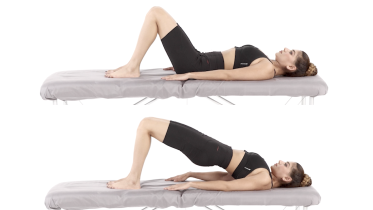 Glute bridge
Stop signs and precautions for the glute bridge
Before you start
- After hip, knee or back surgery, your surgeon's protocol decides when you can start bridges. Once you are past the first three months of pregnancy, check with your physio before exercising flat on your back.
- A bridge needs the knee bent to about 90 degrees before you lift, so if you have had knee surgery and been given a limit on how far the knee may bend, leave this one out and ask your surgeon or physio whether the bend it needs is allowed yet.
When to stop and get help
- You feel back pain rather than buttock work, even when you lift a little lower.
- Pain spreads down the leg or you get numbness or tingling.
- Your hamstrings (the back of the thighs) cramp. This is a common complaint with bridges, and bringing your feet a little closer to your bottom often eases it.
- Pain in the knee itself, or a knee that swells or is clearly more painful the next morning. The position holds the knee bent throughout, so after knee surgery stop and check with your surgeon or physio before you try it again.
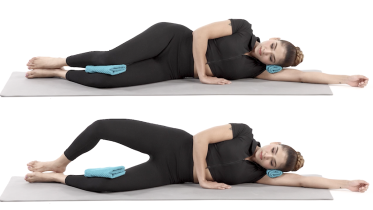 Clamshell
Stop signs and precautions for the clamshell
Before you start
- If you have had a hip replacement or other hip surgery, get the go-ahead from your surgeon or physio before you try clamshells. Opening the knee turns the thigh outward, and many surgeons ask you to avoid that for the first months after some operations. Lying on your side may also be limited in that time.
When to stop and get help
- You feel sharp or pinching pain in the hip or groin.
- Pain spreads into the leg, or you notice numbness or tingling.
- Pain on the outside of your hip builds during the set or is worse the next morning.
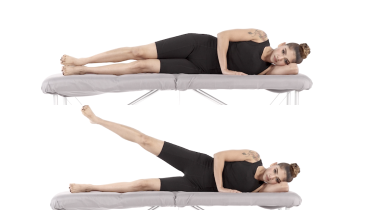 Side lying hip abduction
Stop signs and precautions for the side lying hip abduction
Before you start
- If you have had a hip replacement or other hip surgery, get the go-ahead from your surgeon or physio before you try side-lying hip abduction. Some operations limit this kind of work for the first months, so the timing depends on your surgery. With some surgical approaches, side leg lifts wait until the tissues at the side of the hip have healed.
When to stop and get help
- You feel sharp pain in the side of the hip, the groin or the lower back.
- Pain spreads down the leg or you get numbness or tingling.
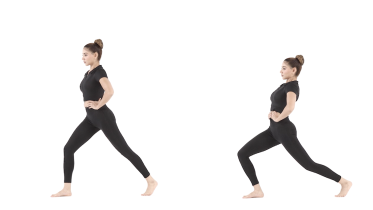 Hip flexor stretch
Stop signs and precautions for the hip flexor stretch
Before you start
- If you have had a hip replacement, get the go-ahead from your surgeon or physio before you try this stretch. Taking the back leg behind the line of your body stretches the front of that hip, and many surgeons ask you to avoid that for the first months after some operations, especially when the hip was replaced from the front.
When to stop and get help
- You feel a sharp or pinching pain in the front of the hip or the groin.
- Your lower back aches or pinches as you push your hips forward.
- Pain, numbness or tingling spreads down the front of the thigh.
- Your front knee hurts as you bend it and push your hips forward.
- You feel dizzy, lightheaded, faint or sick, or the room seems to spin. Stop, sit down and get medical advice the same day before you exercise again. If you faint, it does not settle within a few minutes of sitting still, your vision suddenly blurs or goes double, or you cannot stand or walk steadily, call emergency services.
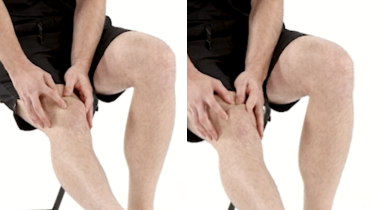 Kneecap glides
Stop signs and precautions for the kneecap glides
Before you start
- If you have had knee surgery, or your kneecap has ever dislocated or partly slipped out of place, check with your surgeon or physio before you try this. Kneecaps usually dislocate toward the outside of the knee, so your physio may ask you to leave out the outward glide.
When to stop and get help
- The kneecap feels as if it might slip out of place, or you feel a sudden sharp pain.
- The knee becomes more swollen, warm or painful after the glides.
- Your calf or thigh is getting more swollen, or becomes warm, tender, red or darker than usual, or has a new throbbing or cramping pain. This can be a blood clot, especially after an operation, an injury, time in a cast, boot or brace, or a spell of being much less mobile than usual, and after an operation it can also be an infection. Stop and contact your medical team or get medical advice the same day. If you are also short of breath or have chest pain, call emergency services.
Stage 2: Load the thigh in mid-range
Move on when stage 1 feels easy and the knee settles overnight. These are closed chain exercises, which means your foot stays on the floor and the knee works in the middle of its range rather than at the end of straightening. Keep the squats and the wall sit shallow to start with, and come up to a soft knee at the top instead of locking back. The band exercise trains control of that last part of straightening, which is the movement this condition is most sensitive to. Breathe steadily through every hold and never hold your breath, especially if you have high blood pressure.
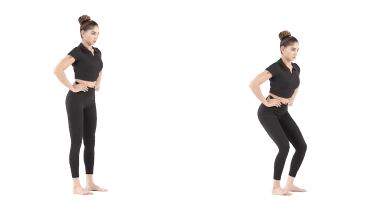 Mini squat
Stop signs and precautions for the mini squat
Before you start
- If you have had a hip replacement or other hip surgery, get the go-ahead from your surgeon or physio before you try mini squats. Some operations limit this kind of work for the first months, so the timing depends on your surgery.
- After a knee replacement, including a partial one, or other knee surgery, get the go-ahead from your surgeon or physio and ask how deep you may go. A squat bends the knee and loads it at the same time, so if you have been given a limit on how far the knee may bend, this is the exercise it applies to first. Keep it shallow and controlled until they say otherwise.
When to stop and get help
- Knee pain is sharp or keeps getting worse through the set.
- The knee swells, gives way or feels unstable afterwards.
- You feel dizzy, lightheaded, faint or sick, or the room seems to spin. Hold your support, sit down and get medical advice the same day before you practice again. If you faint, it does not settle within a few minutes of sitting still, your vision suddenly blurs or goes double, or you cannot stand or walk steadily, call emergency services.
- You feel unsteady enough that you might fall. Hold on to something firm and sit down.
- Your calf or thigh is getting more swollen, or becomes warm, tender, red or darker than usual, or has a new throbbing or cramping pain. This can be a blood clot, especially after an operation, an injury, time in a cast, boot or brace, or a spell of being much less mobile than usual, and after an operation it can also be an infection. Stop and contact your medical team or get medical advice the same day. If you are also short of breath or have chest pain, call emergency services.
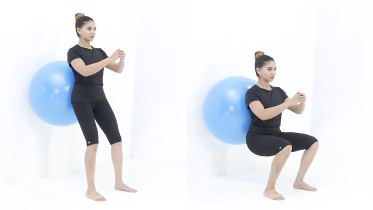 Ball wall squat
Stop signs and precautions for the ball wall squat
Before you start
- If you have had a hip or knee replacement, get the go-ahead from your surgeon or physio before you try the ball wall squat. Some operations limit this kind of work for the first months, so the timing depends on your surgery. Your surgical team will also tell you how far you are allowed to bend.
When to stop and get help
- Sharp pain in or around the kneecap, or knee pain that keeps building with each squat.
- Your knee gives way, or you lose control of the ball.
- Your lower back hurts more the lower you go.
- You feel dizzy, lightheaded, faint or sick, or the room seems to spin. Stop, sit down and get medical advice the same day before you exercise again. If you faint, it does not settle within a few minutes of sitting still, your vision suddenly blurs or goes double, or you cannot stand or walk steadily, call emergency services.
- Chest pain or pressure, dizziness or feeling faint, a racing or irregular heartbeat, or being far more out of breath than the effort should cause.
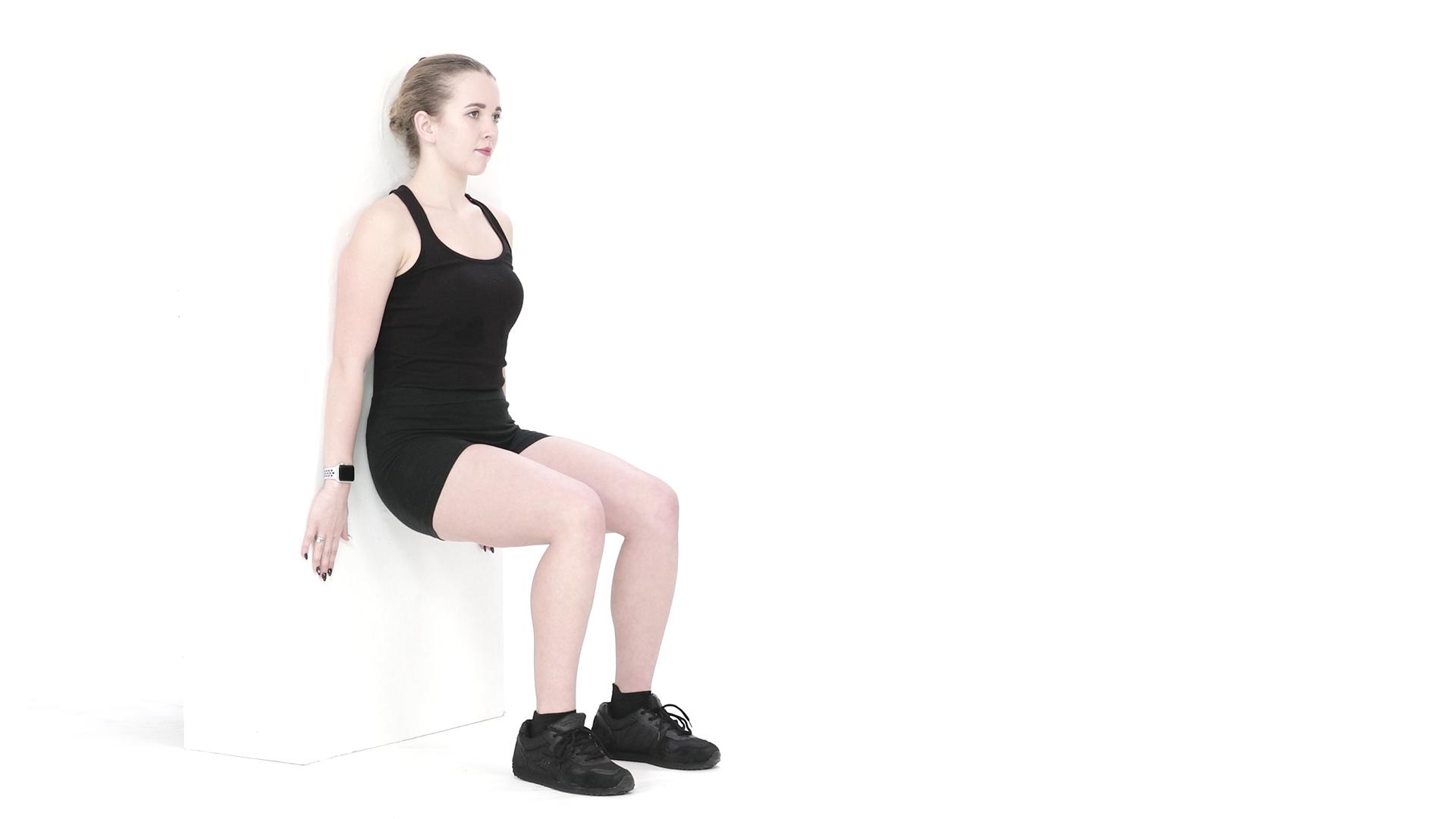 Wall sit
Stop signs and precautions for the wall sit
Before you start
- Holding your breath through a long hold can push your blood pressure up, so if you have high blood pressure or a heart condition, talk to your doctor or physio about long holds first.
When to stop and get help
- Sharp pain in or around the kneecap.
- The knee gives way or you cannot control the slide back up.
- You feel dizzy, lightheaded, faint or sick, or the room seems to spin. Stop, sit down and get medical advice the same day before you exercise again. If you faint, it does not settle within a few minutes of sitting still, your vision suddenly blurs or goes double, or you cannot stand or walk steadily, call emergency services.
- Chest pain or pressure, dizziness or feeling faint, a racing or irregular heartbeat, or being far more out of breath than the effort should cause.
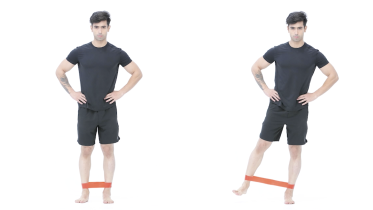 Standing hip abduction with band
Stop signs and precautions for the standing hip abduction with band
Before you start
- If you have had a hip replacement or other hip surgery, get the go-ahead from your surgeon or physio before you try this exercise. Some operations limit this kind of work for the first months, so the timing depends on your surgery. With some surgical approaches, resisted side leg lifts wait until the tissues at the side of the hip have healed.
When to stop and get help
- Sharp pain in the hip, groin or lower back.
- You feel unsteady or close to falling. Hold on to a support or stop.
- Pain spreads down the leg or you get numbness or tingling.
- You feel dizzy, lightheaded, faint or sick, or the room seems to spin. Hold your support, sit down and get medical advice the same day before you practice again. If you faint, it does not settle within a few minutes of sitting still, your vision suddenly blurs or goes double, or you cannot stand or walk steadily, call emergency services.
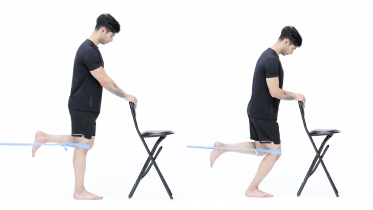 Knee hyperextension control with a band
Stop signs and precautions for the knee hyperextension control with a band
Before you start
- After a knee fracture or knee surgery, including a knee replacement, follow your surgeon's or physio's plan, and start this exercise only when they have cleared you. This matters most after ligament or meniscus surgery, because the band pulls the knee toward over-straightening. If you have had a hip replacement, get the go-ahead from your surgeon or physio before you try this exercise. Some operations limit this kind of work for the first months, so the timing depends on your surgery.
When to stop and get help
- Pain at the back or front of the knee, or the knee gives way or catches.
- You feel close to falling, even with your hands on the chair. Put the other foot down and stop.
- You feel dizzy, lightheaded, faint or sick, or the room seems to spin. Hold your support, sit down and get medical advice the same day before you practice again. If you faint, it does not settle within a few minutes of sitting still, your vision suddenly blurs or goes double, or you cannot stand or walk steadily, call emergency services.
Stage 3: Stairs, chairs and single leg strength
When stage 2 is comfortable and the knee is no worse the next morning, these bring back stairs, chairs and work on one leg at a time. Use a low step at first and lower slowly on the step down, with a rail or a wall to touch. Watch the top of each repetition: standing right up onto a locked knee is where people reproduce the pinch, so finish with the knee soft. If you have had a hip replacement, get the go-ahead from your surgeon or physio before you try the split squat and the step ups. Some operations limit this kind of work for the first months, so the timing depends on your surgery.
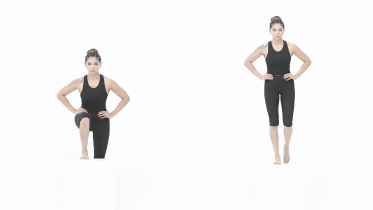 Step up
Stop signs and precautions for the step up
Before you start
- If you have had a hip or knee replacement, or other hip or knee surgery, get the go-ahead from your surgeon or physio before you try step ups. Some operations limit this kind of work for the first months, so the timing depends on your surgery. Your surgeon or physio will also tell you what step height is right for you.
- With a heart condition or high blood pressure, check with your doctor before you start.
- If you have fallen in the past year, have osteoporosis or feel unsteady on your feet, set the step beside a handrail, a kitchen counter or a sturdy chair back, keep one hand on it for every repetition, and ask your physio whether to start with step ups at all or to build up on a single stair first.
When to stop and get help
- You feel sharp pain in the knee or the knee gives way.
- Pain at the front of the knee builds with each rep.
- You feel dizzy, lightheaded, faint or sick, or the room seems to spin. Hold your support, sit down and get medical advice the same day before you practice again. If you faint, it does not settle within a few minutes of sitting still, your vision suddenly blurs or goes double, or you cannot stand or walk steadily, call emergency services.
- You feel unsteady enough that you might fall. Stop and sit down.
- Chest pain or pressure, dizziness or feeling faint, a racing or irregular heartbeat, or being far more out of breath than the effort should cause.
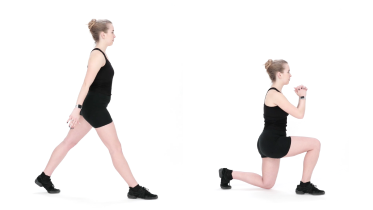 Split squat
Stop signs and precautions for the split squat
Before you start
- If you have had a hip or knee replacement, or other hip or knee surgery, get the go-ahead from your surgeon or physio before you try split squats. Some operations limit this kind of work for the first months, so the timing depends on your surgery.
- If you are pregnant, check with your midwife or physio before you start.
- With a heart condition or high blood pressure, check with your doctor before you start.
- If you have fallen in the past year, have osteoporosis or feel unsteady on your feet, set up beside a kitchen counter, a handrail or a sturdy chair back, keep one hand on it for every repetition, and ask your physio whether to start with split squats at all or to build up with both feet side by side first.
When to stop and get help
- You feel sharp pain in the knee, hip or groin, or the knee gives way.
- Knee pain builds with each rep, or is clearly worse the next morning.
- You feel dizzy, lightheaded, faint or sick, or the room seems to spin. Stop, sit down and get medical advice the same day before you exercise again. If you faint, it does not settle within a few minutes of sitting still, your vision suddenly blurs or goes double, or you cannot stand or walk steadily, call emergency services.
- Chest pain or pressure, dizziness or feeling faint, a racing or irregular heartbeat, or being far more out of breath than the effort should cause.
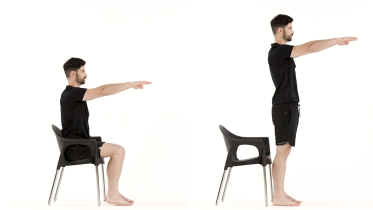 Sit to stand
Stop signs and precautions for the sit to stand
Before you start
- After a knee fracture or knee surgery, including a knee replacement, follow your surgeon's or physio's plan, and start this exercise only when they have cleared you.
- If you have had a hip replacement or other hip surgery, get the go-ahead from your surgeon or physio before you try sit to stand. Standing up from a low seat bends the hip past a right angle, and many surgeons ask you to avoid that for the first months after some operations. Ask them how high your seat should be. If you are pregnant, check with your midwife or physio before you start.
- Set up before the first stand: use a chair that will not slide, ideally with its back against a wall, and have someone nearby, or set the chair beside a kitchen counter you can reach, if you are not sure of your balance or you have fallen in the past year. Wear flat shoes that fit well and grip the floor, not socks, tights or bare feet.
When to stop and get help
- You feel dizzy, lightheaded or faint as you get up. Sit back down and wait for it to pass. If it does not pass within a minute or two, or it keeps happening, get medical advice the same day before you practice again. If you faint, or it does not settle within a few minutes of keeping still, call emergency services.
- Sharp pain in the knee, hip or lower back.
- Your knee gives way or you feel you might fall.
- Chest pain or pressure, dizziness or feeling faint, a racing or irregular heartbeat, or being far more out of breath than the effort should cause.
- You are pregnant and notice bleeding or fluid leaking from your vagina, regular painful tightenings, tummy pain that does not settle when you rest or comes with lower back pain, or a change in your baby's usual movements, such as moving less than usual. Stop and contact your midwife or maternity unit straight away. Do the same for a severe headache, problems with your vision such as blurring or flashing lights, pain just below your ribs, or sudden swelling of your face, hands or feet, which can be signs of pre-eclampsia. Call emergency services if the bleeding is heavy, the tummy pain is severe, bleeding or tummy pain comes with pain in your shoulder or feeling sick, faint or dizzy, or a headache comes on suddenly and is very severe.
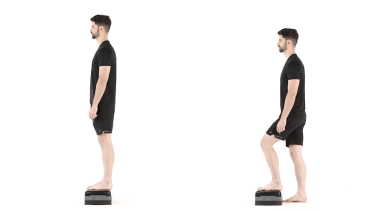 Backward step-down
Stop signs and precautions for the backward step-down
Before you start
- If you have had a hip replacement, get the go-ahead from your surgeon or physio before you try backward step-downs. Some operations limit this kind of work for the first months, so the timing depends on your surgery. The same goes after knee surgery. Your surgeon or physio will also tell you what step height is right for you.
When to stop and get help
- You feel sharp pain in the knee, or the knee gives way.
- Pain at the front of the knee builds with each rep.
- You feel unsteady enough that you might fall. Stop and hold on to something solid.
- You feel dizzy, lightheaded, faint or sick, or the room seems to spin. Hold your support, sit down and get medical advice the same day before you practice again. If you faint, it does not settle within a few minutes of sitting still, your vision suddenly blurs or goes double, or you cannot stand or walk steadily, call emergency services.
- Chest pain or pressure, dizziness or feeling faint, a racing or irregular heartbeat, or being far more out of breath than the effort should cause.
Taping, standing and the day to day load
Everyday habits load the fat pad more than any exercise does. Standing for long spells with the knees pushed back is the big one. Shoes or sandals with no support at the back let the knee drift into that same position without you noticing. And a sudden rise in walking, kicking or kneeling is often what happened in the week before the pain started.
Taping is in both reviews as a way to take pressure off the pad, and it is the one hands-on technique this condition is known for (Dragoo 2012, Kuwabara 2021). We have no taping exercise page, because tape needs someone to show you where it goes and how tight it is. If your physio offers it, treat it as a short-term way of letting you load the knee and walk normally while the program does the work.
Ultrasound is being looked at as a way of imaging the pad, but the published study we read is 11 symptomatic knees and 10 without symptoms, which the authors themselves call exploratory (Mikkilineni 2018). Do not let a small imaging study, in either direction, decide your treatment.
When to see a physio or doctor
See a physio or doctor if the pain is not improving after a few weeks of changing the aggravating activities, if the knee keeps swelling, or if you are not sure which structure is causing it. That last one is a good enough reason on its own, because the pad, the tendon and the kneecap joint all hurt in the same place and the treatment is not the same. An examination, including where the tenderness sits and what happens over the last few degrees of straightening, usually tells more than a scan.
For any of the warning signs below, get help within the time given there.
For physiotherapists
Flores and colleagues' layered approach to the anterior knee is a useful frame for the differential. Kuwabara and Fredericson organize their review the same way (Flores 2018, Kuwabara 2021). The discriminator they give for fat pad against patellar tendon is eccentric quadriceps loading versus full or dynamic extension. The Hoffa test they describe is firm infrapatellar thumb pressure at 90 degrees of flexion followed by full extension, positive when pain increases over the last 10 degrees, repeated medially and laterally.
On imaging, the sentences worth quoting to a worried patient are Draghi and colleagues' teaching points. Subhawong and colleagues read superolateral fat pad edema as a marker of patellofemoral maltracking rather than a stand-alone diagnosis, and Jarraya and colleagues ask the same question of it (Draghi 2016, Subhawong 2010, Jarraya 2018). Park and colleagues give the only long-term surgical series we found, 18 patients at a mean of 148.7 months, and the 27.8% still symptomatic is the figure to quote alongside the fall in pain scores (Park 2025).
On the hyperextension question, which earlier drafts of this page carried as an unresolved disagreement between two reviews: it is not one. Kuwabara and Fredericson's clinical features section for this condition is referenced to Dragoo and colleagues, so "patients have relief while standing with hyperextended knees" is their reading of that paper, not an independent observation. The same paragraph states that the pain is elicited with full or dynamic extension, and the next paragraph gives the Hoffa test as positive when pain increases over the last 10 degrees of extension. Dragoo's own management list, read in the abstract, includes gait training and avoiding hyperextension. One sentence against two in the same review plus the only management statement available, so the page now gives avoidance of sustained standing hyperextension as the instruction and keeps full active extension in the program. Dragoo 2012 full text is behind a paywall with no deposited copy; everything attributed to it here comes from the abstract, which carries the management list verbatim.
Warning signs
Get emergency help now
- Emergency: the kneecap has slipped out of place, even if it went back by itself. If it is still out of place, go to an emergency department straight away, and do not drive yourself. If it went back by itself, get medical advice the same day.
- Your foot became weak or numb at the moment of the knee injury or in the hours after it, for example your foot drags, catches on the ground or slaps down when you walk (foot drop), you cannot pull your foot or toes upward, or the top of your foot has lost feeling. Go to an emergency department straight away. Do not drive yourself: ask someone to drive you or call an ambulance. The nerve that lifts the foot wraps round the bone on the outer side of the knee, and the same force that injures the knee can stretch it. A foot that has been weak or numb from that moment goes with the more severe injuries, where more than one ligament has been torn or the whole knee has been out of place, and in those the artery behind the knee has to be checked on the day. So this one is not watched at home to see whether it gets worse.
- Emergency: you are still growing, you have pain that wakes you at night, pain at rest that keeps getting worse, or a lump or swelling around the knee or thigh that keeps growing, and you also have a rash that does not fade when you press a glass on it. Call emergency services or go to an emergency department straight away. Without the rash, follow the line on the same symptoms further down this list, which gives you a day or two.
- Emergency: a sudden sharp pain, pop or snap at the kneecap or just above or below it while jumping, landing or sprinting, in someone who is still growing, and then the knee cannot be straightened, the leg cannot be lifted out straight or no weight can be put on it, or the knee swells quickly. Keep the weight off the leg and go to an emergency department straight away. In a growing knee this is a break where bone or cartilage pulls away at one end of the extensor mechanism rather than a torn tendon: either the bump at the top of the shin (tibial tubercle avulsion fracture) or the bottom of the kneecap (patellar sleeve fracture). The sleeve one can look almost normal on a first X-ray, so a child who still cannot straighten the knee afterwards needs to be seen again rather than reassured.
Get help today
- The pain started with a fall, a twist or a blow to the knee, or you cannot put weight on the leg. Get medical advice the same day. If the knee has changed shape, swelled up very quickly or you felt a pop or snap, or your foot turns cold, pale or blue or you have tingling or no feeling in the leg or foot, go to an emergency department straight away, and do not drive yourself.
- The knee is hot, red and swollen, or you have knee pain with a high temperature or feel hot, cold or shivery. Get medical advice the same day, and go to an emergency department if you feel very unwell. This can be a sign of infection in the joint, which needs treatment quickly.
- Same day: the knee is locked, which means it is stuck bent and you cannot fully straighten it, even after gently trying to move it, or you cannot bend or straighten the leg at all. Get assessed the same day by a doctor, at urgent care or at an emergency department. A torn piece of meniscus can get caught in the joint and block it, and when a tear like this can be repaired, it should be done as early as possible. A knee that catches for a moment and then frees itself can happen with a meniscus tear. That is not the same as a locked knee, but tell your physio or doctor about it.
- Same day: the knee keeps giving way under you, or it gave way after a recent injury, or it gives way and is also very painful or swollen. Get medical advice the same day. If it only happens now and then, with no recent injury and no swelling, it is not an emergency, but book an assessment with a physio or doctor in the next few days. Until it has been checked, leave out the exercises you do standing on one leg, hold the rail on stairs and take care on uneven ground, because a knee that gives way without warning is how people fall.
- The knee swells up with no clear reason, especially if you take medicine to thin your blood. Get medical advice the same day.
- A calf or thigh that is newly swollen or getting more swollen, warm, tender, red or darker than usual, has swollen veins that are sore to touch, or has a throbbing or cramping pain that does not fit your injury or condition, or that feels different from normal muscle soreness after exercise. This can be a sign of a blood clot (deep vein thrombosis), especially after surgery, an injury, time in a cast or boot, a long trip or a spell of being much less mobile than usual. Get medical advice the same day. If you are also short of breath or have chest pain, call emergency services.
- A leg or foot that is getting weaker, for example your foot drags, catches on the ground or slaps down when you walk (foot drop). Get medical advice the same day. If the weakness is getting worse by the hour, go to an emergency department. If the weakness started at the moment of your knee injury or in the hours after it, the emergency department line above applies instead.
- Same day: you are a teenager who is still growing and you have a limp, or pain in the hip, groin or thigh as well as the knee. Get an urgent appointment with a doctor the same day, and stay off sport and these exercises until you have been checked. If you cannot put weight on the leg, have a high temperature or feel very unwell, go to an emergency department. Some hip problems in growing teenagers, such as a slipped growth plate at the top of the thigh bone (slipped capital femoral epiphysis), are felt in the knee and need checking quickly.
- Pain at night or at rest that keeps getting worse. If you are being treated for cancer now, contact your cancer team the same day.
Book an appointment
- You are still growing and have pain that wakes you at night, pain at rest that keeps getting worse, or a lump or swelling around the knee or thigh that keeps growing. See a doctor within a day or two. Ask for an urgent appointment rather than the next routine one, and say what the pain does at night and whether a lump is getting bigger. Do the same if the pain comes with looking pale, unusual tiredness, fevers with no clear cause, bruising or bleeding easily, or weight loss. Bone pain that is worse at night, or a new lump, needs checking to rule out rarer causes such as a bone tumor or a blood cancer (leukemia).
- Pain at night or at rest that keeps getting worse. If you have had cancer, now or in the past, see your doctor sooner, within a day or two, and mention it, even if the pain is not getting worse. Do the same if you have knee pain and are losing weight without trying, even if it does not hurt at night.
- Pain at night or at rest that keeps getting worse. See your doctor within a few days.
Common questions
Is it the fat pad or the patellar tendon?
They sit within a couple of centimeters (about an inch) of each other, so this is genuinely hard, and Kuwabara and Fredericson say so in their review: telling Hoffa fat pad disease from patellar tendinopathy is difficult because of the similar location (Kuwabara 2021). The axis they give is useful. Tendon pain comes on most with loading, particularly when the thigh muscles are working as the knee bends under weight, while fat pad pain is brought on by full or dynamic extension, that is, by the knee straightening out. Tendon pain also tends to sit on a small spot at the bottom tip of the kneecap that you can cover with a fingertip. If loading is your trigger, read our patellar tendinopathy page, and let a physio settle it if you are not sure.
What is the test for fat pad impingement?
The one named in the literature is the Hoffa test, and it is an examination for a clinician to do, not a self-test. It combines firm pressure just below the kneecap with straightening the knee out, and it counts as positive when that reproduces your pain over the last few degrees of straightening (Kuwabara 2021). We are deliberately not giving you the technique. Pressing hard on your own sore knee and then forcing it straight is a reliable way to flare the pad for a few days, and a result you get on yourself tells you very little, because no study we could find has tested how accurate the test is. Ask your physio or doctor to do it, and tell them where the tenderness sits and what the last part of straightening does.
My scan shows fat pad edema, is that the problem?
Not on its own. Draghi and colleagues put it bluntly in their teaching points: people with abnormalities of the fat pad on MRI are often but not always symptomatic, and radiologists should be cautious about emphasizing them (Draghi 2016). In one series, swelling in the upper outer corner of the fat pad turned up on 25 of 50 knee MRI examinations in 47 people who had symptoms, and the authors read it as a marker of the kneecap tracking poorly rather than as a diagnosis in itself (Subhawong 2010). Our knee osteoarthritis page makes the same point about X-rays. The scan is one piece of information next to where your knee hurts and what brings it on.
Does taping help fat pad impingement?
It is part of the management both reviews describe, and it has not been tested against a sham in this condition. Dragoo and colleagues use tape to unload or shorten an irritated fat pad, and Kuwabara and Fredericson also list taping to offload it (Dragoo 2012, Kuwabara 2021). In practice the aim is to lift the pressure off the pad for long enough that you can do the exercises and walk normally, which makes it a short-term aid alongside the program rather than a treatment on its own. A physio can show you the technique and check whether it changes anything for you, which is the only useful test of it.
Does fat pad impingement need surgery?
Usually not, and the research we have on the operation is small. Arthroscopic resection of the pad is the surgical option, and the longest follow-up we found is 18 patients, median age 22, followed for a mean of about 12 years: pain scores fell from 7.25 to 2.43 at 2 years and were 3.66 at final follow-up, with no significant progression of kneecap arthritis, and 5 of the 18 (27.8%) still reported symptoms at long-term follow-up (Park 2025). That is one series without a comparison group, so it tells you what happened to those 18 people and not how surgery compares with carrying on with exercise.
What is the recovery time after fat pad surgery?
We do not set rehabilitation after this operation, and that is deliberate: timings for weight bearing, range of movement and return to sport come from the surgeon who did it, and they vary. What the long-term series above reports is the pain score at 2 years and at about 12 years, not a return-to-activity timeline (Park 2025). If you are heading for surgery, ask your surgical team for their protocol and follow that rather than this page.
References
- Kuwabara A, Fredericson M. Narrative: Review of Anterior Knee Pain Differential Diagnosis (Other than Patellofemoral Pain). Current Reviews in Musculoskeletal Medicine. 2021;14(3):232-238. https://doi.org/10.1007/s12178-021-09704-9
- Dragoo JL, Johnson C, McConnell J. Evaluation and treatment of disorders of the infrapatellar fat pad. Sports Medicine. 2012;42(1):51-67. https://doi.org/10.2165/11595680-000000000-00000
- Draghi F, Ferrozzi G, Urciuoli L, Bortolotto C, Bianchi S. Hoffa's fat pad abnormalities, knee pain and magnetic resonance imaging in daily practice. Insights into Imaging. 2016;7(3):373-383. https://doi.org/10.1007/s13244-016-0483-8
- Subhawong TK, Eng J, Carrino JA, Chhabra A. Superolateral Hoffa's fat pad edema: association with patellofemoral maltracking and impingement. AJR American Journal of Roentgenology. 2010;195(6):1367-1373. https://doi.org/10.2214/AJR.10.4668
- Jarraya M, Diaz LE, Roemer FW, Arndt WF, Goud AR, Guermazi A. MRI Findings Consistent with Peripatellar Fat Pad Impingement: How Much Related to Patellofemoral Maltracking? Magnetic Resonance in Medical Sciences. 2018;17(3):195-202. https://doi.org/10.2463/mrms.rev.2017-0063
- Mikkilineni H, Delzell PB, Andrish J, Bullen J, Obuchowski NA, Subhas N, Polster JM, Schils JP. Ultrasound evaluation of infrapatellar fat pad impingement: An exploratory prospective study. The Knee. 2018;25(2):279-285. https://doi.org/10.1016/j.knee.2018.01.008
- Park YC, Kim YM, Joo YB. Arthroscopic Resection of Infrapatellar Fat Pad Impingement Syndrome: Long-Term Clinical Results at Minimum 10-Year Follow-Up. Medicina (Kaunas). 2025;61(6):997. https://doi.org/10.3390/medicina61060997
- Katz NB, Tsitsilianos N, Nowak AS, Douglas SR, Tenforde AS, Borg-Stein J. Advanced Non-Operative Interventions for Anterior Knee Pain. Current Reviews in Musculoskeletal Medicine. 2024;17(12):589-615. https://doi.org/10.1007/s12178-024-09930-x
- Flores DV, Mejia Gomez C, Pathria MN. Layered Approach to the Anterior Knee: Normal Anatomy and Disorders Associated with Anterior Knee Pain. Radiographics. 2018;38(7):2069-2101. https://doi.org/10.1148/rg.2018180048
Written and checked by the PocketPhysio editorial team. Last updated 2026-11-06.
This page is general education, not a diagnosis or a personal treatment plan. See a physiotherapist or doctor for advice about your own situation.