
Growing pains in knees: what it is, what it is not, and what to do
Warning signs, and when to get help
What people mean by growing pains in knees
Two different things, and that is where the trouble starts.
The first is a pattern that pediatric sources do describe: an ache or throb in both legs, in the muscles rather than in one joint, arriving in the evening or at night and gone by morning, in a child aged 3 to 12. The NHS calls it harmless and says it usually gets better on its own. KidsHealth New Zealand, the Paediatric Society of New Zealand's patient site, puts it in the muscles of the thighs, calves, shins or behind the knees and adds that there is no medical test for it.
The second is the way the phrase gets used in ordinary life, as a general explanation for any ache in a body that is still growing. That includes a 14 year old whose knee hurts after netball. It is the second use that sends people looking for a page like this one, and it is the one the research does not support.
A scoping review in Pediatrics went looking for a definition and could not find one. O'Keeffe and colleagues (2022) examined 145 studies and 2 diagnostic classification systems. Lower limb pain was the only feature that appeared in more than half of the sources, at 50 percent. Evening or night pain appeared in 48 percent, an episodic or recurring course in 42 percent, a normal physical examination in 35 percent and pain in both legs in 31 percent, and nothing else reached 30 percent.
More than 80 percent of those sources said nothing about the age at which it starts, and 93 percent made no reference to growth at all. The authors' conclusion was that the literature gives no clarity about what defines growing pain, and that clinicians should be wary of relying on the diagnosis to direct treatment. That is a strong thing for a review to say about a term this widely used, and it is the reason this page sorts rather than reassures.
Two other papers are worth knowing. Uziel and Hashkes (2007) argued that physicians should be careful to adhere to clear clinical criteria before diagnosing a child with growing pain. Champion and colleagues (2022) studied 503 identical and 513 non-identical twin pairs aged 3 to 18 and described growing pains as a hybrid condition, with about a third of cases carrying the symptoms and family associations of restless legs syndrome. Even the researchers trying to keep the term are describing something other than one sore knee in an athlete.
The number you will see quoted, and who it is about
O'Keeffe and colleagues open their review by noting that up to one third of children may be given a diagnosis of growing pains. The figure usually standing behind that comes from a questionnaire study of 1,445 families across rural and urban South Australia, which estimated a prevalence of 36.9 percent (95 percent confidence interval 32.7 to 41.1). That study was of children aged 4 to 6 (Evans and Scutter, 2004).
A prevalence measured in 4 to 6 year olds tells you nothing about a 13 year old's knee. It is worth saying out loud, because 36.9 percent is the most quotable number in this literature and it is about preschoolers.
Are growing pains real?
The symptoms are real. The explanation inside the name is the part that does not hold up.
The NHS states that growing pains are not caused by growing and are not a sign of anything serious, and it also notes that they are more common in active children and can follow a lot of sport. KidsHealth New Zealand says that despite the name, growing pains are not directly related to growth spurts. So a child can genuinely have the evening leg ache, and the word growing in the label still explains nothing about why.
Growth does matter in a different way, and it is worth separating from the label. In a growth spurt the bones lengthen before the muscles and tendons catch up, so a fast-growing athlete is often stiffer, taller and less controlled for a few months than the same athlete was last season. That changes how load lands on a knee. It is a reason to adjust training and build strength, not a reason to wait.
Where growing pains occur in the knee
This is the question that quietly undoes the label. Both national sources that describe the benign pattern put it in the muscles of the thighs, calves, shins or behind the knees, usually in both legs, and KidsHealth New Zealand adds that growing pains do not cause a limp. Pain at the front of the knee, around or behind the kneecap, or on the bony bump an inch or two below it, is a different tissue in a different place. That front-of-knee location is where activity-related knee pain in a growing athlete almost always sits.
If the sore spot is on the back of the knee, our page on pain behind the knee covers what sits there. If it is the heel rather than the knee, the equivalent growth plate problem is Sever's disease. If the ache is along the front of the shin with running, read shin splints.
Is it growing pains or something else?
Put the two national descriptions beside an active teenager and almost every item fails.
The NHS puts growing pains in the 3 to 12 age group and describes the feeling as an ache or a throb, felt in both legs rather than one, in the muscle or the joint, arriving in the evening or overnight and gone again by morning. Its own list of reasons to see a GP includes pain in one leg, leg pain in the morning or when walking or taking part in activities, leg pain bad enough to stop a child walking or to make them limp, and pain in one joint such as the knee or ankle. KidsHealth New Zealand's list has the same shape: pain in only one leg, a limp with the pain, a painful area that feels hot or is swollen, and pain in the joints.
Now take a 14 year old with one sore knee that hurts on stairs and for a day after a match. She is older than the age range, the pain is in one leg, it is in a joint, and it comes on with activity rather than at bedtime. She fails every criterion for the benign pattern and meets four of the reasons to be seen. Both national sites already carry the evidence for that. The odd part is that nobody puts it in front of a parent as a decision.
Here is the sorting most physios do first, by where it hurts and what brings it on.
| Where it hurts | What usually brings it on | The likely name |
|---|---|---|
| Around or behind the kneecap, hard to point to | Stairs, squatting, running, long spells sitting | Patellofemoral pain |
| On the tendon just below the kneecap, easy to point to | Jumping and landing, often warming up as you go | Patellar tendinopathy |
| On the bony bump below the kneecap, tender to press | Sprinting, jumping, kneeling, in someone still growing | Osgood-Schlatter disease |
None of those three starts with a bang, and that is worth knowing before you use the table. A sudden pop, snap or one moment of severe pain at the kneecap, or just above or just below it, during a jump or a sprint, after which the knee will not straighten, the leg will not lift out straight or the leg will not take weight, is a different problem. In a knee that is still growing that is usually a break where bone or cartilage pulls away at one end of the straightening mechanism rather than a strained tendon, it needs an emergency department straight away, and it has its own line on the warning list at the foot of this page.
Those three overlap more than the table suggests, and plenty of knees carry two of them. Our question page on jumper's knee or Osgood-Schlatter walks through the difference in detail, and whether jumper's knee affects a teenager's growth answers the question parents ask most often. If joints are generally very mobile and bend further than most people's, read hypermobility as well, since the NHS notes growing pains are also common in children with very flexible joints.
How common is this? In Dutch general practice in and around Rotterdam, Osgood-Schlatter was recorded at 3.8 per 1,000 person-years in 8 to 18 year olds, peaking at age 12 in boys and 11 in girls (van Leeuwen and colleagues, 2022). No source gives a figure for activity-related adolescent knee pain in the USA, UK, Canada, Australia or New Zealand specifically, so the numbers on this page are Danish, Dutch and Australian and are labeled as such.
The one tool built for this exact job is the MAP-Knee Tool (Riel and colleagues, 2025). It is a clinical decision-support tool covering the six most common non-traumatic adolescent knee pain conditions, and it holds a diagnosing component, explanations a young person can use, prognostic factors drawn from an individual participant data meta-analysis, and an option grid. It was designed for the consultation, which is a fair description of where this sorting properly belongs.
How long does this last?
The reassurance usually offered is that it goes away when growth finishes. For activity-related knee pain in adolescents, the prospective studies do not support that, and reading them is uncomfortable.
Rathleff and colleagues (2016) screened 2,200 Danish adolescents aged 15 to 19. Of the 504 who reported knee pain, 55.9 percent still had pain 2 years later (95 percent confidence interval 50.8 to 60.9). Their conclusion was that knee pain during adolescence, and patellofemoral pain in particular, is in most cases still present after 2 years and may not be self-limiting.
Holden and colleagues (2021) pooled individual participant data from 13 studies covering 1,281 adolescents aged 10 to 19 with non-traumatic knee pain. At 12 months, 51 percent still reported knee pain. Lower pain frequency at the start, better quality of life, male sex and pain in one knee rather than both were each associated with a better 12 month outcome. A separate cohort of 51 young people aged 10 to 14 with Osgood-Schlatter saw 46 of them again at 24 months: 37 percent still had knee pain from it, a median of 42 months after their symptoms began, and more than one in five had stopped their sport because of the knee (Holden and colleagues, 2021).
A review of 26 prospective cohorts of 0 to 19 year olds with musculoskeletal pain found female sex, psychological symptoms, increasing age, generalized pain, longer pain duration and smoking all associated with a poor outcome, and found no treatment effect modifiers at all (Pourbordbari and colleagues, 2019). That last point matters for honesty: there is no evidence base for matching a young person to a particular program by her starting characteristics, so nobody should claim one.
The practical reading of all that is simple. Waiting is itself a decision, and on these numbers it is not a safe default.
Night pain, and what to do about it
Searches for how to stop growing pains in the knees at night are among the most common on this topic, so the answer needs to be plain rather than comforting.
In someone who is still growing, pain that wakes you at night, pain at rest that keeps getting worse, or a lump or swelling that keeps growing sits on the warning list on this page. It needs a doctor within a day or two, asked for as an urgent appointment rather than the next routine one. That is not because those symptoms usually mean something serious, because usually they do not. It is because the small number of causes that matter, including a bone tumor and a blood cancer, show up this way and are found by examining and testing rather than by waiting.
The NHS self-care measures for the benign childhood pattern are gentle massage, a covered hot water bottle or heat pack, and children's ibuprofen or paracetamol (acetaminophen), with no aspirin for anyone under 16 unless a doctor has prescribed it. Those are for a 3 to 12 year old with the evening ache in both legs, examined and found normal. They are not a plan for an adolescent knee that hurts at night. Our page on knee pain at night covers the adult version of the same question.
How to use this program
Have the knee looked at first. Every one of the three sibling pages says so. A page whose whole subject is that you do not yet know what you have has to say it harder, not softer. A physical therapist (physiotherapist) or doctor can usually tell the three apart in one appointment, by where it is tender and what it does under load, and that changes what comes next.
Read the warning list before you start, not after. It sits at the foot of this page and the link under the summary at the top goes straight to it, and if any line on it applies, that is the next step rather than the program.
This page speaks to a parent and to a teenager reading it on her own, and the warning list below is written in both voices. Where a warning sign says your child, read it as being about you if you are the one with the sore knee. Where one says you, read it as being about your child if you are the parent. Every line applies either way round.
The program is the common ground of the three published programs on this site, and that is the point of it rather than a compromise. Hip and thigh strength appears in all three, so it is useful whichever condition the knee turns out to have. What is left out is anything that belongs to only one of them: there is no jumping, hopping or plyometric work anywhere on this page, because that sits at the end of a patellar tendinopathy program and is the single most reliable way to flare Osgood-Schlatter. None of this program has been tested as a program in a trial, and no randomized trial of a home exercise program for undiagnosed adolescent knee pain exists in any of our markets.
One gate before the stages, because every exercise here works the thigh muscle through the kneecap tendon. If this knee has been operated on, or a break or a growth plate injury near it has been fixed, pinned or put in a cast, then when the knee may be straightened against resistance, squatted on, lunged on or fully weight bearing is the surgeon's decision and not this page's, and those dates differ from one child and one operation to the next. Follow the program the surgical team and physio gave you, and keep going to the follow-up appointments, which after a fracture fixed near a growth plate often continue while the child is still growing. Nothing on this page replaces them.
Pick the stage that matches you today, and start at stage 1 if you are not sure. Move up when the current stage feels easy and the knee settles well afterward. Each exercise page gives its own typical starting dose, and as a rough guide the lying and sitting work can be done most days while the standing strength work suits 2 to 3 days a week with a day in between. Your physio will adjust the exercises and the numbers.
The exercise program
The exercises below carry their own stop signs and precautions. Open the line under an exercise and read them before you try it.
Stage 1: Settle it down and keep the muscles working
Start here, and start here even if the knee feels only mildly sore. These are done lying or sitting, so the kneecap and the tendon below it carry very little load while the thigh and hip muscles start working again. The front-of-thigh stretch here is the side lying one rather than the standing version, and that is deliberate: standing while you hold your own foot up behind you means balancing on one leg, often on the sore one, and a warning sign further down this page tells a knee that gives way to leave the single-leg standing work out. So stage 1 stays on the floor. Quad sets are often done as 10 repetitions with a 5 to 10 second hold, several times a day, the hip work suits 2 to 3 sets of 10 to 15 and the bridge 2 to 3 sets of 10 to 12, once a day. The two stretches are held for about 20 to 30 seconds, 2 to 3 times on each leg, and the front-of-thigh one is kept gentle, because pulled hard it tugs on the tendon and the bony bump below the kneecap. Your physio will adjust all of these numbers.
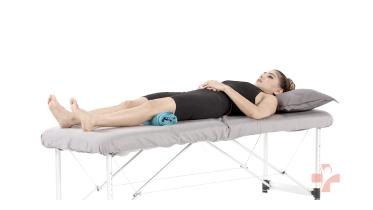 Quad sets (towel under knee)
Stop signs and precautions for the quad sets (towel under knee)
Before you start
- After a knee fracture or knee surgery, including a knee replacement, follow your surgeon's or physio's plan, and start this exercise only when they have cleared you.
When to stop and get help
- Your knee pain goes up sharply.
- Your calf or thigh is getting more swollen, or becomes warm, tender, red or darker than usual, or has a new throbbing or cramping pain. This can be a blood clot, especially after an operation, an injury, time in a cast, boot or brace, or a spell of being much less mobile than usual, and after an operation it can also be an infection. Stop and contact your medical team or get medical advice the same day. If you are also short of breath or have chest pain, call emergency services.
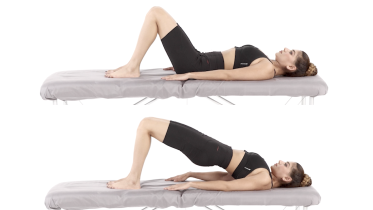 Glute bridge
Stop signs and precautions for the glute bridge
Before you start
- After hip, knee or back surgery, your surgeon's protocol decides when you can start bridges. Once you are past the first three months of pregnancy, check with your physio before exercising flat on your back.
- A bridge needs the knee bent to about 90 degrees before you lift, so if you have had knee surgery and been given a limit on how far the knee may bend, leave this one out and ask your surgeon or physio whether the bend it needs is allowed yet.
When to stop and get help
- You feel back pain rather than buttock work, even when you lift a little lower.
- Pain spreads down the leg or you get numbness or tingling.
- Your hamstrings (the back of the thighs) cramp. This is a common complaint with bridges, and bringing your feet a little closer to your bottom often eases it.
- Pain in the knee itself, or a knee that swells or is clearly more painful the next morning. The position holds the knee bent throughout, so after knee surgery stop and check with your surgeon or physio before you try it again.
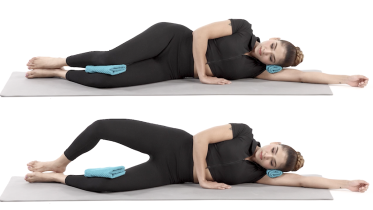 Clamshell
Stop signs and precautions for the clamshell
Before you start
- If you have had a hip replacement or other hip surgery, get the go-ahead from your surgeon or physio before you try clamshells. Opening the knee turns the thigh outward, and many surgeons ask you to avoid that for the first months after some operations. Lying on your side may also be limited in that time.
When to stop and get help
- You feel sharp or pinching pain in the hip or groin.
- Pain spreads into the leg, or you notice numbness or tingling.
- Pain on the outside of your hip builds during the set or is worse the next morning.
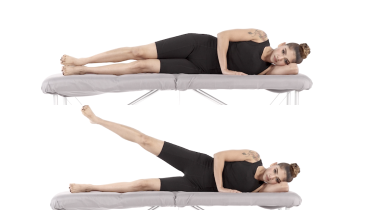 Side lying hip abduction
Stop signs and precautions for the side lying hip abduction
Before you start
- If you have had a hip replacement or other hip surgery, get the go-ahead from your surgeon or physio before you try side-lying hip abduction. Some operations limit this kind of work for the first months, so the timing depends on your surgery. With some surgical approaches, side leg lifts wait until the tissues at the side of the hip have healed.
When to stop and get help
- You feel sharp pain in the side of the hip, the groin or the lower back.
- Pain spreads down the leg or you get numbness or tingling.
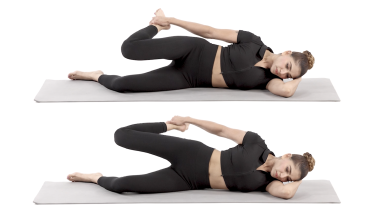 Side lying quad stretch
Stop signs and precautions for the side lying quad stretch
Before you start
- After a knee fracture or knee surgery, including a knee replacement, follow your surgeon's or physio's plan, and start this exercise only when they have cleared you. Pulling the heel in bends the knee a long way, so ask how far yours may bend at your stage. If you have had a hip replacement, get the go-ahead from your surgeon or physio before you try the side lying quad stretch. Easing the top knee back takes the hip behind the line of your body, and many surgeons ask you to avoid that for the first months after some operations. Some operations also limit letting the top knee drop across your body toward the floor, so keep it level with your hip.
When to stop and get help
- Sharp or pinching pain in the knee, or pain in your lower back.
- Pins and needles or numbness running into your thigh, shin or foot.
- Your calf or thigh becomes swollen, warm, tender, red or darker than usual, or has a throbbing or cramping pain that feels different from normal muscle ache. Stop and get medical advice the same day, as this can be a blood clot. If you are also short of breath or have chest pain, call emergency services.
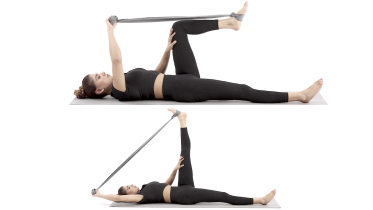 Supine hamstring stretch
Stop signs and precautions for the supine hamstring stretch
Before you start
- If you have had a hip replacement, get the go-ahead from your surgeon or physio before you try this exercise. Lifting the straight leg bends the hip a long way, and many surgeons ask you to avoid that for the first months after some operations. After a recent hamstring tear, ask your physio before you start. If you are pregnant and past the first three months, check with your physio before exercising flat on your back.
When to stop and get help
- You feel tingling, burning or pain running down the leg. That may be coming from a nerve rather than a stretching muscle.
- You get pain in your lower back.
- A sudden sharp pain, pop or snap at the back of your thigh. Stop straight away. If you then get large bruising spreading down the back of the thigh, a gap or dip you can feel, a stiff-legged walk, or clear weakness when you bend the knee, get assessed the same day at urgent care or an emergency department, as the tendon may have pulled away from the bone near the buttock.
Stage 2: Build strength standing up
Move here when stage 1 feels easy and the knee is no sorer the morning after, which usually takes one to three weeks. The wall sit and the mini squat work the front of the thigh with the knee bent, so start shallow and high on the wall and only go as deep as you can without pain at the kneecap or the bump. Holds of 10 to 30 seconds repeated 3 to 5 times suit the wall sit, and 2 to 3 sets of 10 to 15 suit the squat and the band work. The single leg bridge is the one to count separately, at 2 to 3 sets of 8 to 12 on each side with a hold of 2 to 5 seconds at the top, a few days a week, because one leg at a time is harder than it looks and the 10 to 15 above is not its number. The calf stretch is about 30 seconds, 2 to 3 times each leg, once or twice a day. Your physio will adjust this.
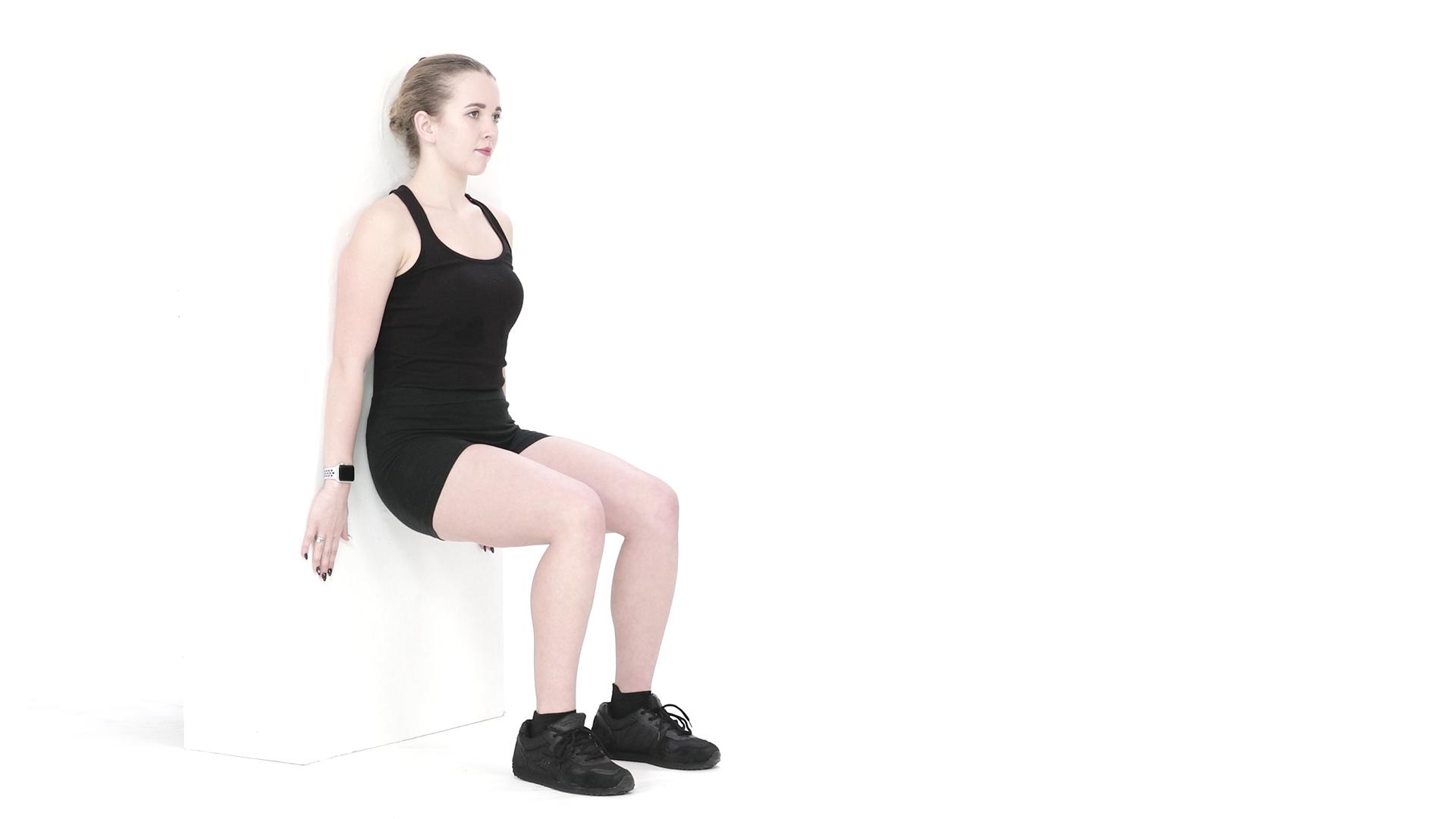 Wall sit
Stop signs and precautions for the wall sit
Before you start
- Holding your breath through a long hold can push your blood pressure up, so if you have high blood pressure or a heart condition, talk to your doctor or physio about long holds first.
When to stop and get help
- Sharp pain in or around the kneecap.
- The knee gives way or you cannot control the slide back up.
- You feel dizzy, lightheaded, faint or sick, or the room seems to spin. Stop, sit down and get medical advice the same day before you exercise again. If you faint, it does not settle within a few minutes of sitting still, your vision suddenly blurs or goes double, or you cannot stand or walk steadily, call emergency services.
- Chest pain or pressure, dizziness or feeling faint, a racing or irregular heartbeat, or being far more out of breath than the effort should cause.
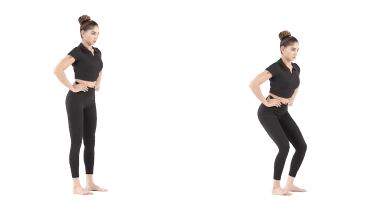 Mini squat
Stop signs and precautions for the mini squat
Before you start
- If you have had a hip replacement or other hip surgery, get the go-ahead from your surgeon or physio before you try mini squats. Some operations limit this kind of work for the first months, so the timing depends on your surgery.
- After a knee replacement, including a partial one, or other knee surgery, get the go-ahead from your surgeon or physio and ask how deep you may go. A squat bends the knee and loads it at the same time, so if you have been given a limit on how far the knee may bend, this is the exercise it applies to first. Keep it shallow and controlled until they say otherwise.
When to stop and get help
- Knee pain is sharp or keeps getting worse through the set.
- The knee swells, gives way or feels unstable afterwards.
- You feel dizzy, lightheaded, faint or sick, or the room seems to spin. Hold your support, sit down and get medical advice the same day before you practice again. If you faint, it does not settle within a few minutes of sitting still, your vision suddenly blurs or goes double, or you cannot stand or walk steadily, call emergency services.
- You feel unsteady enough that you might fall. Hold on to something firm and sit down.
- Your calf or thigh is getting more swollen, or becomes warm, tender, red or darker than usual, or has a new throbbing or cramping pain. This can be a blood clot, especially after an operation, an injury, time in a cast, boot or brace, or a spell of being much less mobile than usual, and after an operation it can also be an infection. Stop and contact your medical team or get medical advice the same day. If you are also short of breath or have chest pain, call emergency services.
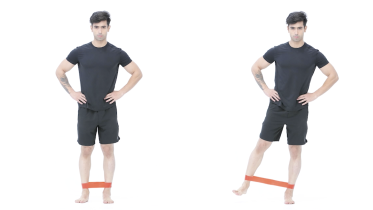 Standing hip abduction with band
Stop signs and precautions for the standing hip abduction with band
Before you start
- If you have had a hip replacement or other hip surgery, get the go-ahead from your surgeon or physio before you try this exercise. Some operations limit this kind of work for the first months, so the timing depends on your surgery. With some surgical approaches, resisted side leg lifts wait until the tissues at the side of the hip have healed.
When to stop and get help
- Sharp pain in the hip, groin or lower back.
- You feel unsteady or close to falling. Hold on to a support or stop.
- Pain spreads down the leg or you get numbness or tingling.
- You feel dizzy, lightheaded, faint or sick, or the room seems to spin. Hold your support, sit down and get medical advice the same day before you practice again. If you faint, it does not settle within a few minutes of sitting still, your vision suddenly blurs or goes double, or you cannot stand or walk steadily, call emergency services.
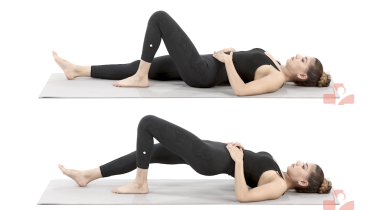 Single leg bridge
Stop signs and precautions for the single leg bridge
Before you start
- After hip, knee or back surgery, single leg work starts when your surgeon's protocol allows it.
- Past the first trimester of pregnancy, ask your physio before doing exercises lying flat on your back.
When to stop and get help
- Sharp pain in the lower back, hip or knee, rather than the feeling of muscles working.
- Pain travels down the leg, or the leg goes numb or tingly.
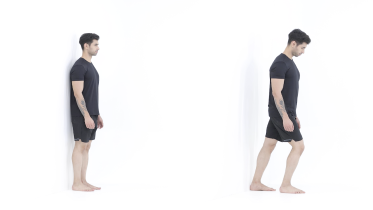 Calf stretch
Stop signs and precautions for the calf stretch
Before you start
- Calf stretching is often limited for the first months after an Achilles tendon repair, so follow your surgeon's and physio's instructions before you try this.
When to stop and get help
- Sharp pain in the Achilles tendon or at the back of the heel.
- Your calf or thigh becomes swollen, warm, tender, red or darker than usual, or has a throbbing or cramping pain that feels different from normal muscle ache. Stop and get medical advice the same day, as this can be a blood clot. If you are also short of breath or have chest pain, call emergency services.
- Tingling, numbness or burning in the foot or down the leg.
- Since the fracture or cast, the foot or ankle is getting more painful rather than less, the skin becomes very sensitive to light touch, or the foot changes color, temperature, swelling or sweating compared with the other one, or looks shiny. See your doctor or physio as soon as you can, within a few days at most, as this can be complex regional pain syndrome (CRPS) and early treatment may help.
- A sudden pop or snap at the back of your ankle or heel, a feeling that someone kicked you there, or sudden pain there after which you cannot push off or rise onto your toes on that leg. Stop, take the weight off that leg carefully and go to an urgent care center or emergency department the same day, even if you can still walk, as this can be a torn Achilles tendon.
Stage 3: One leg at a time
Move here when stage 2 feels routine and any soreness has gone by the next morning. These three load one leg at a time, which is what stairs, running and changing direction actually ask of a knee. Use a step low enough to control, keep the knee pointing over the second toe, and lower slowly on the step-down with a hand on a rail or wall. Start the split squat shallow, and on all three stop at the depth you can hold without pain at the kneecap or at the bony bump below it, because those two spots are what tell you the load has gone past what the knee is ready for. Many programs use 2 to 3 sets of 8 to 12 on each leg, a few days a week with a day in between. This program stops here on purpose: jumping, hopping and landing work is planned with your own physio, because the right amount of it depends on which condition you turn out to have.
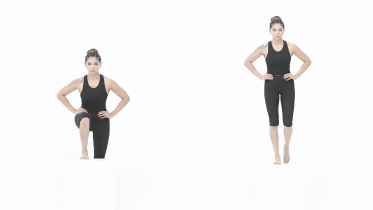 Step up
Stop signs and precautions for the step up
Before you start
- If you have had a hip or knee replacement, or other hip or knee surgery, get the go-ahead from your surgeon or physio before you try step ups. Some operations limit this kind of work for the first months, so the timing depends on your surgery. Your surgeon or physio will also tell you what step height is right for you.
- With a heart condition or high blood pressure, check with your doctor before you start.
- If you have fallen in the past year, have osteoporosis or feel unsteady on your feet, set the step beside a handrail, a kitchen counter or a sturdy chair back, keep one hand on it for every repetition, and ask your physio whether to start with step ups at all or to build up on a single stair first.
When to stop and get help
- You feel sharp pain in the knee or the knee gives way.
- Pain at the front of the knee builds with each rep.
- You feel dizzy, lightheaded, faint or sick, or the room seems to spin. Hold your support, sit down and get medical advice the same day before you practice again. If you faint, it does not settle within a few minutes of sitting still, your vision suddenly blurs or goes double, or you cannot stand or walk steadily, call emergency services.
- You feel unsteady enough that you might fall. Stop and sit down.
- Chest pain or pressure, dizziness or feeling faint, a racing or irregular heartbeat, or being far more out of breath than the effort should cause.
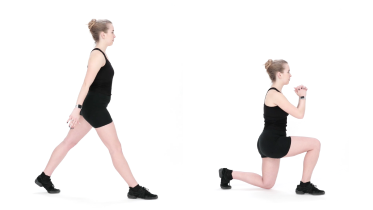 Split squat
Stop signs and precautions for the split squat
Before you start
- If you have had a hip or knee replacement, or other hip or knee surgery, get the go-ahead from your surgeon or physio before you try split squats. Some operations limit this kind of work for the first months, so the timing depends on your surgery.
- If you are pregnant, check with your midwife or physio before you start.
- With a heart condition or high blood pressure, check with your doctor before you start.
- If you have fallen in the past year, have osteoporosis or feel unsteady on your feet, set up beside a kitchen counter, a handrail or a sturdy chair back, keep one hand on it for every repetition, and ask your physio whether to start with split squats at all or to build up with both feet side by side first.
When to stop and get help
- You feel sharp pain in the knee, hip or groin, or the knee gives way.
- Knee pain builds with each rep, or is clearly worse the next morning.
- You feel dizzy, lightheaded, faint or sick, or the room seems to spin. Stop, sit down and get medical advice the same day before you exercise again. If you faint, it does not settle within a few minutes of sitting still, your vision suddenly blurs or goes double, or you cannot stand or walk steadily, call emergency services.
- Chest pain or pressure, dizziness or feeling faint, a racing or irregular heartbeat, or being far more out of breath than the effort should cause.
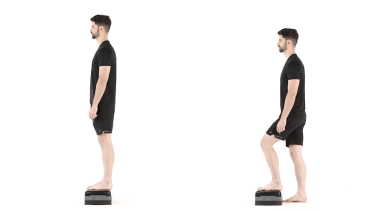 Backward step-down
Stop signs and precautions for the backward step-down
Before you start
- If you have had a hip replacement, get the go-ahead from your surgeon or physio before you try backward step-downs. Some operations limit this kind of work for the first months, so the timing depends on your surgery. The same goes after knee surgery. Your surgeon or physio will also tell you what step height is right for you.
When to stop and get help
- You feel sharp pain in the knee, or the knee gives way.
- Pain at the front of the knee builds with each rep.
- You feel unsteady enough that you might fall. Stop and hold on to something solid.
- You feel dizzy, lightheaded, faint or sick, or the room seems to spin. Hold your support, sit down and get medical advice the same day before you practice again. If you faint, it does not settle within a few minutes of sitting still, your vision suddenly blurs or goes double, or you cannot stand or walk steadily, call emergency services.
- Chest pain or pressure, dizziness or feeling faint, a racing or irregular heartbeat, or being far more out of breath than the effort should cause.
What to change while the knee settles
Cut the amount rather than stopping the sport, in almost every case. KidsHealth New Zealand says there is no need to stop a child from being physically active, and that holds for the named conditions too, within what the knee can settle from. That reassurance is about pain that built up over weeks, not a pop or a snap during a jump or a landing: a knee that then cannot be straightened, lifted out straight or put weight on goes to an emergency department rather than back on. The usual culprits are a jump in training volume, a new surface, a growth spurt that nobody adjusted for, and the week a second team or a tournament arrives.
Three changes do most of the work. Drop the drills that hurt most, usually repeated jumping, deep squatting and long kneeling, while keeping the running and the skill work that the knee tolerates. Keep a rough count of how much sport is happening in a week, because almost nobody knows theirs until they write it down. And watch the morning after rather than the session itself, because next-morning soreness is the signal that actually tracks load.
Kneeling is worth a sentence of its own if the bump below the kneecap is the sore spot. A thick pad and getting up every few minutes beats one long spell on a hard floor, and in a school PE lesson it is reasonable to ask for an alternative to kneeling.
When to see a physio or doctor
Go now rather than later if any warning sign on this page applies. Otherwise, see a physio or doctor if the knee has not improved after 6 to 8 weeks of regular exercise, if pain is stopping sleep, school or sport, if the knee keeps giving way, or if you are not sure which stage suits you. Being seen at the start is also the fastest way to find out which of the three conditions this is, which is the thing this page cannot do for you.
If you have had an operation on this knee, follow the program your surgical team and physio gave you rather than this one. If there is a heart or lung condition, or blood pressure that is not under control, check before starting.
For physiotherapists
This page exists to sort an undiagnosed adolescent knee and then hand over, not to manage one. It carries no plyometric or return-to-sport content on purpose, since the criteria differ across patellofemoral pain, patellar tendinopathy and Osgood-Schlatter, and it routes to the three condition pages for staged loading.
Two things are worth raising with families at the first appointment, both supported above. The prognosis is poorer than the growing-pains framing implies, with 55.9 percent of Danish adolescents still in pain at 2 years and 51 percent of a pooled cohort at 12 months, so the conversation is about starting rather than waiting. And Pourbordbari and colleagues (2019) found no treatment effect modifiers across 26 cohorts, so baseline characteristics identify risk rather than selecting a program. The MAP-Knee Tool (Riel and colleagues, 2025) is the structured option for that consultation.
One surgical point governs the warning list rather than the program, and it is the reason this page screens on function rather than on mechanism. The jump or the sprint that irritates a tendon in an adult can break the growing extensor mechanism at either end. A tibial tubercle avulsion fracture is typically seen in adolescent boys in sports involving jumping or sprinting, with prior Osgood-Schlatter disease suggested as a predisposing factor (Cole and colleagues, 2020), and a patellar sleeve injury is often missed and also threatens the extensor mechanism (Bailey and colleagues, 2020). Superior pole sleeve fracture is described in a skeletally immature adolescent and was initially missed, with a delay to surgery (Hannah and colleagues, 2022), so the red flag here is keyed to loss of active extension and to inability to straight leg raise or weight bear, not to the site of the pop.
Two things follow for any child who has had one. Tibial tubercle fractures can be associated with compartment syndrome, and fixation can be complicated by growth arrest and subsequent recurvatum deformity (Bailey and colleagues, 2020), so that child belongs with the surgical team and its own protocol, not on this page.
Warning signs
Get emergency help now
- Emergency: a sudden sharp pain, pop or snap at the kneecap, or just above or just below it, while jumping, landing or sprinting, in someone who is still growing, and then the knee cannot be straightened, the leg cannot be lifted out straight or no weight can be put on it, or the knee swells quickly. Keep the weight off the leg and go to an emergency department straight away, wherever around the knee the pop was felt. In a growing knee an injury like this breaks bone or cartilage at one end of the straightening mechanism rather than tearing the tendon. It can be a break where the bump at the top of the shin pulls away (tibial tubercle avulsion fracture), which is treated in hospital and is often fixed with an operation, or cartilage and bone pulling away from the kneecap itself, usually at its bottom tip and sometimes at the top (patellar sleeve fracture). A sleeve fracture can look almost normal on a first X-ray, so if you or your child has been sent home reassured and still cannot straighten the knee or lift the leg out straight, go back to the emergency department or the fracture clinic the same day and say that is what the knee will not do.
- The kneecap has slipped out of place, even if it went back by itself. If it is still out of place, go to an emergency department straight away, and do not drive yourself. If it went back by itself, get medical advice the same day.
- Emergency: pain that wakes your child at night, pain at rest that keeps getting worse, or a lump or swelling around the knee or thigh that keeps growing, and your child also has a rash that does not fade when you press a glass on it. Call emergency services or go to an emergency department straight away. Without the rash, follow the line on the same symptoms further down this list, which gives you a day or two.
- Your foot became weak or numb at the moment of the knee injury or in the hours after it, for example your foot drags, catches on the ground or slaps down when you walk (foot drop), you cannot pull your foot or toes upward, or the top of your foot has lost feeling. Go to an emergency department straight away. Do not drive yourself: ask someone to drive you or call an ambulance. The nerve that lifts the foot wraps round the bone on the outer side of the knee, and the same force that injures the knee can stretch it. A foot that has been weak or numb from that moment goes with the more severe injuries, where more than one ligament has been torn or the whole knee has been out of place, and in those the artery behind the knee has to be checked on the day. So this one is not watched at home to see whether it gets worse.
Get help today
- The knee is hot, red and swollen, or you have knee pain with a high temperature or feel hot, cold or shivery. Get medical advice the same day, and go to an emergency department if you feel very unwell. This can be a sign of infection in the joint, which needs treatment quickly. In a child, bone pain with a fever can be a bone infection, which needs treatment quickly. If you have a very high or very low temperature, shivering you cannot control, you are breathing very fast or finding it hard to breathe, you are confused or your speech is slurred, your skin, lips or tongue look blue, gray, pale or blotchy (on brown or black skin this can be easier to see on the palms of the hands or soles of the feet), or you have a rash that does not fade when you press it, call emergency services, as this can be sepsis.
- The pain started with a fall, a twist or a blow to the knee, or you cannot put weight on the leg. Get medical advice the same day. If the knee has changed shape, swelled up very quickly or you felt a pop or snap, or your foot turns cold, pale or blue or you have tingling or no feeling in the leg or foot, go to an emergency department straight away, and do not drive yourself.
- Same day: a pop, a snap or one moment of severe pain at the bony bump, at the kneecap or just above or just below it, while jumping, landing or sprinting, in someone who is still growing, but the knee still straightens and still takes weight. Get medical advice the same day, and stay off sport and these exercises until the knee has been checked. A smaller version of the same break, at the top of the shin or at either end of the kneecap, does not always stop a child walking, so a pop that settles into soreness is still worth a doctor looking at that day. If the knee swells up within a few hours, or the knee stops straightening fully or taking weight, do not wait for that appointment: go to an emergency department. A first X-ray that looks normal does not rule this out, so if the knee still will not straighten fully afterwards, go back and say so.
- Same day: your child or teenager is still growing and has a limp, or pain in the hip, groin or thigh as well as the knee. Get an urgent appointment with a doctor the same day, and keep them off sport and these exercises until they have been checked. If they cannot put weight on the leg, have a high temperature or feel very unwell, go to an emergency department. Some hip problems in growing children and teenagers, such as a slipped growth plate at the top of the thigh bone (slipped capital femoral epiphysis), are felt in the knee and need checking quickly.
- The knee locks and you cannot straighten it, or it keeps giving way under you. Get medical advice the same day. Until it has been checked, leave out the exercises you do standing on one leg, hold the rail on stairs and take care on uneven ground, because a knee that gives way without warning is how people fall.
- The knee swells up with no clear reason, especially if you take medicine to thin your blood. Get medical advice the same day.
- A calf or thigh that is newly swollen or getting more swollen, warm, tender, red or darker than usual, has swollen veins that are sore to touch, or has a throbbing or cramping pain that does not fit your injury or condition, or that feels different from normal muscle soreness after exercise. This can be a sign of a blood clot (deep vein thrombosis), especially after surgery, an injury, time in a cast or boot, a long trip or a spell of being much less mobile than usual. Get medical advice the same day. If you are also short of breath or have chest pain, call emergency services.
- A leg or foot that is getting weaker, for example your foot drags, catches on the ground or slaps down when you walk (foot drop). Get medical advice the same day. If the weakness is getting worse by the hour, go to an emergency department. If the weakness started at the moment of your knee injury or in the hours after it, the emergency department line above applies instead.
- Pain at night or at rest that keeps getting worse. If you are being treated for cancer now, contact your cancer team the same day.
Book an appointment
- Pain that wakes your child at night, pain at rest that keeps getting worse, or a lump or swelling around the knee or thigh that keeps growing. See a doctor within a day or two. Ask for an urgent appointment rather than the next routine one, and say what the pain does at night and whether a lump is getting bigger. Do the same if the pain comes with looking pale, unusual tiredness, fevers with no clear cause, bruising or bleeding easily, or weight loss. Bone pain that is worse at night, or a new lump, needs checking to rule out rarer causes such as a bone tumor or a blood cancer (leukemia). If your child is being treated for cancer now, contact their cancer team the same day.
- Your child's knee stays swollen, or they also have swollen, warm or painful joints elsewhere, joint stiffness that is worst in the morning, or back pain. This is not an emergency, but see a doctor in the next week or two, as it can be a sign of arthritis in children (juvenile arthritis), which is best treated early. A joint that is hot, red and swollen, or joint pain with a high temperature or feeling hot, cold or shivery, is a same day matter and it has its own line above, and a child who cannot put weight on the leg or seems very unwell goes to an emergency department. If your child also has a red, painful eye, get it checked the same day. If light hurts the eye, the eye turns very dark red, their sight changes, or they also have a severe headache and feel sick, go to an emergency department or emergency eye service straight away. Arthritis in children can also inflame the inside of the eye (uveitis), which can harm sight if it is not treated.
- Pain at night or at rest that keeps getting worse. If you have had cancer, now or in the past, see your doctor sooner, within a day or two, and mention it, even if the pain is not getting worse. Do the same if you have knee pain and are losing weight without trying, even if it does not hurt at night.
- Pain at night or at rest that keeps getting worse. See your doctor within a few days.
Common questions
How long do growing pains in knees last?
If the pain is the pattern pediatric sources call growing pains, both legs aching in the evening and clear by morning in a child aged 3 to 12, the NHS says it usually gets better on its own and KidsHealth New Zealand says it usually goes by the mid-teens. If it is activity-related knee pain in an adolescent, which is what most people arriving at this page have, the honest answer is longer than you would hope. In 504 Danish adolescents with knee pain, 55.9 percent still had pain 2 years later (Rathleff and colleagues, 2016), and in pooled data from 1,281 adolescents aged 10 to 19 with non-traumatic knee pain, 51 percent still reported knee pain at 12 months (Holden and colleagues, 2021).
What do growing pains in knees feel like?
The benign pattern, as the NHS and KidsHealth New Zealand describe it, is an ache or throb in the muscles of both legs, in the thighs, calves, shins or behind the knees, coming in the evening or at night and gone by the morning, with a normal examination in between. What people usually mean when they say growing pains in knees is different: a sore spot at the kneecap, behind it or on the bony bump just below it, brought on by stairs, squatting, running or jumping, and present during the day. That second pattern points to a named condition rather than to growing.
Can a 13, 14 or 15 year old have growing pains in the knee?
The term is not defined well enough to answer that as a yes or no, which is the real finding here. The two national pediatric sources that describe growing pains both set it in children aged 3 to 12, in both legs, in the muscles rather than the joints, and both list pain in one joint such as the knee among the reasons to see a doctor. So a 13, 14 or 15 year old with one sore knee sits outside the description on both counts. The useful question is not whether the label can stretch to cover her, but which of the common adolescent knee conditions she has.
Are growing pains real?
The symptoms are real. The explanation inside the name is the part that does not hold up. The NHS says plainly that growing pains are not caused by growing, and KidsHealth New Zealand says that despite the name they are not directly related to growth spurts. A scoping review of 145 studies found 93 percent of them made no reference to growth at all (O'Keeffe and colleagues, 2022). So nobody is suggesting the pain is invented, only that calling it growing pains explains nothing and can delay finding out what is going on.
How do you stop growing pains in knees at night?
Night pain in someone who is still growing is on the warning list on this page rather than something to manage at home. The NHS self-care measures for the benign childhood pattern are gentle massage, a covered hot water bottle or heat pack, and children's ibuprofen or paracetamol, with no aspirin for anyone under 16 unless a doctor has prescribed it. Those are for a 3 to 12 year old with the evening ache in both legs. Pain that wakes a growing child or teenager, pain at rest that keeps getting worse, or a lump that keeps growing needs a doctor within a day or two, as the warning signs set out, and the appointment is asked for as an urgent one.
What causes knee pain in active kids and teenagers?
Most of it is load on tissue that has not yet caught up with the amount of sport being asked of it. The three common patterns are irritation of the joint between the kneecap and the thigh bone, irritation of the tendon just below the kneecap, and irritation at the growth plate where that tendon attaches to the shin. Growth itself contributes something: the bones lengthen first and the muscles and tendons follow, so a fast-growing athlete is often stiffer and less controlled for a few months. That is not the same as growing pains, and it does not make the pain something to wait out.
Do these exercises need equipment?
Very little. A chair, a wall, a towel and a step or the bottom stair cover almost all of it, and standing hip abduction uses a light resistance band. The reason the program has no jumping or hopping in it is not equipment: those sit at the end of a patellar tendinopathy program and are the thing that most often flares Osgood-Schlatter, so they are not safe to prescribe before anyone knows which condition the knee has.
Should the exercises hurt?
In stage 1, aim for pain free. From stage 2 onward, mild discomfort during the set is usually acceptable if it settles soon after and the knee is no worse the next morning. A knee that is more painful or more swollen the morning after, or soreness that builds week on week, means the load was too much, so drop back a stage for a few days rather than stopping everything. Your physio will set the limit for your knee, and any of the warning signs on this page needs checking rather than grading.
References
- O'Keeffe M, Kamper SJ, Montgomery L, et al. Defining growing pains: a scoping review. Pediatrics. 2022;150(2):e2021052578. https://doi.org/10.1542/peds.2021-052578
- Rathleff MS, Rathleff CR, Olesen JL, Rasmussen S, Roos EM. Is knee pain during adolescence a self-limiting condition? Prognosis of patellofemoral pain and other types of knee pain. American Journal of Sports Medicine. 2016;44(5):1165-1171. https://doi.org/10.1177/0363546515622456
- Holden S, Kasza J, Winters M, van Middelkoop M, Rathleff MS. Prognostic factors for adolescent knee pain: an individual participant data meta-analysis of 1281 patients. Pain. 2021;162(6):1597-1607. https://doi.org/10.1097/j.pain.0000000000002184
- Holden S, Olesen JL, Winiarski LM, et al. Is the prognosis of Osgood-Schlatter poorer than anticipated? A prospective cohort study with 24-month follow-up. Orthopaedic Journal of Sports Medicine. 2021;9(8):23259671211022239. https://doi.org/10.1177/23259671211022239
- Pourbordbari N, Riis A, Jensen MB, Olesen JL, Rathleff MS. Poor prognosis of child and adolescent musculoskeletal pain: a systematic literature review. BMJ Open. 2019;9(7):e024921. https://doi.org/10.1136/bmjopen-2018-024921
- van Leeuwen GJ, de Schepper EI, Rathleff MS, Bindels PJ, Bierma-Zeinstra SM, van Middelkoop M. Incidence and management of Osgood-Schlatter disease in general practice: retrospective cohort study. British Journal of General Practice. 2022;72(717):e301-e306. https://doi.org/10.3399/BJGP.2021.0386
- Riel H, Bruun MK, Djurtoft C, et al. Development of a clinical decision-support tool for management of adolescent knee pain (The MAP-Knee tool). Musculoskeletal Science and Practice. 2025;77:103293. https://doi.org/10.1016/j.msksp.2025.103293
- Evans AM, Scutter SD. Prevalence of growing pains in young children. Journal of Pediatrics. 2004;145(2):255-258. https://doi.org/10.1016/j.jpeds.2004.04.045
- Uziel Y, Hashkes PJ. Growing pains in children. Pediatric Rheumatology Online Journal. 2007;5:5. https://doi.org/10.1186/1546-0096-5-5
- Champion GD, Bui M, Sarraf S, et al. Improved definition of growing pains: a common familial primary pain disorder of early childhood. Paediatric and Neonatal Pain. 2022;4(2):78-86. https://doi.org/10.1002/pne2.12079
- National Institute for Health and Care Excellence. Suspected cancer: recognition and referral (NG12). 2015, last updated 2023. https://www.nice.org.uk/guidance/ng12
- NHS. Growing pains. Page last reviewed 16 June 2026. https://www.nhs.uk/conditions/growing-pains/
- KidsHealth New Zealand (Paediatric Society of New Zealand). Growing pains. Last reviewed 6 August 2024. https://www.kidshealth.org.nz/growing-pains
- KidsHealth New Zealand (Paediatric Society of New Zealand). Knee pain in children. https://www.kidshealth.org.nz/knee-pain-in-children
- Cole WW, Brown SM, Vopat B, Heard WMR, Mulcahey MK. Epidemiology, Diagnosis, and Management of Tibial Tubercle Avulsion Fractures in Adolescents. JBJS Reviews. 2020;8(4):e0186. https://doi.org/10.2106/JBJS.RVW.19.00186
- Bailey MEA, Wei R, Bolton S, Richards RH. Paediatric injuries around the knee: Bony injuries. Injury. 2020;51(3):611-619. https://doi.org/10.1016/j.injury.2019.12.033
- Hannah A, Stoddard JE, Sutton PM. Consecutive ipsilateral inferior pole patella and superior patella sleeve fractures. Annals of the Royal College of Surgeons of England. 2022;104(6):e190-e192. https://doi.org/10.1308/rcsann.2021.0286
- American Academy of Orthopaedic Surgeons. Slipped capital femoral epiphysis (SCFE). OrthoInfo. https://orthoinfo.aaos.org/en/diseases--conditions/slipped-capital-femoral-epiphysis-scfe/
Written and checked by the PocketPhysio editorial team. Last updated 2026-11-06.
This page is general education, not a diagnosis or a personal treatment plan. See a physiotherapist or doctor for advice about your own situation.