
Shin splints exercises and physiotherapy
What are shin splints?
Shin splints is the everyday name for pain along the inner edge of the shinbone (tibia), usually in its lower part. The medical name for the most common type is medial tibial stress syndrome, often shortened to MTSS. It is defined as pain along the lower, inner (posteromedial) border of the shinbone that comes on with exercise, with tenderness over a length of 5 cm or more when that edge is pressed (Winters, 2020). It is one of the most common leg injuries in athletes and soldiers (Moen and colleagues, 2009).
The pain is usually an ache or soreness during or after running or jumping, and the edge of the bone is tender to touch. The NHS lists starting exercise after a spell of inactivity, running on hard surfaces and poor running technique as things that raise the risk. OrthoInfo adds sudden increases in how often, how long or how hard you train, flat feet or rigid arches, and shoes that are unsuitable or worn out. The review by Moen and colleagues (2009) lists a foot that rolls in a lot (excessive pronation), being female, a higher body mass index and previous shin splints as risk factors.
Shin splints used to be put down to inflammation of the thin lining of the bone. The review by Moen and colleagues (2009) describes evidence that it is a stress reaction in the bone itself, where bone is broken down faster than it is rebuilt. That fits with load being the main treatment: less impact for a while, then a gradual build-up.
This page is for adults and teenagers aged 16 and over. A child or younger teenager with shin pain should be checked by a doctor or physio before starting any program. If you have had surgery on your lower leg, follow your surgeon's program rather than this one.
Shin splints or a stress fracture?
Shin splints and a tibial stress fracture are both overuse injuries of the shinbone, and they can start in a similar way. The difference that matters most is where it hurts. Shin splints are sore along a stretch of the inner edge of the bone, while a stress fracture tends to be sore at one small spot you can point to, sometimes with swelling over it (Patel and colleagues, 2011).
The pain pattern helps too. OrthoInfo describes a bone stress injury that starts as discomfort at one spot at the end of activity, then hurts throughout activity and with ordinary walking, and may ache in bed at night. Hopping on the sore leg is not a clean test on its own. In the review by Patel and colleagues, it was painful in 70 to 100% of stress fractures, but also in about 46% of people with shin splints. Pain on hopping that sits at one spot on the bone needs checking.
An early X-ray can miss a stress fracture. Patel and colleagues report that X-rays show only about 10% of stress fractures at first, rising to 30 to 70% after 3 weeks, and that MRI is more specific than a bone scan. They also list the front of the shinbone (anterior tibia) among the high-risk sites that may need an opinion from an orthopedic or sports medicine specialist.
Stop running and jumping if you think you may have a stress fracture, and see a doctor within a few days, or the same day if walking hurts or makes you limp. OrthoInfo advises seeing a doctor as soon as possible and warns that exercising through the pain can make the bone crack or break. It also lists not eating enough for the amount you exercise, low vitamin D, short sleep, too few rest days, and conditions or long-term medicines that weaken bone, such as osteoporosis, among the things that raise the risk of bone stress injuries, as does a previous injury of this kind. In women, periods that have stopped or become irregular can be a sign of too little energy for the training load, which weakens bone (Mountjoy and colleagues, 2023). Mention any of these that apply to you.
Could it be compartment syndrome?
Compartment syndrome is a rise in pressure inside a muscle, which restricts blood flow and causes pain (NHS). There are two kinds, and they are handled very differently.
Acute compartment syndrome is an emergency. It comes on suddenly, usually after an injury or when a bandage or plaster cast is too tight. The pain is severe, more than you would expect from the injury, and may be worse when the muscle is stretched, with swelling, numbness, pins and needles or weakness (NHS; OrthoInfo). Call emergency services or go to an emergency department straight away, and do not drive yourself. It is treated with urgent surgery.
Chronic exertional compartment syndrome comes on with exercise and goes away when you rest. Typical signs are pain or cramping in the lower leg muscles during exercise, sometimes with numbness, trouble moving the foot or a foot that slaps down as you run (OrthoInfo). The NHS advises seeing a GP if you keep getting pain, numbness, swelling or trouble moving part of your body when you exercise. It is not an emergency, but it needs assessment by a doctor, who may measure the pressure in the muscles before and after exercise. The program on this page is not designed for it.
What helps shin splints heal?
No single treatment for shin splints has strong evidence behind it. A systematic review of 11 trials found that none was free enough of bias to recommend any treatment with confidence (Winters and colleagues, 2013). Shockwave therapy looked the most promising. Ice massage and some other passive treatments may help compared with a control group, though the evidence is weak, while stretching, strengthening, laser and compression stockings had not been proven to work.
An earlier review found that across three trials, rest did as well as any treatment tried (Moen and colleagues, 2009). A later trial of 74 athletes compared a graded running program on its own with the same program plus calf stretching and strengthening, or plus a compression stocking (Moen and colleagues, 2012). The three groups took about the same time to finish the running program, so the extras added nothing measurable to graded running alone.
So where do the exercises fit? A small trial of 40 recreational runners added lower leg and foot exercises and foam rolling to ice massage, insoles and shockwave therapy (Naderi and colleagues, 2025). After 12 weeks, the exercise group had no less pain, but reported better quality of life and had better foot posture. In this program, the exercises keep the muscles from your hip down to your foot working while you run less, and build up to the impact your legs will need for running. Treat them as support for the graded return to running rather than a cure on their own.
Relative rest for shin splints
Relative rest means cutting back the activity that brings on the pain, not stopping everything. The NHS advises not carrying on with the exercise that caused your shin splints, and switching to gentle exercise such as yoga or swimming while it heals. OrthoInfo describes several weeks off the activity that caused the pain as standard care, and its stress fracture page names swimming and cycling as good alternatives while a bone stress injury heals. Choose whichever does not bring on your shin pain.
For pain, the NHS suggests paracetamol or ibuprofen gel, and an ice pack wrapped in a towel on the shin for up to 20 minutes every 2 to 3 hours. Ask a pharmacist if you are not sure a medicine is safe for you. Supportive shoes that fit well are part of the NHS advice too.
How to use this program
Pick the stage that matches your shin today. If you are unsure, start at stage 1, and move up when the current stage feels easy and your shin is no worse the next morning. The signs given for each stage come from common practice and are a rough guide, not fixed rules.
Each exercise page gives a typical starting dose. As a rough guide, many programs use 2 to 3 sets of about 8 to 15 for the calf and shin strength exercises, once a day or a few days a week, and hold stretches for about 15 to 30 seconds, 2 or 3 times. Hops and jumps usually start with a few short sets a few times a week, not every day. Your physio will adjust the exercises and the numbers to your leg and to what you are getting back to.
In stage 1, the exercises should be pain free. From stage 2 on, mild discomfort is usually fine if it settles soon after you finish and your shin is no worse the next morning. Pain that builds during a session, gathers at one spot on the bone, or is worse the next day means the load was too much, so drop back a step. Keep a hand on a counter or sturdy chair for the standing exercises if your balance is unsteady.
The exercise program
Stage 1: Settle the shin and keep the leg working
For a shin that hurts during or after running, or aches with brisk walking. Pause the running and jumping that bring the pain on, and keep your fitness with activities that do not hurt, such as swimming or cycling. The exercises here are done sitting or lying, so the shinbone takes almost no impact, and each one should be pain free at this stage. Each exercise page gives a typical starting dose that your physio will adjust. Skip the ball massage if your calf is swollen, warm or red, and keep the ball on the calf muscle rather than pressing into the sore edge of the bone.
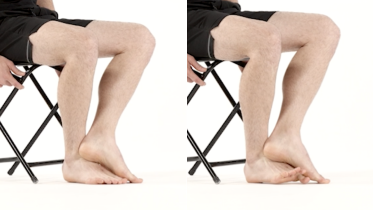 Isometric ankle dorsiflexion
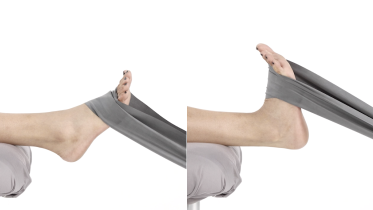 Ankle dorsiflexion with band
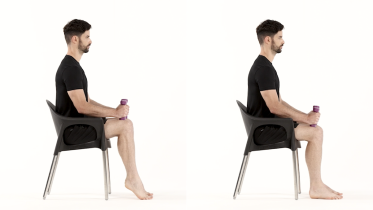 Seated calf raise
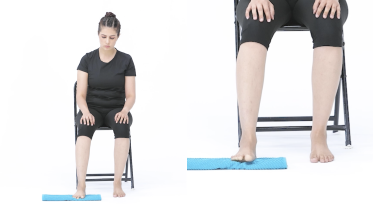 Towel scrunches
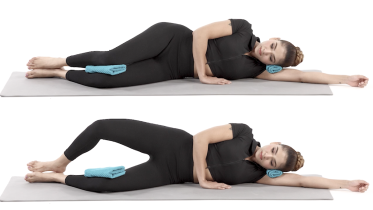 Clamshell
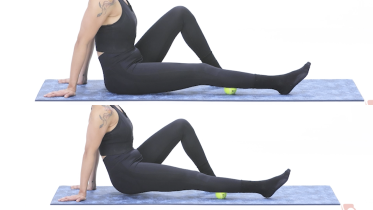 Calf massage with a ball
Stage 2: Build calf and shin strength standing
When everyday walking is pain free and the shin is no worse the next morning after stage 1. Calf raises and heel and toe raises work the calf and the muscle at the front of the shin on both feet, and heel walking works the front of the shin while you move. The single leg bridge works the buttock muscles that help control the leg when you run. The two stretches are optional: use the calf stretch if your calf feels tight and the standing shin stretch if the front of your shin does, holding on to something for balance.
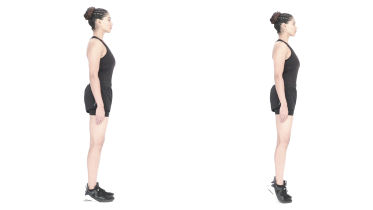 Calf raises
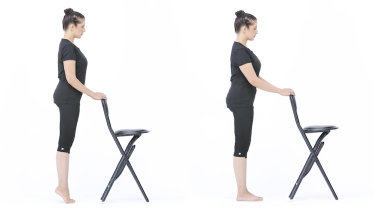 Heel and toe raises
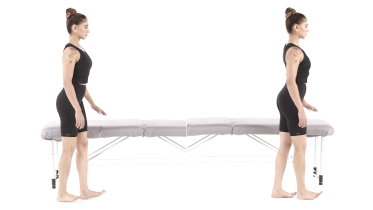 Heel walking
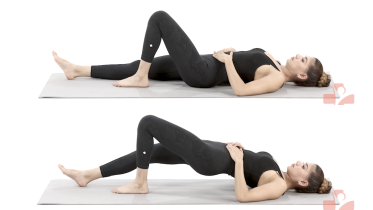 Single leg bridge
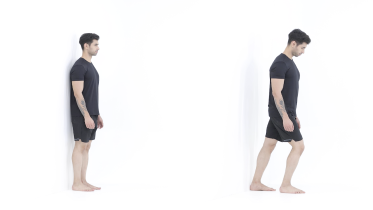 Calf stretch
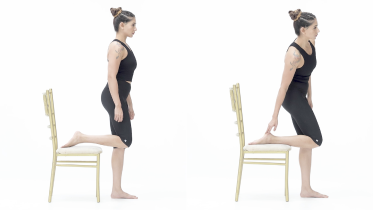 Standing shin stretch
Stage 3: One leg strength and the first impact
When the stage 2 exercises feel easy and brisk walking, including stairs, brings on no shin pain. Single leg heel raises and the bent-knee calf raise build the calf strength that running needs. Then bring impact back in small steps: easy jogging on the spot first, then low pogo hops on both feet, then small line jumps. Keep the landings quiet and soft, and stop if the pain gathers at one spot on the bone, because that needs checking for a stress fracture. Your shin should be no worse the next morning before you add more.
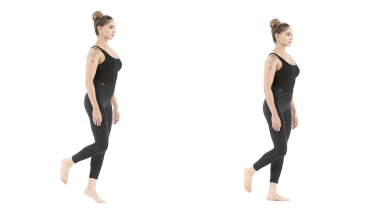 Single leg heel raise
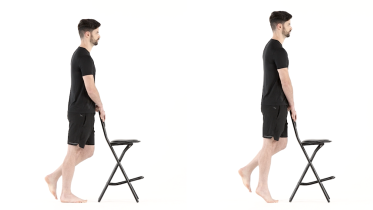 Bent-knee calf raise
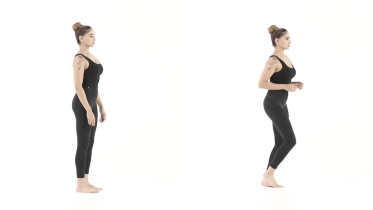 Jogging on the spot
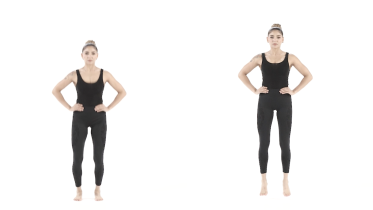 Pogo hops
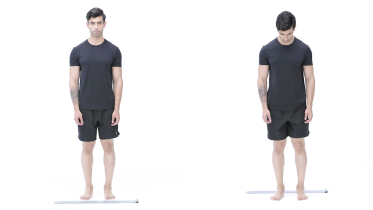 Line jumps
Stage 4: A graded return to running
When you have been free of pain in everyday life for at least 2 weeks and low hops on both feet bring on no shin pain. Start with short sessions that alternate easy running with walking, about 3 times a week with a rest day between, and build toward continuous running over several weeks, as described below. Keep the single leg heel raises going and add weighted calf raises 2 or 3 times a week. Single leg hops over a line are a harder test to add before faster running or sports with jumping. Your physio will adjust the plan to your leg and your sport.
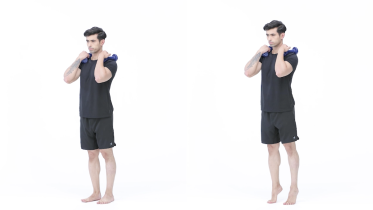 Weighted calf raise
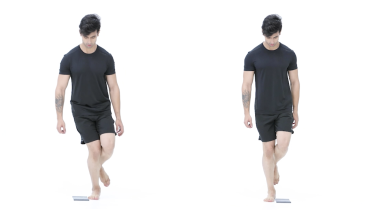 Single leg hops over a line
A graded return to running after shin splints
The most clearly described plan comes from the Dutch trial by Moen and colleagues (2012). Runs were 3 times a week with a rest day between. Athletes whose shin hurt with walking did not start running until they had walked pain free for 2 days in a row.
Each athlete started at a level set by how far they could run on a treadmill at the start. The early levels alternated 2 minutes of running with 2 minutes of walking, then 3 minutes of running with 2 minutes of walking, for 16 to 20 minutes in all. The last levels were continuous running, 16 minutes at an easy pace and then 18 minutes at a pace where talking becomes hard.
The trial used a simple pain score out of 10, where 4 is the point where the pain starts to become annoying. Athletes moved up only when they finished a level without the pain reaching 4 during their runs. If the pain reached 4 or more straight after a run or the next day, the athlete stayed at the same level and cut the run by 2 minutes. On average it took about 3 to 4 months to complete the program.
You do not need a treadmill to follow the same idea. The NHS suggests exercising on soft ground when you are feeling better, and OrthoInfo advises coming back less often, for less time and at a lower intensity than before the injury. Many physios build running time before speed, and bring back hills, speed work and jumping sports last. Your physio will adjust the steps to your leg and your sport.
When to see a physio or doctor about shin splints
See a physio or doctor if the pain is getting worse or is not getting better after looking after it yourself, as the NHS advises. The NHS also suggests getting urgent advice (NHS 111 in the UK) if the pain is severe or you have injured your shin. Shin splints can usually be diagnosed reliably from your history and an examination (Winters and colleagues, 2018). The same study found another lower leg injury alongside shin splints in about a third of people, which is one reason a proper assessment helps.
A physio can check for a stress fracture or compartment syndrome, set your starting stage, and look at your training, the way you run and your shoes. If you have had shin splints before, or they come back each time you build up your training, that is worth an assessment too. The warning signs below say how quickly to get help.
For physiotherapists
This page gives patients a starting framework for MTSS. Winters (2020) defines it as exercise-induced pain along the distal posteromedial tibial border with recognizable pain on palpation over 5 cm or more. In a multicenter reliability study of 46 athletes with non-traumatic lower leg pain, two blinded clinicians agreed on the diagnosis with a kappa of 0.89 (Winters and colleagues, 2018). Concurrent lower leg injuries were present in 32% of MTSS cases and were also identified reliably (kappa 0.73). The MTSS score, a 0 to 10 patient-reported outcome measure, can track progress, but its smallest detectable change for an individual is 4.8 points (Winters and colleagues, 2016).
Treatment evidence is weak. The 2013 systematic review rated ESWT, ice massage, ultrasound, iontophoresis and phonophoresis as possibly effective against control (level 3 to 4 evidence), found no proven effect for stretching, strengthening, laser or compression stockings, and judged no trial free enough of bias to support a recommendation (Winters and colleagues, 2013). In the 2012 trial, adding calf exercises or a compression stocking to a graded running program did not shorten the time to complete it, and 14 of 74 athletes dropped out for lack of progress (Moen and colleagues, 2012). In a 2025 trial, adding lower leg exercises to ice massage, orthoses and ESWT improved quality of life and foot posture but not pain or MTSS severity (Naderi and colleagues, 2025). The progression criteria in this program's stages are pragmatic and untested.
Screen for bone stress injury first. Patel and colleagues (2011) describe focal rather than diffuse tenderness, and edema, as pointing to a stress fracture; the hop test was positive in 70 to 100% of stress fractures but also in 45.6% of MTSS cases. Plain radiographs have about 10% sensitivity early, and anterior tibial stress fractures are high risk and may warrant orthopedic or sports medicine referral. The 2012 trial excluded clinical suspicion of stress fracture, noting that stress fracture pain is often focal with an abrupt onset.
Consider chronic exertional compartment syndrome with exertional pain, cramping, paresthesia or foot slap, confirmed by compartment pressure testing, and ask about fueling (low energy availability), sleep, rest days and vitamin D, which OrthoInfo lists as risk factors for bone stress injury, along with previous bone stress injury and conditions or long-term medicines that reduce bone strength. Take a menstrual history: the 2023 IOC consensus lists menstrual dysfunction and previous bone stress injuries among the indicators in its REDs clinical assessment tool (Mountjoy and colleagues, 2023).
See a doctor promptly if
- Emergency: sudden, severe pain in your lower leg that is much worse than you would expect, especially after an injury or with a plaster cast or tight bandage on the leg. It may come with a tight, swollen leg, pain that gets worse when the muscle is stretched, numbness, pins and needles or weakness. Call emergency services or go to an emergency department straight away, and do not drive yourself. This can be acute compartment syndrome, which needs urgent surgery.
- The pain sits at one small spot on the shinbone that you can point to with a finger, the bone is sore at rest or aches at night, or hopping on that leg hurts at one spot. Stop running and jumping and see a doctor within a few days, as this can be a stress fracture rather than shin splints. This matters even more if the spot is on the front of the shinbone, because doctors treat stress fractures there as high risk. If walking hurts or makes you limp, get it checked the same day.
- Your lower leg muscles get tight, cramping or painful during exercise and settle when you stop and rest, especially if your foot goes numb or tingly, feels weak, or slaps down as you run. This is not an emergency, but stop that activity and see a doctor in the next week or two, as it can be chronic exertional compartment syndrome. If the numbness or weakness is still there after you have rested, get it checked the same day.
- The pain started with a fall, a blow or a twist, or you cannot put weight on the leg. Get it checked the same day.
- A calf or thigh that is newly swollen, warm, tender, red or darker than usual, has swollen veins that are sore to touch, or has a throbbing or cramping pain that does not fit your injury or condition, or that feels different from normal muscle soreness after exercise. This can be a sign of a blood clot (deep vein thrombosis), especially after surgery, an injury, time in a cast or boot, a long trip or a spell of being much less mobile than usual. Get medical advice the same day. If you are also short of breath or have chest pain, call emergency services.
- Your shin is hot, red and swollen, or you have a fever or feel unwell. Get medical help the same day, and go to an emergency department if you feel very unwell. If you have a very high or very low temperature, shivering you cannot control, you are breathing very fast or finding it hard to breathe, you are confused or your speech is slurred, your skin, lips or tongue look blue, gray, pale or blotchy (on brown or black skin this can be easier to see on the palms of the hands or soles of the feet), or you have a rash that does not fade when you press it, call emergency services, as this can be sepsis.
- The pain is there at night or at rest as well as with activity and keeps getting worse. See your doctor within a few days. If you have had cancer, now or in the past, or are losing weight without trying, see your doctor sooner, within a day or two, and mention it. This applies even if the pain is not getting worse. If you are being treated for cancer now, contact your cancer team the same day.
Common questions
How long do shin splints take to heal?
Often a few weeks. The NHS says shin splints usually get better within a few weeks, and OrthoInfo advises being pain free for at least 2 weeks before going back to exercise. Pain that has lasted longer can take months to get back to full running. In a Dutch trial of athletes whose shin pain had lasted more than 3 weeks, it took on average about 3 to 4 months to complete a graded running program (Moen and colleagues, 2012).
Can I keep running with shin splints?
Usually not at first. The NHS advises not carrying on with the exercise that caused your shin splints, and not rushing back at the level you were at before. Keep your fitness with swimming, cycling or other exercise that does not hurt, then bring running back gradually once everyday activity is pain free. In the Dutch trial, athletes moved up a level only when the pain stayed below 4 out of 10 during their runs, and held back if it reached 4 after a run or the next day. Your physio will adjust how much running suits your leg.
How can I tell if it is shin splints or a stress fracture?
Shin splints usually hurt along a stretch of the inner shinbone, 5 cm or longer (Winters, 2020), while a stress fracture tends to be sore at one small spot, sometimes with swelling over it (Patel and colleagues, 2011). Aching in bed at night and pain with ordinary walking also point more toward a stress fracture (OrthoInfo). Hopping is not a clean test, because it hurts in many people with shin splints as well. If you are not sure which it is, stop running until it has been checked. An early X-ray can look normal even when there is a stress fracture.
Should I stretch or ice shin splints?
Ice can ease the pain, but neither ice nor stretching is proven to speed up recovery. The NHS suggests an ice pack wrapped in a towel on the shin for up to 20 minutes every 2 to 3 hours, and warming up before exercise and stretching after it. A systematic review found weak evidence that ice massage may help compared with a control group, and no proof that stretching or strengthening exercises work as treatments (Winters and colleagues, 2013). Your physio will tell you whether stretches have a place in your program.
Do insoles or compression socks help shin splints?
The evidence is thin. A review by Moen and colleagues (2009) found that neoprene or semi-rigid insoles may help prevent shin splints, and OrthoInfo notes that insoles (orthotics) may help people with flat feet. In a trial of 74 athletes, adding a compression stocking to a graded running program did not speed up the return to running (Moen and colleagues, 2012). Supportive shoes that fit well are part of the NHS advice, and a physio can check whether insoles are worth trying for your feet.
References
- Winters M, Eskes M, Weir A, Moen MH, Backx FJ, Bakker EW. Treatment of medial tibial stress syndrome: a systematic review. Sports Medicine. 2013;43(12):1315-1333. https://doi.org/10.1007/s40279-013-0087-0
- Moen MH, Tol JL, Weir A, Steunebrink M, De Winter TC. Medial tibial stress syndrome: a critical review. Sports Medicine. 2009;39(7):523-546. https://doi.org/10.2165/00007256-200939070-00002
- Moen MH, Holtslag L, Bakker E, Barten C, Weir A, Tol JL, Backx F. The treatment of medial tibial stress syndrome in athletes; a randomized clinical trial. Sports Medicine, Arthroscopy, Rehabilitation, Therapy and Technology. 2012;4:12. https://doi.org/10.1186/1758-2555-4-12
- Winters M, Bakker EWP, Moen MH, Barten CC, Teeuwen R, Weir A. Medial tibial stress syndrome can be diagnosed reliably using history and physical examination. British Journal of Sports Medicine. 2018;52(19):1267-1272. https://doi.org/10.1136/bjsports-2016-097037
- Winters M. The diagnosis and management of medial tibial stress syndrome: an evidence update. Der Unfallchirurg. 2020;123(Suppl 1):15-19. https://doi.org/10.1007/s00113-019-0667-z
- Winters M, Moen MH, Zimmermann WO, et al. The medial tibial stress syndrome score: a new patient-reported outcome measure. British Journal of Sports Medicine. 2016;50(19):1192-1199. https://doi.org/10.1136/bjsports-2015-095060
- Naderi A, Fallah Mohammadi M, Heidaralizadeh A, Moen MH. Effects of Integrating Lower-Leg Exercises Into a Multimodal Therapeutic Approach on Medial Tibial Stress Syndrome Management Among Recreational Runners: A Randomized Controlled Study. Orthopaedic Journal of Sports Medicine. 2025;13(2):23259671241311849. https://doi.org/10.1177/23259671241311849
- Mountjoy M, Ackerman KE, Bailey DM, et al. 2023 International Olympic Committee's (IOC) consensus statement on Relative Energy Deficiency in Sport (REDs). British Journal of Sports Medicine. 2023;57(17):1073-1097. https://doi.org/10.1136/bjsports-2023-106994
- Patel DS, Roth M, Kapil N. Stress fractures: diagnosis, treatment, and prevention. American Family Physician. 2011;83(1):39-46. https://www.aafp.org/pubs/afp/issues/2011/0101/p39.html
- NHS. Shin splints. Page last reviewed 9 February 2023. https://www.nhs.uk/conditions/shin-splints/
- NHS. Compartment syndrome. Page last reviewed 4 September 2026. https://www.nhs.uk/conditions/compartment-syndrome/
- NHS. Deep vein thrombosis (DVT). Page last reviewed 30 April 2026. https://www.nhs.uk/conditions/deep-vein-thrombosis-dvt/
- American Academy of Orthopaedic Surgeons. Shin splints. OrthoInfo. https://www.orthoinfo.org/en/diseases--conditions/shin-splints/
- American Academy of Orthopaedic Surgeons. Stress fractures. OrthoInfo. https://www.orthoinfo.org/en/diseases--conditions/stress-fractures/
- American Academy of Orthopaedic Surgeons. Compartment syndrome. OrthoInfo. https://www.orthoinfo.org/en/diseases--conditions/compartment-syndrome/
Written and checked by the PocketPhysio editorial team. Last updated 2026-09-28.
This page is general education, not a diagnosis or a personal treatment plan. See a physiotherapist or doctor for advice about your own situation.