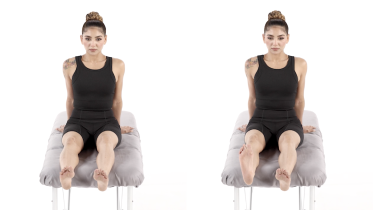
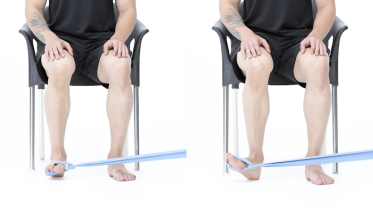
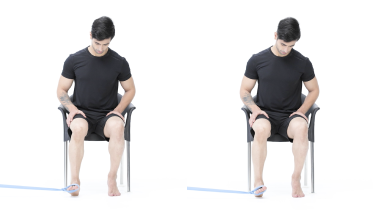
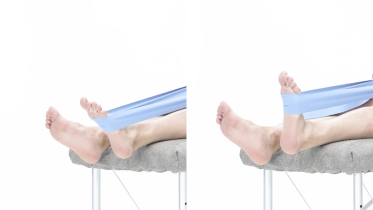
Standing shin stretch
The standing shin stretch gently points your foot down to stretch the front of your ankle and shin (tibialis anterior and the muscles that lift the toes). You stand with your back to a chair, rest the top of one foot on the seat behind you, and press down on that heel with your hand. It is often used when the ankle is stiff pointing down, for example after a spell in a boot or cast.
How to do the standing shin stretch
- Stand upright with your back to a sturdy chair, about a short step in front of the seat. Hold a wall, a counter or a second chair with your free hand for balance.
- Bend the knee of the leg you want to stretch and place the top of that foot on the chair seat behind you, sole facing up and toes pointing back.
- Stand tall on your other leg with that knee soft, not locked.
- Reach back with the hand on the same side and press gently down on the heel of the raised foot, so the foot points further down.
- Stop pressing when you feel a stretch across the front of the ankle, hold it, then ease off. Lower the foot to the floor between stretches.
What you should feel
A pull across the front of the ankle, the top of the foot or up the front of the shin. It should feel like a stretch, not a pinch at the back of the ankle.
Common mistakes
- Letting the foot roll inward on the seat so the stretch goes into the outside of the ankle.
- Leaning forward or arching your lower back to reach the heel.
- Pushing hard or bouncing on the heel.
- Standing too close to the chair, which cramps the knee and makes balance harder.
How often
Many programs hold each stretch for 15 to 30 seconds and repeat it 2 or 3 times per leg, once or twice daily. Your physio will adjust this.
Stop and check with your physio if
- Sharp or pinching pain at the front or back of the ankle.
- Tingling or numbness on the top of the foot.
- Pain in the knee of the raised leg.
- You lose your balance or feel dizzy. Put the foot down and hold on. If you faint while exercising, call emergency services, even if you feel fine again quickly.
From the clinic
The person in the video holds nothing. Still, you are standing on one leg and reaching behind you, so keep a counter or wall within reach. If standing on one leg makes you wobble, ask your physio for a seated version instead. A chair with a low seat is easier on the bent knee than a tall one.
Early after an ankle sprain, pointing the foot down and letting it turn in puts strain on the ligaments on the outside of the ankle. Ask your physio before stretching in this position in the first weeks, and after an ankle fracture or surgery. To stretch the back of the lower leg instead, see the calf stretch, and for gentle movement in every direction try ankle circles.
Written and checked by the PocketPhysio editorial team. Last updated 2026-09-26.
This page is general education, not a diagnosis or a personal treatment plan. If you have pain, an injury or a health condition, see a physiotherapist or doctor before starting new exercises.