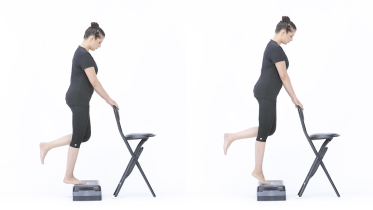
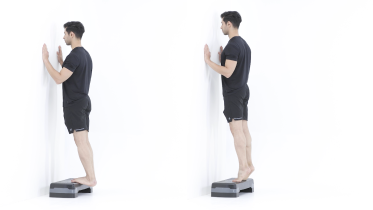
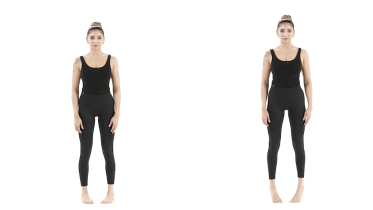
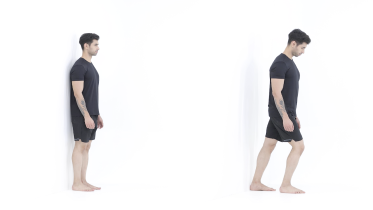
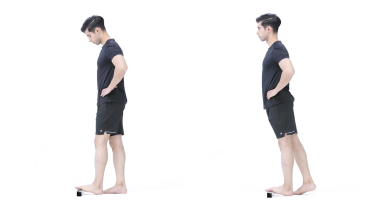
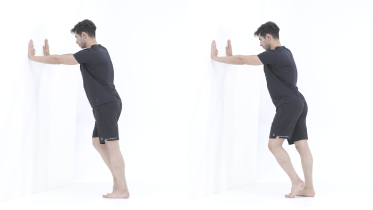
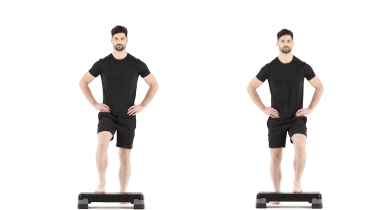
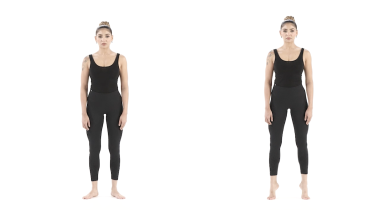
Heel and toe raises
Heel and toe raises work the ankle in both directions while you stand holding a chair. You rise onto the balls of your feet and lower down again, which works the calf, then rock back onto your heels and lift the front of your feet, which works the front of the shin (tibialis anterior). Physios often give it after ankle injuries and in programs for leg strength and balance.
How to do the heel and toe raises
- Stand facing the back of a sturdy chair with both hands resting on it. Feet slightly apart, toes pointing forward, knees and back straight.
- Rise onto the balls of both feet, lifting your heels as high as you can without strain.
- Bring your heels back down to the floor slowly. Repeat the rise and lower for the rest of the set, as the video does.
- To finish, shift your weight back onto your heels and lift the front of both feet toward the ceiling. The video shows this toe lift once, at the end.
- Lower the front of your feet gently and stand with your weight even again.
What you should feel
Your calves working as you rise and lower. On the toe lift, the effort moves to the front of your shins. Tiredness there is normal, sharp pain is not.
Common mistakes
- Letting the ankles roll outward so your weight goes onto the little toes as you rise.
- Dropping the heels quickly instead of lowering them under control.
- Pushing your hips back or bending forward at the waist to lift the toes.
- Leaning your weight onto the chair and pulling yourself up with your arms.
How often
A common range is 10 to 15 slow rises per set, for 2 or 3 sets, once daily, with a few toe lifts added. Your physio will adjust this.
Stop and check with your physio if
- A sharp pain in your Achilles, your heel or the front of the ankle.
- A calf cramp that does not settle when you stop and stand still.
- Dizziness or a feeling that you might fall. Sit down straight away. If you faint while exercising, call emergency services, even if you feel fine again quickly.
- A sudden pop or snap at the back of your ankle or heel, a feeling that someone kicked you there, or sudden pain there after which you cannot push off or rise onto your toes on that leg. Stop, take the weight off that leg carefully and go to an urgent care center or emergency department the same day, even if you can still walk, as this can be a torn Achilles tendon.
From the clinic
Keep both hands on the chair the whole time, and pick one that will not slide or tip, such as a heavy chair pushed against a wall. A kitchen counter works just as well. Rocking back onto your heels tips your weight backward, so the toe lift is where most people feel wobbly. If you have had a fall or often feel unsteady, have someone nearby the first few times.
The voice guide alternates a heel raise and a toe lift on every repetition, while the video shows a run of heel raises with one toe lift at the end. Your physio will tell you which pattern to follow. The voice guide also makes it harder by going faster. Only speed up once you can do it slowly without wobbling. For calf work on its own, see calf raises.
Written and checked by the PocketPhysio editorial team. Last updated 2026-09-28.
This page is general education, not a diagnosis or a personal treatment plan. If you have pain, an injury or a health condition, see a physiotherapist or doctor before starting new exercises.