
Adductor tendinopathy exercises and recovery
Warning signs, and when to get help
What is adductor tendinopathy?
The adductors are the group of muscles you can feel along the inside of your thigh. They start up on the pubic bone at the front of the pelvis, run down the inner thigh, and they draw the leg in toward the other one, which is the movement a ball squeeze asks for. Adductor tendinopathy is pain and loss of tolerance in the tendon end of those muscles, where they attach to the pubic bone, and it comes from load rather than from one accident.
The pattern is specific enough to recognize. It builds over weeks, usually after you increased your training or came back to sport after a layoff. It is sore to press high on the inner thigh, it hurts to squeeze your knees together against resistance, and it is worst at the start of a session before easing as you warm up. The next morning is often the honest report on yesterday.
This page is for adults with that gradual pattern, managed without an operation. It is written for sport, and the early stages suit anyone with a load-related inner thigh pain. If you have had groin or hip surgery, follow your surgeon's program rather than this one. A child or teenager with a limp, or with pain in the groin, hip, thigh or knee, should be seen by a doctor before starting any program.
Is it adductor tendinopathy or something else?
This is the question that decides your next 3 months. Give it more of your attention than the exercise list. Several different problems live in this patch of the body, and they do not share a treatment.
An acute adductor strain begins at one moment: a sprint, a kick or a stretched-out tackle, with sharp pain and often bruising over the following days. If that is your story, the groin strain program is the right page, and a criteria-based rehabilitation program for exactly that injury exists in the published literature (Serner and colleagues, 2020). Tendinopathy, by contrast, has no single moment behind it, and squeezing a ball between your knees today tells you more about it than any scan would.
A hip joint problem sits deeper in the groin and comes on with bending and twisting, often with a click or a catch. Hip impingement, a labral tear and hip osteoarthritis all sit here, and the Doha expert group advised that the hip joint should always be considered in groin pain (Weir and colleagues, 2015). It also goes the other way round. Pain in the front of the hip with a sore hip flexor points at hip flexor strain, and pain over the bony point on the outside of the hip at greater trochanteric pain. Pain tucked up under the buttock where you sit belongs to hamstring tendinopathy, which behaves the same way under load but at the back of the thigh instead of the inside.
The pubic bone at the front of the pelvis is the near neighbor that gets missed. The two halves of the pelvis meet at a small joint there, and in the Doha taxonomy pubic-related groin pain is tenderness directly over that joint and the bone either side of it, with no single resistance test that picks it out (Weir and colleagues, 2015). An athlete can have more than one of these problems at once, and this one tends to sit alongside adductor pain rather than instead of it. If your sorest spot is on the bone at the very front rather than up the inner thigh, say so when you are examined, because the squeezes in this program press through that joint as well and the pacing may need to be different. It is also why pain over the pubic bone turns up as a reason to stop in the notes under the exercises below.
Then there are the time-critical ones, and this is where a web page earns its keep. A hernia shows as a bulge or lump where the leg joins the body, which the NHS says may grow when you cough or sneeze and go down when you lie down. A painless one needs a doctor's appointment. One that becomes painful or tender, or comes with a bloated tummy, vomiting, constipation or a fever, needs help the same day, because a hernia that gets trapped can lose its blood supply, and that is not a groin to exercise.
Pain in a testicle is not a groin strain either, and it has the shortest clock on this page. Sudden severe pain in a testicle, pain there alongside feeling sick, being sick or tummy pain, or pain that has lasted more than an hour or carries on while you rest, means an emergency department now rather than tomorrow. A lump or swelling in a testicle, a change in its shape or size, or an ache there that worries you is an urgent same-day appointment with a doctor instead.
The last one has a clock on it as well, and it is the one that most resembles tendinopathy at the start: a stress fracture in the neck of the thighbone. It builds up with running, marching or jumping, usually after a jump in training, and then starts hurting when you walk. These are rare and are often missed at first, so it has to be suspected early in anyone whose groin pain came on with training and who is also sore at the ends of hip movement. Being seen again soon is what stops one progressing to a displaced fracture, which considerably worsens the long-term outlook (Clough, 2002).
Keep loading that leg and you can turn a crack into a break, so this one needs advice the same day, no running or jumping in the meantime, as little walking as you can manage, and an emergency department if you cannot put weight on the leg. Groin pain works through the rest of the causes.
What the evidence says about loading the adductors
Strength work has the best support, and the trial that established it is worth knowing in detail. A Danish team randomized 68 athletes whose adductor-related groin pain had lasted a median of 40 weeks into two groups: an 8 to 12 week active training program aimed at the strength and coordination of the muscles around the pelvis, especially the adductors, or physiotherapy treatment without active training. Four months after treatment ended, 23 athletes in the training group were back at their sport at the same level without groin pain, against 4 in the other group, an odds ratio of 12.7 with a 95% confidence interval of 3.4 to 47.2 (Hölmich and colleagues, 1999). The examining doctor did not know which group anyone had been in.
Set against that, a later randomized trial is a useful dose of realism. It compared a home exercise program with a return-to-running plan against a multimodal package of heat, manual therapy and stretching that had a return-to-running plan of its own, in athletes who had at least 2 months of pain at the top of the adductor tendons. The multimodal group got back to full sport faster, at an average of 12.8 weeks against 17.3 weeks. But only about half of the athletes in either group made a full return at all, there was no difference in pain during sport, and the authors wrote plainly that neither treatment was very effective (Weir and colleagues, 2011).
Read those two trials together. The loading approach is the best-supported option and the results in the real world are mixed, and knowing the second half of that sentence is what stops a slow month feeling like failure. It does not rest on one trial either: the Doha expert group, looking at the same field, reported moderate evidence that supervised active training returns more athletes with long-standing adductor-related groin pain to play than passive treatments, and moderate evidence that adding hands-on treatment can return them faster without making success more likely (Weir and colleagues, 2015). A systematic review of all the non-surgical options reached the same conclusion from a different direction: 19 studies across 7 treatment types, with the evidence base described by its own authors as limited and of low quality (Bisciotti and colleagues, 2021).
How long does adductor tendinopathy take to heal?
Plan in months. The trials above ran their programs for 8 to 12 weeks and then measured the result months later, and the faster of the two groups in the 2011 trial averaged 12.8 weeks to full sport. Anyone promising you 3 weeks has not read them.
More useful than a number is the order things come back in, because it saves a lot of worry. Getting out of a car and rolling over in bed usually ease first. A firm squeeze of a ball stops hurting next, which is your gate out of stage 1. Then walking, then easy jogging, then wide and loaded positions. Sprinting, kicking and sliding come last and are often still uncomfortable when everything else feels normal, which is not a sign the program failed.
Progress is lumpy, not steady, and that catches people out. A good two weeks followed by a sore one is the usual shape of tendon rehabilitation, not a relapse. What matters is the trend over a month, so if you want to track something, track how many sets you can do at the same soreness rather than how the groin feels on a given morning.
What we see in the clinic
The groin gets blamed for a training error more often than for anything wrong with the groin. Ask what changed 4 to 6 weeks before it started and you usually get an answer: preseason, a new gym program, a return after a long break, or a sport added on top of another. Nothing has to be wrong with the tendon for a sudden doubling of sprinting to hurt it.
Two habits keep it going. The first is warming up until it feels fine and then training as though nothing is wrong, because a tendon that eases with warmth has not been fixed by it, only quietened for an hour. The second is stretching it. Almost everyone with this problem has been stretching the groin hard for weeks by the time they arrive, usually in a butterfly position, and in our clinics it is the habit that most often keeps it sore. A tendon that hurts under load is not short.
What people also miss is how little of this is the inner thigh alone. The adductors pull on a pelvis, and if the muscles at the side and back of the hip are not steadying it, the groin is working against a moving anchor. The trial above trained the whole pelvic group rather than the adductors in isolation, which is why there is a clamshell and a glute bridge in this program and not just a ball to squeeze.
How to use this program
Pick the stage that matches your groin today, and start at stage 1 if you are not sure. Move up when the stage you are on feels easy and the groin is no sorer the next morning. The gate from stage 1 to stage 2 is simple and you can test it yourself: a firm squeeze of the ball no longer hurts and you walk normally.
Each exercise page gives its own starting dose, and the stage texts above repeat the numbers so you do not have to open four pages to plan a session. As a rough guide, the holds are 5 to 10 seconds repeated 5 to 10 times once or twice a day, and the strength work is 2 to 3 sets of 8 to 15, daily for the early exercises and 2 to 3 days a week for the standing work in stage 3. Your physio will adjust the exercises and the numbers to your groin and your sport.
Before you start, read the checks below against yourself. They are the reasons to get the groin looked at or to change an exercise, so they sit before the program and not halfway down it.
Squeezing the inner thighs puts effort through the joint at the front of the pelvis, so if you are pregnant, have had a baby recently, or have pain over the pubic bone, check with your physio or midwife before you begin. Past the first 3 months of pregnancy, ask about the exercises done flat on your back as well, and use the seated hold instead.
If you have had a hip replacement or any other hip surgery, get the go-ahead from your surgeon or physio before you start. Several of these exercises bend the hip past a right angle, take the leg across the middle of the body or turn the thigh outward, and surgeons limit those after some operations for the first months. Ask the same question after back surgery, because both bridges lift your hips off the floor, and after knee surgery or a knee replacement, because the two standing squats in stage 3 depend on how deep and how wide your surgeon lets you go. Get those limits from the person who operated or from your physio rather than guessing them.
The half kneeling stretch needs you to kneel and to get down to the floor and up again, so check that one as well after knee surgery, and keep a sturdy chair beside you. Your head finishes below your heart in it, so if you have glaucoma or have had recent eye surgery, ask your doctor or physio before you try it. If you have low bone density (osteoporosis), stay up on your hands in that stretch with your back long, rather than curling down onto your elbows, and ask your physio whether it suits you at all.
If you have high blood pressure, breathe steadily through every hold and never hold your breath. Counting the seconds out loud is the simplest way to keep the air moving. Check with your doctor before you start if you have a heart or lung condition, or blood pressure that is not under control.
If you have fallen in the past year, feel unsteady on your feet, or take medicines that make you dizzy, keep a hand on a kitchen counter through the standing exercises in stage 3, practice only when someone else is at home, and ask your doctor or physio about a falls check. Ask them about the half kneeling stretch too, because getting down to the floor and back up again is a transfer that needs balance of its own.
Read the warning signs at the foot of this page before your first session rather than after something happens. Three of them stop the program outright until the groin has been looked at: a painful lump or bulge in the groin and groin pain that built up with running and now makes you limp both need help the same day, and sudden or lasting pain in a testicle needs an emergency department now.
The exercise program
The exercises below carry their own stop signs and precautions. Open the line under an exercise and read them before you try it.
Stage 1: Start with holds that do not hurt
Start here if walking, getting out of a car or squeezing your knees together is sore, and stay here until a firm squeeze no longer hurts. The three holds work the inner thigh without the hip moving, which is usually the easiest way to load an irritable tendon, and the glute bridge keeps the buttocks and the back of the thighs going in the meantime. Begin with a moderate squeeze rather than your hardest. The exercise pages put the holds at 5 to 10 seconds, repeated 5 to 10 times, once or twice a day, with the seated hand-resisted version at about 10 seconds, and the bridge at 2 to 3 sets of 10 to 12 with a short hold at the top. Your physio will adjust this. Use the seated hold when only one side hurts, because two knees pressing into one ball lets the good leg take over and you cannot feel that happening. This stage should not hurt while you do it, and the groin should be no sorer the next morning. Stretching, wide steps and side to side movement wait.
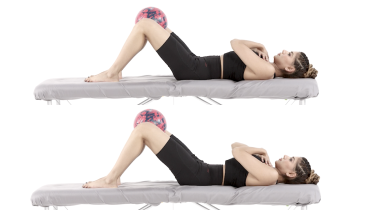 Adductor ball squeeze
Stop signs and precautions for the adductor ball squeeze
Before you start
- If you have had a hip replacement or other hip surgery, get the go-ahead from your surgeon or physio before you try the adductor ball squeeze. Some operations limit this kind of work for the first months, so the timing depends on your surgery.
- Pregnant, or have pain over the pubic bone at the front of your pelvis? Squeezing the inner thighs puts effort through that joint, so check with your physio before you start.
- If you are pregnant and past the first three months, check with your physio before exercising flat on your back. The sitting version is often the better choice.
When to stop and get help
- You feel sharp pain in the groin or over the pubic bone at the front of the pelvis.
- Groin pain builds during the holds or is worse the next morning.
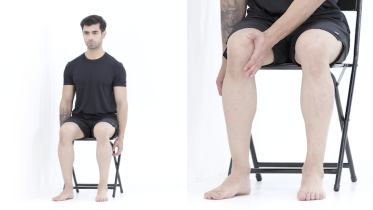 Seated isometric hip adduction
Stop signs and precautions for the seated isometric hip adduction
Before you start
- If you have had a hip replacement, get the go-ahead from your surgeon or physio before you try seated isometric hip adduction. Some operations limit this kind of work for the first months, so the timing depends on your surgery. If you are pregnant or have pain over the pubic bone, check with your physio first, since pressing the knee inward puts effort through the joint at the front of the pelvis.
- If you have high blood pressure, breathe steadily through every hold and never hold your breath. Counting the seconds out loud is a simple way to keep the air moving.
When to stop and get help
- Sharp pain in the groin or inner thigh during the press.
- Pain over the pubic bone at the front of your pelvis, or groin pain that is worse the next day.
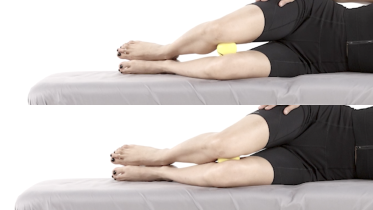 Side lying isometric hip adduction
Stop signs and precautions for the side lying isometric hip adduction
Before you start
- If you have had a hip replacement, get the go-ahead from your surgeon or physio before you try side lying isometric hip adduction. Some operations limit this kind of work for the first months, so the timing depends on your surgery. Your physio will tell you which side you can lie on, as the operated hip may be too sore to lie on early in recovery.
- Pregnant, or have pain over the pubic bone? Check with your physio before you start, as pressing the thighs together loads the joint at the front of the pelvis.
- If you have high blood pressure, breathe steadily through every hold and never hold your breath.
When to stop and get help
- A sharp pain in your groin or on the pubic bone, where the two halves of the pelvis meet at the front.
- Groin pain that builds with each hold, or is worse the following day.
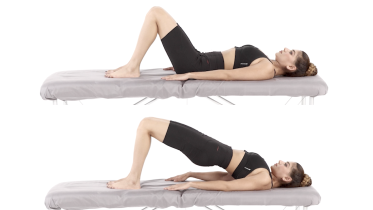 Glute bridge
Stop signs and precautions for the glute bridge
Before you start
- After hip, knee or back surgery, your surgeon's protocol decides when you can start bridges. Once you are past the first three months of pregnancy, check with your physio before exercising flat on your back.
When to stop and get help
- You feel back pain rather than buttock work, even when you lift a little lower.
- Pain spreads down the leg or you get numbness or tingling.
- Your hamstrings (the back of the thighs) cramp. This is a common complaint with bridges, and bringing your feet a little closer to your bottom often eases it.
Stage 2: Load the muscle through its range
Move up when you walk normally, the holds are comfortable and a firm squeeze of the ball is pain free. Side lying hip adduction takes the same muscles through a range instead of only tightening them, and the bridge with a ball squeeze asks them to keep working while a bigger movement happens around them. The clamshell is here because the groin rarely works alone: the muscles at the side and back of the hip steady the pelvis that the adductors pull on, and the trial behind this program trained strength and coordination around the pelvis rather than the inner thigh in isolation. A common range is 2 to 3 sets of 10 to 15 for the side lying lift and 2 to 3 sets of 8 to 12 for the bridge with the squeeze, with holds of 3 to 10 seconds, and 2 to 3 sets of 10 to 15 clamshells. Your physio will adjust this. The stretch can start now, to a gentle pull and never into pain, held 20 to 30 seconds and repeated 2 to 3 times each side. It needs a knee on the floor with a folded towel under it, so leave it out if kneeling hurts and ask your physio for another way to get that length.
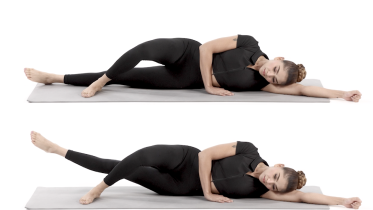 Side lying hip adduction
Stop signs and precautions for the side lying hip adduction
Before you start
- If you have had a hip replacement, get the go-ahead from your surgeon or physio before you try side-lying hip adduction. Here the top leg crosses over in front of you and the bottom leg lifts past the middle of your body, and many surgeons ask you to avoid that for the first months after some operations.
When to stop and get help
- You feel sharp pain in the groin or at the pubic bone at the front of the pelvis.
- Pain in the lower back, or pain that spreads down the leg.
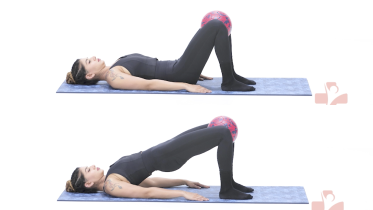 Bridge with ball squeeze
Stop signs and precautions for the bridge with ball squeeze
Before you start
- After hip, knee or back surgery, your surgeon's protocol decides when bridges can start, so ask before you begin.
- Squeezing the inner thighs puts effort through the joint at the front of the pelvis. If you are pregnant or have pain over that area, check with your physio first, and past the first three months of pregnancy ask them about lying flat on your back too.
When to stop and get help
- Sharp pain in the groin, or over the pubic bone at the front of the pelvis.
- Back pain rather than buttock and thigh work, even when you lift less high.
- Pain, numbness or tingling that spreads down the leg.
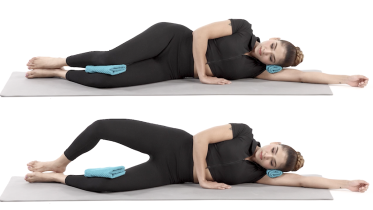 Clamshell
Stop signs and precautions for the clamshell
Before you start
- If you have had a hip replacement or other hip surgery, get the go-ahead from your surgeon or physio before you try clamshells. Opening the knee turns the thigh outward, and many surgeons ask you to avoid that for the first months after some operations. Lying on your side may also be limited in that time.
When to stop and get help
- You feel sharp or pinching pain in the hip or groin.
- Pain spreads into the leg, or you notice numbness or tingling.
- Pain on the outside of your hip builds during the set or is worse the next morning.
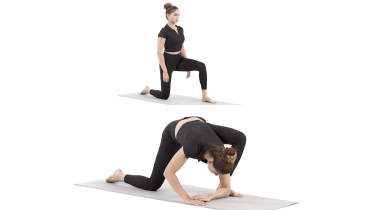 Half kneeling adductor stretch
Stop signs and precautions for the half kneeling adductor stretch
Before you start
- If you have had a hip replacement, get the go-ahead from your surgeon or physio before you try the half kneeling adductor stretch. Taking your elbows down beside the front foot folds that hip far beyond a right angle, and many surgeons ask you to avoid that for the first months after some operations. The kneeling hip is also taken back behind you, which some surgeons limit after a replacement done from the front of the hip.
- If you have had knee surgery or a knee replacement, check with your surgeon or physio before you kneel on that knee. Getting down to the floor and up again takes strength and balance, so have a sturdy chair next to you to lean on as you rise, and if you have fallen in the past year, ask your physio first.
- If you have high blood pressure, a heart condition, glaucoma or recent eye surgery, check with your doctor or physio first, keep breathing and come up slowly. If you have low bone density (osteoporosis), stay up on your hands with your back long rather than curling down to your elbows, and ask your physio whether this stretch suits you.
- If you are pregnant and have pain at the front or back of your pelvis, ask your physio first.
When to stop and get help
- Sharp or pinching pain deep in the groin or at the front of the hip.
- Pain, numbness or tingling that travels down the back of the leg as you straighten the knee.
- You feel dizzy, lightheaded or faint as you get up. Stay down or sit on the chair and wait for it to pass. If it does not pass within a minute or two, or it keeps happening, get medical advice the same day before you practice again. If you faint, or it does not settle within a few minutes of keeping still, call emergency services.
Stage 3: Stand up and go wide
This is the stage most programs never reach, and it is the one that decides whether the groin holds up. Both exercises load the inner thigh with your own weight on it, which is the job it does in life and in sport. The squat with a ball squeeze puts a shallow squat and the squeeze together, to about 45 degrees of knee bend, with a hold of 3 to 5 seconds at the bottom. The side to side squat then adds the sideways step, so the muscle has to steady a stance it has just created rather than one you set up carefully. Many programs use 2 to 3 sets of 8 to 12 for each, 2 or 3 days a week so the muscle recovers in between, and your physio will adjust this. Go as wide and as low as you can control and no further. A mild pulling feeling along the inner thigh is expected. A sharp or tearing feeling is not, and it means going back a stage rather than finishing the set. Clear rugs, cables and furniture from your path before the side to side squat, and work along a kitchen counter if your balance is not steady.
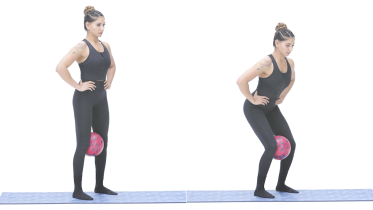 Squat with ball squeeze
Stop signs and precautions for the squat with ball squeeze
Before you start
- If you have had a hip replacement, get the go-ahead from your surgeon or physio before you try the squat with ball squeeze. Some operations limit this kind of work for the first months, so the timing depends on your surgery.
- After knee surgery or a knee replacement, check with your surgeon or physio before you start, and follow their plan for how deep you may go.
- If you are pregnant or have pain over the pubic bone, check with your physio first, since squeezing the inner thighs puts effort through the joint at the front of the pelvis.
- If you have high blood pressure, breathe steadily through every hold and never hold your breath.
When to stop and get help
- Sharp pain in or around the kneecap, or knee pain that builds with every repetition.
- Your knee gives way, catches or locks, or is swollen later that day.
- A sharp or pinching pain in your groin, or pain over the bone at the very front of your pelvis where the two sides meet.
- You feel dizzy, lightheaded, faint or sick, or the room seems to spin. Stop, sit down and get medical advice the same day before you exercise again. If you faint, it does not settle within a few minutes of sitting still, your vision suddenly blurs or goes double, or you cannot stand or walk steadily, call emergency services.
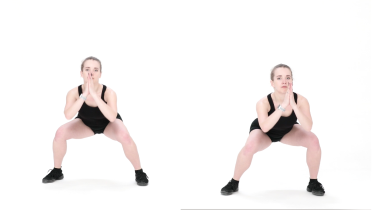 Side to side squat
Stop signs and precautions for the side to side squat
Before you start
- If you have had a hip or knee replacement, get the go-ahead from your surgeon or physio before you try side to side squats. Some operations limit this kind of work for the first months, so the timing depends on your surgery. Ask how wide to step and how deep to squat as well.
When to stop and get help
- The knee catches, buckles or gives a sharp pain.
- Sudden pain high in the inner thigh as you step wide.
- You catch a foot or stumble as you step.
- You feel dizzy, lightheaded, faint or sick, or the room seems to spin. Stop, sit down and get medical advice the same day before you exercise again. If you faint, it does not settle within a few minutes of sitting still, your vision suddenly blurs or goes double, or you cannot stand or walk steadily, call emergency services.
- Chest pain or pressure, dizziness or feeling faint, a racing or irregular heartbeat, or being far more out of breath than the effort should cause.
Getting the detail right
Stage 1 looks too easy to be doing anything, which is exactly where people overdo it. A tendon that has been sore for months does not need your hardest squeeze on day one, so set the adductor ball squeeze at a moderate effort and leave something in reserve. Three habits quietly cheat it: your hips lifting off the bed, your back arching to push harder, and your breath held through the count. Only the knees press in. Keep using that ball as your daily test, because the day a firm squeeze stops hurting is the day stage 1 has done its job.
When only one side is the problem, use your hand instead of the ball. In seated isometric hip adduction you reach across, press one knee in against the opposite hand, and let go the instant the groin complains, which a ball pressing back at you will not allow. Stay tall as you reach, because leaning toward the hand makes the press feel stronger without the inner thigh doing any more work.
The first moving exercise surprises people, because the lift is much smaller than they expect. In side lying hip adduction the bottom leg comes up only a short way, since the inner thigh muscles pull at a poor angle from down there, and that small lift with one hip stacked above the other is the whole exercise. Roll the hips backward to gain height and the work moves off the muscle you are here for. The bottom knee stays straight and the toes point forward.
Then the squeeze that has to survive a bigger movement. In the bridge with ball squeeze and the squat with ball squeeze, the squeeze is the part that fades, and it usually goes on the way up. Ask yourself at the top of every repetition whether the knees are still pressing or just resting against the ball. Pick a ball that fits between your knees when they sit straight over your feet, and keep the kneecaps roughly over your second toes through the squat.
Which exercises should you avoid with adductor tendinopathy?
Early on, the ones that stretch the muscle long while it is also working hard. That combination is what an irritable adductor tendon tolerates worst, and it accounts for most of the flares we see. The list is short and specific: wide lunges and side lunges, deep sumo squats, breaststroke kick, hard stretching into the groin, sliding tackles, and the Copenhagen adduction exercise, which has its place later and is far too much in the first weeks.
None of that is banned for good, and the difference between a sensible pause and avoidance is the plan to bring it back. Wide and loaded positions return in stage 3 of this program, then the Copenhagen adduction once your physio judges the groin ready, then sport. The one thing that does not come back is stretching into pain: the gentle length work in stage 2 is as far as that goes, for the reason above.
Two things not to drop. Walking, because a groin that stops moving stiffens and the first sprint back is worse for it. And easy straight-line running, if it is pain free during and after, because it loads the tendon in a direction it usually copes with and keeps you fit while the strength work does its job.
Getting back to sport and keeping the groin
The order is the useful part. It is the same one every time. Straight-line running first, built up to full sprints. Then changes of direction you have planned, then ones you react to. Kicking last, starting with short passes.
Tell a coach that list rather than a diagnosis, and ask to sit out small-sided games until you are through it, because that is where the sharp turns and stretched-out tackles live.
The step almost everyone skips is carrying on. Groin problems recur, and the groin prevention program with the largest trial behind it kept going through the season rather than stopping at the end of rehabilitation: teams of semiprofessional male soccer players doing an Adductor Strengthening Programme built on the Copenhagen adduction exercise, 3 times a week before the season and once a week during it, reported fewer groin problems than teams training as usual (Harøy and colleagues, 2019). That trial set out to stop groin problems across whole squads, not to stop one coming back after adductor tendinopathy, so treat it as a sensible habit rather than a tested one: two sessions a week of the stage 3 work, with the Copenhagen adduction added when your physio says so.
A sore day with no obvious cause does not mean stopping. It means going back a stage: keep the holds going, keep walking, and spend a few days climbing back to where you were.
When to see a physio or doctor
See a physio or doctor if the groin is no better after 6 to 8 weeks of steady loading, if it settles and flares every time you go back to sport, or if you cannot tell whether the pain is coming from the adductors, the hip joint or somewhere else. A physical therapist (physiotherapist) can usually sort that out in one appointment and pick your starting stage, which is quicker than working through it alone.
Go sooner if you are not sure this is tendinopathy at all. The alternatives above have different treatments and three of them have a deadline, so a page cannot settle it and an examination usually can.
The warning signs below say which problems need help faster than a physiotherapy appointment, and how fast, from an emergency department now down to an appointment within 2 weeks.
For physiotherapists
This page is a starting framework for adults with adductor-related groin pain of gradual onset. The Doha agreement defines adductor-related groin pain as adductor tenderness and pain on resisted adduction testing, in an athlete who reports pain in that region that worsens on exercise. It also asks that the pain provoked on resistance testing be felt in the adductors themselves and not somewhere else, for example the inguinal region (Weir and colleagues, 2015). Gradual onset is this page's own restriction and is not part of that definition.
Acute adductor injury is routed to the groin strain page, which follows the criteria-based protocol of Serner and colleagues (2020). Hip-related groin pain, the pubic-related, inguinal-related and iliopsoas-related entities, femoral neck stress injury and testicular causes are handled in the differential section and the warning signs. Two Doha points carry through both: the hip joint is always considered, and one athlete can carry more than one entity.
The staging is built on Hölmich and colleagues (1999): an 8 to 12 week active training program targeting strength and coordination of the pelvic muscles, especially the adductors, in 68 athletes with a median symptom duration of 40 weeks. A blinded examiner assessed them 4 months after treatment ended: 23 were back at sport at the same level without groin pain, against 4 in the comparison group, odds ratio 12.7 (95% confidence interval 3.4 to 47.2). The published abstract does not state how the 68 were split between the two arms. The review that extracted the trial reports 34 in each, in its narrative text and in its extraction table, and that is the source for the split given here (Bisciotti and colleagues, 2021). The same review scores the trial 13 of 24 on MINORS and rates its risk of bias as high, so the size of that odds ratio is worth less than the direction of it, which the Doha synthesis supports separately.
The page carries the counterweight. Weir and colleagues (2011) found a mean return to full sport of 12.8 weeks (SD 6.0) with multimodal treatment against 17.3 weeks (SD 4.4) with exercise therapy, p = 0.043. Only 50 to 55% of athletes in either arm made a full return, there was no difference in the objective outcome score or in pain during sport, and the authors concluded that neither treatment was very effective. That abstract does not state the number randomized, so this page does not state one.
Isometric loading in stage 1 and the pelvic work alongside the adductors are the two design choices worth flagging. The isometrics are a tolerance-led entry point rather than an analgesic claim, and no analgesic effect is asserted on the page, because the trial evidence for one in this tendon is absent. A published modification of the Hölmich protocol, evaluated before and after in 15 male athletes, opens its first part with pain-free isometric adduction against a soccer ball between the knees in crook lying and brings in through-range elastic adduction from week 3 (Yousefzadeh and colleagues, 2018), which is the order used here. Adductor stretching was part of the physiotherapy both arms received in that 1999 trial, as the Bisciotti and colleagues (2021) extraction records, which is why a gentle stretch sits in stage 2 while stretching into pain stays out. The seated hand-resisted hold is prescribed where the problem is unilateral, because the bilateral ball squeeze permits unquantified substitution by the uninvolved limb and the patient cannot detect it.
On hold length: the first part of that modified protocol holds each pain-free squeeze for 10 seconds, 3 sets of 10, three times a week. Ten seconds is the top of the 5 to 10 second range stage 1 gives, which is the dose on the adductor ball squeeze and side lying isometric exercise pages, with the seated hand-resisted page at about 10 seconds. The lower end of that range is the tolerance-led entry, and the repetition count here sits deliberately below the protocol's. The 30 to 45 second holds a reader may have met elsewhere come from isometric analgesia protocols written for other tendons, and with no analgesic effect claimed on this page there is nothing for them to be doing.
Long-length and weight-bearing loading is deferred to stage 3. Progressive eccentric work, including the Copenhagen adduction, is left to the treating clinician, and the Copenhagen adduction is named rather than linked because the library holds no video of it. Harøy and colleagues (2019) support the Copenhagen-based Adductor Strengthening Programme for prevention in male football players, and the groin strain page carries that trial's detail and its figures.
Bisciotti and colleagues (2021) screened 234 articles, included 19 across 7 treatment categories, and rated the strongest level of evidence as moderate for compression clothing, manual therapy combined with strengthening exercise, and prolotherapy, with the remaining four categories conflicting. Read the grade letters from its table 5 and its conclusion, which put those three at C and the other four at D, not from its abstract, which prints D for all seven and contradicts both. Those ratings appear on the page as a limitation, not as a menu to pick from.
Adductor tenotomy exists and is not staged here, so the page carries no post-operative section. For the non-responder, the Doha group recorded moderate evidence that partial release of the adductor longus tendon is effective for return to sport over time (Weir and colleagues, 2015). That conversation belongs with a sports physician or surgeon. Screen for femoral neck stress fracture in runners and recruits with exertional groin pain and a limp, which is often missed initially (Clough, 2002), and for inguinal and femoral hernia, testicular causes, lumbar referral and, in adolescents, apophyseal avulsion at the pubic bone.
Warning signs
Get emergency help now
- Emergency: sudden, severe pain in a testicle, testicle pain that comes with feeling sick, being sick or pain in your tummy, or testicle pain that has lasted more than an hour or carries on while you rest. Go to an emergency department straight away or call emergency services, and do not drive yourself. The testicle may have twisted (testicular torsion), which needs treatment quickly.
- Emergency: you have had a fall or an injury and now have severe hip pain, or you cannot walk or put weight on the leg. Call emergency services or go to an emergency department. This can be a sign of a broken hip (hip fracture).
- Emergency: tingling or loss of feeling in the hip or leg after a fall or injury. Call emergency services or go to an emergency department.
- Emergency: pain, tingling, numbness or weakness in both legs, numbness or altered feeling around your genitals or bottom, or new trouble peeing or controlling your bladder or bowels. The same applies if you lose feeling in one leg. Call emergency services or go to an emergency department straight away, and do not drive yourself. These can be signs of pressure on the nerves at the base of the spine (cauda equina syndrome).
Get help today
- Same day: a lump or bulge in your groin or upper thigh has become painful or tender, or you have a groin lump and a bloated tummy, you feel or are being sick, you are constipated, or you have a high temperature or feel hot, cold or shivery. This can be a hernia that has become trapped. Get medical help straight away, the same day, for example at urgent care or an emergency department. If the pain is severe or came on suddenly, you cannot poo or pass wind at all, you are vomiting blood or your vomit looks like coffee grounds, or you have suddenly become confused, call emergency services or go to an emergency department straight away.
- Same day: aching or discomfort in a testicle that worries you, a lump or swelling in a testicle, a change in its shape or in how it feels, or one testicle that has become bigger than the other. Get an urgent appointment with your doctor the same day.
- Same day: you felt a pop or snap in the groin or inner thigh and now have large bruising spreading down the inner thigh, a dip or gap you can feel in the muscle, or you cannot squeeze your knees together at all. Get assessed the same day, for example at an urgent care center, and ask whether you need a scan. The muscle may be badly torn or pulled away from the bone, which takes much longer to recover and needs its own plan.
- Same day: the groin or inner thigh is very painful or the pain is getting worse, the bruising or swelling is large or growing, you cannot walk more than a few steps, or the leg feels very stiff and hard to move. Get medical advice the same day.
- Same day: groin pain that built up with running, marching or jumping, often after you increased your training, and now hurts when you walk, makes you limp, or aches at rest or at night. Stop running and jumping and keep walking to a minimum until it has been checked. Get medical advice the same day and mention your training. If you cannot put weight on the leg, go to an emergency department. This can be a stress fracture in the neck of the thighbone (femoral neck stress fracture), which is easy to miss at first and can become a full break if you keep loading it.
- Same day: the hip or groin is hot and swollen, the skin around it has changed color, or you have groin pain with a high temperature or feel hot, cold or shivery. Get medical help the same day, and go to an emergency department if you feel very unwell. An infection in the joint or bone needs treatment quickly. If you have a very high or very low temperature, shivering you cannot control, you are breathing very fast or finding it hard to breathe, you are confused or your speech is slurred, your skin, lips or tongue look blue, gray, pale or blotchy (on brown or black skin this can be easier to see on the palms of the hands or soles of the feet), or you have a rash that does not fade when you press it, call emergency services, as this can be sepsis.
- Same day: since a needle was put into the groin or inner thigh, for example a steroid or other injection, the area has become hotter, redder, more swollen or more painful, fluid or pus is leaking from the needle mark, or you have a fever or feel hot, cold or shivery. Contact the team who did it, or get medical advice the same day if you cannot reach them, and go to an emergency department if you feel very unwell. Redness can be harder to see on brown or black skin. A needle is a way through the skin, so do not put these signs down to the old problem flaring.
- Same day: a calf or thigh that is newly swollen or getting more swollen, warm, tender, red or darker than usual, has swollen veins that are sore to touch, or has a throbbing or cramping pain that does not fit your injury or condition, or that feels different from normal muscle soreness after exercise. This can be a sign of a blood clot (deep vein thrombosis), especially after surgery, an injury, time in a cast or boot, a long trip or a spell of being much less mobile than usual. Get medical advice the same day. If you are also short of breath or have chest pain, call emergency services.
- Same day: a leg or foot that is getting weaker, for example your foot drags, catches on the ground or slaps down when you walk (foot drop). Get medical advice the same day. If the weakness is getting worse by the hour, go to an emergency department.
- Same day: a child or teenager has sudden pain in the hip, thigh or knee, is limping, or cannot put weight on one leg. Get an urgent appointment with a doctor the same day. If they have a high temperature or seem very unwell, go to an emergency department. This page is for adults, and hip pain in children has different causes.
- Same day: new hip or groin pain after a fall, even a small one, if you are older, have low bone density (osteoporosis) or have taken steroid tablets for a long time, even if you can still walk. Get medical advice the same day. A broken hip is not always obvious at first.
- Same day: hip or groin pain that is worse at night or does not ease with rest, and keeps getting worse. If you are being treated for cancer now, contact your cancer team the same day.
Book an appointment
- Within a day or two: hip or groin pain that is worse at night or does not ease with rest, and keeps getting worse. If you have had cancer, now or in the past, or are losing weight without trying, see your doctor sooner, within a day or two, and mention it. This applies even if the pain is not getting worse.
- Within a few days: hip or groin pain that is worse at night or does not ease with rest, and keeps getting worse. See your doctor within a few days.
- Within a few days: new groin or hip pain and you take steroid tablets long term, or have in the past, or you regularly drink a lot of alcohol. This can be a sign of a problem with the blood supply to the top of the thighbone (avascular necrosis). Book an appointment with your doctor within a few days and mention the steroids or alcohol.
- Within 2 weeks: a lump in your groin or upper thigh that is not painful, especially one that gets bigger when you cough or sneeze and smaller when you lie down. This can be a hernia. Book an appointment with your doctor.
- Within 2 weeks: pain that spreads down the leg below the knee, especially with numbness or tingling in the leg or foot. The pain may be coming from your lower back rather than the groin. Book an appointment with a doctor or physio.
- Within 2 weeks: groin pain that came on slowly without a clear injury, or sits deep in the groin with clicking, catching or locking of the hip. Book an appointment with a physio or doctor. Groin pain has several possible causes, including the hip joint itself.
- Within 2 weeks: the groin is no better after 6 to 8 weeks of steady loading, or it settles and flares every time you go back to sport. Book an assessment with a physio or doctor, and take a note of what you have been doing and for how long.
Common questions
How long does adductor tendinopathy take to heal?
Months rather than weeks, and the published figures are sobering. The 1999 trial that put active training on the map ran its program for 8 to 12 weeks in athletes whose groin pain had already lasted a median of 40 weeks, and measured the result 4 months after treatment finished (Hölmich and colleagues, 1999). A later randomized trial in athletes with at least 2 months of pain at the top of the adductor tendons found a return to full sport at an average of 12.8 weeks in one group and 17.3 weeks in the other, and only about half of the athletes in either group made a full return at all (Weir and colleagues, 2011). So plan in months, expect progress to be uneven, and treat a figure you read online with suspicion.
Is it adductor tendinopathy or a groin strain?
How it started separates them more reliably than where it hurts. A strain begins at one identifiable moment, usually a sprint, a kick or a stretched-out tackle, often with a pop and bruising over the next day or two. Tendinopathy creeps up over weeks of training, is worst at the start of a session and eases as you warm up, and has no single moment behind it. The treatments differ in the early weeks, so if yours began in one moment, use the groin strain program instead of this one. An international expert group meeting in Doha set out a shared vocabulary for exactly this reason, because the mix of names for groin pain had become its own source of confusion (Weir and colleagues, 2015).
What does adductor tendinopathy feel like?
A deep ache high on the inner thigh, close to where the leg meets the body, which people often point to with one fingertip just below the groin crease. It is sore to press there, it hurts to squeeze your knees together against resistance, and it bites on the first few sprints or kicks and then fades. Getting out of a car, rolling over in bed and the first few steps in the morning are the everyday complaints. If the pain sits deep in the groin and the hip clicks or catches instead, hip impingement or a labral problem is a closer fit.
Should adductor tendinopathy exercises hurt?
Not in stage 1, and not much after that. Our rule on this page is that the exercise can feel like work and a mild pull, as long as it eases within an hour or so and the groin is no sorer the next morning. Pain that climbs rep by rep, a sharp catch, or a groin that is worse the following day all mean the load was too much. Drop back a stage for a few days rather than stopping everything, because a groin that stops working does not get stronger.
Can I keep running or playing with adductor tendinopathy?
Often some of it, and rarely all of it. Straight-line running at an easy pace is usually the first thing you keep and the last thing to bother the tendon. Sprinting, kicking, sliding tackles and sharp changes of direction are the loads that keep it going, and cutting those back while you build strength is what lets the tendon catch up. Agree the list with your physio rather than guessing, and expect to take something out for 6 to 8 weeks rather than for a season.
Which gym and class exercises are a problem with adductor tendinopathy?
The test is whether the inner thigh is being stretched long at the same time as it is working hard, which is the combination an irritable adductor tendon tolerates worst. That rules out wide-stance squats, sumo deadlifts, side lunges, the adductor machine at the long end of its range and the Copenhagen adduction exercise for now. Narrow-stance squats, hip thrusts, leg press with the feet close together and straight-line running are usually fine, and so is the adductor machine through a short, comfortable range if your physio sets it. In a class, the two to watch for are a wide second-position squat and a hard butterfly stretch, both of which turn up more often than anyone expects.
Do injections or shockwave help adductor tendinopathy?
The honest answer is that nobody knows well enough to promise you anything. A systematic review of non-surgical treatments for long-standing adductor-related groin pain screened 234 papers, included 19 covering seven types of treatment, and concluded that the literature is limited and of a low level of evidence (Bisciotti and colleagues, 2021). The strongest ratings in that review were moderate, and they went to compression clothing, to manual therapy combined with strengthening exercise, and to prolotherapy, with corticosteroid injection, platelet-rich plasma, percutaneous electrolysis and pulse-dose radiofrequency resting on conflicting evidence. Shockwave was not one of the seven. The randomized work on shockwave in this area was done in footballers with pubic bone overload rather than adductor tendinopathy, and randomized 44 players in total, so it does not answer the question for this tendon (Schöberl and colleagues, 2017). Strength work is where the better trials are, which is why this page is built around it, and the rest is a conversation with a clinician who has examined you. If you do go ahead with an injection, learn one sign before you have it: a groin that turns hotter, redder, more swollen or more painful over the days afterward, anything leaking from the needle mark, or a fever, has its own same-day line in the warning list on this page. Use that line rather than assuming the old problem is flaring, because a needle is a way through the skin.
How do I stop it coming back?
Keep loading the muscle after the pain goes, because that is the step almost everyone skips. In a cluster-randomized trial in male soccer teams, the squads that did an Adductor Strengthening Programme built on the Copenhagen adduction exercise reported fewer groin problems through the season than the squads that trained as usual (Harøy and colleagues, 2019). That trial was squad-wide prevention in soccer players, not treatment of a groin that already hurts, so read it as a reason to keep loading rather than as proof for your own case. The groin strain program carries the detail of that trial and how the exercise is built up. The library here has no video of the Copenhagen adduction, so ask your physio to teach it and to tell you which level suits you.
References
- Weir A, Brukner P, Delahunt E, et al. Doha agreement meeting on terminology and definitions in groin pain in athletes. British Journal of Sports Medicine. 2015;49(12):768-774. doi:10.1136/bjsports-2015-094869
- Hölmich P, Uhrskou P, Ulnits L, et al. Effectiveness of active physical training as treatment for long-standing adductor-related groin pain in athletes: randomised trial. The Lancet. 1999;353(9151):439-443. doi:10.1016/S0140-6736(98)03340-6
- Weir A, Jansen JAC, van de Port IGL, Van de Sande HBA, Tol JL, Backx FJG. Manual or exercise therapy for long-standing adductor-related groin pain: a randomised controlled clinical trial. Manual Therapy. 2011;16(2):148-154. doi:10.1016/j.math.2010.09.001
- Bisciotti GN, Chamari K, Cena E, et al. The conservative treatment of longstanding adductor-related groin pain syndrome: a critical and systematic review. Biology of Sport. 2021;38(1):45-63. doi:10.5114/biolsport.2020.97669
- Harøy J, Clarsen B, Wiger EG, et al. The Adductor Strengthening Programme prevents groin problems among male football players: a cluster-randomised controlled trial. British Journal of Sports Medicine. 2019;53(3):150-157. doi:10.1136/bjsports-2017-098937
- Yousefzadeh A, Shadmehr A, Olyaei GR, Naseri N, Khazaeipour Z. The Effect of Therapeutic Exercise on Long-Standing Adductor-Related Groin Pain in Athletes: Modified Hölmich Protocol. Rehabilitation Research and Practice. 2018;2018:8146819. doi:10.1155/2018/8146819
- Schöberl M, Prantl L, Loose O, et al. Non-surgical treatment of pubic overload and groin pain in amateur football players: a prospective double-blinded randomised controlled study. Knee Surgery, Sports Traumatology, Arthroscopy. 2017;25(6):1958-1966. doi:10.1007/s00167-017-4423-z
- Serner A, Weir A, Tol JL, et al. Return to sport after criteria-based rehabilitation of acute adductor injuries in male athletes: a prospective cohort study. Orthopaedic Journal of Sports Medicine. 2020;8(1):2325967119897247. doi:10.1177/2325967119897247
- Clough TM. Femoral neck stress fracture: the importance of clinical suspicion and early review. British Journal of Sports Medicine. 2002;36(4):308-309. doi:10.1136/bjsm.36.4.308
- NHS. Hernia. Page last reviewed 19 May 2026. https://www.nhs.uk/conditions/hernia/
- NHS. Deep vein thrombosis (DVT). Page last reviewed 30 April 2026. https://www.nhs.uk/conditions/deep-vein-thrombosis-dvt/
- NHS. Sepsis. Page last reviewed 14 May 2026. https://www.nhs.uk/conditions/sepsis/
Written and checked by the PocketPhysio editorial team. Last updated 2026-10-29.
This page is general education, not a diagnosis or a personal treatment plan. See a physiotherapist or doctor for advice about your own situation.