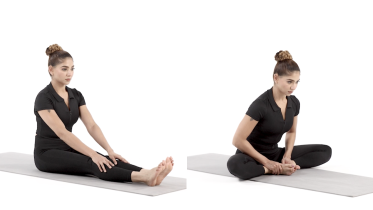
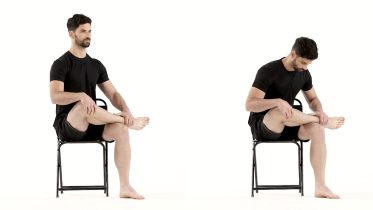
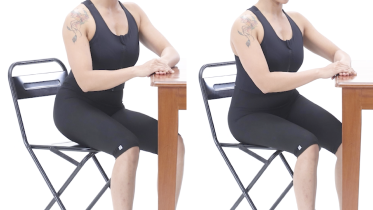
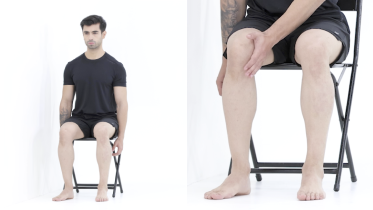
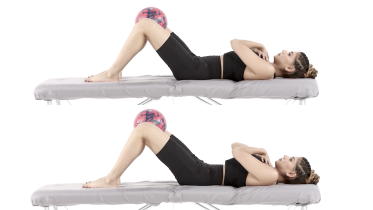
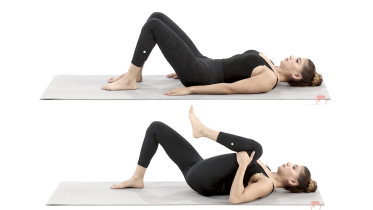
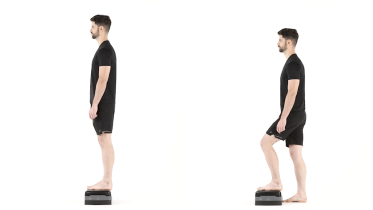
Seated isometric hip internal rotation
Seated isometric hip internal rotation works the muscles that turn your thigh inward, without the hip moving. You sit side-on to a wall with your knee bent and press the outer edge of your foot into the wall, holding the push for a few seconds. The joint stays still, so it is one way to start working this direction when turning the hip through that range hurts.
How to do the seated isometric hip internal rotation
- Place a sturdy chair side-on to a wall, close enough that the outer edge of one foot can touch it. Sit tall with both feet flat and your knees bent to about a right angle.
- Put a rolled towel between the outer edge of your foot and the wall for comfort, as in the video. Rest your hands on your knees.
- Keeping the knee where it is, press the outer edge of the foot into the wall. Nothing should move: the effort tries to turn the thigh inward, and the wall stops it.
- Keep the pressure on and breathe steadily through the hold, then let it go slowly.
- Rest for a few seconds and repeat. To work the other leg, turn the chair to face the other way.
What you should feel
A firm tightening at the side and front of the hip on the pressing leg. Some people feel the outer thigh working too.
Common mistakes
- Letting the knee swing inward as you push, which turns the hold into a movement. A hand on the knee tells you if it shifts.
- Rolling the ankle or turning the foot to press, instead of pushing the whole lower leg out from the hip.
- Holding your breath while you push against the wall.
- Leaning your body away from the wall to push harder.
How often
Many programs use 5 to 10 presses of 5 to 10 seconds each, once or twice a day, starting at about half effort. Your physio will adjust this.
Stop and check with your physio if
- Sharp or pinching pain deep in the hip or in the groin.
- Pain in the knee during the press.
- Tingling, numbness or pain running into the leg or foot.
From the clinic
If you have high blood pressure, breathe steadily through every hold and never hold your breath. Counting slowly out loud during each press helps with that.
With the knee bent, the foot and the hip turn opposite ways, which surprises many people. Pushing the foot out works the muscles that roll the thigh in. The chair has to stay put while you push sideways, so use one without wheels on a floor that does not slip. Once the holds feel easy, prone hip rotation moves the hip through the same turning range, and seated isometric hip adduction is a similar hold for the inner thigh.
If you have had a hip replacement, get the go-ahead from your surgeon or physio before you try seated isometric hip internal rotation. Pressing the foot outward is an effort to turn the thigh inward, and many surgeons ask you to avoid that for the first months after some operations. After a replacement done from the back of the hip (posterior approach), turning the leg inward with the hip bent is one of the usual early limits, so leave this exercise out until your surgeon says it is safe. Sitting on a low chair also bends the hip past a right angle, so ask your physio how high your seat should be. The push passes through the bent knee, so after a knee injury or knee surgery, check with your physio first.
Written and checked by the PocketPhysio editorial team. Last updated 2026-09-26.
This page is general education, not a diagnosis or a personal treatment plan. If you have pain, an injury or a health condition, see a physiotherapist or doctor before starting new exercises.