
Hip dysplasia in adults: exercise, surgery and what to expect
Warning signs, and when to get help
What is hip dysplasia in adults?
Hip dysplasia in adults means the socket does not cover enough of the ball at the top of the thighbone. The joint is not out of place, and nothing is broken. The socket is simply shallower than it should be, so the load that a whole dome of bone is meant to share lands on a smaller area at the rim, along with the ring of tough cartilage that lines that rim (the labrum).
That explains most of what people with a dysplastic hip describe: groin pain that builds through a long day on your feet, clicking or catching, and a hip that feels unreliable rather than simply sore. Quite a few people describe a hip that feels about to give way under them. The NHS page on developmental dysplasia of the hip lists hip pain, groin pain and a clicking, snapping or popping feeling in the joint for adults, and says that in older children and adults the diagnosis is made with X-rays.
Two facts have to sit next to each other here, and both are true. Exercise will not change the shape of your socket. It still matters, because the muscles have to supply steadiness the bone is not supplying. Everything below comes from holding both of those at once instead of picking the comfortable one.
Being told it was a groin strain for years
Plenty of people reach a diagnosis of dysplasia after a long run of other explanations: a groin strain that never settled, a tight hip flexor, clicky hips you were told to ignore. That is not carelessness by any one clinician. The Zurich consensus on hip-related pain says in as many words that clinical examination and imaging have limited diagnostic value on their own, and that competing causes such as the lumbar spine have to be excluded first (Reiman and colleagues, 2020). A shallow socket also hurts long after it forms, so the pain arrives in your twenties or thirties with no injury to point at.
If that was your experience, there is one practical thing to take from it. Ask what your X-ray measurements were, and ask whether anyone has looked at the shape of the socket as well as the soft tissue. The answer changes which treatments belong on the table.
How is hip dysplasia in adults diagnosed?
Plain X-rays, read alongside an examination, are the starting point. The Zurich consensus recommends an anteroposterior view of the pelvis and a lateral view of the head and neck of the thighbone first, keeping MRI and CT for when more detail would change the plan, such as confirming a diagnosis or planning an operation (Reiman and colleagues, 2020). It also places acetabular dysplasia and hip instability as one of the three main causes of hip-related pain in young and middle-aged active adults, alongside hip impingement and the labral and cartilage problems that come without a distinct bone shape.
Cover is usually described with a measurement called the lateral center edge angle. The dysplasia consensus takes an angle below 20 degrees as dysplastic and 20 to 25 degrees as borderline, and in the same breath calls that single number an oversimplification of the diagnosis, useful mainly for deciding when a physical therapist (physiotherapist) should refer on (Disantis and colleagues, 2023). So the angle is a signpost, not a verdict. Two hips with the same angle can behave completely differently depending on how the socket is turned, how the thighbone is shaped and how much control the muscles have.
Hip dysplasia and early hip osteoarthritis
A shallow socket raises the risk of the joint wearing, and that link has been measured, not assumed. In the Rotterdam study, 835 people aged 55 and over whose hips were normal or near normal at the start were X-rayed again after an average of 6.6 years. Those with a center edge angle below 25 degrees had about 4.3 times the risk of developing hip osteoarthritis on the X-ray (Reijman and colleagues, 2005).
Read that for what it is. The population was older adults, the outcome was a change on imaging rather than an operation, and a risk multiplier across a group says nothing certain about one person. It is still the main reason a shallow socket in a young adult is taken seriously instead of watched, and the reason surgeons talk about correcting the shape before the cartilage is worn, not after. If an X-ray has already shown established wear, the hip osteoarthritis program is a better fit than this page.
What exercise can and cannot do
Nothing in the program below will deepen your socket. What it can do is improve how well the muscles control a joint that is structurally unstable, which is exactly how the dysplasia consensus describes the goal of non-operative care: re-establishing strength and functional control to improve dynamic stability (Disantis and colleagues, 2023). People get stronger, stand and walk for longer and hurt less, with nothing changed on the X-ray at all.
That consensus is a panel of 15 physiotherapists in North America, each treating at least 20 patients with dysplasia a year, who reached agreement on all 16 questions put to them. The authors are open about what it is: expert opinion, with no patient outcome data behind it, in a field they describe as having a paucity of research. So the shape of the program below is well agreed by people who do this work, and the proof that it works is thinner than anyone would like. Where the evidence is thin, this page says so and does not dress it up.
Three of the panel's positions change what a program looks like, and each one catches people out. Stretching is not a focus, because this is an instability problem and the muscles at the front and inside of the hip that feel tight are contributing to stability at the front of the joint. Note where the panel puts that caution: it is about the early stages, and once the muscles at the back and side of the hip have built up, stretching can be added as you tolerate it, with strength and control still carrying most of the work. Strengthening the hip flexors waits until the muscles at the back and side of the hip have improved, and starts with the knee bent rather than with a long straight leg. And progress from both legs to one leg is judged on control, not on the calendar: the double leg version has to happen without the trunk or pelvis giving way first.
The panel asks for one more thing alongside the strength work, and it is the part people drop when the hip hurts. Keep your general fitness going with exercise that does not provoke the hip: cycling, a cross trainer and swimming are the three it names, with a pull buoy if kicking bothers the hip, and running and jumping left until strength and control have improved and the hip has quietened down (Disantis and colleagues, 2023).
How to use this program
First, check this is your page. The stages below are written for a hip that has not been operated on. If you have had an operation on this hip, a periacetabular osteotomy or keyhole surgery, follow the plan your surgeon and physio gave you, because nothing here can set your weight bearing or your movement limits.
A few readers belong somewhere else. If an X-ray has shown established wear, use the hip osteoarthritis program. If you have been told the main problem is the hip pinching at the front and not the socket being shallow, the hip impingement program and the hip labral tear program go into that in more detail. A child or teenager with hip, thigh or knee pain, or a limp, needs to see a doctor first.
The surgery rule above has one exception, for anyone whose operation is years behind them and not weeks. If you have been signed off with nothing left to observe, no weight bearing limit, no movement limit and clearance for normal exercise, then stage 1 is a reasonable place to begin. Begin there even if you feel ready for more: a hip that has been comfortable for a year is still a hip that needed an operation, and the muscles around it are usually weaker than they feel. If you are not certain every restriction has been lifted, or you cannot remember what you were told, ring the team and ask before you start. Do not take the answer off this page.
Then start at stage 1 unless a physio has placed you higher. Move up when the current stage is easy and your hip is no worse the day after. Each stage above gives its own dose, and those numbers are the ones that govern: where an exercise page's starting dose is different from the stage you are working in, use the stage. That matters more than it sounds, because stacking one page's sets on top of another's is how a careful week turns into several times the work you intended.
Some discomfort while you exercise is usually fine, as long as it eases soon afterward and your hip feels no worse the day after. A pinch or catch at the front of the hip means the movement went too deep or turned too far, so make it smaller and do not push on. If the groin is clearly more sore the next morning, drop back a stage for a few days instead of stopping altogether.
A note on the precautions printed under each exercise. Of the 18 exercises here, 17 carry a line about hip surgery, and every one of those lines covers hip surgery in general and not a replacement alone, so if you have had a periacetabular osteotomy or keyhole surgery on the hip the line is written for you as well. The operations differ and so do the limits, and the answer still has to come from your own surgeon, not from a web page. The one exercise without a hip surgery line is the deep stomach muscle hold, where the hip neither moves nor takes weight; it carries a line about recent spine surgery instead.
If you have high blood pressure, breathe steadily through every hold and repetition and never hold your breath. Check with your doctor before you start if you have a heart or lung condition, or blood pressure that is not under control. If you have fallen in the past year or feel unsteady, do the standing exercises next to a kitchen counter.
Getting down to the floor and back up again is a transfer of its own, and on a hip that catches or gives way it is the part of a session most likely to drop you. Everything in stage 1 can be done on a firm bed instead. The two exercises on hands and knees in stage 2 cannot, because a mattress gives way under your hands and knees, so if you cannot get down to the floor safely, leave those two out and ask a physio for another way to work the same thing, and do not improvise one. When you do use the floor, get down and up beside something solid you can hold, take the weight through your arms and your better leg, and if you live alone, keep a phone where you could reach it from the floor.
If you are pregnant, check with your midwife or physio before you start. If you are pregnant and past the first three months, check with your physio before exercising flat on your back, which covers three of the five stage 1 exercises, the supine marching in stage 2 and the single leg bridge in stage 3. If you have recently given birth, including by cesarean section, or you have a gap down the middle of your stomach muscles (diastasis recti), ask your physio, midwife or doctor first. The deep stomach muscle hold in stage 1, the two exercises on hands and knees in stage 2 and the side plank in stage 3 all ask the stomach wall and the pelvic floor to work, and a cesarean scar is a healing surgical wound.
Three of these exercises put your body weight through your arms: bird dog and the leg lift on hands and knees in stage 2, and the kneeling side plank in stage 3. After recent heart or chest surgery, get your surgeon's or surgical team's okay before all three, because the weight travels through one or both hands and shears across the healing breastbone. If the breastbone clicks, grinds, shifts or feels as if it is moving while you do it, stop, and contact your surgical team the same day. After a broken wrist, hand or forearm, or surgery on any of them, start those three only when your doctor, surgeon, physio or hand therapist says the bone or the repair is ready to take weight through the arms. The kneeling side plank balances on one hand, so if your shoulder is painful, or you have had shoulder surgery or a dislocated shoulder, check with your physio before you put your weight through that arm.
Read the warning signs at the end of this page before you start, not after something happens. If you have had an operation on this hip, the lines that begin "since your operation" or that name an operation are the ones written for you, and they are more urgent than the general ones that follow.
The exercise program
The exercises below carry their own stop signs and precautions. Open the line under an exercise and read them before you try it.
Stage 1: Settle the hip and build the muscles that steady it
This is the place to start if you are not sure, and the stage to drop back to in a flare. Everything here is done lying down, so the hip is not carrying your body weight, and nothing is taken to the end of its range. The dysplasia consensus starts local, with work for the buttock muscles, the deep rotators and the deep abdominal muscles, before anything weight bearing (Disantis and colleagues, 2023). Nothing here takes the hip backward behind the line of your body, and nothing takes it backward and turns it outward at the same time, which is the combination that tends to feel unsafe in a shallow socket, so the buttock work starts as a press you hold, not a leg lift. The same thinking applies to the side leg lift: keep the top leg level with your body and do not let it drift behind you, and point the kneecap and toes forward instead of turning them up toward the ceiling, which also keeps the hip flexors out of a lift meant for the side of the hip. Dose for this stage: holds of 5 to 10 seconds, 5 to 10 times on each side, once or twice a day, and 2 to 3 sets of 8 to 12 for the lifts, once a day rather than twice. Stop short of any pinch or catch at the front of the hip, and keep the leg lifts small, because height is not what you are after here. If the front of the hip is already sore, the side leg lift and the clamshell are the two to make smaller or leave out until it settles, because both can switch on the hip flexors alongside the buttock.
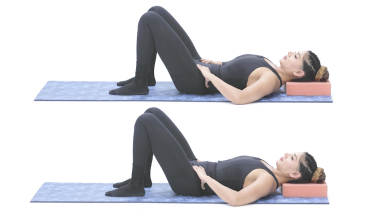 Transverse abdominis activation
Stop signs and precautions for the transverse abdominis activation
Before you start
- If you have had surgery on your spine in recent months, get the go-ahead from your surgical team or physio first.
When to stop and get help
- Your back pain increases during or after the exercise.
- Pain spreads down your leg, or you get numbness or tingling.
- You feel pressure or bulging in your stomach wall or pelvic floor. Tell your physio about this.
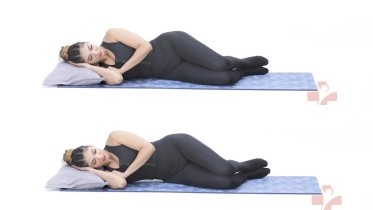 Isometric clamshell
Stop signs and precautions for the isometric clamshell
Before you start
- If you have had a hip replacement or other hip surgery, get the go-ahead from your surgeon or physio before you try the isometric clamshell. Some operations limit this kind of work for the first months, so the timing depends on your surgery. Lying on your side and turning the leg outward are both limited after some operations, and your surgical team will tell you which side you can lie on and whether you need a pillow between your knees.
When to stop and get help
- Sharp or pinching pain in the hip, groin or buttock.
- Pain, numbness or tingling that travels down your leg.
- The outside of your hip aches more with each hold, or feels sorer the next day.
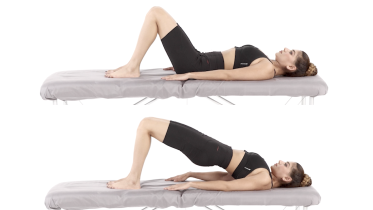 Glute bridge
Stop signs and precautions for the glute bridge
Before you start
- After hip, knee or back surgery, your surgeon's protocol decides when you can start bridges. Once you are past the first three months of pregnancy, check with your physio before exercising flat on your back.
When to stop and get help
- You feel back pain rather than buttock work, even when you lift a little lower.
- Pain spreads down the leg or you get numbness or tingling.
- Your hamstrings (the back of the thighs) cramp. This is a common complaint with bridges, and bringing your feet a little closer to your bottom often eases it.
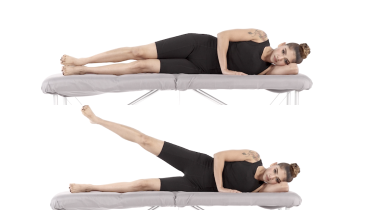 Side lying hip abduction
Stop signs and precautions for the side lying hip abduction
Before you start
- If you have had a hip replacement or other hip surgery, get the go-ahead from your surgeon or physio before you try side-lying hip abduction. Some operations limit this kind of work for the first months, so the timing depends on your surgery. With some surgical approaches, side leg lifts wait until the tissues at the side of the hip have healed.
When to stop and get help
- You feel sharp pain in the side of the hip, the groin or the lower back.
- Pain spreads down the leg or you get numbness or tingling.
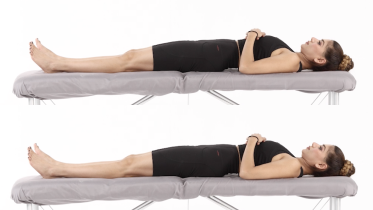 Isometric hip extension
Stop signs and precautions for the isometric hip extension
Before you start
- If you have had a hip replacement or other hip surgery, get the go-ahead from your surgeon or physio before you try isometric hip extension. Pulling the thigh closer to your chest than upright bends the hip past a right angle, and many surgeons ask you to avoid that for the first months after some operations.
- If you have high blood pressure, breathe steadily through every hold and never hold your breath.
- If you are pregnant and past the first three months, check with your physio before exercising flat on your back.
When to stop and get help
- Sharp pain in the buttock, hip or groin while you press.
- Pain, numbness or tingling spreads down your leg.
- Your calf or thigh becomes swollen, warm, tender, red or darker than usual, or has a throbbing or cramping pain that feels different from normal muscle ache. Stop and get medical advice the same day, as this can be a blood clot. If you are also short of breath or have chest pain, call emergency services.
Stage 2: Trunk and pelvis control, then both legs loaded
Start this when stage 1 is easy and your hip is no worse the day after, which often takes a few weeks. The consensus works up from lying and four-point positions to standing on both legs, and holds single leg work back until the double leg version happens without the trunk or pelvis giving way (Disantis and colleagues, 2023). Dose for this stage: 2 to 3 sets of 8 to 12 for the lying and side lying work, daily, and 2 or 3 days a week for the standing work. Three of these are counted lower on purpose, so use their own figures and not the stage range above. Bird dog and the leg lift on hands and knees are control exercises, so 1 to 2 sets of 6 to 10 on each side, holding the bird dog reach for a few seconds, and end a set when the form goes rather than when the number is reached. Sit to stand starts at 2 to 3 sets of 5 to 10, since every repeat lifts your whole body weight through the hip. Begin it from a higher chair and keep the mini squat shallow at first. The clamshell turns the thigh outward, so open the knee only as far as stays comfortable, and make it smaller if the front of the hip catches. Supine marching is the one that lifts the thigh using the muscles at the front of the hip, so leave it out while the front of the hip or the groin is still irritable and come back to it later: the consensus holds hip flexor work until the back and side of the hip have improved and the joint has settled, and says to stop that work if it increases pain (Disantis and colleagues, 2023).
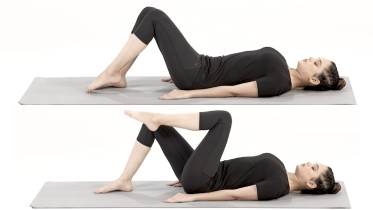 Supine marching
Stop signs and precautions for the supine marching
Before you start
- If you have had a hip replacement or other hip surgery, get the go-ahead from your surgeon or physio before you try supine marching. Some operations limit this kind of work for the first months, so the timing depends on your surgery. If you are pregnant, check with your midwife or physio first.
- From the second trimester on, the obstetric guideline for Australia and New Zealand (RANZCOG) advises against long spells of exercise lying flat on your back, because the weight of the growing uterus can obstruct the blood returning to your heart. The NHS puts the limit at a few minutes flat on your back in later pregnancy, because it can make you dizzy and is not good for the baby.
When to stop and get help
- The lower back starts to ache and gets worse lift by lift.
- A sharp pinch in the front of your hip or groin.
- Pain, pins and needles or numbness spreading into a leg.
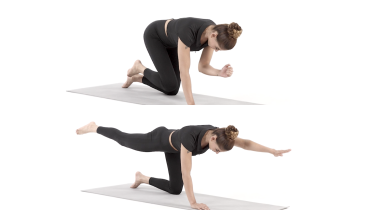 Bird dog
Stop signs and precautions for the bird dog
Before you start
- If you have had a hip replacement or other hip surgery, get the go-ahead from your surgeon or physio before you try bird dog. Lifting the leg takes the hip back behind the line of your body and drawing the knee in toward your elbow bends it well past a right angle, and many surgeons ask you to avoid that for the first months after some operations. After a hip or knee replacement, kneeling may not be comfortable yet either.
- After back surgery, keep to it until your surgeon and physio say bending the spine is fine.
- After a broken wrist, hand or forearm, or surgery on any of them such as a tendon repair, start only when your doctor, surgeon, physio or hand therapist says the bone or repair is ready to take weight through the arms, and follow their plan for how much to do.
- After recent heart or chest surgery, get your surgeon's or surgical team's okay first, because with one arm lifted, your whole upper body weight goes through the other hand, which shears across the healing breastbone. If the breastbone clicks, grinds, shifts or feels as if it is moving while you do it, stop, and contact your surgical team the same day.
When to stop and get help
- Your back hurts more during or after the exercise and it does not settle.
- You get pain running down your leg, or numbness or tingling.
- Your knees or wrists hurt from taking your weight. Ask your physio about padding under you or another position.
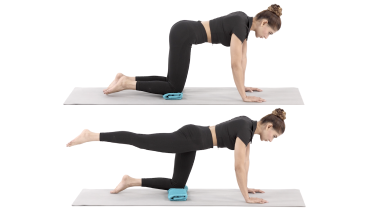 Quadruped hip extension
Stop signs and precautions for the quadruped hip extension
Before you start
- If you have had a hip replacement or other hip surgery, get the go-ahead from your surgeon or physio before you try quadruped hip extension. Lifting the leg takes the hip back behind the line of your body, and many surgeons ask you to avoid that for the first months after some operations. After a hip or knee replacement, kneeling may not be comfortable yet either.
- After recent heart or chest surgery, get your surgeon's or surgical team's okay first, because being up on your hands and knees holds your upper body weight through your arms and across the healing breastbone. If the breastbone clicks, grinds, shifts or feels as if it is moving while you do it, stop, and contact your surgical team the same day.
When to stop and get help
- Your lower back hurts more during or after the exercise.
- Pain runs down your leg, or you get numbness or tingling.
- Your knees or wrists hurt from taking your weight.
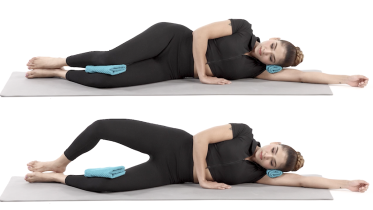 Clamshell
Stop signs and precautions for the clamshell
Before you start
- If you have had a hip replacement or other hip surgery, get the go-ahead from your surgeon or physio before you try clamshells. Opening the knee turns the thigh outward, and many surgeons ask you to avoid that for the first months after some operations. Lying on your side may also be limited in that time.
When to stop and get help
- You feel sharp or pinching pain in the hip or groin.
- Pain spreads into the leg, or you notice numbness or tingling.
- Pain on the outside of your hip builds during the set or is worse the next morning.
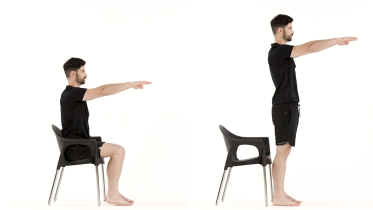 Sit to stand
Stop signs and precautions for the sit to stand
Before you start
- If you have had a hip replacement or other hip surgery, get the go-ahead from your surgeon or physio before you try sit to stand. Standing up from a low seat bends the hip past a right angle, and many surgeons ask you to avoid that for the first months after some operations. Ask them how high your seat should be. If you are pregnant, check with your midwife or physio before you start.
- Set up before the first stand: use a chair that will not slide, ideally with its back against a wall, and have someone nearby, or set the chair beside a kitchen counter you can reach, if you are not sure of your balance or you have fallen in the past year. Wear flat shoes that fit well and grip the floor, not socks, tights or bare feet.
When to stop and get help
- You feel dizzy, lightheaded or faint as you get up. Sit back down and wait for it to pass. If it does not pass within a minute or two, or it keeps happening, get medical advice the same day before you practice again. If you faint, or it does not settle within a few minutes of keeping still, call emergency services.
- Sharp pain in the knee, hip or lower back.
- Your knee gives way or you feel you might fall.
- Chest pain or pressure, dizziness or feeling faint, a racing or irregular heartbeat, or being far more out of breath than the effort should cause.
- You are pregnant and notice bleeding or fluid leaking from your vagina, regular painful tightenings, tummy pain that does not settle when you rest or comes with lower back pain, or a change in your baby's usual movements, such as moving less than usual. Stop and contact your midwife or maternity unit straight away. Do the same for a severe headache, problems with your vision such as blurring or flashing lights, pain just below your ribs, or sudden swelling of your face, hands or feet, which can be signs of pre-eclampsia. Call emergency services if the bleeding is heavy, the tummy pain is severe, bleeding or tummy pain comes with pain in your shoulder or feeling sick, faint or dizzy, or a headache comes on suddenly and is very severe.
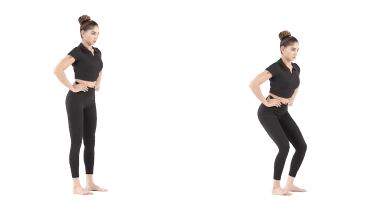 Mini squat
Stop signs and precautions for the mini squat
Before you start
- If you have had a hip replacement or other hip surgery, get the go-ahead from your surgeon or physio before you try mini squats. Some operations limit this kind of work for the first months, so the timing depends on your surgery.
When to stop and get help
- Knee pain is sharp or keeps getting worse through the set.
- The knee swells, gives way or feels unstable afterwards.
- You feel dizzy, lightheaded, faint or sick, or the room seems to spin. Hold your support, sit down and get medical advice the same day before you practice again. If you faint, it does not settle within a few minutes of sitting still, your vision suddenly blurs or goes double, or you cannot stand or walk steadily, call emergency services.
- You feel unsteady enough that you might fall. Hold on to something firm and sit down.
- Your calf or thigh is getting more swollen, or becomes warm, tender, red or darker than usual, or has a new throbbing or cramping pain. This can be a blood clot, especially after an operation, an injury, time in a cast, boot or brace, or a spell of being much less mobile than usual, and after an operation it can also be an infection. Stop and contact your medical team or get medical advice the same day. If you are also short of breath or have chest pain, call emergency services.
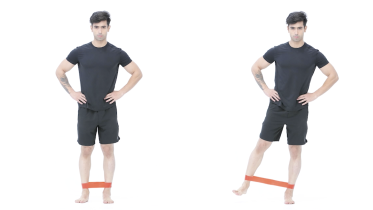 Standing hip abduction with band
Stop signs and precautions for the standing hip abduction with band
Before you start
- If you have had a hip replacement or other hip surgery, get the go-ahead from your surgeon or physio before you try this exercise. Some operations limit this kind of work for the first months, so the timing depends on your surgery. With some surgical approaches, resisted side leg lifts wait until the tissues at the side of the hip have healed.
When to stop and get help
- Sharp pain in the hip, groin or lower back.
- You feel unsteady or close to falling. Hold on to a support or stop.
- Pain spreads down the leg or you get numbness or tingling.
- You feel dizzy, lightheaded, faint or sick, or the room seems to spin. Hold your support, sit down and get medical advice the same day before you practice again. If you faint, it does not settle within a few minutes of sitting still, your vision suddenly blurs or goes double, or you cannot stand or walk steadily, call emergency services.
Stage 3: One leg at a time
Move up when stage 2 is comfortable, the hip settles quickly afterward, and you can stand on one leg without the pelvis dropping on the free side. Everything here loads one leg, which is what stairs, walking any distance and running actually ask of the hip. Dose for this stage: 2 to 3 sets of 6 to 12 on each side for the strength work, 2 or 3 days a week. Two of these are not counted in sets of repeats at all, and the numbers above do not apply to them. The kneeling side plank is 3 to 5 holds of 10 to 30 seconds on each side, which is a couple of minutes of work and not sets of twelve holds. Standing on one leg is 5 to 10 holds on each leg, a few seconds each to begin with, and a set ends the moment you have to grab the counter rather than when you reach the number. Keep a kitchen counter within reach for the balance and step work, and lower the step instead of pushing through a session that leaves the hip aching for a day. Running and jumping come after this stage, on a plan you build with your physio. The consensus asks for strength back to normal before running starts, along with symptoms that have settled, a normal walking pattern at faster walking speeds and good control of the pelvis on one leg, and then for that strength and control to hold up through running and agility work before full sport (Disantis and colleagues, 2023). If you cannot get to a physio at all, be honest about which of those you can check: strength back to normal is the one nobody can judge from the inside, so the safer default is to stay with stage 3 and build walking instead, first further and then faster, which is one of the consensus criteria in its own right. That is not a consolation prize, and it is a better outcome than a flare that costs you two months.
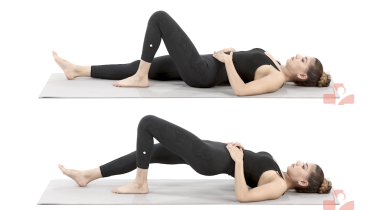 Single leg bridge
Stop signs and precautions for the single leg bridge
Before you start
- After hip, knee or back surgery, single leg work starts when your surgeon's protocol allows it.
- Past the first trimester of pregnancy, ask your physio before doing exercises lying flat on your back.
When to stop and get help
- Sharp pain in the lower back, hip or knee, rather than the feeling of muscles working.
- Pain travels down the leg, or the leg goes numb or tingly.
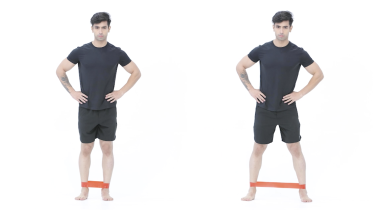 Lateral band walk
Stop signs and precautions for the lateral band walk
Before you start
- If you have had a hip replacement or other hip surgery, get the go-ahead from your surgeon or physio before you try lateral band walks. Some operations limit this kind of work for the first months, so the timing depends on your surgery. Some surgical approaches hold back resisted side leg movements, so check before you add a band.
When to stop and get help
- Sharp pain in the hip, groin, knee or lower back.
- Pain spreads down the leg, or you get numbness or tingling.
- You feel unsteady or close to tripping over the band.
- You feel dizzy, lightheaded, faint or sick, or the room seems to spin. Stop, sit down and get medical advice the same day before you exercise again. If you faint, it does not settle within a few minutes of sitting still, your vision suddenly blurs or goes double, or you cannot stand or walk steadily, call emergency services.
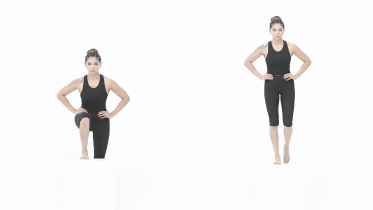 Step up
Stop signs and precautions for the step up
Before you start
- If you have had a hip or knee replacement, or other hip surgery, get the go-ahead from your surgeon or physio before you try step ups. Some operations limit this kind of work for the first months, so the timing depends on your surgery. Your surgeon or physio will also tell you what step height is right for you.
When to stop and get help
- You feel sharp pain in the knee or the knee gives way.
- Pain at the front of the knee builds with each rep.
- You feel dizzy, lightheaded, faint or sick, or the room seems to spin. Hold your support, sit down and get medical advice the same day before you practice again. If you faint, it does not settle within a few minutes of sitting still, your vision suddenly blurs or goes double, or you cannot stand or walk steadily, call emergency services.
- You feel unsteady enough that you might fall. Stop and sit down.
- Chest pain or pressure, dizziness or feeling faint, a racing or irregular heartbeat, or being far more out of breath than the effort should cause.
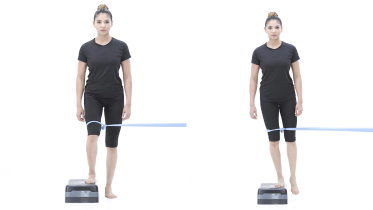 Lateral step-down with band
Stop signs and precautions for the lateral step-down with band
Before you start
- If you have had a hip replacement or other hip surgery, get the go-ahead from your surgeon or physio before you try lateral step-downs. Some operations limit this kind of work for the first months, so the timing depends on your surgery. After knee surgery, wait until your surgeon and physio clear you for single leg step work.
When to stop and get help
- Sharp pain in the knee, or the knee buckles or gives way.
- Pain at the front of the knee that grows rep after rep.
- You feel unsteady enough to fall. Hold the wall or rail and step off.
- You feel dizzy, lightheaded, faint or sick, or the room seems to spin. Hold your support, sit down and get medical advice the same day before you practice again. If you faint, it does not settle within a few minutes of sitting still, your vision suddenly blurs or goes double, or you cannot stand or walk steadily, call emergency services.
- Chest pain or pressure, dizziness or feeling faint, a racing or irregular heartbeat, or being far more out of breath than the effort should cause.
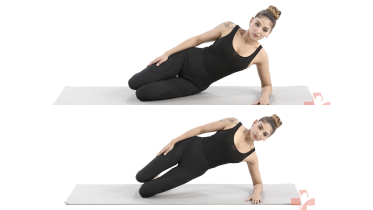 Kneeling side plank
Stop signs and precautions for the kneeling side plank
Before you start
- Holding your hips up also works the muscles at the side of the bottom hip, much like a side leg lift. If you have had a hip replacement or other hip surgery, get the go-ahead from your surgeon or physio before you try the kneeling side plank. Some operations limit this kind of work for the first months, so the timing depends on your surgery.
- If your shoulder is painful, or you have had shoulder surgery or a dislocation, check with your physio before putting your weight through that arm. After a wrist fracture or wrist surgery, stay on the forearm version until your physio says the hand can take your weight.
- After recent heart or chest surgery, get your surgeon's or surgical team's okay first, because even on your knees, the side plank balances on one hand, so that weight goes through one arm and shears across the healing breastbone. If the breastbone clicks, grinds, shifts or feels as if it is moving while you do it, stop, and contact your surgical team the same day.
When to stop and get help
- Pain in the shoulder, elbow or wrist you are leaning on.
- Sharp pain in the lower back or the side of the hip.
- Pain or tingling spreads down the arm.
- Pins and needles in your arm or hand that do not go away after you stop, or part of your arm or hand goes numb. Get medical advice the same day. If one side of your face or body suddenly goes numb or weak, or your speech becomes slurred or muddled, call emergency services, even if it goes away.
- Chest pain or pressure, dizziness or feeling faint, a racing or irregular heartbeat, or being far more out of breath than the effort should cause.
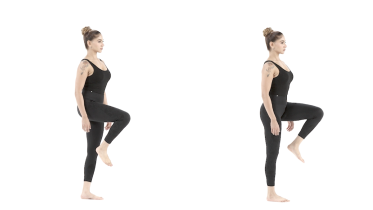 Single leg stance
Stop signs and precautions for the single leg stance
Before you start
- If you have had a hip or knee replacement, or other hip surgery, get the go-ahead from your surgeon or physio before you try single leg stance. Standing on the operated leg alone comes at a set stage of rehab, and some hip operations limit how high the knee can lift in the first months after surgery.
When to stop and get help
- You feel dizzy, lightheaded, faint or sick, or the room seems to spin. Hold your support, sit down and get medical advice the same day before you practice again. If you faint, it does not settle within a few minutes of sitting still, your vision suddenly blurs or goes double, or you cannot stand or walk steadily, call emergency services.
- You lose your balance and cannot steady yourself with your support.
- Sharp pain in the hip, knee or ankle of the standing leg.
Periacetabular osteotomy: what the operation does
When the socket itself needs correcting in a younger adult whose joint is not yet worn out, the operation usually discussed is a periacetabular osteotomy, often shortened to PAO and sometimes called the Ganz or Bernese osteotomy. The surgeon makes a series of cuts in the pelvis around the socket, frees it, turns it so that it covers more of the ball, and holds it there with metalwork while the bone joins. The Bernese description sets out a shortened ilioinguinal approach with four osteotomies and one controlled fracture, keeps the back column of the pelvis intact to aid stability and rehabilitation, leaves the birth canal unchanged, and allows the shape of the head and neck of the thighbone to be corrected at the same time (Lerch and colleagues, 2016).
Two things follow from that description, and the whole recovery turns on them. The correction is held by metalwork, not by healed bone, for the first weeks. And the pelvis has been cut in several places, so the bone around those cuts has to unite before it can take your full weight safely.
Long-term results depend heavily on the hip and on the correction. The review of the Bernese technique reports that where the socket was reoriented well and the ball of the hip was still round, 80 to 90% of hips had survived at 10 years. In the very first 75 patients operated on with the technique, 60% had survived at 20 years, and a preliminary look at that same group at 30 years put it near 30% (Lerch and colleagues, 2016). Those last two figures come from one unit's earliest cases followed for three decades, so they are not a prediction for a hip operated on today. Survivorship in a series like that counts the hips that had not yet needed a replacement or declined past a set mark, which is a different question from how any one of them felt.
After a periacetabular osteotomy: weight bearing, movement limits and crutches
Your weight bearing, your crutch time and your movement limits come from your surgeon, and nothing on this page replaces them, whatever numbers you read below. The reason is not caution for its own sake. A systematic review of 63 studies found partial weight bearing was the commonest instruction after this operation, most often for six weeks and next most often for eight, described with at least six different terms across the literature, and concluded that these protocols show substantial variability and imprecise terminology and are not standardized (Leopold and colleagues, 2025). So a figure taken from a protocol is one unit's choice, and yours may be different for good reasons.
The published consensus is still worth reading, because it shows you the usual shape of a recovery, which is a different thing from your own instructions. A panel of 16 physiotherapists in the United States and Canada agreed on limiting weight bearing to 25% foot-flat for 6 to 8 weeks, on limiting hip bending to 90 degrees and turning the leg outward to 20 degrees at that depth for the first 4 to 6 weeks, on full movement being expected by 12 to 16 weeks, on end-range stretching starting somewhere between 8 and 12 weeks, and on holding long-lever hip flexion work back for 8 to 12 weeks (Disantis and colleagues, 2022).
Long lever is worth putting in plain words, because it is a restriction you cannot keep to if you cannot tell what it means: it is lifting the whole leg with the knee held straight, lying down or standing, as against lifting the knee with the leg bent. The same paper states that no studies currently exist supporting specific weight bearing and movement precautions, and that these are expert opinion.
Those figures also describe a PAO on its own. The panel noted that another procedure done at the same sitting, keyhole surgery inside the joint or a microfracture, can lengthen both the weight bearing and the movement limits, and can add limits on taking the hip backward or turning it inward that an isolated osteotomy does not carry.
Read all of that as a description and not as dates you are cleared to act on. None of those numbers is a release. If your own plan is stricter or runs longer, it is the plan written for your pelvis; if it is shorter, that is your surgeon's judgment on bone that has been seen on your own X-rays and in your own operation. The one thing not to do with a borrowed figure is use it to do more than you have been cleared for, because the bone around those cuts is exactly where a fracture after this operation happens. That applies to the movement limits as much as to the weight bearing: if you were told to keep the hip bending below 90 degrees, or to turn the leg out less than 20, or to hold either of those limits for longer than six weeks, yours is the figure that governs and nothing here is permission to go past it.
Two of the numbers invite being read as a start date, so take them the other way round. Eight weeks is the earliest point in the panel's range for end-range stretching, not a date you are cleared to stretch at: the cuts in the pelvis may still be joining then, and the stress fracture described below turns up at an average of nine weeks, so the word to begin stretching comes from your surgeon. And full movement by 12 to 16 weeks is what the panel expected to see, not a target to force. If your range is not back by then, tell your team and keep working at it, rather than pushing the hip into a range it will not yet give you. Coming off crutches, that panel agreed, is judged on X-rays showing the bone has healed and on how you walk, with your surgeon's clearance, and not on a date.
One detail runs against the instinct, and it is also the detail surgeons and physiotherapists genuinely disagree about. The physiotherapy panel says that toe-touch and non-weight-bearing walking should be avoided after this operation and that the foot should stay flat on the floor instead, to keep the hip flexor at the front of the joint quieter (Disantis and colleagues, 2022). Plenty of surgical protocols say the opposite: in the review of 63 studies, 7 prescribed toe-touch weight bearing, 3 tip-touch and 2 touch-down, against 2 that specified flat foot (Leopold and colleagues, 2025). So if your own team told you to keep the foot off the floor, or to touch the toe down only, that is your instruction and you keep to it, because it asks less of the healing bone than 25% does, not more. The figures above are there so you can tell whether your own plan is ordinary, never so you can take more weight than you were told to.
The reason to keep to whatever limit you were given, even when the hip feels fine, is what has been reported when it is not kept to. The same systematic review found that delayed weight bearing went with fewer pelvic fractures than immediate full weight bearing, citing a series in which fractures occurred in 8 of 76 hips allowed immediate full weight bearing against 1 of 80 with delayed full weight bearing, and it also records delayed union being more common with earlier partial weight bearing in another series (Leopold and colleagues, 2025). The evidence there is retrospective and limited, which the authors say themselves. It is enough to make an unnecessary-feeling restriction worth keeping.
That fracture is the part of this operation people are least often warned about, so it is worth knowing what it is. Once the socket has been cut free and turned, load does not travel through the pelvis the way it used to: the consensus panel describes more of it passing through the inferior pubic ramus, the ischium and the back column of the pelvis, which is the reason early weight bearing is restricted at all, and it puts the reported rate of post-operative stress fracture across the literature at 2 to 18.4% (Disantis and colleagues, 2022). The top of that range comes from a series of 348 patients under two high-volume surgeons, in which 64 (18.4%) developed a stress fracture of the inferior pubic ramus at a mean of 9.1 weeks after surgery, with a range from 5 to 55 weeks. Of those 64, 58 healed, and 40 (62.5%) also had the pubic cut fail to join, against 7% of the patients without a stress fracture. Being older and having a larger deformity before surgery both went with a higher chance of it (Malviya and colleagues, 2015).
Take that as a reason to report pain that is building, not as a reason to expect trouble. The practical point is the timing: a mean of 9 weeks is after the usual crutch period ends, so the fracture tends to turn up in the weeks when a reader has decided the risky part is behind her.
Clot prevention belongs in this section too, because it has a warning line of its own further down. What a team gives you after a pelvic osteotomy is not standardized, and the authors of a study that screened for it say so plainly: in 134 adults given aspirin, compression stockings and pneumatic compression, about 1% developed a clot in a leg vein with symptoms, none had symptoms of a clot in the lung, and the authors describe the best preventive measures as not established (Polkowski and colleagues, 2014). Whatever your own team gave you, tablets, injections or stockings, use it exactly as they said and do not stop it on your own. Bleeding more easily is the known trade-off of those medicines, so there is a line about it in the warning signs below.
Return to sport in that literature was reported in only a minority of studies, and where it was, the recommendation usually fell between six and twelve months, most often around six (Leopold and colleagues, 2025). A physio leading that progression is recommended by the Zurich consensus for rehabilitation after any hip surgery (Kemp and colleagues, 2020), and it is the stage where measurement beats guesswork.
One more thing people are rarely warned about. A numb, burning or tingling patch on the front or outer thigh after this operation is common, because the nerve that carries feeling to the skin there runs close to the approach. In a prospective series of 40 hips operated on through the front of the hip, half of them, 20 hips, had symptoms from that nerve at one year, and at three years or more 7 of those had fully settled while 13 still had some (Fujita and colleagues, 2024). That is one center's series, so treat it as a rough guide and not a rate.
In the same group, the people whose symptoms were still there at three years scored lower for satisfaction and for mental health than those whose had gone, which is a reason to mention a numb patch to the team and not quietly put up with it. The route for it is on the warning list on this page, at a few days rather than the same day, with the escalations that matter written into the line.
Where hip arthroscopy fits
Keyhole surgery on the hip is a different operation with a different job, and in a dysplastic hip it is the one that needs the most careful thought. The reason is mechanical. The labrum and the capsule are doing more stabilizing work in a shallow socket than they would in a deep one, so an operation that trims the labrum, releases the capsule or takes bone off the rim can leave the hip less stable than it was.
A published case describes exactly that: a patient with mild dysplasia and a labral tear who had a labral repair and partial division of the ligamentum teres, then developed subluxation and joint space narrowing within three months and end-stage arthritis inside a year, going on to a hip replacement (Mei-Dan and colleagues, 2012). One case is not a rate. It is a warning about a direction.
The picture for borderline dysplasia is better than that case suggests. A long-term cohort compared arthroscopy for impingement in 38 hips with borderline dysplasia against 96 matched hips without it and found no meaningful difference in outcome scores at a mean of 9.6 years, with low revision rates, and the authors put that down to preserving the labrum and closing the capsule carefully, and to sorting patients into an impingement group and an instability group before deciding (Selley and colleagues, 2023). The international physiotherapy agreement on rehabilitation after hip arthroscopy names borderline hip dysplasia as a structural factor that should be taken into account, without giving it a protocol of its own, and says plainly that its own guidance is expert opinion (Disantis and colleagues, 2026).
So the practical position is this. Arthroscopy has a place in a borderline hip in the right hands, with the labrum preserved and the capsule closed. In frank dysplasia, where the socket is clearly short of cover, keyhole surgery on its own is not the operation that addresses the problem, and this is stronger than a caution. That same long-term study opens by stating that outcomes after isolated hip arthroscopy in patients with dysplasia have been unfavorable, with iatrogenic instability and conversion to a hip replacement at a young age among the results, and it closes by saying that patients should be sorted into an impingement group or an instability group and treated with arthroscopy or a periacetabular osteotomy accordingly (Selley and colleagues, 2023).
Keyhole surgery done at the same sitting as an osteotomy is a different matter, because the shape of the socket is being corrected as well. If someone has offered you keyhole surgery on its own and your X-ray shows a clearly shallow socket, ask specifically how the instability is being dealt with, and ask whether a surgeon who does osteotomies has seen your X-rays. If you are already recovering from keyhole surgery, hip arthroscopy rehab covers that pathway.
Pregnancy and childbirth
This comes up constantly, mostly because so many people with dysplasia are young women, and the research on it is thin and reassuring in roughly equal measure. A systematic review of five studies found no documented pregnancy or delivery complications after a periacetabular osteotomy when each study was set against population averages, but higher rates of cesarean section, 43 of 115 women across the four studies that reported deliveries, which is 37% (Hutchinson and colleagues, 2024). It graded the certainty of all five studies as low and called the literature low in both quality and quantity. Its conclusion was that cesarean section is more likely after this operation without reliable evidence that it is necessary. Note what that comparison is and is not: none of those studies followed a matched group of women who had not had the operation, so the honest reading is that nothing has been detected, not that nothing is there.
The individual surveys say the same thing. In 31 women with 38 pregnancies after the operation, the cesarean rate was 53% against a national average of about 32%, 17 of the 31 said their obstetrician had voiced concern about their ability to carry to term or to deliver vaginally, and only one woman had a pregnancy complication (Bartosiak and colleagues, 2020). The authors suggest the higher rate may reflect obstetrician preference rather than anything about the pelvis. The Bernese technique is itself described as leaving the birth canal unchanged (Lerch and colleagues, 2016).
None of that is advice for your pregnancy, and nothing here should be read as a reason to argue with your maternity team. What it gives you is the state of the evidence to take into the conversation, which is best had between your obstetric team and your hip surgeon with your own imaging in front of them. If pain in the hip or pelvis arrives during pregnancy, that goes to your midwife or doctor, not into this program.
When to see a physio or doctor
See a GP or physio if hip pain is getting in the way of normal activities or sleep, if it is worsening or keeps returning, if the hip is stiff for more than 30 minutes after you wake up, or if two weeks of home care have not helped, which is the NHS guidance for hip pain in adults. Groin pain with clicking, catching or a hip that gives way is worth getting assessed, as several hip problems can cause it, and a hip that gives way is on the warning list below.
If you are working through a program like this one, the dysplasia consensus suggests referral to a hip specialist when symptoms have not reduced after 4 to 8 weeks of physiotherapy despite strength and neuromuscular control improving, with a minority of the panel preferring at least 12 weeks (Disantis and colleagues, 2023). Referral does not mean stopping the exercise: for hip-related pain generally, the Zurich consensus recommends exercise-based treatment for a minimum of 3 months, physio-led rehabilitation after hip surgery, staying physically active, and decisions made together with you after a proper discussion of what to expect (Kemp and colleagues, 2020). The dysplasia consensus also notes that some hips are too severely affected for a trial of non-operative care to be reasonable, because of the risk of arthritis arriving early, which is a surgeon's call and not a physio's (Disantis and colleagues, 2023).
Some symptoms need faster help than an appointment. The warning signs below say how fast, from calling emergency services to booking within 2 weeks.
For physiotherapists
The non-operative framework on this page follows Disantis and colleagues (2023), the North American Delphi on acetabular dysplasia: 15 physiotherapists, each managing at least 20 patients a year, consensus at more than 75% on all 16 questions, level V. Its evaluation set is reproduced in the body only in part, and the full set is worth having in clinic: supine and prone hip rotation with a prone internal and external rotation difference of about 20 degrees raising the question of femoral version; abductor, extensor, deep rotator and core strength by manual testing or handheld dynamometry, with plank and side plank screened against a 45 second hold; FADIR, FABER, log roll and apprehension testing, understood as screens for intra-articular pain and not as diagnostic; and single leg stance, squat and step-down with observation for a Trendelenburg sign.
The panel's positions that most often change a program are carried onto the page: stretching de-emphasized because this is an instability presentation, with the adductors and iliopsoas framed as anterior stabilizers, and the panel's own second half carried too, that stretching may be initiated as tolerated once posterolateral strength has been established, so the page reads as a staging point rather than a ban for life; hip flexor strengthening deferred until posterolateral strength has improved and irritability has settled, begun in short-lever positions, with long-lever work reserved for specific demands such as dance; progression local to global, isometric to concentric to eccentric, double to single leg on the criterion of no trunk or pelvic compensation; and increased anterior pelvic tilt noted as a potentially useful compensation in this population and not a fault to correct.
The panel gives no sets, repetitions or frequency, so the doses on this page are our own house ranges, declared as the governing numbers to avoid a reader stacking two different doses.
Because they govern, each stage dose was then checked exercise by exercise against the library page it prescribes, and five exercises now carry their own lower figure inside the stage text rather than inheriting the stage range: bird dog at its own page's 1 to 2 sets of 6 to 10, quadruped hip extension held to the same figure rather than its own page's 2 to 3 sets of 8 to 12 because the two are done in the same position for the same purpose, sit to stand at its own page's 2 to 3 sets of 5 to 10, and the kneeling side plank and single leg stance stated as holds rather than as sets of repeats, each at its own page's count.
A single blanket range across a mixed stage multiplies the two exercises that are not rep counters: 3 sets of 12 side plank holds of 30 seconds is 18 minutes a side against the 150 seconds its own page asks for, and 3 sets of 15 bird dogs was more than four times the volume on its page. Stage 2's upper figure also came down from 15 to 12 so that no stage figure now sits above the exercise page it governs, which supine marching at 3 sets of 15 per leg did. No individual figure was out of range, which is why the stage line read as reasonable. Stage 1 now states a once-a-day frequency for the two lifts, because the "once or twice a day" that belongs to the holds also reads as governing the whole stage, which doubles side lying abduction past its own page's once a day.
Stage 3 states the return-to-run criterion with normalized strength inside it, which is where the panel puts it: strength, minimal irritability, single leg control and a normal gait at faster paces are all required before straight line running begins, not just before full sport. The cardiovascular consensus point is carried too, since a page that lists what hurts without naming a tolerable alternative tends to produce a deconditioned reader.
Stage 1 deliberately carries no exercise that loads end-range hip extension. Prone hip extension was prescribed there in an earlier draft and was replaced with an isometric hip extension in supine: the panel's own extensor examples are a gluteal bridge and quadruped extension isometrics, never a prone straight-leg lift, and combined extension with external rotation is the position the same paper uses to test for anterior apprehension, so a long-lever lift from a hip already at zero degrees sat badly beside this stage's own promise that nothing is taken to the end of its range. Quadruped hip extension stays in stage 2, where the hip travels from flexion toward neutral rather than beyond it. The stage 1 caution about the side leg lift and the clamshell when the anterior hip is irritable follows Disantis and colleagues (2022), which cites EMG evidence of substantial hip flexor activity in sidelying abduction in external rotation and in clamshells and advises caution with both in the presence of anterior hip pain.
Imaging and classification follow Reiman and colleagues (2020): acetabular dysplasia and hip instability as one of three groups of hip-related pain, AP pelvis and lateral head-neck radiographs as initial imaging, advanced imaging for definitive diagnosis or surgical planning, and limited diagnostic utility of examination and imaging in isolation. The LCEA thresholds quoted (below 20 degrees dysplastic, 20 to 25 borderline) are Disantis and colleagues (2023), carried with the authors' own caveat that the angle oversimplifies the diagnosis. The osteoarthritis risk figure is Reijman and colleagues (2005): 835 participants aged 55 and over with Kellgren and Lawrence 0 or 1 at baseline, 9.3% incident radiographic OA at a mean 6.6 years, and a reported risk about 4.3 times higher (95% CI 2.2 to 8.7) for a center edge angle below 25 degrees, independent of age, sex and BMI. The population is older than most readers of this page and the outcome is radiographic, both of which are stated on the page and not left for the reader to infer.
On the surgical side, the page hands every number that governs a patient's own recovery to the operating surgeon and cites the reason: Leopold and colleagues (2025), 63 studies, partial weight bearing in 41 (65%), most commonly six weeks (14 studies) then eight (12 studies), at least six distinct descriptors, crutches reported in 30 studies (48%), bracing in 3, return to sport reported in 9 and usually recommended between six and twelve months. The Disantis and colleagues (2022) PAO Delphi figures are given with its own statement that no studies support specific weight bearing and ROM precautions, with its restriction to an isolated PAO and its note that concomitant arthroscopy or microfracture may prolong both the weight bearing and the ROM limits or alter them to add extension and internal rotation restrictions, and with its foot-flat rationale, which is that toe-touch and non-weight bearing gait are avoided after a PAO to limit iliopsoas irritation.
Those figures are printed as description and never as permission: the page says in terms that none of them is a release, that a stricter or longer plan of the reader's own wins, and that a borrowed number is not a reason to do more than she has been cleared for. The one number the sibling page conditions/hip-arthroscopy-rehab withholds, a weight bearing percentage, is given here because this page's own reason for withholding would not hold: a PAO reader whose team has given her nothing has no way to tell whether 25% foot flat for six weeks is ordinary, and the restriction it describes only ever asks for less than full weight. The fracture and union data are quoted from Leopold's extraction of individual series rather than presented as pooled rates. Fujita and colleagues (2024) is cited for LFCN symptoms after anterior-approach PAO as a proportion in 40 hips, not a rate.
The arthroscopy section is deliberately two-sided. Mei-Dan and colleagues (2012) is a single case of iatrogenic instability progressing to arthroplasty within a year and is presented as a mechanism and a direction, never as an incidence. Selley and colleagues (2023) is a matched cohort in borderline dysplasia with no significant between-group difference at a mean of 9.6 years, attributed by its authors to labral preservation and capsular closure and to separating impingement from instability presentations. The ISHA physiotherapy agreement (Disantis and colleagues, 2026) names borderline dysplasia as a factor to consider and excludes several concomitant procedures from its scope; it does not exclude dysplastic hips, and this page does not claim that it does.
The pulmonary embolism line is carried here in the recorded house wording because this page has post-operative readers and the clot line on its own only reaches a reader whose leg has swollen: breathlessness, pleuritic chest pain or a faint weeks after a pelvic osteotomy, with a normal looking leg, otherwise had no route on the page.
Three other things about the warning list are worth a reviewer's attention. The post-PAO line is written for a correction or a fixation that is failing quietly: pain building over days with no single moment, and weight bearing going backward week on week, which is how a pelvic stress fracture, a loss of fixation or a delayed union presents rather than as a sudden event. It tells the reader to offload as far as she can while keeping the foot flat, which follows the same paper's reason for avoiding toe-touch gait, and it routes her to the surgical team the same day with urgent care or an emergency department as the fallback. The emergency line for a leg that looks shorter or a foot that turns, which a surgeon reviewer asked about, is carried word for word from conditions/total-hip-replacement-rehab rather than folded into the PAO line, because those signs point to a dislocation or a displaced fracture and not to the slow failure that line describes, and because every other emergency item here needs either a fall or severe pain, so a reader who saw a short or rotated leg without either had no route. The hip that gives way is left at a few days, which is the recorded wording: on this page giving way is a feature of the condition itself rather than a change of state, the acute versions are already routed above it at emergency and same-day levels, and what protects her while she waits is the falls precaution the line carries in its own words.
Hutchinson and colleagues (2024) is cited for what its comparator can actually carry. Every included study set its results against population averages rather than against a matched group of women who had not had the operation, which the page now says, so no reader takes an absence of detected complications for evidence of safety. Its GRADE certainty was low for all five studies; the moderate rating in the same paper is a MINORS methodological score rather than a certainty rating, and the page attributes each to the right instrument. The cesarean figure is given as 43 of 115 women across the four studies that reported deliveries, which is the denominator the 37% comes from.
Five surgical points were settled on this page rather than left general. The quiet post-operative failure line now names a stress fracture of the inferior pubic ramus, because that is the commonest structural complication of this operation and not a rare one: Disantis and colleagues (2022) puts the literature range at 2 to 18.4%, and the upper figure is Malviya and colleagues (2015), 64 of 348 patients at a mean of 9.1 weeks (range 5 to 55), 58 of the 64 healing, pubic nonunion in 40 of them (62.5%) against 7% of the rest, with older age and larger pre-operative deformity associated. The mean of 9.1 weeks is the reason it is named: it falls after the usual crutch period, so a reader who has been discharged from protected weight bearing is exactly the reader this line has to reach.
The foot-flat point is now given as a genuine disagreement rather than a rule, since the physiotherapy panel says toe-touch and non-weight-bearing gait should be avoided in favour of a foot-flat pattern to reduce iliopsoas activity while Leopold and colleagues (2025) records 7 studies prescribing toe-touch, 3 tip-touch and 2 touch-down against 2 specifying flat foot, so the page tells a reader on a toe-touch instruction to keep to it and says why it is not less protective. The anticoagulant bleeding line was added from the house record, byte identical, because thromboprophylaxis is given after a pelvic osteotomy without a standard regimen (Polkowski and colleagues, 2014: aspirin, stockings and pneumatic compression in 134 adults, symptomatic deep vein thrombosis about 1% with no symptomatic pulmonary embolism, the best preventive measures described as not established), and this page previously told post-operative readers nothing about the other side of that medicine. The lateral femoral cutaneous nerve line keeps its few-days tier, since nothing about a sensory patch is treatable out of hours and its dangerous differentials, spreading numbness, motor weakness, severe pain and any perineal or bladder change, are already routed above it, but its mechanism sentence attributed the injury to arthroscopic traction alone, which is false for the anterior-approach osteotomy reader it mainly serves, and its "most of these patches settle" contradicted Fujita and colleagues (2024), where 13 of the 20 affected still had symptoms at three years or more. And the arthroscopy section now carries Selley's own background position, that outcomes after isolated hip arthroscopy in dysplasia have been unfavorable with iatrogenic instability and conversion to arthroplasty at a young age, with its conclusion that patients be sorted into impingement or instability groups and treated with arthroscopy or a periacetabular osteotomy accordingly, which is stronger than "can make instability worse" and is the paper's own wording, not ours.
Four populations the page had named but not routed now have one. A reader whose operation is long behind her and who has been formally signed off is sent to stage 1 rather than left with an instruction to follow a plan she no longer has, with the condition stated as every restriction lifted and the default being to ring the team if she is unsure. A reader with no access to a physio is told which return-to-run criterion she cannot self-assess, normalized strength, and given building walking distance and then speed as the default, which is one of the paper's own criteria.
The postnatal reader is reached with the recorded POSTNATAL-ASK sentence, byte identical at 183 characters, which no exercise on this program carries: this page generates that reader by telling her cesarean section is more likely after the operation, and stage 1's deep abdominal hold, stage 2's two four-point exercises and stage 3's side plank all load the abdominal wall and pelvic floor. The pregnancy warning sentence (PREG-WARN-EX, verified byte identical at 743 characters against the house record and against the copy on conditions/diastasis-recti) is added to the warning list, because its only route onto this page was the collapsed gate block on one exercise, sit to stand, so reduced fetal movements and pre-eclampsia reached a pregnant reader of an 18-exercise program only if she opened a disclosure. And floor transfers are addressed in their own paragraph: all five stage 1 exercises and two of stage 2's are done on the floor, the page's own text names deep bending with a twist as a usual aggravator, and getting up off the floor is exactly that, with nothing on the page about it. The two four-point exercises are the ones told to be left out rather than moved to a bed, because a mattress gives way under hands and knees.
Two gates visible for one exercise and collapsed for others was the display fault found here. The per-exercise blocks are closed by default, and the page's own prose had lifted the sternum and wrist weight bearing checks out for bird dog alone, while quadruped hip extension carries the sternum line and the kneeling side plank carries the sternum, shoulder and wrist lines in blocks a reader has to open. All three are now named together in that paragraph. Counted on the built page rather than the sources: 18 of 18 prescribed exercises render a gate block, 17 of them a hip surgery line.
Lerch and colleagues (2016) is an abstract read in the original: the 80 to 90% at 10 years is conditional in the source on a well-placed reorientation and a spherical head, and only the 20-year 60% and the preliminary 30-year figure belong to the first 75 patients, which is how the page now attributes them.
Warning signs
Get emergency help now
- Emergency: you have had a fall or an injury and now have severe hip pain, or you cannot walk or put weight on the leg. Call emergency services or go to an emergency department. This can be a sign of a broken hip (hip fracture).
- Emergency: your operated leg looks shorter than it did, or its foot turns in or out more than before, or the hip moves in an unusual way, even if the pain is not severe. Keep your weight off it and go to an emergency department straight away, and do not drive yourself. If you are in severe pain or cannot move the leg, call emergency services.
- Emergency: since your operation, you suddenly become short of breath, you get chest pain or pain in your upper back that may be worse when you breathe in, you cough up blood, your heart is beating very fast, or you faint. Call emergency services straight away, even if your leg looks normal. These can be signs of a blood clot in the lungs (pulmonary embolism).
- Emergency: tingling or loss of feeling in the hip or leg after a fall or injury. Call emergency services or go to an emergency department.
- Emergency: pain, tingling, numbness or weakness in both legs, numbness or altered feeling around your genitals or bottom, or new trouble peeing or controlling your bladder or bowels. The same applies if you lose feeling in one leg. Call emergency services or go to an emergency department straight away, and do not drive yourself. These can be signs of pressure on the nerves at the base of the spine (cauda equina syndrome).
Get help now, day or night
- You are pregnant and notice bleeding or fluid leaking from your vagina, regular painful tightenings, tummy pain that does not settle when you rest or comes with lower back pain, or a change in your baby's usual movements, such as moving less than usual. Stop and contact your midwife or maternity unit straight away. Do the same for a severe headache, problems with your vision such as blurring or flashing lights, pain just below your ribs, or sudden swelling of your face, hands or feet, which can be signs of pre-eclampsia. Call emergency services if the bleeding is heavy, the tummy pain is severe, bleeding or tummy pain comes with pain in your shoulder or feeling sick, faint or dizzy, or a headache comes on suddenly and is very severe.
Get help today
- Same day: the hip is hot and swollen, the skin around it has changed color, or you have hip pain with a high temperature or feel hot, cold or shivery. Get medical help the same day, and go to an emergency department if you feel very unwell. A joint infection needs treatment quickly. If you have a very high or very low temperature, shivering you cannot control, you are breathing very fast or finding it hard to breathe, you are confused or your speech is slurred, your skin, lips or tongue look blue, gray, pale or blotchy (on brown or black skin this can be easier to see on the palms of the hands or soles of the feet), or you have a rash that does not fade when you press it, call emergency services, as this can be sepsis.
- Same day: since your operation, your wound is oozing, leaking or has pus coming out of it, or its edges start to come apart, or your hip is tender, swollen, painful or red and it is not getting better or is getting worse, or you have a high temperature or feel hot and cold or shivery. Redness can be harder to see on brown or black skin. Contact your surgical team the same day, or get urgent medical advice if you cannot reach them. These can be signs of an infection in the wound or the hip joint. If you feel very unwell, go to an emergency department. If you have a very high or very low temperature, shivering you cannot control, you are breathing very fast or finding it hard to breathe, you are confused or your speech is slurred, your skin, lips or tongue look blue, gray, pale or blotchy (on brown or black skin this can be easier to see on the palms of the hands or soles of the feet), or you have a rash that does not fade when you press it, call emergency services, as this can be sepsis.
- Same day: since your pelvic osteotomy, pain in the groin, hip or thigh that builds over days instead of easing, or you are putting less and less weight through the leg and cannot stand on it the way you could a week ago, with no fall and no one moment you can point to. Stop the exercises, go back to your crutches and take as little weight as you can through that leg, keeping the foot flat on the floor rather than up on tiptoe unless your team told you to keep the foot off the floor, and contact your surgical team the same day, or get assessed the same day at urgent care or an emergency department if you cannot reach them. The cuts in the pelvis are held with metalwork while the bone joins, and three things can go wrong quietly: the correction can shift, the cut can be slow to join, and the thin bar of bone at the front of the pelvis (the inferior pubic ramus) can crack as a stress fracture. In one series of 348 patients operated on by two high-volume surgeons, 64 of them, 18.4%, developed that stress fracture, at an average of 9 weeks after the operation and sometimes much later, and most of those healed (Malviya and colleagues, 2015). Nine weeks is often just after people come off crutches, so do not treat a date on your plan as proof that new pain cannot be coming from bone. If you cannot put any weight on the leg at all, or if that followed a fall or an injury, follow the emergency warnings at the top of this list instead. If the hip is only achy after a busier day and settles by the next morning, with nothing else from this list, it is not an emergency, but tell your physio or surgeon in the next few days.
- Same day: since keyhole surgery on your hip, you have new severe pain in the groin, hip or thigh, you cannot put your full weight through the leg, or the hip catches, clicks, gives way or feels as if it is slipping again, whether that followed a twist, a knock, a deep bend or simply doing more than your plan allows. Stop the exercises, go back to your crutches if you were given them and keep your full weight off that leg, and contact your surgical team the same day, or get assessed the same day at urgent care or an emergency department if you cannot reach them. If you cannot put any weight on the leg, go to an emergency department, and if that followed a fall or an injury, follow the first emergency warning above instead. A labral repair can come apart before it has healed, and bone that was reshaped at the top of the thighbone is weaker for a while, so a break there is possible even though it is rare. If the hip is only a little achy after a busy day, with no swelling and nothing catching, it is not an emergency, but tell your physio or surgeon in the next few days.
- Same day: severe hip pain that came on suddenly without a fall, or pain that is getting worse quickly over a few days. Get medical advice the same day.
- Same day: groin pain that built up with running, marching or jumping, often after you increased your training, and now hurts when you walk, makes you limp, or aches at rest or at night. Stop running and jumping and keep walking to a minimum until it has been checked. Get medical advice the same day and mention your training. If you cannot put weight on the leg, go to an emergency department. This can be a stress fracture in the neck of the thighbone (femoral neck stress fracture), which is easy to miss at first and can become a full break if you keep loading it.
- Same day: new hip or groin pain after a fall, even a small one, if you are older, have low bone density (osteoporosis) or have taken steroid tablets for a long time, even if you can still walk. Get medical advice the same day. A broken hip is not always obvious at first.
- Same day: a child or teenager has sudden pain in the hip, thigh or knee, is limping, or cannot put weight on one leg. Get an urgent appointment with a doctor the same day. If they have a high temperature or seem very unwell, go to an emergency department. This page is for adults, and hip pain in children has different causes.
- Same day: a leg or foot that is getting weaker, for example your foot drags, catches on the ground or slaps down when you walk (foot drop). Get medical advice the same day. If the weakness is getting worse by the hour, go to an emergency department.
- Same day: a calf or thigh that is newly swollen or getting more swollen, warm, tender, red or darker than usual, has swollen veins that are sore to touch, or has a throbbing or cramping pain that does not fit your injury or condition, or that feels different from normal muscle soreness after exercise. This can be a sign of a blood clot (deep vein thrombosis), especially after surgery, an injury, time in a cast or boot, a long trip or a spell of being much less mobile than usual. Get medical advice the same day. If you are also short of breath or have chest pain, call emergency services.
- Same day: you are taking tablets or having injections to lower your risk of a blood clot and you notice blood in your urine, black or bloody stools, bleeding gums, a nosebleed that goes on and on, bruising far beyond what the knock would explain, or you are being sick or coughing up blood. Get medical advice the same day, and do not stop the medicine on your own. Bleeding more easily is the known trade-off of these medicines (NHS), and the dose or the type may need looking at. Go to an emergency department if the bleeding will not stop, you feel faint, or you bang your head while you are taking it, even if you feel fine, because the NHS advises getting urgent advice after a head injury on medicine that thins your blood and only a hospital can scan for a bleed inside the head.
- Same day: hip or groin pain that is worse at night or does not ease with rest, and keeps getting worse. If you are being treated for cancer now, contact your cancer team the same day.
Book an appointment
- Within a day or two: hip or groin pain that is worse at night or does not ease with rest, and keeps getting worse. If you have had cancer, now or in the past, or are losing weight without trying, see your doctor sooner, within a day or two, and mention it. This applies even if the pain is not getting worse.
- Within a few days: since your operation, a patch of numbness, burning, pins and needles or altered feeling on the front or outer thigh, or over the groin. Tell your surgical team within a few days. Keep ice off skin that feels numb, and keep a cloth between an ice pack and your skin, because numb skin cannot feel a cold burn. Get medical advice the same day instead if the numb area is spreading, if the leg or foot is getting weaker, or if the pain is severe or stopping you sleeping. The nerve that carries feeling to the skin on the front and outer thigh runs right beside the cut used to reach the socket in a pelvic osteotomy done from the front, and during keyhole surgery the nerves there can be stretched or pressed on by the traction used to hold the leg. Some of these patches settle and some do not, so do not wait for it to go away before you mention it. If you have numbness or altered feeling around your genitals or bottom, or new trouble peeing or controlling your bladder or bowels, call emergency services or go to an emergency department straight away, as the emergency warning sign above says. Do not drive yourself.
- Within a few days: the hip gives way under you, or it catches or locks so that you have to shift your leg to free it. Book an appointment with a doctor or physio, and until it has been checked, leave out the exercises you do standing on one leg, hold the rail on stairs and take care on uneven ground, because a hip that gives way without warning is how people fall.
- Within a few days: hip or groin pain that is worse at night or does not ease with rest, and keeps getting worse. See your doctor within a few days.
- Within a few days: new groin or hip pain and you take steroid tablets long term, or have in the past, or you regularly drink a lot of alcohol. This can be a sign of a problem with the blood supply to the top of the thighbone (avascular necrosis). Book an appointment with your doctor within a few days and mention the steroids or alcohol.
- Within a few days: a baby's hip clicks, clunks or pops, one leg looks shorter than the other or moves differently during play or nappy changes, the skin creases on the legs look uneven, or they drag one leg when they crawl or limp when they start walking. Book an appointment with your doctor, health visitor or child health nurse and ask about a hip check. This page is for adults, and a clicking hip in a baby is checked for a problem with the way the socket has formed (developmental dysplasia of the hip), which is usually painless, so it is easy to miss.
- Within 2 weeks: pain that spreads down the leg below the knee, especially with numbness or tingling in the leg or foot. The pain may be coming from your lower back rather than the hip. Book an appointment with a doctor or physio.
Common questions
How do adults get hip dysplasia?
In most cases the socket formed shallow while you were growing, and nobody noticed. The NHS says hip dysplasia is often picked up at the newborn physical examination and confirmed with an ultrasound scan, while older children and adults are diagnosed with X-rays. Some adults were treated as babies and have a socket that is still short of cover. The pain usually arrives much later than the shape does, which is why a young adult can be told for years that it is a groin strain.
Can hip dysplasia develop in adulthood?
The shallow socket itself is a growth problem, not something that starts in your twenties, but the symptoms can. A rim that has been overloaded for years begins to hurt at some point, often when training, work or a pregnancy changes the demand on the hip. So the honest answer is that the dysplasia is not new, and the pain is. That distinction matters, because it is the reason an X-ray can look much the same before and after the symptoms start.
What does hip dysplasia feel like in an adult?
Groin or front of hip pain is the usual complaint, often with a sense that the joint cannot be trusted under you. The NHS page lists hip pain, groin pain and a clicking, snapping or popping feeling in the joint for adults. Standing for a long time and walking far are common aggravators: the dysplasia consensus flags prolonged upright activity and large hip movements, especially bending and turning (Disantis and colleagues, 2023). Many people also describe the hip giving way or catching, which is on the warning list on this page and is worth getting assessed.
How is hip dysplasia in adults diagnosed?
With an examination and plain X-rays, read together. The Zurich consensus on hip-related pain recommends an anteroposterior pelvis X-ray and a lateral view of the head and neck of the thighbone as the first imaging, keeping MRI and CT for when more detail would change the plan, and it states plainly that examination and imaging have limited value on their own (Reiman and colleagues, 2020). On the X-ray, cover is often described using the lateral center edge angle: the dysplasia consensus takes below 20 degrees as dysplastic and 20 to 25 degrees as borderline, while calling that single angle an oversimplification of the diagnosis (Disantis and colleagues, 2023). Ask for the measurement and what it was, because it changes which treatments are on the table.
Can exercise fix hip dysplasia?
No, and any page that implies otherwise is misleading you. Nothing you do in a gym changes how much bone sits over the ball of the hip. What exercise does is train the muscles to steady a joint whose shape does not steady itself, which the dysplasia consensus describes as improving dynamic stability in a hip that is structurally unstable (Disantis and colleagues, 2023). People get stronger, walk further and hurt less without a single thing changing on the X-ray. That counts as a real result.
What exercises should I avoid with hip dysplasia?
Stretching is the surprise on this list. The dysplasia panel agreed that stretching should not be a focus, because dysplasia is an instability problem, and the muscles at the front and inside of the hip that often feel tight are helping to hold the joint steady (Disantis and colleagues, 2023). That caution belongs to the early stages and is not a ban for life: the same panel says stretching can start, as you tolerate it, once the muscles at the back and side of the hip have built up. It also holds hip flexor strengthening back until the muscles at the back and side of the hip have improved, and starts it with the knee bent rather than with a long straight leg. Beyond that, the guide is your own response: prolonged standing, long walks and deep bending with a twist are the usual culprits, and anything that leaves the hip worse the next morning is too much for now.
How do you fix hip dysplasia in adults?
If the socket needs correcting, the usual operation in a younger adult with a hip that is not yet worn out is a periacetabular osteotomy, which cuts the socket free and reorients it over the ball. The Bernese version keeps the back column of the pelvis intact, which the authors say aids stability and rehabilitation (Lerch and colleagues, 2016). The reoriented socket is held with metalwork while the bone joins. Where the joint is already badly worn, the conversation is usually about a hip replacement instead. A trial of good physiotherapy first is normal, and the dysplasia consensus suggests referral to a hip specialist if symptoms have not settled after 4 to 8 weeks despite strength and control improving (Disantis and colleagues, 2023).
Does hip dysplasia lead to hip arthritis?
It raises the risk, and that is well documented, not a guess. In the Rotterdam study, 835 people aged 55 and over with normal or near-normal hips at the start were re-X-rayed after about 6.6 years; those with a center edge angle below 25 degrees had roughly 4.3 times the risk of developing hip osteoarthritis on the X-ray (Reijman and colleagues, 2005). That was an older population and the outcome was a change on imaging rather than a hip replacement, so it is not a forecast for one person. It is the main reason a shallow socket in a young adult gets taken seriously instead of watched.
How long are you on crutches after a periacetabular osteotomy?
Long enough to protect the cut, and the published protocols genuinely disagree about the number. A systematic review of 63 studies found partial weight bearing was the commonest instruction, most often for six weeks and next most often for eight, described with at least six different terms across the literature, and it concluded that these protocols are highly variable and not standardized (Leopold and colleagues, 2025). A physiotherapy consensus panel recommended 25% foot-flat weight bearing for 6 to 8 weeks while stating that no studies support specific weight bearing precautions (Disantis and colleagues, 2022). Plenty of surgical protocols are stricter than that and ask for toe-touch, tip-touch or touch-down weight bearing instead (Leopold and colleagues, 2025). Your surgeon's instruction is the one to follow, and if you have lost it, ring the team instead of borrowing somebody else's.
Can I have a baby after a periacetabular osteotomy?
Women do, and the research so far has not found a pattern of pregnancy or delivery complications caused by the surgery. A systematic review of five studies found no documented pregnancy or delivery complications when each study was set against population averages rather than against a matched group of women who had not had the operation, but higher rates of cesarean section, 43 of 115 women across the four studies that reported deliveries, and it graded the certainty of all five as low (Hutchinson and colleagues, 2024). In one survey of 31 women with 38 pregnancies after the operation, the cesarean rate was 53% against a national average of about 32%, and more than half said their obstetrician had voiced concern about carrying to term or delivering vaginally (Bartosiak and colleagues, 2020). The authors of both suggest the higher rate may reflect caution rather than necessity, and the Bernese technique is described as leaving the birth canal unchanged (Lerch and colleagues, 2016). This is a conversation for your obstetric team and your hip surgeon together, with your own X-rays in front of them.
References
- Disantis AE, Martin RL, Enseki K, Spaid V, McClincy M. Non-operative rehabilitation principles for use in individuals with acetabular dysplasia: a North American based Delphi study. International Journal of Sports Physical Therapy. 2023;18(6):1331-1345. https://doi.org/10.26603/001c.89265
- Disantis AE, Ruh E, Martin R, Enseki K, McClincy M. Rehabilitation guidelines for use following a periacetabular osteotomy (PAO): a North American based Delphi consensus. International Journal of Sports Physical Therapy. 2022;17(6):1002-1015. https://doi.org/10.26603/001c.38043
- Leopold VJ, Hildebrandt A, Hubner E, Grammatopoulos G, Beaule PE, Perka C, Hardt S. Postoperative weight-bearing restrictions and rehabilitation after periacetabular osteotomy: a systematic review. Journal of Orthopaedic Surgery and Research. 2025;20(1):944. https://doi.org/10.1186/s13018-025-06448-x
- Malviya A, Dandachli W, Beech Z, Bankes MJ, Witt JD. The incidence of stress fracture following peri-acetabular osteotomy: an under-reported complication. Bone and Joint Journal. 2015;97-B(1):24-28. https://doi.org/10.1302/0301-620X.97B1.34525
- Polkowski GG, Duncan ST, Bloemke AD, Schoenecker PL, Clohisy JC. Screening for deep vein thrombosis after periacetabular osteotomy in adult patients: is it necessary? Clinical Orthopaedics and Related Research. 2014;472(8):2500-2505. https://doi.org/10.1007/s11999-014-3614-x
- Reiman MP, Agricola R, Kemp JL, et al. Consensus recommendations on the classification, definition and diagnostic criteria of hip-related pain in young and middle-aged active adults from the International Hip-related Pain Research Network, Zurich 2018. British Journal of Sports Medicine. 2020;54(11):631-641. https://doi.org/10.1136/bjsports-2019-101453
- Kemp JL, Risberg MA, Mosler A, et al. Physiotherapist-led treatment for young to middle-aged active adults with hip-related pain: consensus recommendations from the International Hip-related Pain Research Network, Zurich 2018. British Journal of Sports Medicine. 2020;54(9):504-511. https://doi.org/10.1136/bjsports-2019-101458
- Reijman M, Hazes JM, Pols HA, Koes BW, Bierma-Zeinstra SM. Acetabular dysplasia predicts incident osteoarthritis of the hip: the Rotterdam study. Arthritis and Rheumatism. 2005;52(3):787-793. https://doi.org/10.1002/art.20886
- Lerch TD, Steppacher SD, Liechti EF, Siebenrock KA, Tannast M. Bernese periacetabular osteotomy: indications, technique and results 30 years after the first description. Orthopade. 2016;45(8):687-694. Article in German; English abstract. https://doi.org/10.1007/s00132-016-3265-6
- Mei-Dan O, McConkey MO, Brick M. Catastrophic failure of hip arthroscopy due to iatrogenic instability: can partial division of the ligamentum teres and iliofemoral ligament cause subluxation? Arthroscopy. 2012;28(3):440-445. https://doi.org/10.1016/j.arthro.2011.12.005
- Selley RS, Day MA, Olsen R, Buza SS, Sink EL, Ranawat AS, Kelly BT, Nawabi DH. Long-term outcomes after arthroscopic treatment of femoroacetabular impingement for patients with borderline dysplasia. American Journal of Sports Medicine. 2023;51(6):1531-1537. https://doi.org/10.1177/03635465231161348
- Fujita J, Doi N, Kinoshita K, Seo H, Doi K, Yamamoto T. Incidence and clinical outcome of lateral femoral cutaneous nerve injury after periacetabular osteotomy. Bone and Joint Journal. 2024;106-B(5 Suppl B):11-16. https://doi.org/10.1302/0301-620X.106B5.BJJ-2023-0621.R1
- Hutchinson K, Baig K, Smith C, Malviya A. Sexual function and pregnancy outcomes after periacetabular osteotomy: a systematic review. Journal of Hip Preservation Surgery. 2024;12(1):74-80. https://doi.org/10.1093/jhps/hnae039
- Bartosiak K, Stockburger C, Stockburger J, Putnam S, Conner S, Clohisy J. Is previous periacetabular osteotomy associated with pregnancy, delivery, and peripartum complications? Clinical Orthopaedics and Related Research. 2020;478(1):68-76. https://doi.org/10.1097/CORR.0000000000000921
- Disantis A, Bonin N, Byrd T, et al. The 2024 International Society for Hip Preservation physiotherapy agreement on post-operative rehabilitation following hip arthroscopy for femoroacetabular impingement syndrome. Journal of Hip Preservation Surgery. 2026;13(3):288-294. https://doi.org/10.1093/jhps/hnaf055
- NHS. Developmental dysplasia of the hip. Page last reviewed 11 March 2026. https://www.nhs.uk/conditions/developmental-dysplasia-of-the-hip/
- NHS. Hip pain in adults. Page last reviewed 20 November 2025. https://www.nhs.uk/symptoms/hip-pain/
- NHS. Anticoagulant medicines. Page last reviewed 9 September 2024. https://www.nhs.uk/conditions/anticoagulant-medicines/
Written and checked by the PocketPhysio editorial team. Last updated 2026-10-29.
This page is general education, not a diagnosis or a personal treatment plan. See a physiotherapist or doctor for advice about your own situation.