
Degenerative disc disease exercises and physiotherapy
What does degenerative disc disease mean?
The discs between the bones of your spine change as you get older. They hold less water, they can get thinner, and their edges can bulge a little. On an MRI report you may see words such as disc degeneration, disc desiccation (drying out), loss of disc height or a disc bulge. Degenerative disc disease is a name some reports and clinicians give to these changes, and Cleveland Clinic points out that it is not actually a disease.
The label describes how your discs look on a scan. It does not tell you how much your back will hurt, and it is not a sentence to a lifetime of back trouble. The word "degenerative" sounds worse than what it describes, so try not to let it talk you out of moving.
Are disc changes on a scan a normal part of aging?
Yes, for most people. A review of 33 studies, covering 3,110 people with no back pain, found disc degeneration on the scans of 37% of 20-year-olds, rising to 96% of 80-year-olds (Brinjikji 2015). Disc bulges rose from 30% to 84% over the same ages. The authors concluded that signs of spine degeneration are present in high proportions of people without symptoms and increase with age. So if your report mentions them, you are in very large company, and most of that company has no back pain.
Can disc changes still cause back pain?
Sometimes. A second review by the same research group looked at adults aged 50 and under, some with back pain and some without (Brinjikji and colleagues, meta-analysis, 2015). Disc degeneration was more common in the people with back pain, and so were bulges and protrusions. But all of them were also common in people with no pain. So a scan cannot tell you whether one particular disc is the source of your pain. Your physio learns more from examining you and hearing what you can and cannot do than from the picture.
How is this different from a slipped disc or other back pain?
This page is about the label on your scan report and what it means for you. If your pain stays in your back, the low back pain program covers the same care in more detail, and most of its advice applies to you. If pain, numbness or tingling travels down one leg, a disc may be irritating a nerve, and the lumbar disc herniation and sciatica programs fit better. If your legs get heavy or painful as you walk and ease when you sit down or bend forward, look at the spinal stenosis program.
What about disc changes in the neck?
The same thing happens in the neck. The NHS calls age-related wear and tear of the bones and discs in the neck cervical spondylosis, and says it is a normal part of aging and many people do not have any symptoms. In a study of 1,211 people without symptoms, most had bulging discs in the neck on MRI, including most people in their 20s (Nakashima 2015).
For neck pain and stiffness, see the neck pain program. If pain or tingling runs down one arm, see cervical radiculopathy. Both pages list the warning signs for the neck. Wear and tear in the neck can sometimes press on the spinal cord, so the signs of that are also in the warning signs below: new trouble walking, clumsy hands or symptoms in both arms.
Does exercise help degenerative disc disease?
Care follows the same guidance as low back pain in general. NICE advises encouraging people to carry on with their normal activities, suggests considering a group exercise program for a specific episode or flare-up, and advises against routine imaging for low back pain outside specialist care. For back pain that has lasted three months or more, a Cochrane review found that exercise probably reduces pain compared with no treatment or usual care (Hayden 2021). The benefit was modest, and smaller for day-to-day function than for pain.
Most of this research is on low back pain in general, not on people given this particular label, so the evidence for any one exercise is thin. The case for this program is a practical one: it gives you safe ways to keep moving during a flare-up, then builds the strength and stamina your back needs for daily life. Keep it up over weeks and months rather than expecting a quick change.
How to use this program
Start with the stage that fits your back as it is now. Can't decide? Begin at stage 1. Go slowly and keep breathing. Stay where the movement feels comfortable, or only a little uncomfortable. Once a stage feels easy and your back is no worse afterward, try the next one.
For doses, go by each exercise page. As a rough guide, the stage 1 movements are often done once or twice a day: 2 to 3 sets of 10 pelvic tilts, 5 to 10 slow cat-camel cycles, 10 to 15 slow trunk rolls to each side, and 3 to 5 knee to chest holds of 15 to 30 seconds on each leg. The standing back extension is often 3 to 5 bends with a hold of about 10 seconds, a few times a day, for example after a long spell of sitting.
In stage 2, many programs use 8 to 10 deep trunk holds of 5 to 10 seconds, 2 to 3 sets of 10 to 12 bridges, and 6 to 10 slow bird dogs or dead bugs on each side, with brisk walking often starting at 10 to 20 minutes on most days. The stage 3 exercises are often done on a few days a week, with plank holds of 10 to 30 seconds and strength work building toward 2 to 3 sets. Your physio will adjust this.
Mild discomfort or a stretching feeling in your back is common and usually fine if it settles within a day and is not building up from week to week. Stop an exercise and tell your physio if pain spreads into your leg, you get new numbness or tingling, or your back is clearly worse the next day.
The exercise program
Stage 1: Ease stiffness and keep moving
For a flare-up, or when your back feels stiff first thing in the morning or after sitting. These are small movements done lying down, on your hands and knees or standing, kept inside a comfortable range. Some backs prefer bending forward and some prefer gentle arching, so the list has both: the knee to chest stretch bends you forward, and the standing back extension arches you back. Keep the ones that leave you the same or easier. Keep walking around the house and outdoors as much as you can alongside them.
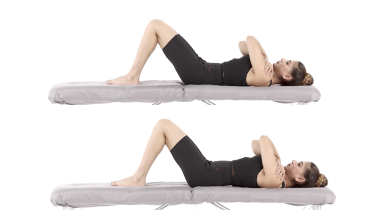 Pelvic tilt
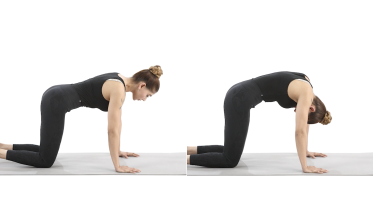 Cat-camel stretch
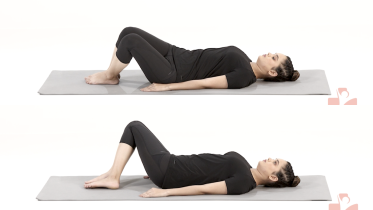 Lower trunk rotation
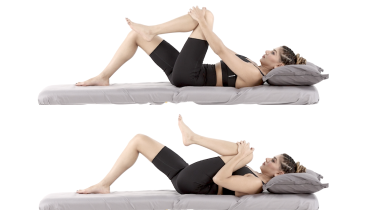 Knee to chest stretch
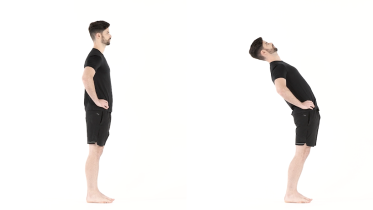 Standing back extension
Stage 2: Build control and stamina
When moving around is easier, which takes a few days for some people and a few weeks for others. The first four work your deep trunk and buttock muscles while your back stays fairly still. Brisk walking builds on your everyday walking and is one of the simplest habits to keep up for good.
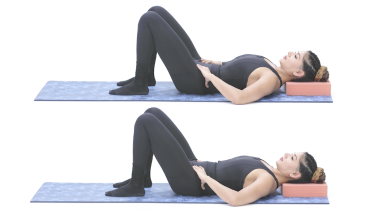 Transverse abdominis activation
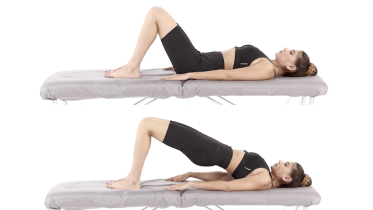 Glute bridge
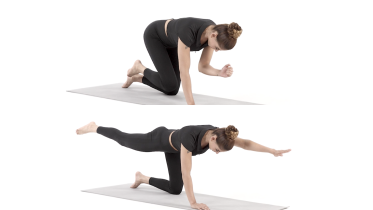 Bird dog
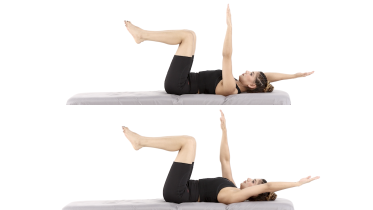 Dead bug
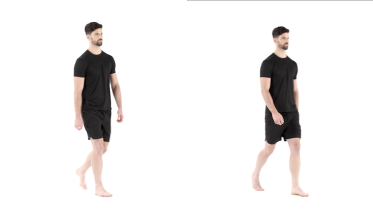 Brisk walking
Stage 3: Strength for lifting and long days
For lifting, housework, gardening, sport and long days at work. The planks run from easier to harder, so move on only when the one before feels steady. Sit to stand and the squat train the thighs and buttocks you use every time you bend down and get up. The superman works the muscles along your back and is the last one to add.
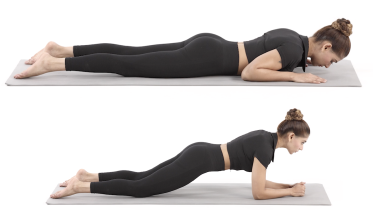 Kneeling plank
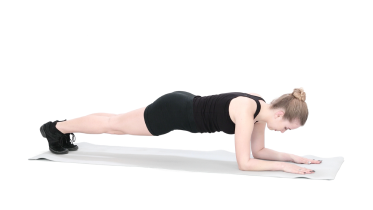 Plank
Plank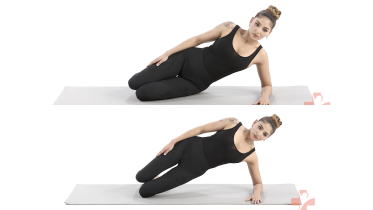 Kneeling side plank
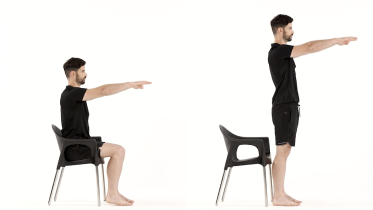 Sit to stand
 Squat
Squat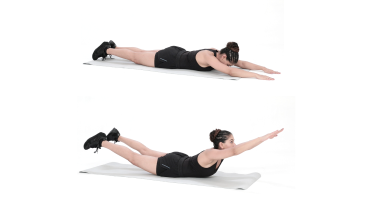 Superman
What to avoid or change
You do not need to give up bending or lifting because of a scan report. Physios usually advise building up load gradually, in small steps, because a sudden jump, such as a full day of gardening after a quiet month, can stir up a sore back. If you sit for long spells, stand up now and then to move about, and split big jobs into shorter ones.
If you have been told you have narrowing of the spinal canal (spinal stenosis) or a forward slip of one vertebra on another (spondylolisthesis), check with your physio before the standing back extension and the superman, because bending backward can make both worse. If you have low bone density (osteoporosis), ask your physio before the knee to chest stretch, the trunk rotation and the cat-camel, because deep forward bending and twisting are usually limited, as is rounding the back to the end of its range. If you have high blood pressure, breathe steadily through every hold and never hold your breath. If you feel unsteady on your feet, keep a kitchen counter or a sturdy chair within reach for the standing exercises.
If you have had a hip replacement, get the go-ahead from your surgeon or physio before you try the knee to chest stretch, the lower trunk rotation or the kneeling side plank. Pulling the knee in bends the hip well past a right angle and rolling the knees to one side turns the upper hip inward across your body, and many surgeons ask you to avoid that for the first months after some operations. The kneeling side plank also works the muscles at the side of the bottom hip, and some operations limit that kind of work for the first months too, so the timing depends on your surgery.
After an operation on your back, follow your surgeon's rehab program rather than this one. If you are pregnant, ask your physio or midwife before starting. The program is written for adults, so if a child or teenager has back pain, get them checked by a doctor or physio first.
When to see a physio or doctor
See a physio or GP if your back pain is not getting better after a few weeks, if it stops you doing your day-to-day activities, or if you are worried about it. The NHS also lists a lump or swelling in your back and pain high up in your back as reasons to see a GP. Losing weight without trying is on the NHS list too, and this page goes further: get medical advice the same day and mention it. The emergency signs below, including numbness around your genitals or bottom and new bladder or bowel trouble, need help straight away.
For physiotherapists
Use this as a starting point for patients, not a full plan. Brinjikji and colleagues (AJNR April 2015) give age-based prevalence in asymptomatic people for each finding, from disc degeneration and bulges to protrusions and annular fissures. That table is useful when a patient is worried by a report.
Their December 2015 meta-analysis, limited to adults aged 50 and under, found disc degeneration and bulge more prevalent in symptomatic than asymptomatic groups, and the same held for protrusion and extrusion. The findings are not meaningless. They just cannot identify the pain source in an individual.
Manage the person as non-specific low back pain under NICE NG59, including risk stratification at first contact. NG59 recommends against spinal fusion for low back pain outside a randomized controlled trial, and against disc replacement (checked against the version updated 29 July 2026). Nakashima 2015 found spinal cord compression in 5.3% of asymptomatic volunteers, rising after age 50, so with neck findings check gait and hand function, and ask about symptoms in both arms, to screen for degenerative cervical myelopathy. Finucane 2020 reports no high-quality evidence for the diagnostic accuracy of most red flags. Use them to prompt clinical reasoning, not as a checklist.
See a doctor promptly if
- Emergency: numbness, tingling or altered feeling around or under your genitals, between your inner thighs, or around your bottom (anus), for example it feels different when you wipe after using the toilet. Call emergency services or go to an emergency department straight away. This can be a sign of pressure on the bundle of nerves at the base of the spine (cauda equina syndrome), which needs emergency treatment.
- Emergency: you find it hard to start peeing, cannot pee, cannot feel yourself peeing or cannot control when you pee, or you do not notice when you need to poo or cannot control when you poo, and this is not normal for you. The same applies to a new change in how your genitals feel during sex, or new trouble getting an erection or ejaculating. Call emergency services or go to an emergency department straight away. These can also be signs of cauda equina syndrome.
- Emergency: sciatica in both legs, or pain, tingling, numbness or weakness in both legs. The same applies if you lose feeling in one leg. Call emergency services or go to an emergency department straight away.
- Emergency: back or leg pain that started after a serious accident, such as a car crash or a fall from a height, or back pain with chest pain. Call emergency services.
- A leg or foot that is getting weaker, for example your foot drags, catches on the ground or slaps down when you walk (foot drop). Get medical advice the same day. If the weakness is getting worse by the hour, go to an emergency department.
- Emergency: new neck or back pain after a fall, a knock or a jolt, even a minor one such as a trip or a sudden stop in a car, if you have a condition that stiffens the spine, such as ankylosing spondylitis. Call emergency services or go to an emergency department straight away, do not drive yourself, and tell the staff about your spine condition, so they keep your neck and back in their usual position. A stiff spine can break after a small injury, and the break is easy to miss at first. If the pain started straight after the injury, or you also have numbness, tingling or weakness in your arms or legs, keep still and call emergency services.
- Emergency: new problems walking, for example your legs feel stiff, heavy or weak or you have become unsteady on your feet, new trouble controlling your bladder or bowels, or hands that suddenly become clumsy, for example you can no longer do up buttons. Call emergency services straight away. These can be signs of pressure on the spinal cord in the neck.
- Hands that have slowly become clumsy, for example trouble doing up buttons or dropping things, or numbness in both hands. Get medical advice the same day. These can be signs of pressure on the spinal cord in the neck (cervical myelopathy). If the clumsiness or numbness gets worse quickly, call emergency services straight away.
- Pain or tingling in both arms at the same time, rather than in one. Get medical advice the same day. This can also be a sign of pressure on the spinal cord in the neck.
- Back pain after a minor fall or strain if you are older, have low bone density (osteoporosis) or have taken steroid tablets for a long time. Get medical advice the same day.
- Back or leg pain with a fever, or you feel hot, cold, shivery or generally unwell. Get medical advice the same day, and go to an emergency department if you feel very unwell.
- You have back pain and have lost weight without trying. Get medical advice the same day and mention the weight loss.
- New back pain and you have had cancer, now or in the past. Get medical advice the same day and mention your cancer history. If you are being treated for cancer now, contact your cancer team the same day.
- Emergency: you have had cancer, now or in the past, and your back or neck pain feels like a tight band around your body, or comes with pain spreading down an arm or leg, weakness, numbness or pins and needles in your arms or legs, trouble walking, or trouble controlling your bladder or bowels. Call your cancer team's emergency number straight away, or go to an emergency department if you do not have one or cannot get through. This can be cancer pressing on the spinal cord (metastatic spinal cord compression), which needs treatment straight away.
- Pain that is worse at night, or does not ease at all when you rest. See your doctor within a few days. If you have had cancer, now or in the past, or you have lost weight without trying, get medical advice the same day. If you are being treated for cancer now, contact your cancer team the same day.
- Severe pain that comes on suddenly or is getting worse quickly. Get medical advice the same day.
Common questions
Is degenerative disc disease serious?
Usually not. Despite the name, it describes changes that most people's discs go through with age, and Cleveland Clinic notes that it is not actually a disease. The same changes are found on scans of many people with no back pain (Brinjikji 2015). It becomes a concern when it comes with the warning signs listed on this page, such as numbness around your bottom, new bladder or bowel trouble, or a leg that is getting weaker.
Can degenerative disc disease be reversed?
Exercise is not meant to change how your discs look on a scan, and it does not need to. Many people with the same scan findings have no pain at all, so the aim is a back that hurts less and lets you do more. For back pain that has lasted three months or more, a Cochrane review found that exercise probably reduces pain compared with no treatment or usual care (Hayden 2021).
Does degenerative disc disease get worse with age?
The scan changes become more common with age. In people with no back pain, disc degeneration was found in 37% of 20-year-olds and 96% of 80-year-olds (Brinjikji 2015). That is a picture of normal aging, not a forecast of more pain. The authors note that many of these changes are likely part of normal aging and not linked to pain.
Is walking good for degenerative disc disease?
For most people, yes. The NHS lists walking among the activities that can help ease back pain, and NICE advises carrying on with normal activities as far as you can. Start with a distance you can manage comfortably and add a few minutes at a time. The brisk walking page in stage 2 shows how to build it up.
Do I need surgery for degenerative disc disease?
Not because of the scan alone. The NHS says surgery may be an option when back pain is caused by a condition such as a slipped disc and other treatments have not helped. For low back pain itself, NICE advises against spinal fusion except as part of a research trial, and against disc replacement. Any decision about an operation is made with a spine specialist and depends on your symptoms and examination, not on how the discs look.
References
- National Institute for Health and Care Excellence. Low back pain and sciatica in over 16s: assessment and management (NG59). Published 2016, last updated July 2026. https://www.nice.org.uk/guidance/ng59
- NHS. Back pain. Last reviewed 5 March 2026. https://www.nhs.uk/conditions/back-pain/
- Brinjikji W, Luetmer PH, Comstock B, et al. Systematic literature review of imaging features of spinal degeneration in asymptomatic populations. American Journal of Neuroradiology. 2015;36(4):811-816. https://doi.org/10.3174/ajnr.A4173
- Brinjikji W, Diehn FE, Jarvik JG, et al. MRI findings of disc degeneration are more prevalent in adults with low back pain than in asymptomatic controls: a systematic review and meta-analysis. American Journal of Neuroradiology. 2015;36(12):2394-2399. https://doi.org/10.3174/ajnr.A4498
- Hayden JA, Ellis J, Ogilvie R, Malmivaara A, van Tulder MW. Exercise therapy for chronic low back pain. Cochrane Database of Systematic Reviews. 2021;(9):CD009790. https://doi.org/10.1002/14651858.CD009790.pub2
- Cleveland Clinic. Degenerative disk disease. Last reviewed 4 February 2025. https://my.clevelandclinic.org/health/diseases/16912-degenerative-disk-disease
- NHS. Cervical spondylosis. Last reviewed 2 August 2023. https://www.nhs.uk/conditions/cervical-spondylosis/
- Nakashima H, Yukawa Y, Suda K, Yamagata M, Ueta T, Kato F. Abnormal findings on magnetic resonance images of the cervical spines in 1211 asymptomatic subjects. Spine. 2015;40(6):392-398. https://doi.org/10.1097/BRS.0000000000000775
- Finucane LM, Downie A, Mercer C, et al. International framework for red flags for potential serious spinal pathologies. Journal of Orthopaedic and Sports Physical Therapy. 2020;50(7):350-372. https://doi.org/10.2519/jospt.2020.9971
Written and checked by the PocketPhysio editorial team. Last updated 2026-09-28.
This page is general education, not a diagnosis or a personal treatment plan. See a physiotherapist or doctor for advice about your own situation.