
Cervical radiculopathy exercises and physiotherapy
What is cervical radiculopathy?
Cervical radiculopathy is the medical name for a pinched nerve in the neck. The nerves for your arm leave the spine through small openings between the bones of the neck. When one of those nerve roots is pressed on or irritated, you can feel pain, numbness, tingling or weakness along the path of that nerve, down the arm and sometimes into the hand. Neck pain and pain around the shoulder blade often come with it.
The NHS names a slipped disc or bone pressing on the nerve as the causes. A population study from Rochester, Minnesota, found that a confirmed disc bulge was the cause in about 1 in 5 people, and that about two thirds were linked to age-related changes in the neck, a disc, or both (Radhakrishnan 1994). The C7 nerve root was affected most often, then C6. Only about 15% of people could link it to an injury or a strain, and the average age was around 48.
If your pain stays in your neck and shoulders and does not travel down the arm, the neck pain program is the better starting point.
Do exercises help a pinched nerve in the neck?
They can help, but the evidence is modest and no single treatment stands out. One review of non-surgical treatment found no approach clearly better than the rest, and people tended to improve over time whatever they were given (Thoomes 2013). A larger review of 59 trials found a lack of high-quality evidence for any conservative treatment, which limited what the authors could conclude (Plener 2023).
The trials that tested exercise point the same way. A review of 10 trials found that exercise, alone or with other treatment, may ease pain and improve function, but rated the evidence low quality (Liang 2019). In a Dutch trial of people whose arm pain had started within the past month, 6 weeks of physio with home exercises eased arm pain more than waiting alone did (Kuijper 2009). On a 0 to 100 scale, arm pain in the waiting group fell by about 19 points over 6 weeks, and the physio group gained about 12 points more.
The US physical therapy guideline for neck pain has a separate group for pain spreading into the arm (Blanpied 2017). For a recent episode it lists mobilizing and stabilizing exercises as an option. For longer-lasting arm pain it recommends stretching and strengthening exercise combined with other physio treatment such as traction and hands-on therapy, and advice that encourages you to stay at work and keep exercising.
How to use this program
Pick the stage that matches how your arm feels today. If you are not sure, start at stage 1. Move slowly, breathe normally and stay in a range that feels comfortable or only mildly uncomfortable.
Each exercise page gives its own starting dose. As a rough guide, many programs use 5 to 10 slow turns or repetitions of the movement exercises, once or twice up to a few times a day, and the chin tuck often starts with 8 to 10 holds of 3 to 5 seconds. The isometric exercises and the deep neck flexor exercise usually start with gentle holds of 5 to 10 seconds, repeated 5 to 10 times, once or twice a day. The shoulder blade squeeze is often 10 to 15 squeezes of about 5 seconds, 2 to 3 times a day.
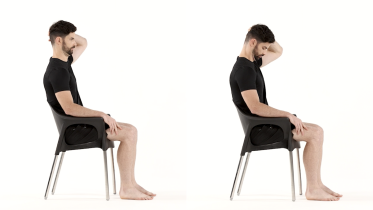
The nerve glides often start with 5 to 10 slow, easy glides, 1 to 3 times a day. The suboccipital stretch is often held for 15 to 30 seconds, 2 to 4 times. The band and face-down exercises are often done as 2 to 3 sets of 8 to 15, about once a day, and the prone chin tuck as 5 to 10 lifts. Your physio will adjust this.
With a pinched nerve, your arm tells you more than your neck does. After each exercise, notice where the pain, numbness or tingling sits. If it spreads further down your arm or into your hand, stop that exercise and leave it out for now. Check your arm again that evening and the next morning, because an irritated nerve can flare a few hours later. If it is clearly worse, do fewer or drop back a stage.
A little ache in the neck and shoulders is common and usually fine if it settles within a day.
If the arm symptoms ease or pull back toward your neck, that is usually a good response. There is one exception. If the arm pain eases but numbness or weakness in the arm gets worse, stop the exercises and get medical advice the same day.
Keep walking and doing your normal activities as much as the pain allows. Move up a stage when the current one feels easy and your arm settles well afterward.
The exercise program
Stage 1: Settle the arm and keep your neck moving
For the first days or weeks, when the arm pain is strong and some head positions bring it on. These are small, slow movements done sitting or standing, kept inside the range that leaves your arm the same or better. Turn your head only as far as your arm stays quiet, which may be less far toward the sore side at first. The two isometric exercises work the neck muscles without moving the neck, and the scapular squeeze keeps the muscles between your shoulder blades working. Stop any movement that sends pain, numbness or tingling further down your arm.
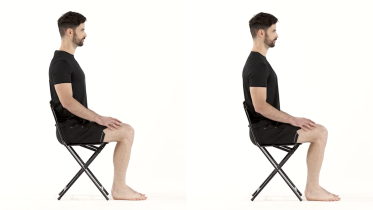 Chin tuck
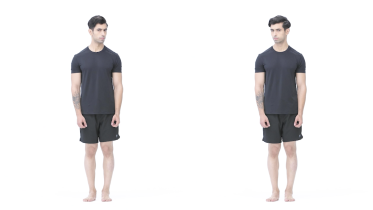 Neck rotation
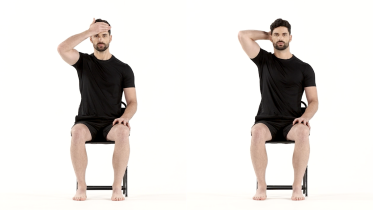 Neck isometric exercises
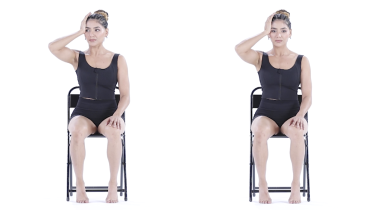 Isometric neck rotation
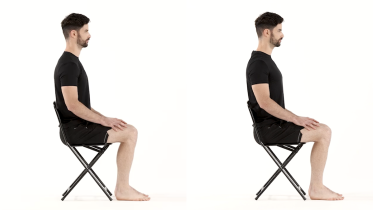 Scapular squeeze
Stage 2: Glide the nerve and build control
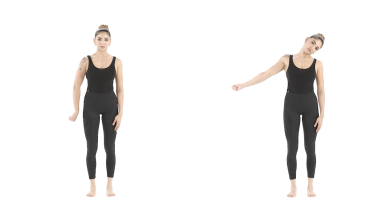
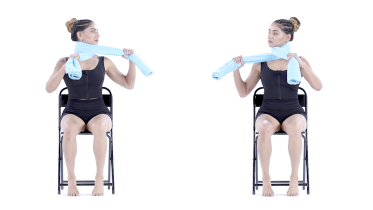
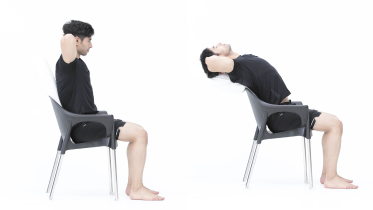
When the arm pain is less constant and turning your head is easier (days for some people, weeks or longer for others), the deep neck flexor exercise and the band row start the strength work, and the two nerve glides move the nerves of the arm gently without stretching them. Ask a physio to check your arm before you start the glides, and aim for no tingling: if a faint tingle comes on, make the movement smaller, and it should settle within a few seconds of stopping. If the tingling builds with each repetition or lingers afterward, leave that glide out for now. Use the towel SNAG only if a physio has taught it to you in person first, and leave out any of the last three that stirs up your arm. As you lean back over the chair, keep your head resting in your hands and your chin a little tucked, so the bend happens in your upper back and not your neck.
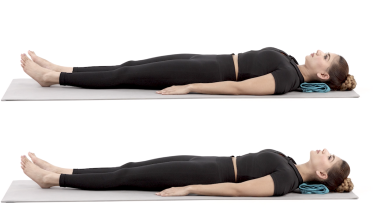 Deep neck flexor exercise
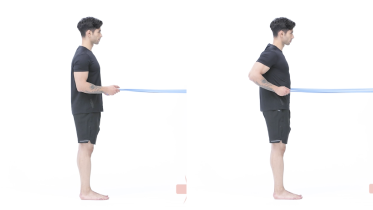 Resistance band row
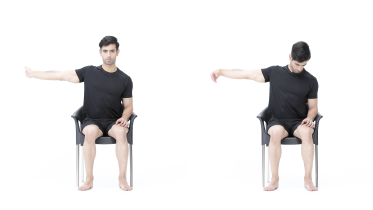 Median nerve glide
 Radial nerve glide
 Neck rotation SNAG with a towel
 Thoracic extension over a chair
 Suboccipital stretch
Stage 3: Build strength and endurance
For getting back to work, lifting, driving and sport once the arm pain has settled or only comes and goes. Now the muscles at the back of your neck and those between and below your shoulder blades work harder, and the band row from stage 2 keeps going. For the face-down exercises, rest your forehead on a small folded towel where the page allows it, and if a page has you turn your head to one side, pick the side that keeps your arm quiet. In the prone scapular retraction the arm hangs over the edge of the bed, and its weight pulls on the nerve, so leave it out on the sore side if the hanging arm tingles. Stop any of these if they bring on pain, numbness or tingling in your arm, and drop back a stage if the arm flares up.
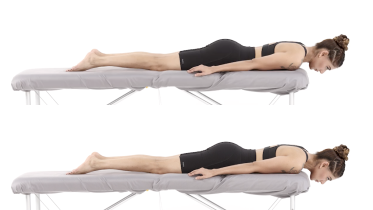 Prone chin tuck
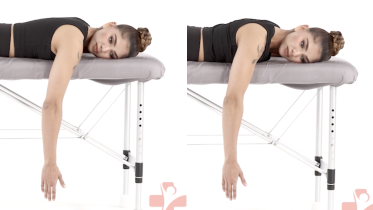 Prone scapular retraction
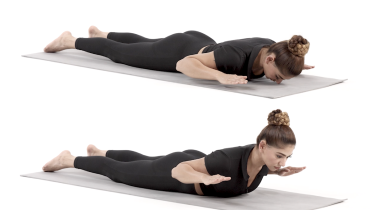 Prone W raise
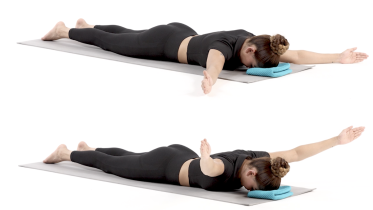 Prone Y raise
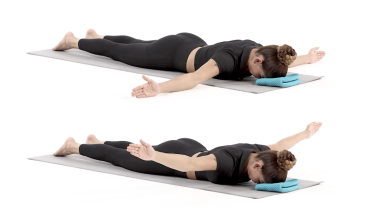 Prone T raise
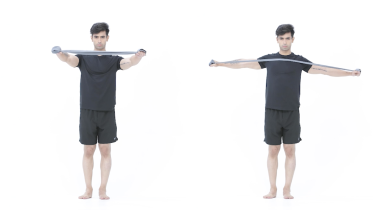 Band pull-apart
What to avoid or change
Some head movements make the arm pain worse, and a review of this condition advises avoiding them as much as you can (Kuijper 2014). Physios test for a pinched nerve by tipping the head back and toward the sore side, sometimes with gentle pressure on top (Spurling's test), because that position narrows the opening the nerve passes through and can bring the arm pain on. Looking up for a long time tips the head back in a similar way, so go easy on tasks such as painting a ceiling or reaching for things on a high shelf. Break them up, and bring the work down to eye level where you can. Your physio can tell you which positions to avoid for your own neck.
This program leaves out the stretches that tip your head away from the sore arm and hold it there, such as the upper trapezius, levator scapulae and scalene stretches. Holding the head tipped away can pull on the nerve on the sore side and stir it up. The nerve glides in stage 2 also tip the head away, but only for a moment and only while the wrist or arm lets the nerve go slack at the other end, so the nerve slides instead of being pulled tight. Your physio may add the stretches back once the arm has settled.
Do not drive until you can turn your head to check over your shoulder, as the NHS advises for neck pain, and until your arm is strong enough to steer and brake safely. A neck collar is something to discuss with your physio or doctor rather than start on your own (see the questions below).
If you have rheumatoid arthritis, or you have been told the spaces around the nerves or spinal cord in your neck are narrowed, check with your physio or doctor before you start. This program is not for rehab after neck surgery: follow your surgeon's program. If you are pregnant, check with your midwife, doctor or physio before starting. The program is written for adults, so if a child or teenager has pain or tingling down one arm, get them checked by a doctor or physio first.
When to see a physio or doctor
If you have pins and needles in an arm together with neck or arm pain, or your arm feels heavy or weak, the NHS advises asking for an urgent GP appointment or calling NHS 111. Wherever you live, get it checked the same day if nobody has looked at it yet. The NHS also says that if neck symptoms do not improve within a few weeks, you may need physiotherapy. See a physio or doctor, too, if the pain stops you sleeping or working or is getting worse. The warning signs below need faster help.
For physiotherapists
This page gives patients a starting framework, not a full plan. The 2017 JOSPT neck pain guideline (Blanpied 2017) groups radicular presentations as neck pain with radiating pain. For acute cases it lists mobilizing and stabilizing exercises, laser and short-term collar use as options. For chronic cases it recommends mechanical intermittent cervical traction combined with stretching and strengthening exercise plus cervical and thoracic mobilization or manipulation. It adds education and counseling that encourage the patient to keep working and exercising.
Set that against the reviews. Thoomes 2013 found low-level evidence that traction was no more effective than placebo traction, and that a collar was no more effective than physiotherapy in the short term. Plener 2023 (59 trials) found only very-low certainty evidence supporting acupuncture, prednisolone, cervical manipulation and low-level laser therapy for short-term pain and disability, and concluded that the lack of high-quality evidence limited any meaningful conclusions. The NASS guideline (Bono 2011) is based on literature up to May 2009, so it predates these reviews.
For diagnosis, the 2026 update of the Thoomes review found high specificity for Spurling's test across studies (0.84 to 1.00), high pooled sensitivity (0.97) but low specificity (0.51) for a combination of upper limb neurodynamic tests, and pooled sensitivity 0.49 and specificity 0.76 for the shoulder abduction relief test, all at low to very low certainty (Thoomes 2026). The NASS guideline gives a grade C recommendation that the shoulder abduction and Spurling's tests may be considered (Bono 2011). Read MRI alongside the examination. In recent onset cases, the clinically affected root was compressed on MRI in 73%, compression without a clinical match appeared in 45%, and 13 to 15% of scans were normal (Kuijper 2011).
The JOSPT guideline also advises monitoring symptom irritability and adjusting manual therapy and exercise to it, and restricting collars to a limited time in the acute phase for people who do not get relief from other treatments (Blanpied 2017).
The nerve glides in stage 2 are sliders. Basson 2017 found that neural mobilization reduced pain in chronic neck-arm pain, but the evidence was limited and of varying quality. Wong 2014 found substantial improvement within 4 to 6 months in most cervical disc herniations with radiculopathy, with a workers' compensation claim linked to a poorer outlook. In the Rochester cohort, recurrence occurred in 31.7% over a median of 4.9 years (Radhakrishnan 1994).
Screen for degenerative cervical myelopathy (Davies 2018): ask about hand dexterity, gait, balance, bilateral symptoms and bladder or bowel change, and refer promptly if you suspect it. Symptoms can also be one-sided and pain may be absent, so a one-sided arm presentation does not rule it out. The Finucane 2020 red flags framework notes that high-quality evidence for the diagnostic accuracy of most red flags is lacking, so use them as prompts for clinical reasoning. To track change, Kuijper 2009 used the Neck Disability Index with separate arm and neck pain scales. That works well in clinic too.
See a doctor promptly if
- Emergency: any sign of a stroke, even if it goes away. That means a face that droops on one side, an arm you cannot lift or keep up, slurred or muddled speech, weakness or numbness on one side of your body or face, sudden blurred vision, double vision or loss of sight, trouble swallowing, sudden dizziness with unsteadiness or falling over, a sudden severe headache, or a sudden fall where your legs give way but you do not black out (a drop attack). Call emergency services straight away. With neck pain, these can rarely come from a tear in an artery in the neck.
- Emergency: a new headache, or new pain on one side of your face, jaw or neck, with a drooping eyelid or a smaller pupil on the same side, or with a new pulsing or whooshing sound in one ear that keeps time with your heartbeat. Call emergency services or go to an emergency department straight away, and do not drive yourself. This can be a tear in an artery in the neck (cervical artery dissection), which can lead to a stroke.
- Emergency: a sudden, severe headache or neck pain that feels new and unlike anything you have had before. Call emergency services straight away.
- Emergency: neck, jaw or arm pain that comes with chest pain, shortness of breath, sweating or feeling sick. Call emergency services.
- Emergency: neck pain straight after a high-energy accident, such as a crash at high speed, a car that rolled over, being thrown from a vehicle, being hit by a vehicle while walking or cycling, a motorbike or quad bike accident, a horse riding accident, a diving injury, or a fall from a height or down several stairs. Keep still and call emergency services. If the neck pain only starts later and nobody has checked your neck since, go to an emergency department straight away, and do not drive yourself.
- Emergency: in the first days after the accident, numbness, tingling, pins and needles or weakness in your arms or legs, or a sudden electric shock feeling in your neck and back that runs into your arms or legs. If it starts straight after the accident, keep still and call emergency services. If it starts later, call emergency services or go to an emergency department straight away, and do not drive yourself.
- Emergency: a stiff neck with a fever, a severe headache that is getting worse, pain when you look at bright lights, confusion, or a rash that does not fade when you press a glass on it. Call emergency services. These can be signs of meningitis.
- Emergency: new problems walking, for example your legs feel stiff, heavy or weak or you have become unsteady on your feet, new trouble controlling your bladder or bowels, or hands that suddenly become clumsy, for example you can no longer do up buttons. Call emergency services straight away. These can be signs of pressure on the spinal cord in the neck.
- Hands that have slowly become clumsy, for example trouble doing up buttons or dropping things, or numbness in both hands. Get medical advice the same day. These can be signs of pressure on the spinal cord in the neck (cervical myelopathy). If the clumsiness or numbness gets worse quickly, call emergency services straight away.
- Pain or tingling in both arms at the same time, rather than in one. Get medical advice the same day. This can also be a sign of pressure on the spinal cord in the neck.
- An arm or hand that is getting weaker. Get medical advice the same day.
- Severe neck or arm pain that comes on suddenly or is getting worse quickly, without any of the emergency signs above. Get medical advice the same day.
- Pins and needles in an arm together with neck or arm pain, or an arm that feels heavy or weak, and nobody has checked it yet. Get medical advice the same day.
- Dizziness, a spinning feeling or feeling sick that comes on when you turn or tip your head, without any of the emergency signs above. Stop the exercises and get medical advice the same day. If you faint, it does not settle within a few minutes of sitting still, or you cannot stand or walk steadily, call emergency services.
- Neck or arm pain with a fever or chills, or you feel generally unwell. Get medical advice the same day, and go to an emergency department if you feel very unwell.
- New, frequent headaches with pain or tenderness at your temples or on your scalp, or jaw pain when you eat or talk. Get medical advice the same day. These can be signs of inflamed arteries in the head (temporal arteritis, also called giant cell arteritis). If your vision changes, call emergency services.
- New neck or arm pain and you have had cancer, now or in the past, or you have lost weight without trying. Get medical advice the same day and mention it. If you are being treated for cancer now, contact your cancer team the same day.
- Emergency: you have had cancer, now or in the past, and your back or neck pain feels like a tight band around your body, or comes with pain spreading down an arm or leg, weakness, numbness or pins and needles in your arms or legs, trouble walking, or trouble controlling your bladder or bowels. Call your cancer team's emergency number straight away, or go to an emergency department if you do not have one or cannot get through. This can be cancer pressing on the spinal cord (metastatic spinal cord compression), which needs treatment straight away.
- Pain that is there all the time and does not ease with rest or changing position, or pain at night that keeps getting worse. See your doctor within a few days. If you have had cancer, now or in the past, or you have lost weight without trying, get medical advice the same day. If you are being treated for cancer now, contact your cancer team the same day.
- Emergency: new neck or back pain after a fall, a knock or a jolt, even a minor one such as a trip or a sudden stop in a car, if you have a condition that stiffens the spine, such as ankylosing spondylitis. Call emergency services or go to an emergency department straight away, do not drive yourself, and tell the staff about your spine condition, so they keep your neck and back in their usual position. A stiff spine can break after a small injury, and the break is easy to miss at first. If the pain started straight after the injury, or you also have numbness, tingling or weakness in your arms or legs, keep still and call emergency services.
- Neck pain after a car accident or a fall, even a minor one, if you are 65 or older, have low bone density (osteoporosis) or have taken steroid tablets for a long time. Get your neck checked by a doctor the same day, for example at an emergency department, before you start these exercises. At 65 or older, doctors usually want an X-ray or scan of the neck after an accident.
- You have rheumatoid arthritis and get new neck pain, or a new headache at the back of your head that keeps coming back. If it comes with tingling or numbness in your hands or arms, get medical advice the same day. If you also feel unsteady on your feet or your legs feel stiff, heavy or weak, call emergency services straight away. Without any of those, tell your doctor or rheumatology team within a few days, and leave out any neck exercises until you have been checked.
Common questions
How long does a pinched nerve in the neck take to heal?
Usually a few months, though it varies a lot. A review of how cervical disc problems with arm pain progress found that most people start with intense pain, and that big improvements tend to come within the first 4 to 6 months (Wong 2014). Full recovery takes longer: about 83% of people had recovered fully, over 2 to 3 years. In a population study from Minnesota, 90% of people had no symptoms or only mild ones at their last check, although about a third had symptoms come back during about 5 years of follow-up (Radhakrishnan 1994).
Should I wear a neck collar for a pinched nerve in the neck?
Not as a first step, and only if your doctor or physio suggests it. For everyday neck pain, the NHS advises against a collar unless a doctor tells you to wear one, because it is better to keep your neck moving. A new pinched nerve is a bit different: in a Dutch trial of people whose arm pain had started less than a month before, a semi-hard collar with rest for 3 to 6 weeks eased arm pain about as much as 6 weeks of physio with home exercises, and both did better than waiting alone (Kuijper 2009). The US physical therapy guideline lists a short spell in a collar in the first weeks as one option, but only for people who do not get relief from other treatment, because wearing one for a long time can do harm (Blanpied 2017). If you are given one, your doctor or physio will tell you how long to wear it.
Can a pinched nerve in the neck cause numbness in the hand?
Yes. The nerve roots in the neck carry feeling to the arm and hand, so a pinched root can cause numbness, tingling or pain down the arm and into the hand or fingers. Which part is affected depends on which root is involved. Tingling in the hand can also come from a nerve pressed at the wrist, as in carpal tunnel syndrome, so a physio or doctor will usually check both.
What is the best sleeping position for a pinched nerve in the neck?
There is no single best position, so use whatever keeps your arm quiet. The NHS advice for neck pain is a low, firm pillow and a firm mattress, keeping your head at the same height as the rest of your body, and not sleeping on your front. Some people with a pinched nerve find the arm pain eases when they rest the hand of the sore arm on top of their head. Physios check for this in the assessment (the shoulder abduction relief test), although only about half of people with a pinched nerve get this relief (Thoomes 2026). If it helps you, it is fine to rest in that position for a while, but lower the arm if your shoulder aches or your hand starts to tingle or go numb.
Do I need an MRI for a pinched nerve in the neck?
Not always. A review by Kuijper and colleagues (2009) found that the diagnosis is made mainly from your symptoms and an examination, and that an MRI can confirm it. Scans also need careful reading: in a study of people with recent arm pain from the neck, the scan showed the nerve root that matched the symptoms being pressed on in 73%, and 13 to 15% of scans looked normal (Kuijper 2011). A scan is usually arranged when the pain is not settling and surgery is being considered (Kuijper 2014), or when a doctor suspects something more serious.
Will I need surgery for cervical radiculopathy?
Most people do not. The NHS says surgery is only considered when a nerve is being pinched by a slipped disc or bone, or when there is a problem with the spinal cord. The pain usually settles without surgery, which is mainly considered when it does not (Kuijper 2014). In a Dutch study where patients chose surgery or non-surgical care after talking it through, neck pain fell more in the surgical group over 2 years, and arm pain fell a little more too, although that difference was borderline (Gül 2025). The study was not randomized, so the groups may have differed in ways that affected the results, and the decision is one to make with your surgeon.
References
- Blanpied PR, Gross AR, Elliott JM, et al. Neck pain: revision 2017. Clinical practice guidelines linked to the International Classification of Functioning, Disability and Health from the Orthopaedic Section of the American Physical Therapy Association. Journal of Orthopaedic and Sports Physical Therapy. 2017;47(7):A1-A83. https://doi.org/10.2519/jospt.2017.0302
- Bono CM, Ghiselli G, Gilbert TJ, et al. An evidence-based clinical guideline for the diagnosis and treatment of cervical radiculopathy from degenerative disorders. The Spine Journal. 2011;11(1):64-72. https://doi.org/10.1016/j.spinee.2010.10.023
- Thoomes EJ, Scholten-Peeters W, Koes B, Falla D, Verhagen AP. The effectiveness of conservative treatment for patients with cervical radiculopathy: a systematic review. The Clinical Journal of Pain. 2013;29(12):1073-1086. https://doi.org/10.1097/AJP.0b013e31828441fb
- Plener J, Csiernik B, To D, et al. Conservative management of cervical radiculopathy: a systematic review. The Clinical Journal of Pain. 2023;39(3):138-146. https://doi.org/10.1097/AJP.0000000000001092
- Liang L, Feng M, Cui X, et al. The effect of exercise on cervical radiculopathy: a systematic review and meta-analysis. Medicine (Baltimore). 2019;98(45):e17733. https://doi.org/10.1097/MD.0000000000017733
- Kuijper B, Tans JT, Beelen A, Nollet F, de Visser M. Cervical collar or physiotherapy versus wait and see policy for recent onset cervical radiculopathy: randomised trial. BMJ. 2009;339:b3883. https://doi.org/10.1136/bmj.b3883
- Kuijper B, Tans JT, Schimsheimer RJ, et al. Degenerative cervical radiculopathy: diagnosis and conservative treatment. A review. European Journal of Neurology. 2009;16(1):15-20. https://doi.org/10.1111/j.1468-1331.2008.02365.x
- Kuijper B, Tans JT, van der Kallen BF, Nollet F, Lycklama a Nijeholt GJ, de Visser M. Root compression on MRI compared with clinical findings in patients with recent onset cervical radiculopathy. Journal of Neurology, Neurosurgery and Psychiatry. 2011;82(5):561-563. https://doi.org/10.1136/jnnp.2010.217182
- Kuijper B. [Cervical radiculopathy]. Nederlands Tijdschrift voor Tandheelkunde. 2014;121(10):483-486. Article in Dutch with an English abstract. https://doi.org/10.5177/ntvt.2014.10.14134
- Wong JJ, Côté P, Quesnele JJ, Stern PJ, Mior SA. The course and prognostic factors of symptomatic cervical disc herniation with radiculopathy: a systematic review of the literature. The Spine Journal. 2014;14(8):1781-1789. https://doi.org/10.1016/j.spinee.2014.02.032
- Radhakrishnan K, Litchy WJ, O'Fallon WM, Kurland LT. Epidemiology of cervical radiculopathy: a population-based study from Rochester, Minnesota, 1976 through 1990. Brain. 1994;117(2):325-335. https://doi.org/10.1093/brain/117.2.325
- Gül A, van Geest S, Kuijper B, van der Plas AA, Steyerberg E, Vleggeert-Lankamp C. The CASINO trial: surgical versus conservative management in patients with cervical radiculopathy due to intervertebral disc herniation: a prospective cohort study. European Spine Journal. 2025;34(8):3398-3407. https://doi.org/10.1007/s00586-025-09045-y
- Thoomes EJ, Arvanitidis M, van Geest S, et al. Diagnostic accuracy of physical examination tests for painful cervical radiculopathy: update of a systematic review and meta-analysis. BMC Musculoskeletal Disorders. 2026;27(1):338. https://doi.org/10.1186/s12891-026-09551-0
- Basson A, Olivier B, Ellis R, Coppieters M, Stewart A, Mudzi W. The effectiveness of neural mobilization for neuromusculoskeletal conditions: a systematic review and meta-analysis. Journal of Orthopaedic and Sports Physical Therapy. 2017;47(9):593-615. https://doi.org/10.2519/jospt.2017.7117
- Davies BM, Mowforth OD, Smith EK, Kotter MR. Degenerative cervical myelopathy. BMJ. 2018;360:k186. https://doi.org/10.1136/bmj.k186
- Finucane LM, Downie A, Mercer C, et al. International framework for red flags for potential serious spinal pathologies. Journal of Orthopaedic and Sports Physical Therapy. 2020;50(7):350-372. https://doi.org/10.2519/jospt.2020.9971
- NHS. Cervical spondylosis. https://www.nhs.uk/conditions/cervical-spondylosis/
- NHS. Neck pain. https://www.nhs.uk/symptoms/neck-pain-and-stiff-neck/
- NHS. Symptoms of a stroke. https://www.nhs.uk/conditions/stroke/symptoms/
- NHS. Meningitis. https://www.nhs.uk/conditions/meningitis/
- NHS. Temporal arteritis. https://www.nhs.uk/conditions/temporal-arteritis/
Written and checked by the PocketPhysio editorial team. Last updated 2026-09-28.
This page is general education, not a diagnosis or a personal treatment plan. See a physiotherapist or doctor for advice about your own situation.