Thoracic extension over a chair
Thoracic extension over a chair is a seated stretch for a stiff upper back. You sit with the top of the backrest against the middle of your spine, put your hands behind your head and lean back over it, so your chest opens and your upper back bends backward. Physios often give it to people who spend long hours sitting at a desk or hunched over a phone.
How to do the thoracic extension over a chair
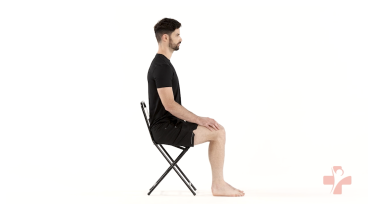
- Sit tall on a sturdy chair with your feet flat on the floor. Shuffle back until the top edge of the backrest sits against the middle of your back.
- Put both hands behind your head and point your elbows out to the sides.
- Slowly lean back over the top of the chair. Let your chest lift toward the ceiling as your upper back bends over the backrest.
- Keep your hands taking the weight of your head so your neck is not doing the work. Let your head move with your upper back rather than tipping it back on its own. Your bottom stays where it is on the seat.
- Hold for a breath or two where you feel a comfortable stretch, then come back up to sitting in a controlled way.
What you should feel
A stretch or firm pressure across your upper back where it meets the chair, and some opening across the front of your chest. Your neck should feel supported, not strained.
Common mistakes
- Letting the head drop back on its own so the neck takes the bend instead of the upper back.
- Sliding the hips forward and arching the lower back rather than bending over the backrest.
- Dropping back quickly. Lower yourself slowly and come up just as slowly.
- Using a chair with a low or wobbly back, or one on wheels.
How often
Many programs use 5 to 10 slow repetitions with a short hold of a few seconds, once or twice a day. Your physio will adjust this for you.
Stop and check with your physio if
- Sharp pain in your back or ribs, or pain that stays once you sit up.
- You feel dizzy, faint or unsteady. Stop and get medical advice the same day. If you faint, it does not settle within a few minutes of sitting still, or you cannot stand or walk steadily, call emergency services.
- Things look double, your vision suddenly blurs or goes, your speech slurs or becomes muddled, swallowing becomes hard, your face or lips go numb, one side of your face droops or one side of your body goes weak or numb, you suddenly become so dizzy or unsteady that you fall or cannot stand or walk, your legs suddenly give way but you do not black out (a drop attack), or you get a sudden severe headache. Stop and call emergency services, even if it goes away.
- Pain, numbness or tingling spreads into your arms.
From the clinic
Where the backrest meets your spine is where you will bend. If the top edge lands on your lower back, you mostly arch there, which is not what you want, so pick a chair with a higher back. Only go back as far as you can come up again without a struggle.
In the video the head goes well back, but it stays cradled in the hands the whole time. If your neck is sore, keep your chin a little tucked.
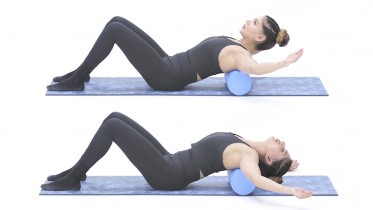
If you have osteoporosis, a past fracture in the spine or ribs, or have had recent heart or chest surgery, check with your physio before you lean over a chair edge. They may keep the range small or give you a gentler version, such as lying on your back over a rolled towel placed across your upper back. For a softer start on the same area, try wall angels or the cat-camel stretch.
Written and checked by the PocketPhysio editorial team. Last updated 2026-09-26.
This page is general education, not a diagnosis or a personal treatment plan. If you have pain, an injury or a health condition, see a physiotherapist or doctor before starting new exercises.