Thoracic rotation
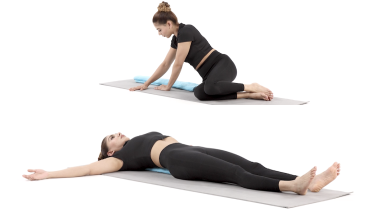
This thoracic rotation is done kneeling, with your bottom back toward your heels and one forearm on the floor. You put the other hand behind your lower back and turn your chest toward that side, as far as you can without shifting your hips. Sitting back toward your heels limits how much your lower back can turn, so more of the movement comes from your upper back (thoracic spine).
How to do the thoracic rotation
- Kneel on a mat and sit your bottom back toward your heels. Lean forward and rest both forearms on the floor in front of your knees.
- Leave one forearm on the floor. Take the other hand off the floor and place it behind your lower back.
- Turn your chest and the bent elbow up toward the ceiling on that side. Let your head turn with your chest.
- Go as far as you can while your bottom stays back toward your heels and the forearm on the floor stays put.
- Pause, then turn slowly back to face the floor. Repeat, then change sides.
What you should feel
A turning stretch through your upper and middle back, and some work between the shoulder blades on the side that opens. Your lower back should stay quiet.
Common mistakes
- Lifting the bottom off the heels or shifting the hips to get more turn.
- Pulling the elbow back without turning the chest. The shoulder blade squeezes, but the spine hardly moves.
- Rushing the turn or bouncing at the end of it.
How often
Many programs use 8 to 10 slow repetitions on each side, pausing for a breath or two at the end of each turn, once or twice a day. Your physio will adjust this for you.
Stop and check with your physio if
- Sharp pain in your back, ribs or shoulder as you turn.
- Pain, numbness or tingling spreads into your arm or down your leg.
- Pins and needles in your arm or hand that do not go away after you stop, or part of your arm or hand goes numb. Get medical advice the same day. If one side of your face or body suddenly goes numb or weak, or your speech becomes slurred or muddled, call emergency services, even if it goes away.
- Kneeling or sitting back on your heels hurts your knees.
From the clinic
If you cannot sit back onto your heels comfortably, put a pillow between your calves and your bottom, or a folded towel under your knees. The turn does not need to be big. A small, slow rotation with the hips still does more for your upper back than a big one where the whole body swings around.
If you have osteoporosis or a past fracture in the spine, check the range with your physio before you start, as twisting to the end of your range is often limited.
If you have had a hip replacement, get the go-ahead from your surgeon or physio before you try thoracic rotation. Sitting back toward your heels with your body leaned forward bends the hip well past a right angle, and many surgeons ask you to avoid that for the first months after some operations.
The same upper back area is worked in thread the needle, and the lower trunk rotation turns the lower back instead.
Written and checked by the PocketPhysio editorial team. Last updated 2026-09-28.
This page is general education, not a diagnosis or a personal treatment plan. If you have pain, an injury or a health condition, see a physiotherapist or doctor before starting new exercises.