
Upper back pain exercises and physiotherapy
What is upper back pain?
Upper back pain is pain anywhere from the base of your neck to the bottom of your ribs, often felt between the shoulder blades. Physios call this part of the spine the thoracic spine. Each of its 12 bones joins a pair of ribs.
Most upper back pain is put down to the muscles and joints, but this part of the spine has had far less research than the neck and lower back (Heneghan 2016). In adults, new episodes of mid-back pain are less common than neck or low back pain (Johansson 2017). It is still a frequent complaint at work. Across studies of different jobs, between 3% and 55% of working adults reported upper back pain in the past year, and most groups were around 30% (Briggs 2009).
Is this the right page for you?
This page is for general pain and stiffness in the middle and upper back. If your main worry is a rounded, hunched upper back, the kyphosis program covers that. If your pain starts in your neck and spreads toward your shoulder blades, start with the neck pain program.
Some conditions have their own program. For low bone density or a fracture in the spine, use the osteoporosis program. Back pain and stiffness that built up gradually over months or years, starting as a teenager or young adult, can be ankylosing spondylitis (NHS), which has its own program. If your spine curves to the side, see the scoliosis program.
Check the warning signs first
Pain between the shoulder blades does not always come from the back. The NHS lists chest pain that spreads to the back as a reason to call 999, and pain in the chest or upper back as a sign of a blood clot in the lungs. A tear in the main blood vessel from the heart (aortic dissection) can cause sharp, tearing pain under the shoulder blades (MedlinePlus). Gallstones can cause tummy pain that spreads to the back, and pleurisy can cause chest pain that spreads to the back when you breathe in (NHS).
Shingles is another one to know. It often starts as tingling or pain in one patch of skin before any rash appears, usually on one side of the chest or tummy (NHS). The NHS also advises seeing a GP about back pain that comes from between your shoulders rather than your lower back, so if your pain has not been checked, see your doctor before you start stage 1. If any of the other warning signs below apply to you, get checked before you start this program.
Does exercise help upper back pain?
The honest answer is that there is very little good research. A systematic review of treatments without medicine for upper back and chest wall pain found only two studies with a low risk of bias (Southerst 2015). Neither tested an exercise program on its own. In one, a mix of treatments that included hands-on treatment of the spine reduced chest wall pain about as much as a single education session, though more people in that group reported an important improvement.
So the program leans on general advice for back pain. The NHS advises staying active, carrying on with your daily activities and trying exercises and stretches for back pain. The stages follow the pattern used for neck and low back pain: get the area moving first, then build strength in the muscles around the spine and shoulder blades. Treat it as a sensible starting point rather than a proven cure.
How to use this program
Begin with stage 1, unless your physio has put you on a later one. Go up a stage when the current one is easy and your back settles well after it.
You will find a typical starting dose on each exercise page. As a rough guide, many programs use 5 to 10 slow repetitions of the stage 1 movements, once or twice a day, and 10 to 15 shoulder blade squeezes with a hold of about 5 seconds, 2 to 3 times a day. The stage 2 turning exercises are often done 8 to 10 times on each side, or held for 10 to 30 seconds 3 to 5 times for thread the needle. The foam roller and chest stretch are usually held for 20 to 30 seconds, 2 to 3 times, and wall angels start at 1 to 3 sets of 8 to 12 slow repetitions.
The band exercises in stage 3 often start at 2 to 3 sets of 10 to 15, once a day or every other day. The prone T and Y raises start at about 2 to 3 sets of 8 to 12 with a 3 to 5 second hold, and the back extension on elbows at 1 to 3 sets of 5 to 10 short holds. Your physio will adjust this.
Tired muscles and a stretch across your chest or upper back are expected. A little discomfort is usually fine, as long as it fades soon after and your back feels no worse when you wake up. Stop and check the warning signs below if you get sharp pain in your back or around your ribs, or pain, numbness or tingling spreading into an arm or leg. If you have high blood pressure, breathe steadily through every hold and never hold your breath.
If chest pain, pressure or tightness does not ease quickly when you rest, spreads to your arm, neck, jaw, stomach or back, or comes with sweating, feeling sick, feeling light-headed or being short of breath, call emergency services straight away, as this can be a heart attack. If it eases quickly and none of these happen, get medical advice the same day, and do not exercise again until you have been checked.
Keep up your normal activities alongside the exercises. The NHS suggests a heat pack wrapped in a towel for stiffness or muscle spasm, and some people find it makes the first few movements easier. If you sit for long spells, get up every so often and do a few of the stage 1 movements.
The exercise program
Stage 1: Get your upper back moving
For a new spell of upper back pain or stiffness, and for anyone new to exercise. The seated extension and the shoulder blade squeeze are done on a chair, so they fit into breaks from a desk. The cat camel moves the whole spine gently on your hands and knees, and the open book turns the upper back while you lie on your side. Move slowly, and only as far as is comfortable.
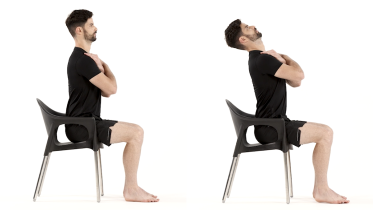 Seated thoracic extension
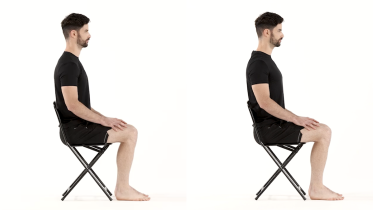 Scapular squeeze
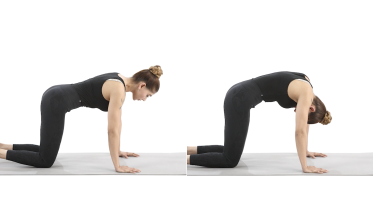 Cat-camel stretch
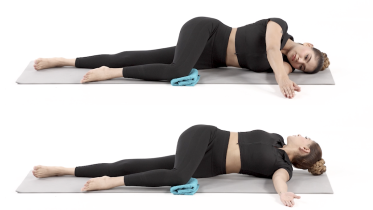 Open book stretch
Stage 2: Turn and open up
Move on to this stage once stage 1 is easy, which for many people takes a week or two. Thoracic rotation and thread the needle turn the upper back further while your hips stay still, and the foam roller and pec stretch open a stiff upper back and a tight chest. Wall angels start the work for the muscles around your shoulder blades. If you have osteoporosis or have had a fracture in your spine, check with your physio before the turning stretches and the foam roller.
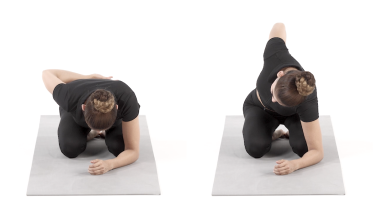 Thoracic rotation
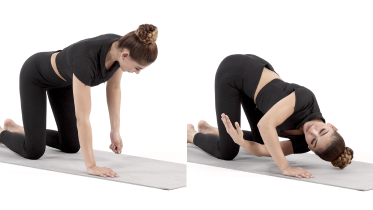 Thread the needle
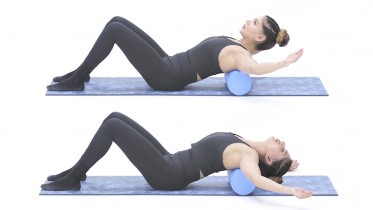 Foam roller thoracic extension
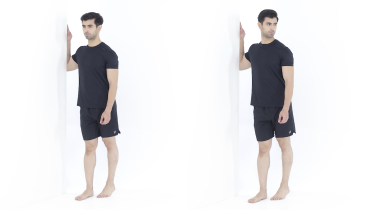 Pec stretch at a wall
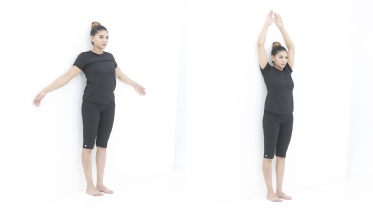 Wall angels
Stage 3: Build strength
Start this stage when stage 2 feels steady and your back settles well after each session. The band row and band pull-apart work the muscles between your shoulder blades, and the prone T and Y raises make them lift your arms against gravity. The back extension on elbows starts strength work for the long muscles beside your spine. If you have had a fracture in your spine, check with your physio before you begin.
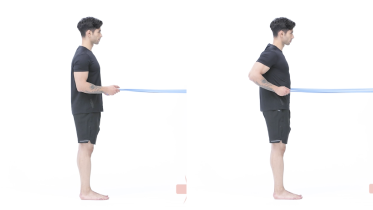 Resistance band row
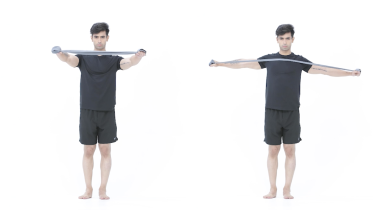 Band pull-apart
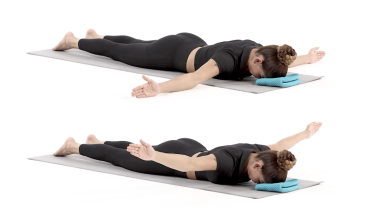 Prone T raise
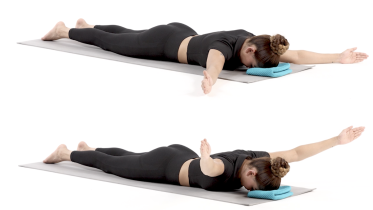 Prone Y raise
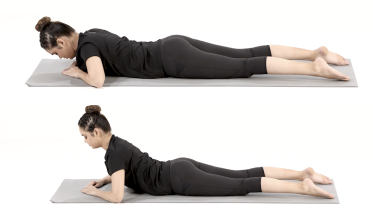 Back extension on elbows
Osteoporosis and fractures in the spine
With low bone density (osteoporosis), a cough or sneeze can sometimes break a rib or partly collapse one of the bones of the spine (NHS). The UK consensus on exercise for osteoporosis recommends spinal extension exercise, as in the seated extension, and advises avoiding postures that bend the spine far forward (Brooke-Wavell 2022). Twisting to the end of your range is often limited too. Keep the cat camel small, and check the range with your physio before the open book, thoracic rotation and thread the needle. Ask your physio first before the foam roller, which presses on the spine and bends it backward.
If you have had a fracture in your spine, check with your physio before you begin. The Royal Osteoporosis Society says a spinal fracture takes 6 to 12 weeks to heal.
Other things to check first
Had an operation on your spine, chest or heart in the last few months? Your surgical team or physio needs to give you the go-ahead first. After back surgery, the program from your surgeon comes before this one.
If you have had a hip replacement, get the go-ahead from your surgeon or physio before you try the open book stretch. Some operations limit this kind of work for the first months, so the timing depends on your surgery. The stage 2 and 3 exercises that use your arms put load through the shoulder. After shoulder surgery or a dislocation, add them when your surgeon's or physio's plan says you can. If you are pregnant, ask your physio or midwife before you start.
This program is written for adults. If a child or teenager has upper back pain, see a GP first.
When to see a physio or doctor
The NHS advises seeing a GP about back pain that comes from the top of your back, between your shoulders, rather than your lower back. See a GP as well if the pain has not improved after a few weeks at home, stops you doing your day-to-day activities, is worse at night or when you sneeze or cough, or you are worried about it (NHS). A physio can help if you are not sure where to start or you are not improving after several weeks of regular exercise. The warning signs below need faster help.
For physiotherapists
The thoracic spine is under-researched compared with the cervical and lumbar regions, with gaps in etiology, epidemiology and the mechanisms of the interventions in use (Heneghan 2016). Johansson 2017 found adult mid-back pain incidence lower than for neck and low back pain, and no studies of adult recovery trajectories or prognostic factors. Southerst 2015 (OPTIMa) appraised 2 low risk of bias RCTs: thoracic manipulation gave statistically significant but clinically nonimportant short-term pain reduction versus placebo, acupuncture matched placebo electrotherapy, and multimodal care for chest wall pain matched a single education session on pain, with more patients reporting important improvement.
Keep visceral referral in the differential: cardiac ischemia, aortic dissection, pulmonary embolism, pleural and lung disease, hepatobiliary disease and herpes zoster can all present as thoracic or interscapular pain. Screen for thoracic myelopathy (gait change, a sensory level, sphincter change) and for osteoporotic vertebral fracture before loading into extension or rotation. The Finucane 2020 framework notes that high-quality evidence for the diagnostic accuracy of most red flags is lacking, so use them as prompts for clinical reasoning rather than as a checklist.
See a doctor promptly if
- Emergency: chest pain, pressure or tightness, which may spread to your arm, neck, jaw or back, or upper back pain that comes with shortness of breath, sweating, feeling sick or feeling light-headed. Call emergency services straight away, as this can be a heart attack. The same applies to sudden, severe pain in your chest or between your shoulder blades that feels sharp, tearing or ripping, as this can be a tear in the main blood vessel from the heart (aortic dissection).
- Emergency: you suddenly become short of breath, you get chest pain or pain in your upper back that may be worse when you breathe in, you cough up blood, your heart is beating very fast, or you faint. Call emergency services straight away, even if your leg looks normal. These can be signs of a blood clot in the lungs (pulmonary embolism).
- Emergency: back or leg pain that started after a serious accident, such as a car crash or a fall from a height, or back pain with chest pain. Call emergency services.
- Emergency: new neck or back pain after a fall, a knock or a jolt, even a minor one such as a trip or a sudden stop in a car, if you have a condition that stiffens the spine, such as ankylosing spondylitis. Call emergency services or go to an emergency department straight away, do not drive yourself, and tell the staff about your spine condition, so they keep your neck and back in their usual position. A stiff spine can break after a small injury, and the break is easy to miss at first. If the pain started straight after the injury, or you also have numbness, tingling or weakness in your arms or legs, keep still and call emergency services.
- Emergency: new problems walking, for example your legs feel stiff, heavy or weak or you have become unsteady on your feet, or new numbness or pins and needles in a band around your chest or tummy, or below it. Call emergency services or go to an emergency department straight away. These can be signs of pressure on the spinal cord in the upper back.
- Emergency: numbness, tingling or altered feeling around or under your genitals, between your inner thighs, or around your bottom (anus), for example it feels different when you wipe after using the toilet. Call emergency services or go to an emergency department straight away. This can be a sign of pressure on the bundle of nerves at the base of the spine (cauda equina syndrome), which needs emergency treatment.
- Emergency: you find it hard to start peeing, cannot pee, cannot feel yourself peeing or cannot control when you pee, or you do not notice when you need to poo or cannot control when you poo, and this is not normal for you. The same applies to a new change in how your genitals feel during sex, or new trouble getting an erection or ejaculating. Call emergency services or go to an emergency department straight away. These can also be signs of cauda equina syndrome.
- Emergency: sciatica in both legs, or pain, tingling, numbness or weakness in both legs. The same applies if you lose feeling in one leg. Call emergency services or go to an emergency department straight away.
- Emergency: sudden, severe pain in your tummy, pain that spreads from your tummy to your back while you are being sick, a very high temperature or feeling hot, cold or shivery with tummy pain, or skin or whites of the eyes that turn yellow. Call emergency services or go to an emergency department straight away. These can be signs of a problem with gallstones. Pain in the middle of your tummy or under your ribs on the right that lasts longer than 30 minutes, without these signs, needs medical advice the same day.
- Back pain after a minor fall or strain if you are older, have low bone density (osteoporosis) or have taken steroid tablets for a long time. Get medical advice the same day.
- Back pain that comes on suddenly after lifting, bending, a cough or a sneeze, even without a fall, if you have low bone density (osteoporosis). Get medical advice the same day. This can be a sign of a broken bone in the spine (vertebral fracture). Stop the exercises until you have been checked.
- Severe pain that comes on suddenly or is getting worse quickly. Get medical advice the same day.
- Back or leg pain with a fever, or you feel hot, cold, shivery or generally unwell. Get medical advice the same day, and go to an emergency department if you feel very unwell.
- Sharp pain in your upper back or around your ribs that has been coming and going when you breathe in or cough, or back pain with a cough, a high temperature or yellow or green mucus. Get medical advice the same day. These can be signs of inflammation of the lining of the lungs (pleurisy) or a chest infection. If the pain came on suddenly, or you find it hard to breathe, call emergency services straight away.
- A burning, tingling or painful patch of skin on one side of your back, chest or tummy, with or without a rash of blisters on the same side. See a pharmacist or doctor within a day or two, as treatment for shingles works best when it starts within 3 days of the rash appearing. If you are pregnant or have a severely weakened immune system, get medical advice the same day.
- A leg or foot that is getting weaker, for example your foot drags, catches on the ground or slaps down when you walk (foot drop). Get medical advice the same day. If the weakness is getting worse by the hour, go to an emergency department.
- You have back pain and have lost weight without trying. Get medical advice the same day and mention the weight loss.
- New back pain and you have had cancer, now or in the past. Get medical advice the same day and mention your cancer history. If you are being treated for cancer now, contact your cancer team the same day.
- Emergency: you have had cancer, now or in the past, and your back or neck pain feels like a tight band around your body, or comes with pain spreading down an arm or leg, weakness, numbness or pins and needles in your arms or legs, trouble walking, or trouble controlling your bladder or bowels. Call your cancer team's emergency number straight away, or go to an emergency department if you do not have one or cannot get through. This can be cancer pressing on the spinal cord (metastatic spinal cord compression), which needs treatment straight away.
- Pain that is worse at night, or does not ease at all when you rest. See your doctor within a few days. If you have had cancer, now or in the past, or you have lost weight without trying, get medical advice the same day. If you are being treated for cancer now, contact your cancer team the same day.
- Routine: back pain that comes from the top of your back, between your shoulders, rather than your lower back, and has not been checked, or back pain that is worse when you sneeze, cough or poo, or comes with a lump or swelling, or a back that has changed shape. Book an appointment with your doctor, as the NHS advises, and have it checked before you start this program. If the pain came on suddenly, get medical advice the same day.
Common questions
What causes upper back pain between the shoulder blades?
Most often it is put down to strain of the muscles and joints of the upper back and ribs. In studies of working adults, upper back pain was linked with a high workload, feeling that the workstation was a problem and high mental pressure, although links like these do not prove cause (Briggs 2009). Less often the pain comes from somewhere else: the heart, the main blood vessel from the heart, the lungs, the gallbladder or shingles can all cause it (NHS; MedlinePlus). That is why the warning signs on this page matter.
When should I worry about upper back pain?
Call emergency services for upper back pain with chest pain, breathlessness, sweating, feeling sick or light-headed, for sudden tearing pain between the shoulder blades, or for new trouble walking or numbness in a band around your chest. Get medical advice the same day for severe pain that comes on suddenly, pain with a fever, or sudden pain if you have osteoporosis. The NHS also advises seeing a GP about back pain that comes from between your shoulders rather than your lower back. The full list of warning signs is below.
Can upper back pain be a sign of a heart problem?
Yes, sometimes. The NHS says to call 999 for chest pain that spreads to your arms, neck, jaw, stomach or back, or chest pain with sweating, feeling sick, light-headedness or shortness of breath. A tear in the main blood vessel from the heart (aortic dissection) causes sharp, tearing or ripping pain that can move under the shoulder blades or to the back (MedlinePlus). If you are not sure, call emergency services rather than waiting to see if it passes.
How long does upper back pain last?
There is little research to answer this for adults. A review of the evidence found no studies that tracked how adults recover from mid-back pain (Johansson 2017). The NHS says back pain usually improves within a few weeks, though that is mostly based on the lower back. If your upper back has not improved after a few weeks of looking after it at home, see a GP or physio.
Is a foam roller good for upper back pain?
Lying back over a foam roller is a common stretch for a stiff upper back, and it is in stage 2 of this program. There are no trials showing it treats upper back pain on its own, so use it alongside moving and strengthening. Keep the roller under your upper back, not your neck or lower back. If you have osteoporosis, have had a fracture in your spine or have a recent rib injury, ask your physio first.
References
- NHS. Back pain. https://www.nhs.uk/conditions/back-pain/
- Briggs AM, Bragge P, Smith AJ, Govil D, Straker LM. Prevalence and associated factors for thoracic spine pain in the adult working population: a literature review. Journal of Occupational Health. 2009;51(3):177-192. https://doi.org/10.1539/joh.K8007
- Johansson MS, Jensen Stochkendahl M, Hartvigsen J, Boyle E, Cassidy JD. Incidence and prognosis of mid-back pain in the general population: a systematic review. European Journal of Pain. 2017;21(1):20-28. https://doi.org/10.1002/ejp.884
- Heneghan NR, Rushton A. Understanding why the thoracic region is the 'Cinderella' region of the spine. Manual Therapy. 2016;21:274-276. https://doi.org/10.1016/j.math.2015.06.010
- Southerst D, Marchand AA, Côté P, et al. The effectiveness of noninvasive interventions for musculoskeletal thoracic spine and chest wall pain: a systematic review by the Ontario Protocol for Traffic Injury Management (OPTIMa) collaboration. Journal of Manipulative and Physiological Therapeutics. 2015;38(7):521-531. https://doi.org/10.1016/j.jmpt.2015.06.001
- Finucane LM, Downie A, Mercer C, et al. International framework for red flags for potential serious spinal pathologies. Journal of Orthopaedic and Sports Physical Therapy. 2020;50(7):350-372. https://doi.org/10.2519/jospt.2020.9971
- NHS. Chest pain. https://www.nhs.uk/symptoms/chest-pain/
- NHS. Heart attack. https://www.nhs.uk/conditions/heart-attack/
- MedlinePlus. Aortic dissection. US National Library of Medicine. https://medlineplus.gov/ency/article/000181.htm
- NHS. Pulmonary embolism. https://www.nhs.uk/conditions/pulmonary-embolism/
- NHS. Pleurisy. https://www.nhs.uk/conditions/pleurisy/
- NHS. Gallstones: symptoms. https://www.nhs.uk/conditions/gallstones/symptoms/
- NHS. Shingles. https://www.nhs.uk/conditions/shingles/
- NHS. Osteoporosis. https://www.nhs.uk/conditions/osteoporosis/
- Brooke-Wavell K, Skelton DA, Barker KL, et al. Strong, steady and straight: UK consensus statement on physical activity and exercise for osteoporosis. British Journal of Sports Medicine. 2022;56(15):837-846. https://doi.org/10.1136/bjsports-2021-104634
- Royal Osteoporosis Society. Spinal fractures (vertebral fractures). https://theros.org.uk/information-and-support/living-with-osteoporosis-and-broken-bones/spinal-fractures-vertebral-fractures/
- NHS. Ankylosing spondylitis. https://www.nhs.uk/conditions/ankylosing-spondylitis/
- Cancer Research UK. Spinal cord compression. https://www.cancerresearchuk.org/about-cancer/coping/physically/spinal-cord-compression
Written and checked by the PocketPhysio editorial team. Last updated 2026-09-28.
This page is general education, not a diagnosis or a personal treatment plan. See a physiotherapist or doctor for advice about your own situation.