
Kyphosis exercises and physiotherapy
What is kyphosis?
Kyphosis is a curve in the spine that makes the top of your back look hunched or rounded (NHS). Everyone's upper back curves forward a little. OrthoInfo gives the normal range as 20 to 45 degrees, and kyphosis is the name for a curve beyond that. A mild curve may cause no symptoms at all, while a more noticeable one can bring back pain and stiffness (NHS).
This page is mainly about kyphosis exercises for postural kyphosis, the most common type. It is usually put down to posture and often shows up in the teenage years (NHS). The curve is round and smooth, and you can often correct it when you stand up straight. It is rarely painful and does not usually progress (OrthoInfo). In older adults a rounded upper back is common too, and there it is linked with low bone density, broken bones in the spine and wear in the discs (Katzman 2010).
Types of kyphosis and how they differ
Postural kyphosis is flexible. OrthoInfo notes that the curve can often be corrected when you are asked to stand up straight. That is the group this program is written for.
Scheuermann's kyphosis is a different problem. The backs of the bones in the spine grow faster than the fronts, so the bones become wedge-shaped (NHS). The curve is usually sharp, angular and stiff, it often appears in the teenage years, and it can hurt at the top of the curve (OrthoInfo). Treatment is set by a specialist and can include physio, bracing while a child is still growing and, for large curves or severe pain, surgery (OrthoInfo). If you are an adult with Scheuermann's kyphosis, ask your doctor or physio which parts of this program suit you.
Broken bones in the spine from osteoporosis are the third cause to know about. The Royal Osteoporosis Society says that if you break several bones in your spine you will probably lose some height and may notice an outward curve at the top of your back, and the bones do not go back to their old shape. These fractures can happen after a small strain, or with no fall at all. If that might be you, see your doctor first and follow the osteoporosis program, which has the spine precautions set out in full.
Rounding can also come with arthritis (NHS). In ankylosing spondylitis, a long-term condition, bones in the spine can fuse in a fixed position (NHS), and the ankylosing spondylitis program is the better fit. If your spine also curves to the side, see the scoliosis program.
Do kyphosis exercises help?
For pain and stiffness, exercise is a reasonable first step, and the NHS lists physiotherapy to improve posture and relieve back pain and stiffness among the treatments. OrthoInfo says specific exercises can help relieve back pain and improve posture by strengthening muscles. The NHS also says you should be able to exercise with kyphosis.
For the angle of the curve, the evidence is limited and the sources do not agree. The NHS says exercises will not improve the curve or stop it getting worse. A review of 24 studies in adults with age-related rounding found, with moderate certainty, a small improvement in the curve with exercise, and a small drop in pain with low certainty (Ponzano 2021). Another review found low to moderate quality evidence that structured exercise programs of up to 3 months reduce the curve, with a much larger effect in younger adults than in older adults. It did not find a clear effect from longer programs in older adults (Jenkins 2021).
The best known trial gives a sense of the size of the change. In SHEAF, 99 adults aged 60 and over with a curve of at least 40 degrees did physio-led group spine strengthening and posture training for an hour three times a week for 6 months (Katzman 2017). Their curve on X-ray improved by 3 degrees more than the comparison group, and they felt better about how they looked. Physical function did not differ between the groups. So aim for a back that feels better and is easier to hold upright, and count any change in the curve itself as a small bonus.
How to use this program
Start at stage 1 unless your physio has set you a level. Move up when a stage feels easy and your back settles well afterward.
Each exercise page gives a typical starting dose. As a rough guide, many programs use 5 to 15 slow repetitions of the upper back movements, once to three times a day, and hold the chest stretch for 20 to 30 seconds, 2 to 3 times.
The band and face-down arm exercises often start at 2 to 3 sets of 8 to 15, once a day or every other day. The two back extensions start at 1 to 3 sets: 5 to 10 short holds on your elbows, or 8 to 12 slow lifts lying face down. Your physio will adjust this. The SHEAF program ran for 6 months, so treat this as steady, long-term work rather than a quick fix.
Working muscles should feel tired, and a stretching feeling across your chest or upper back is normal. Mild discomfort is usually fine if it settles soon after and your back is no worse the next morning. Stop and check the warning signs below if you get sharp or sudden back pain, pain around your ribs, or pain, numbness or tingling spreading into an arm or leg. If you have high blood pressure, breathe steadily through every hold and never hold your breath.
The exercise program
Stage 1: Loosen your upper back and find upright
For everyone starting out, and for a spell of upper back pain or stiffness. All four are done sitting or standing, so they fit into breaks from a desk or phone. The seated extension bends your upper back gently backward, the shoulder blade squeeze and chin tuck teach you where upright is, and the pec stretch eases a tight chest. Keep every movement slow and inside a comfortable range. If you have had a fracture in your spine, check with your physio before you begin this program.
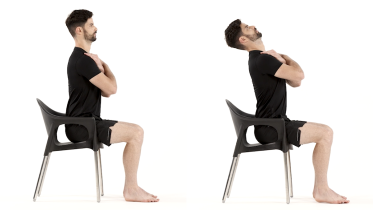 Seated thoracic extension
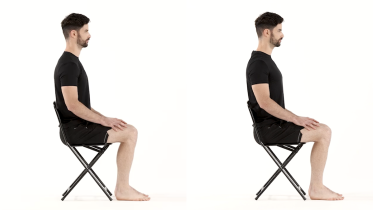 Scapular squeeze
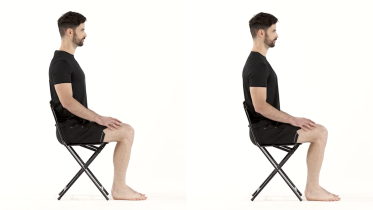 Chin tuck
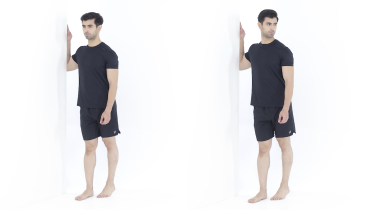 Pec stretch at a wall
Stage 2: Strengthen the muscles that hold you upright
When stage 1 feels easy, often after a week or two. Wall angels, the band row and the band pull-apart work the muscles between your shoulder blades, and the back extension on elbows starts strength work for the long muscles beside your spine. Thoracic extension over a chair is a stronger stretch for the upper back. If you have osteoporosis or have had a fracture in your ribs, check with your physio before the chair stretch. If you have had a fracture in your spine, check with your physio before you begin the chair stretch or the back extension on elbows.
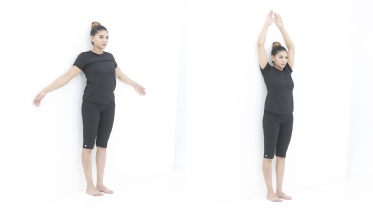 Wall angels
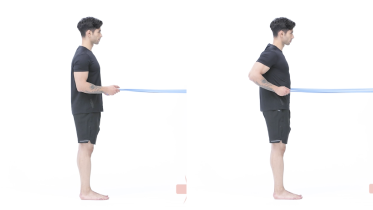 Resistance band row
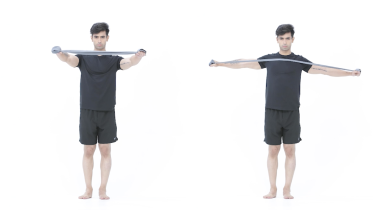 Band pull-apart
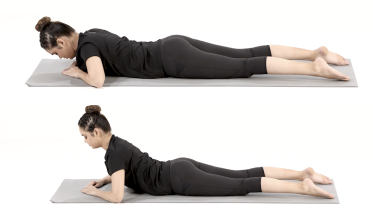 Back extension on elbows
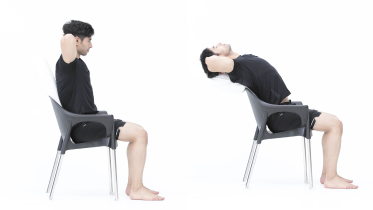 Thoracic extension over a chair
Stage 3: Build strength lying face down
Once stage 2 feels steady and your back settles well afterward. The prone T raise and prone Y raise make the lower shoulder blade muscles lift your arms against gravity, and the prone back extension lifts your chest with no help from your arms. A small lift you control is the aim, not height. If you cannot lie flat on your front comfortably, for example with a large or stiff curve or from the middle months of pregnancy, leave these out and ask your physio for a version done sitting or leaning forward. Leave out the Y raise if your arms will not reach overhead without pain. With narrowing of the spinal canal (spinal stenosis) or a vertebra that has slipped forward (spondylolisthesis), check with your physio before the prone back extension. If you have had a fracture in your spine, check with your physio before you begin.
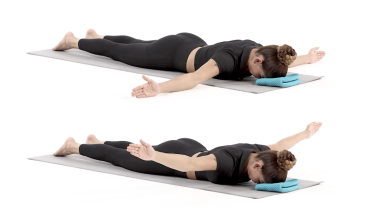 Prone T raise
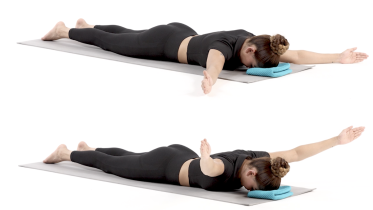 Prone Y raise
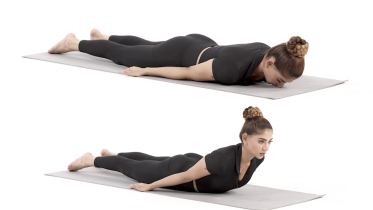 Prone back extension
Osteoporosis and fractures in the spine
If you have low bone density (osteoporosis), back extension work is generally encouraged. The UK consensus recommends spinal extension exercise to improve posture and advises avoiding postures that bend the spine far forward, during exercise and in daily life (Brooke-Wavell 2022). In practice that means leaving out sit-ups and toe touches, bending from your hips rather than rounding your back, and not bending or twisting while you hold something heavy. The osteoporosis program explains the hip hinge and safe lifting.
Check with your physio before thoracic extension over a chair, as its page advises. If you have had a fracture in your spine, check with your physio before you begin this program. The Royal Osteoporosis Society says a spinal fracture takes 6 to 12 weeks to heal and advises staying as active as you can, then building up muscle strength once it has healed.
Children and teenagers
This program is written for adults. If you think a child or teenager has kyphosis, see a GP, who can refer them to a specialist if needed (NHS).
Other things to check first
If you have had surgery on your spine, chest or heart in recent months, get the go-ahead from your surgical team or physio first. After any operation on your back, follow your surgeon's program. The arm exercises in stages 2 and 3 load the shoulder, so after shoulder surgery or a dislocation, follow your surgeon's or physio's plan for when to add them. If you are pregnant, check with your physio or midwife before you start.
When to see a physio or doctor
See a GP if you think you have kyphosis and it has not been checked (NHS). The same applies if the rounding stays when you try to stand straight, looks sharp rather than smooth, or has come on in later life. New rounding or loss of height in an older adult can come from broken bones in the spine, so a doctor's check comes before exercise.
A physio can help if you are not sure where to start, if pain limits what you do, or if you are not improving after several weeks of regular exercise. Breathlessness with a large upper back curve, or a curve that seems to be getting worse quickly, needs a doctor within a few days. The emergency signs are listed below.
For physiotherapists
Ponzano 2021 (24 studies, GRADE) found exercise or physical therapy improved kyphosis outcomes in age-related hyperkyphosis (SMD -0.31, 95% CI -0.46 to -0.16, moderate certainty), with small effects on pain (low certainty) and health-related quality of life (moderate certainty), and no serious adverse events reported. Jenkins 2021 (28 studies) pooled exercise effects of SMD -2.8 in younger and -0.3 (95% CI -0.6 to 0.0) in older participants, with low to moderate quality evidence for programs of 3 months or less; programs longer than 3 months in older adults were judged ineffective, although SHEAF (6 months) found a benefit.
SHEAF (Katzman 2017) used group spine strengthening and postural training, 1 hour three times a week for 6 months, in adults 60 and over with kyphosis of at least 40 degrees. It found a -3.0 degree (95% CI -5.2 to -0.8) between-group difference in Cobb angle and better SRS-30 self-image, but no difference in physical function. Screen older adults for vertebral fracture before loading into extension, and refer rigid or angular curves, and any curve in a child or adolescent, for medical assessment.
See a doctor promptly if
- Emergency: numbness, tingling or altered feeling around or under your genitals, between your inner thighs, or around your bottom (anus), for example it feels different when you wipe after using the toilet. Call emergency services or go to an emergency department straight away. This can be a sign of pressure on the bundle of nerves at the base of the spine (cauda equina syndrome), which needs emergency treatment.
- Emergency: you find it hard to start peeing, cannot pee, cannot feel yourself peeing or cannot control when you pee, or you do not notice when you need to poo or cannot control when you poo, and this is not normal for you. The same applies to a new change in how your genitals feel during sex, or new trouble getting an erection or ejaculating. Call emergency services or go to an emergency department straight away. These can also be signs of cauda equina syndrome.
- Emergency: sciatica in both legs, or pain, tingling, numbness or weakness in both legs. The same applies if you lose feeling in one leg. Call emergency services or go to an emergency department straight away.
- Emergency: new problems walking, for example your legs feel stiff, heavy or weak or you have become unsteady on your feet, or new numbness or pins and needles in a band around your chest or tummy, or below it. Call emergency services or go to an emergency department straight away. These can be signs of pressure on the spinal cord in the upper back.
- Emergency: back or leg pain that started after a serious accident, such as a car crash or a fall from a height, or back pain with chest pain. Call emergency services.
- Emergency: chest pain, pressure or tightness, which may spread to your arm, neck, jaw or back, or upper back pain that comes with shortness of breath, sweating, feeling sick or feeling light-headed. Call emergency services straight away, as this can be a heart attack. The same applies to sudden, severe pain in your chest or between your shoulder blades that feels sharp, tearing or ripping, as this can be a tear in the main blood vessel from the heart (aortic dissection).
- Emergency: new neck or back pain after a fall, a knock or a jolt, even a minor one such as a trip or a sudden stop in a car, if you have a condition that stiffens the spine, such as ankylosing spondylitis. Call emergency services or go to an emergency department straight away, do not drive yourself, and tell the staff about your spine condition, so they keep your neck and back in their usual position. A stiff spine can break after a small injury, and the break is easy to miss at first. If the pain started straight after the injury, or you also have numbness, tingling or weakness in your arms or legs, keep still and call emergency services.
- Back pain after a minor fall or strain if you are older, have low bone density (osteoporosis) or have taken steroid tablets for a long time. Get medical advice the same day.
- Back pain that comes on suddenly after lifting, bending, a cough or a sneeze, even without a fall, if you have low bone density (osteoporosis). Get medical advice the same day. This can be a sign of a broken bone in the spine (vertebral fracture). Stop the exercises until you have been checked.
- Severe pain that comes on suddenly or is getting worse quickly. Get medical advice the same day.
- Back or leg pain with a fever, or you feel hot, cold, shivery or generally unwell. Get medical advice the same day, and go to an emergency department if you feel very unwell.
- A leg or foot that is getting weaker, for example your foot drags, catches on the ground or slaps down when you walk (foot drop). Get medical advice the same day. If the weakness is getting worse by the hour, go to an emergency department.
- Breathlessness that is new or getting worse, especially if you have a large curve in your upper back, for example you get out of breath doing everyday things you used to manage or when you lie down, or you are short of breath and your ankles are swollen. See your doctor within a few days. If you are having trouble breathing or are more short of breath than usual right now, you cough up blood, you feel sick with it, or your heart is racing, fluttering or skipping beats, get medical advice the same day. If you are gasping, choking or cannot get your words out, your chest feels tight or heavy, you have pain that spreads to your arms, back, neck or jaw, your lips or skin turn very pale, blue or gray, you feel suddenly confused, or you are short of breath and one leg is painful or swollen, call emergency services.
- You have back pain and have lost weight without trying. Get medical advice the same day and mention the weight loss.
- New back pain and you have had cancer, now or in the past. Get medical advice the same day and mention your cancer history. If you are being treated for cancer now, contact your cancer team the same day.
- Emergency: you have had cancer, now or in the past, and your back or neck pain feels like a tight band around your body, or comes with pain spreading down an arm or leg, weakness, numbness or pins and needles in your arms or legs, trouble walking, or trouble controlling your bladder or bowels. Call your cancer team's emergency number straight away, or go to an emergency department if you do not have one or cannot get through. This can be cancer pressing on the spinal cord (metastatic spinal cord compression), which needs treatment straight away.
- Pain that is worse at night, or does not ease at all when you rest. See your doctor within a few days. If you have had cancer, now or in the past, or you have lost weight without trying, get medical advice the same day. If you are being treated for cancer now, contact your cancer team the same day.
- Your rounding seems to be getting worse quickly, for example over a few weeks or months you stoop further forward, lose height or your clothes hang differently. See your doctor within a few days. If it came on with sudden back pain, get medical advice the same day.
- Routine: you have lost height, or your upper back has become more rounded and you are starting to stoop, or you have back pain, or pain that wraps around to your ribs, with no clear cause. Book an appointment with your doctor. A broken bone in the spine can cause this, and it does not always cause the pain you would expect. If the pain came on suddenly, get medical advice the same day.
- Routine: the rounding stays when you try to stand up straight, or it looks sharp and angled rather than a smooth curve, and it has not been checked. Book an appointment with your doctor before you start this program, as it may not be postural kyphosis.
Common questions
Can kyphosis be corrected with exercise?
It depends on the type, and the evidence on the angle itself is limited. Postural kyphosis is flexible, so you can straighten up when you try, and exercise aims to make that position easier to hold and less sore. For the curve measured on an X-ray, a review of 24 studies in adults with age-related rounding found a small improvement with exercise (Ponzano 2021), but the NHS says exercises will not improve the curve or stop it getting worse. After broken bones in the spine, the Royal Osteoporosis Society says the bones do not go back to the shape they were before.
What is the difference between postural kyphosis and Scheuermann's kyphosis?
Postural kyphosis is the most common type and is usually put down to posture (NHS). OrthoInfo describes it as a round, smooth curve that can often be corrected when you stand up straight, and says it does not usually progress. In Scheuermann's kyphosis, the backs of the bones in the spine grow faster than the fronts, so the bones become wedge-shaped (NHS). That curve is usually sharp, angular and stiff, and it often shows up in the teenage years (OrthoInfo).
Is kyphosis serious?
Postural kyphosis usually is not. OrthoInfo says it is rarely painful and does not usually lead to problems in adult life. The NHS says severe kyphosis can cause very bad back pain and difficulty breathing, and surgery may be considered if a curve is severe, getting worse or causing very bad pain. In older adults, a rounded back is linked with low bone density and broken bones in the spine (Katzman 2010), which is why new rounding or loss of height needs a doctor's check.
What exercises should you avoid with kyphosis?
With postural kyphosis alone, no exercise is off limits, and the NHS says you should be able to exercise. If you have osteoporosis or have had a fracture in your spine, deep or repeated forward bending, such as sit-ups and toe touches, and bending or twisting while you hold a weight usually need changing. The UK consensus on exercise for osteoporosis advises avoiding postures that bend the spine far forward (Brooke-Wavell 2022). The osteoporosis program explains how to bend and lift instead.
Can you fix a hunched back as you get older?
Exercise can help, though the changes seen in trials are modest. In the SHEAF trial, 99 adults aged 60 and over did physio-led group spine strengthening and posture training for an hour three times a week for 6 months. Their curve improved by about 3 degrees more than the comparison group, and they felt better about how they looked, but physical function did not differ between the groups (Katzman 2017). Before starting, see your doctor if the rounding is new or you have lost height, as broken bones in the spine can cause it.
References
- NHS. Kyphosis. https://www.nhs.uk/conditions/kyphosis/
- American Academy of Orthopaedic Surgeons. Kyphosis (roundback) of the spine. OrthoInfo. https://www.orthoinfo.org/en/diseases--conditions/kyphosis-roundback-of-the-spine/
- Ponzano M, Tibert N, Bansal S, Katzman W, Giangregorio L. Exercise for improving age-related hyperkyphosis: a systematic review and meta-analysis with GRADE assessment. Archives of Osteoporosis. 2021;16(1):140. https://doi.org/10.1007/s11657-021-00998-3
- Jenkins HJ, Downie AS, Fernandez M, Hancock MJ. Decreasing thoracic hyperkyphosis: which treatments are most effective? A systematic literature review and meta-analysis. Musculoskeletal Science and Practice. 2021;56:102438. https://doi.org/10.1016/j.msksp.2021.102438
- Katzman WB, Vittinghoff E, Lin F, et al. Targeted spine strengthening exercise and posture training program to reduce hyperkyphosis in older adults: results from the study of hyperkyphosis, exercise, and function (SHEAF) randomized controlled trial. Osteoporosis International. 2017;28(10):2831-2841. https://doi.org/10.1007/s00198-017-4109-x
- Katzman WB, Wanek L, Shepherd JA, Sellmeyer DE. Age-related hyperkyphosis: its causes, consequences, and management. Journal of Orthopaedic and Sports Physical Therapy. 2010;40(6):352-360. https://doi.org/10.2519/jospt.2010.3099
- Brooke-Wavell K, Skelton DA, Barker KL, et al. Strong, steady and straight: UK consensus statement on physical activity and exercise for osteoporosis. British Journal of Sports Medicine. 2022;56(15):837-846. https://doi.org/10.1136/bjsports-2021-104634
- Royal Osteoporosis Society. Spinal fractures (vertebral fractures). https://theros.org.uk/information-and-support/living-with-osteoporosis-and-broken-bones/spinal-fractures-vertebral-fractures/
- NHS. Ankylosing spondylitis. https://www.nhs.uk/conditions/ankylosing-spondylitis/
- NHS. Heart attack. https://www.nhs.uk/conditions/heart-attack/
- NHS. Back pain. https://www.nhs.uk/conditions/back-pain/
- NHS. Shortness of breath. https://www.nhs.uk/symptoms/shortness-of-breath/
- NHS. Chest pain. https://www.nhs.uk/symptoms/chest-pain/
- MedlinePlus. Aortic dissection. US National Library of Medicine. https://medlineplus.gov/ency/article/000181.htm
- Cancer Research UK. Spinal cord compression. https://www.cancerresearchuk.org/about-cancer/coping/physically/spinal-cord-compression
Written and checked by the PocketPhysio editorial team. Last updated 2026-09-28.
This page is general education, not a diagnosis or a personal treatment plan. See a physiotherapist or doctor for advice about your own situation.